










Solutions
Explore how to grow

The most popular advice on how to advertise on Instagram is usually also the most expensive: take a post that "looks good," hit Promote, and wait for sales. That works to buy reach. Not to build a profitable channel.
At Bigbuda we are a social media management that sells with a focus on results.
Instagram Ads fails when it is treated as a content function and not as a commercial system. The problem is usually not in Meta's interface or in isolated creativity. It is in the disconnect between targeting, measurement, offer, post-click experience, and financial judgment.
In eCommerce, that disconnect is paid for quickly. An ad can generate clicks, likes, and even qualified traffic, and still destroy margin. The opposite can also happen. A campaign with less apparent volume can become a better investment if it brings buyers with higher intent, better repurchase, and a better relationship between CAC and LTV.
From a growth perspective, Instagram should not be evaluated as a visibility channel. It should be evaluated as part of the revenue engine. That changes the whole conversation. What matters is no longer just how many people see the ad, but what signal Meta receives, which audience it learns to find, what experience the user gets when leaving the platform, and what real return that sequence generates.
Most brands confuse interaction with traction. If you need to better align that difference between attention and commercial results, it is worth starting by understanding what engagement is. Having useful engagement helps. Chasing it as an end in itself does not.
Most accounts do not lose money on Instagram for lack of creativity. They lose it because they buy attention before organizing the business that should capture that demand.
That mistake is seen every day in Chilean eCommerce. A campaign is activated, clicks go up, the CPM drops a bit, and the team assumes the account is doing well. Then the real results arrive. Abandoned carts, a CAC misaligned with the margin, and a conversion rate that cannot withstand the cost of the traffic. The problem was not Instagram. It was the system around Instagram.
Promoting posts from the app speeds up going to market, but it also cuts variables that define profitability. Media buying is simplified at the very point where commercial judgment matters most.
That is why so many campaigns show activity without generating growth. The platform finds people willing to interact, not always people willing to buy. If you need to better distinguish between superficial attention and a business signal, it is worth starting by understanding what engagement is and when it adds commercial value.
In practice, a campaign fails before the ad when there is no clear acquisition logic. The offer does not talk to the user's stage. The message promises something the site does not resolve. The landing pushes cold traffic to weak product pages. And the evaluation stays at platform metrics, without connecting ROAS, contribution margin, and repurchase.
That is the difference between spending and building a predictable channel.
From a growth perspective, Instagram works well when it is integrated with CRO, measurement, and a retention strategy. It is not enough to target better or design a flashier piece. You have to align the ad with purchase intent, the post-click experience with the expectation created, and the budget with the customer's real value. At Bigbuda we work on this point with a focus on the full funnel, because a campaign can look healthy inside Ads Manager and still perform poorly in the cash register.
For an eCommerce manager, the right question is not how much reach you can buy this month. The question is which combination of audience, offer, experience, and follow-up lets you turn investment into repeatable revenue. That change of focus usually marks the difference between an account that chases isolated sales and one that uses Instagram as a growth engine with better ROAS and better LTV.
The mistake is usually not in the ad. It is usually in the measurement.
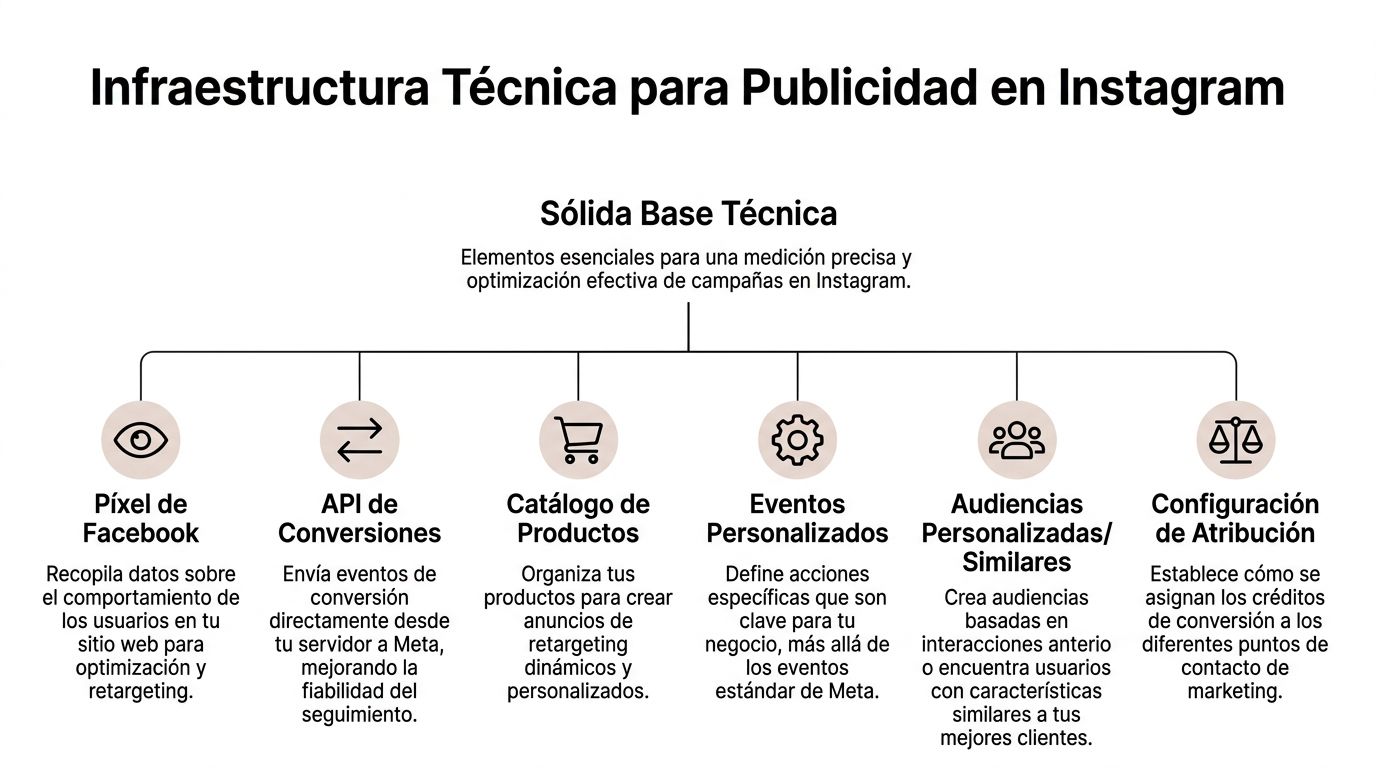
In Chilean eCommerce, an account can show clicks, reach, and even sales inside Ads Manager, and still destroy margin if the purchase signal arrives incomplete or poorly classified. That is where real profitability starts. Before investing more budget, it is worth making sure Meta is receiving consistent events, that the catalog is clean, and that attribution reflects the real business, not a partial version.
An organized setup starts in Meta Business Suite, with the verified business account, the .cl domain associated, and the assets under company ownership. It is not a formality. It is operational control.
In accounts where marketing, agency, development, and design work on the same assets, problems appear quickly. Poorly assigned permissions, catalogs connected from personal profiles, duplicate pixels, events edited without criteria. That disorder affects campaign continuity and complicates any serious ROAS analysis.
For teams managing several events, tags, and validations in an eCommerce, an orderly implementation with Google Tag Manager to centralize measurement helps reduce errors and maintain traceability between site, campaigns, and conversions.
Operating only with the Pixel leaves gaps. Operating CAPI poorly does too.
The healthiest practice is to use Pixel + Conversions API with a clear event structure, well-configured deduplication, and defined priorities for the events that actually move cash, such as ViewContent, AddToCart, InitiateCheckout, and Purchase. Especially after the iOS privacy changes, depending on a single signal source weakens optimization and makes the reading of results less reliable.
This has a concrete consequence. If Meta receives purchases, carts, and product views consistently, the algorithm can look for users with patterns closer to your real buyers. If the signal arrives incomplete, the platform optimizes with less context and the cost per result tends to rise.
In eCommerce, the technical foundation also defines what kind of campaigns can be run well. If the catalog is poorly categorized, with products without updated stock, broken variants, or inconsistent images, dynamic ads lose strength and retargeting becomes generic.
That is why it is worth resolving three points before scaling investment:
In Chile, this point carries more weight than it seems, because many eCommerce businesses combine paid traffic with extensive catalogs, seasonal promotions, and frequent stockouts. If that layer is not well resolved, the ad can bring demand toward products that do not convert or are no longer available. That lowers the conversion rate and makes acquisition more expensive.
The account does not need complexity. It needs order.
ComponentWhat must be resolvedBusiness impactBusiness accountVerified ownership and centralized assetsLess operational riskDomainCorrectly associated with the accountBetter measurement controlPixelBasic events workingOptimization and audiencesCAPIComplementary server-side sendingMore reliable attributionCatalogSynced productsDynamic ads and retargetingAggregated eventsCorrect prioritization post-iOSLess signal loss
When a campaign does not perform, the problem often appears before the ad. It appears in the quality of the signal the account delivers to Meta.
A good technical foundation does not replace the commercial strategy nor fix a weak offer. But it does let you measure with less noise, optimize with a better signal, and decide with more judgment where to put budget.
That change matters a lot for an eCommerce manager. With a well-built infrastructure, Instagram stops being a channel that consumes investment and becomes a system you can audit, improve, and scale with business logic. There the conversation changes. It no longer revolves around pretty platform metrics, but around how much real return each invested peso is generating and which adjustments improve ROAS without harming LTV.
Instagram does not fail for lack of beautiful pieces. It fails when the campaign is designed to generate interaction and not to move a person toward a profitable purchase.

In Chilean eCommerce, the problem is usually not inside Ads Manager. It usually appears in how the ad connects with purchase intent, the offer, the destination page, and the business's real margin. A well-designed campaign does not chase cheap clicks. It seeks clicks with a probability of turning into sustainable revenue, without deteriorating CAC or compromising LTV.
Targeting well does not mean narrowing by intuition. It means deciding which signal to use according to the funnel stage and the volume of data the account already has.
If the brand already accumulates purchases, product views, or cart events, it is worth starting from that first-party signal. It is a more useful base than building campaigns from generic interests or from audiences that are too broad just because the CPM seems competitive. In practice, an account with a good history usually organizes its prospecting and retargeting better in three layers:
The frequent mistake is not only opening the audience too wide. It is also mixing cold and warm intent within the same campaign, with the same message and the same expected result. That distorts the performance reading and ends up hiding which part of the funnel is actually producing return.
Choosing a format out of habit usually gets expensive.
Reels, Stories, Feed, and catalog do not do the same job. Each one captures a different part of attention and demands a different level of clarity. If the goal is to prospect, the format must quickly explain what you sell, who it is for, and why it is worth clicking. If the goal is retargeting, the format can assume more prior context and focus on reducing purchase friction.
A useful way to decide it is this:
FormatMain roleWhen it makes senseReelsGenerate initial attentionLaunches, prospecting, problem-solution anglesStoriesDrive immediate actionPromotions, urgency, retargeting with a direct CTAFeedProvide visual context and reinforce trustProducts with more consideration or mid-range ticketCollection or catalogFacilitate exploration and discoveryAccounts with a variety of SKUs and a well-organized catalog
The point is not to chase the trendiest format. The point is to use the format that best translates a commercial proposition into a measurable action. If your team needs to refine that criterion, it is worth reviewing how a reel works on Instagram and what role it plays within a content and performance strategy.
A person on Instagram is not asking for infinite inspiration. They are filtering options.
That is why ads that sell usually answer four questions in a few seconds:
That filter seems basic, but it changes the quality of the traffic a lot. An ambiguous creative can get interaction. A clear creative helps bring people with better intent to the landing. And that difference matters more than the isolated CTR, because a poorly qualified visit rarely improves ROAS.
At Bigbuda we usually see the same pattern. The campaign brings traffic, but the ad's promise does not match the destination experience. That is where value is lost.
Designing campaigns with a conversion focus means connecting three elements without unnecessary friction:
If the ad talks about a main benefit, the page must confirm it in the first screen. If the creative uses social proof, the product page or landing must reinforce that trust with reviews, product attributes, and clear commercial conditions. If the campaign pushes a category, it is not advisable to send the user to a generic home where they have to search again for what already interested them.
That crossover between media and CRO is the point where Instagram stops operating as a reach channel and starts behaving as a growth system.
A piece with comments, saves, or plays can contribute little margin. The opposite can also happen. A less flashy ad can sell better because it filters better, promises more precisely, and attracts users closer to purchase.
That is why it is worth separating discovery campaigns, consideration campaigns, and conversion-oriented campaigns. Not for academic order, but for financial control. Each objective demands a different reading of success. If everything is mixed, the account optimizes toward inconsistent signals and the budget ends up rewarding the easiest interaction, not the most profitable revenue.
Designing campaigns to capture value demands commercial judgment. Sometimes the best ad is not the one most celebrated within the creative team. It is the one that gets better-quality sessions, a higher conversion rate, and a ROAS that can be sustained when scaling.
The budget does not define the result on its own. The way it is distributed and the bidding logic that accompanies it usually explain more about ROAS than the amount invested.
In Chilean eCommerce, the usual mistake is not investing too little. It is mixing exploration, scaling, and remarketing within the same pool, with the same performance demand and the same evaluation horizon. That structure makes learning opaque, distorts CPA, and ends up penalizing campaigns that have not yet received enough signal to demonstrate value.
The choice between ABO and CBO is not resolved by technical preference. It is resolved by level of certainty.
ABO serves to buy information with order. It gives control over each ad set and lets you compare audiences, offers, or creatives without Meta redirecting spending too soon toward a single winning variable. In accounts that are still finding their message or validating a new product line, that control prevents false conclusions.
CBO works better when the account already knows which combination produces sales consistently. At that point, giving up part of the manual control improves budget allocation and reduces operational friction. It also helps to scale without having to adjust each ad set as if it were a separate campaign.
ModelWhen to use itWhat it providesMain riskABOTesting, validation, diagnosisClarity for comparingSlower scalingCBOConsolidation, scaling, efficiencyBetter automatic distributionLess visibility per ad set
In practice, it is worth starting with ABO when the account is still looking for stability. It is worth moving to CBO when there is already a clear base of winners. Doing it earlier reduces useful learning. Doing it too late slows growth.
The right bid depends on how much margin the brand has, how much CPA variation it can tolerate, and how mature the conversion history is.
The choice changes according to the commercial moment. A brand during Hot Sale can accept more volatility to capture demand. A brand with tight cash flow needs to protect profitability even if that reduces volume.
If the team does not know its maximum acceptable CPA, its contribution margin, and the minimum ROAS to grow without destroying cash flow, the bid becomes a gamble.
A new campaign needs stability to generate a useful reading. Changing budget, audiences, or bid every few hours interrupts that process and forces the system to relearn with fragmented data.
That does not mean waiting blindly. It means distinguishing between a bad initial streak and a bad structure. If the campaign starts with a weak offer, a poorly conceived audience, or a page that does not sustain the click's intent, no budget adjustment will fix the underlying problem. If the base is well built, it is worth observing the trend before intervening.
In accounts we audit at Bigbuda, this point carries a lot of weight in Chile because the volume is not always enough to tolerate excessive fragmentation. Splitting too much and editing too much usually produces the same result. Less signal per ad set, slower decisions, and a more unstable CPA.
Healthy accounts allocate capital by function.
A useful structure separates three fronts:
That distribution protects the business from two expensive mistakes. The first is spending everything on prospecting and then blaming Instagram for weak conversion. The second is living off remarketing, showing an attractive ROAS for a few weeks, and discovering too late that the acquisition of new customers has dried up.
Smart budget management seeks a balance between learning and efficiency. It is not about spending less. It is about putting more money into systems that already proved they can turn clicks into margin and customers into LTV.
The real performance of Instagram Ads is not decided on launch day. It is defined in the following weeks, when the account starts to accumulate enough signal to fix what holds back sales and protect what does produce margin.

A new campaign is a hypothesis with budget behind it. It is not yet a predictable asset. It becomes one when the team can identify whether the leak is in the ad, in the offer, in the post-click experience, or in the business economics, and acts on that point with judgment.
Meta delivers many signals. Few are useful for making business decisions.
In eCommerce, the right reading starts with four questions:
CTR, reach, and interactions help read attention. They are not enough to evaluate profitability. If optimization stays at surface metrics, the account can look active while the financial result deteriorates.
In the Chilean market, a significant part of the waste does not come from the CPM or the targeting. It comes from the stretch between the click and the purchase.
A correct promise in the ad can lose value in seconds if the landing loads slowly, if the featured product does not match the message, if the checkout asks for too much effort, or if basic trust signals are missing such as clear shipping times, visible payment methods, or an easy-to-find returns policy. In that scenario, Instagram is not failing. The campaign is sending traffic to an experience that does not convert.
That is why continuous optimization cannot stay inside Ads Manager. At Bigbuda, when we audit eCommerce accounts, the question is not just which ad won. The useful question is which combination of message, page, and offer best sustained ROAS without deteriorating the site's conversion rate.
An expensive campaign is sometimes a correct campaign connected to a bad post-click experience.
There is a practical sequence that avoids impulsive changes.
If the response to the ad drops, it is worth reviewing the angle, the offer, the audience, or creative fatigue.
If the ad generates quality clicks but the site does not convert, the review shifts to message continuity, speed, visual hierarchy, social proof, and purchase friction.
If sales exist but the return falls short, the problem is no longer just about advertising. You have to review average ticket, margin, discounts, logistics cost, repurchase, and how much of that sale corresponds to acquisition versus remarketing.
This reading organizes decisions and avoids touching budget or bid to cover failures that come from another part of the funnel.
Accounts that scale with stability operate with cadence. They do not edit every minor variation, but they also do not wait a month to react.
A useful review framework includes:
Below, this resource helps ground the continuous review approach in a practical context:
Raising the budget does not always equal growing. Many accounts improve one week and fall apart the next because they scale before understanding which variable was sustaining performance.
There are two common ways to grow:
Type of scalingWhat it involvesWhen it makes senseVerticalIncrease budget on winning campaignsWhen CPA and ROAS stay stable with more investmentHorizontalOpen new audiences, messages, or formatsWhen the current campaign already shows fatigue or a volume limit
Vertical scaling works better when the offer already proved consistency and the audience still has room. Horizontal serves to avoid overusing the same ad set, but it demands a clear hypothesis to avoid fragmenting signal.
The difference between an account that grows and one that only spends more is in the discipline with which the full funnel is reviewed. Some brands solve it in-house. Others organize it with external teams specialized in performance and experimentation that, as at Bigbuda, integrate media, data, and funnel reading into a single operation.
The accounts that convert best do not test more things. They test fewer variables, with more discipline, and connect each test with margin, conversion rate, and customer value.

In many eCommerce accounts in Chile, the supposed A/B test mixes too many decisions into a single change. The copy, the piece, the audience, the placement, and the budget are modified at the same time. If performance rises or falls, there is no useful learning. There is only noise.
The right logic is simpler. One hypothesis, one main variable, one business metric, and a minimum window to read a signal. If the goal is a sale, the test is not evaluated only by CTR. It is evaluated by its effect on cost per purchase, post-click conversion rate, and ROAS.
The signals that usually appear in local accounts go in that direction. As mentioned earlier in the article, messages like "Free shipping SCL" usually win the click over more generic versions, and UGC content usually sustains return better than overly produced creativity. The point is not to copy formulas. The point is to validate which promise reduces friction in your category and which format keeps intent up to checkout.
Not all variables carry the same weight. It is worth prioritizing like this:
Practical rule. Each test must answer a question that affects revenue.
Efficiency does not improve only by finding winners. It improves when the account stops funding obvious losses.
In practice, that means defining exit thresholds. If an ad accumulates spend, does not generate quality events, and also brings sessions that do not advance on the site, it is not worth continuing to wait "to see if it learns." In accounts with serious operations, automated rules help pause pieces with weak signals, but the right reading is still human. A high CPC can be acceptable if the traffic buys. A low CPC can destroy margin if it brings visits without intent.
It is also worth clearly separating prospecting and retargeting. Cold traffic and the user who already saw the product are not measured with the same demand nor respond to the same message. In retargeting, the most frequent mistake is insisting with the same prospecting creative, instead of resolving real objections such as shipping, returns, payment methods, or trust in the store.
Before launching a new test, it is worth reviewing these points:
MistakeReal business impactVisible signalTesting several variables at onceDoes not allow identifying what improves the resultChanges without useful conclusionsScaling a piece without validating post-click conversionIncreases spend on a weak funnelGood CTR, bad ROASKeeping ads out of inertiaConsumes budget that could be reallocatedSustained spend without purchasesGeneric retargetingWastes already-paid intentMany repeat visitors, few salesOptimizing for surface metricsImproves platform indicators, not cash flowStable CPM or clicks, flat revenue
In Instagram Ads, a creative improvement does little if the product page does not sustain the intent. That is why, at Bigbuda, we treat A/B testing as a shared task between media and CRO. The ad filters interest. The landing turns that interest into revenue. If one of the two parts fails, the budget gets diluted.
That approach changes the conversation. Instead of asking which ad "works best," the right question is which combination of message, audience, and post-click experience leaves the most margin and allows repurchase. There Instagram stops being a variable-spend channel and starts behaving as a more predictable growth system.
Advertising on Instagram profitably does not depend on a secret tactic or a viral creative. It depends on building a system where measurement, audiences, budget, message, and post-click experience work in the same direction.
That change of focus is the turning point. Investment stops being evaluated by activity and starts being evaluated by return. Campaigns stop being isolated actions and become a continuous process of learning, correction, and scaling.
In eCommerce, that matters because Instagram can be a very effective channel for generating demand, but only when the company knows how to capture it. If the business buys attention without designing the journey to conversion well, the platform becomes a cost that is hard to defend. If the company designs the full journey, Instagram becomes a more predictable source of growth.
The real advantage is not in "making ads better." It is in making decisions with a better signal, cutting earlier what does not contribute, scaling with more judgment what does work, and protecting the value of the traffic after the click.
That is the standard that separates an active account from one managed with business logic.
If your team needs to turn Instagram Ads into a more measurable and profitable channel, Bigbuda can help you organize the strategy, the measurement, and the optimization of the full funnel for eCommerce in Chile.
Related article: The truth about what a community manager does in 2026
Order, not complexity. Verify business ownership in Meta Business Suite, associate the domain, centralise assets, get basic Pixel events working, add server-side sending through CAPI, sync the catalogue with the store and prioritise aggregated events correctly. If the purchase signal arrives incomplete, the platform optimises with less context and cost per result rises.
Operating only with the Pixel leaves gaps. The healthiest practice is Pixel plus Conversions API with a clear event structure, well-configured deduplication and defined priorities for events that move cash, such as ViewContent, AddToCart, InitiateCheckout and Purchase. After the iOS privacy changes, depending on a single signal source weakens optimisation.
It is not a technical preference, it is a question of certainty. ABO buys information with order and lets you compare audiences, offers or creatives while the account is still finding its message. CBO works better once you know which combination produces sales consistently, improving budget allocation and reducing operational friction when scaling.
Follow the financial model, not intuition. Lowest cost prioritises volume and gives the system room to find conversions at the best available price. Cost cap adds discipline for tighter margins. ROAS goal demands more maturity and enough accumulated signal. Without knowing your maximum acceptable CPA and contribution margin, the bid becomes a gamble.
A significant part of the waste sits between the click and the purchase. A correct promise loses value if the landing loads slowly, the featured product does not match the message, checkout asks for too much effort, or trust signals are missing, such as clear shipping times, visible payment methods and an easy-to-find returns policy.
One hypothesis, one main variable, one business metric and a minimum window to read a signal. Prioritise offer and main promise first, then creative angle, audience and post-click destination. Evaluate by cost per purchase, post-click conversion rate and ROAS, not by CTR alone. Each test must answer a question that affects revenue.