










Solutions
Explore how to grow

Most articles about what a community manager does still make the same mistake. They present the role as the person who publishes posts, replies to a couple of comments, and keeps the social channels active.
At Bigbuda we are a social media management agency in Chile with a focus on results.
That view no longer holds up when it comes to making business decisions.
If you lead eCommerce, marketing, or growth, you need to understand something else. The community manager who matters in 2026 does not operate as a “poster.” They operate as a layer of commercial, reputational, and conversion intelligence between the brand and the market. Their value is not in filling a calendar. Their value is in detecting friction, capturing intent, protecting revenue, and turning interaction into useful demand.
In Chile, that difference matters even more because social media is not a peripheral channel. It is part of the commercial journey, of customer service, and of brand perception. If your company still separates social media from sales, customer experience, and performance optimization, it is losing information it has already paid for with traffic, attention, and budget.
The idea that the community manager just “runs the social channels” became outdated years ago. Today the role touches brand, revenue, and risk.

In Chile, the role became professionalized after 2010, when social media use spread widely among the connected population. In addition, a report cited by Xtrared indicates that Chilean companies with specialized CMs saw 35% more organic interactions and 18% more conversions without increasing advertising investment (the evolution of the community manager in Chile). That data changes the conversation. We are no longer talking about visibility. We are talking about commercial efficiency.
A strategic community manager listens better than they publish.
They read real objections. They detect buying patterns. They identify customer language. They recognize early signs of dissatisfaction. All of that has a direct impact on campaigns, value propositions, commercial content, and improvement priorities.
When a brand ignores that flow of information, marketing works on assumptions. When it integrates it, marketing decides with real-time market signals.
A good CM does not manage a social channel. They manage the most exposed point of contact between the company and its audience.
Many companies still evaluate this role by volume. How many posts went out, how many stories were published, how many comments were answered.
That approach rewards motion, not results.
The right question is not whether there was activity. The question is whether community management helped to:
That shift in criteria also forces a company to rethink how it understands its social assets, even in more classic spaces like a well-managed Facebook Fan Page, which remains relevant when used as a channel for service, validation, and trust.
The best community manager does not work in isolation. They connect with paid media, eCommerce, CRM, customer service, and content.
That is why, when a director asks what a community manager does, the serious answer is not “they post and reply.” The answer is different. They interpret market conversations, protect reputation, and feed decisions that affect acquisition, conversion, and retention.
The important functions of a community manager do not fit into a task list. They work as a system.
When that system is well designed, the brand speaks with consistency, listens better, reacts sooner, and converts more value from the traffic it already has.
The first function is not creative. It is strategic. The CM safeguards the company’s tone, judgment, and public consistency.
This matters because the brand does not only express itself in campaigns. It also expresses itself in replies, clarifications, complaints, praise, and silences. A bad response can do more damage than a bad piece of design.
Their work here includes:
This is the most underrated part of the role.
A competent CM does not just answer questions. They classify them mentally. They distinguish between recurring doubts, purchase objections, signs of distrust, interest in new categories, and comparisons with competitors.
That information helps fine-tune commercial messaging, detect gaps in the offer, and understand where intent is being lost.
What shows up on socialWhat it means for the businessRepeated questionsFriction in information or the offerComparative commentsCompetitive pressureSimilar complaintsAn operational or expectations problemInterested messages with no closeAn opportunity for commercial nurturing
Not every interaction is worth the same. A friendly comment can help the brand climate, but a healthy community contributes something deeper. Trust, spontaneous advocacy, and signals of intent.
The CM builds that when they activate relevant conversations, not when they chase empty engagement.
A useful community is not the loudest one. It is the one that reduces uncertainty for future buyers.
Here is where the least glamorous and most profitable side of the role appears.
According to IEBS, a good community manager can identify up to 75% of negative comments before they escalate. In Chile, where 82% of internet users are active on social media daily, fast CM intervention reduced the negative impact of reputational crises by an average of 40%, preserving conversion rates that average 2.5% in online stores (the impact of the community manager on crisis and reputation).
That is not “managing comments.” That is protecting the business.
A digital crisis rarely starts as a crisis. It starts as a small signal that someone prepared catches in time. If you do not have that capability, the brand always arrives late.
Here is the point most companies overlook. The community manager not only influences awareness. They also influence conversion.

If your eCommerce receives traffic from Instagram, Facebook, TikTok, or LinkedIn, that traffic brings questions, intentions, and objections. The CM is on the front line where all of that appears. Ignoring that layer means giving up a direct source of commercial improvement.
According to Cursos Femxa, most content about what a community manager does ignores their role in CRO. It also notes that, in a projection for 2025, Chilean eCommerce would grow 18%, while 65% of stores would report conversion rates below 2%. In that context, a CM integrated with CRO can increase conversions by between 25% and 40% through dynamic social CTAs that drive traffic to optimized destinations, and only 22% of Chilean agencies train their CMs in that area (the role of the community manager in CRO for eCommerce).
They do not do it by magic. They do it because they gather signals that a dashboard alone cannot explain.
A clear example. If dozens of users ask about shipping, exchanges, or compatibility, you do not have a community management problem. You have a commercial clarity problem. A good CM turns that pattern into an alert for marketing and eCommerce.
That impacts decisions like these:
Many brands celebrate likes. Few check whether the conversations moved a user closer to purchase.
The business-oriented CM works with a different logic. They look for interactions that move the user through the decision process. Inquiry, comparison, validation, social proof, urgency, or trust.
This video helps ground that shift in perspective:
The problem is not that social media does not sell. The problem is that many companies do not connect social with the variables that actually explain sales.
A well-integrated CM collaborates with paid media, content, CRM, and eCommerce. Not to “do more social,” but to understand which promise generates clicks, which objection stalls, which format attracts weak traffic, and which conversation brings leads closer to the close.
If your business still separates community from performance, it is making decisions with incomplete information.
The most common mistake when evaluating a community manager is asking for visible metrics instead of useful ones. Followers, likes, and reach can serve as context, but they are not enough to defend an investment.
Serious measurement starts from the business and works down to social, not the other way around.
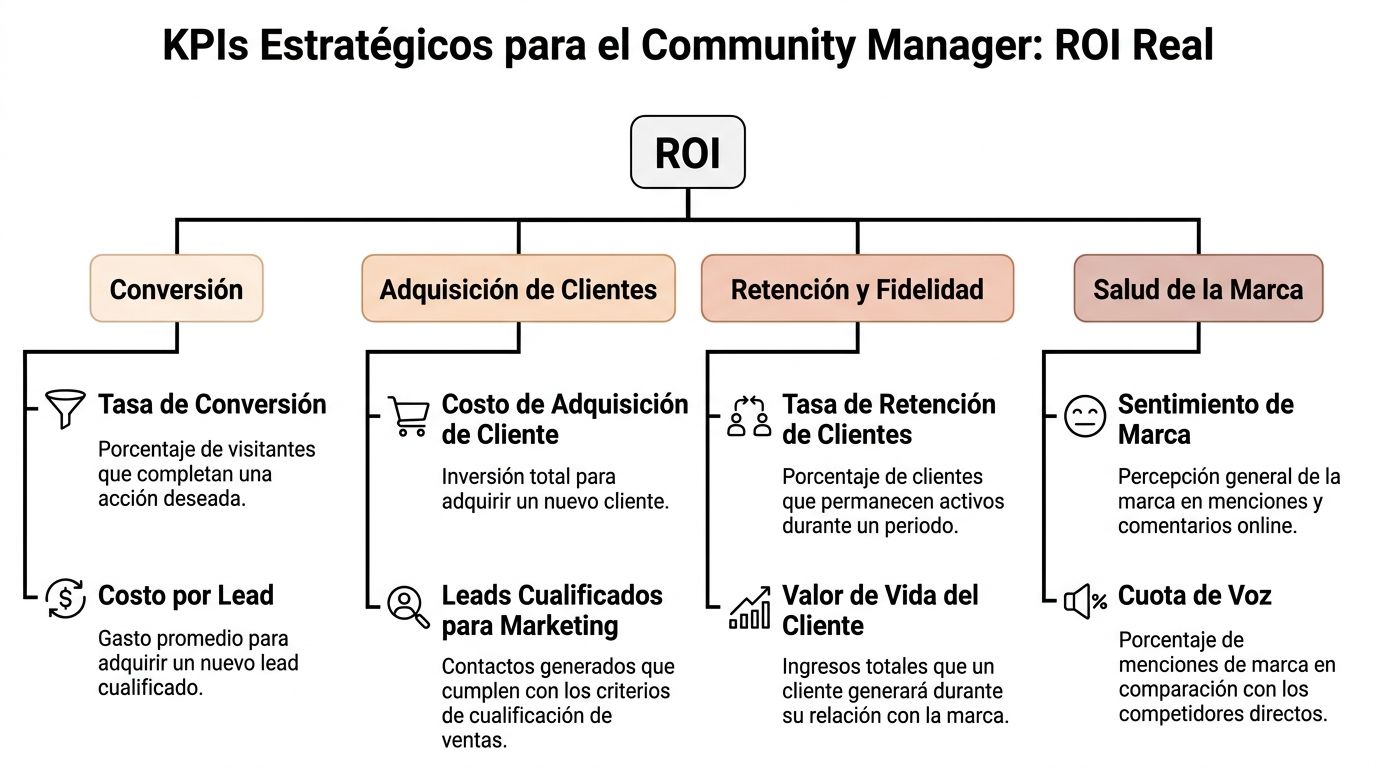
If you want to know what a community manager does with real impact, look at indicators that connect interaction with results.
Conversion
Acquisition
Retention and loyalty
Brand health
According to UNIR, the average engagement rate on Instagram for Chilean eCommerce brands sits between 1.2% and 2.5%, but an expert CM can raise it to 4% to 6% by optimizing posting times. The same framework notes that, by interpreting qualitative and quantitative metrics, a CM can reduce CAC by an average of 22% (how to measure engagement and CAC in community management).
That data matters for a simple reason. It does not just show an improvement in interaction. It shows commercial efficiency.
To dig deeper into that metric, it is worth reviewing what engagement is, but with one key nuance. Engagement is not valuable on its own. It is valuable when it anticipates intent, strengthens trust, or reduces acquisition cost.
A community management report that does not connect conversation with conversion serves to describe work, not to justify budget.
Ask yourself these three questions when reviewing results:
If you cannot answer that clearly, you do not need more content. You need better management.
Tools do not make a community manager strategic. But without the right tools, the role ends up reacting late, reporting poorly, and operating blind.

This is where platforms like Brandwatch, Mention, or similar monitoring systems come in.
Their function is not “to see comments.” Their function is to capture context. What is being said about the brand, in what tone, in response to what event, compared with which competitor. Without that layer, a company only hears what happens within its own profiles.
Tools like Hootsuite, Buffer, Metricool, Asana, Trello, or Notion play a different role. They bring order to operations.
They are not important for scheduling content. They are important because they enable consistency, traceability, and coordination with other areas. An isolated CM publishes. A well-integrated CM documents, routes, escalates, and learns.
A business-oriented community manager needs to connect social with performance data. For that, they often work alongside environments like Google Analytics, visualization dashboards, and eCommerce or CRM data.
The key here is not the software. It is the ability to connect conversation with results. Which traffic arrived, which advanced, where friction appeared, and what kind of interaction preceded better closes.
AI is already part of the stack. ChatGPT, writing assistants, transcription tools, and creative support speed up work.
The recommendation is simple:
If the stack only helps you publish faster, it is underused. It should help you listen better, decide sooner, and report with business logic.
The best way to understand what a community manager does is to look at business situations, not job descriptions.
An apparel brand gets a lot of interaction on Instagram. Good surface-level metrics. But sales do not take off at the expected pace.
The CM detects something the general dashboard does not clearly show. People always ask the same things. How the garment fits, whether the real color matches the photo, how long shipping takes, and what happens with exchanges.
That reveals a trust and information problem. Not a reach problem.
Smart management is not about answering each question as if it were isolated. It is about elevating the pattern to the responsible team. From there, the company can improve descriptions, commercial pieces, response sequences, and demonstrative content. Even interaction formats like an Instagram Live can help resolve objections in real time when the product needs visual validation and context.
In B2B, the common mistake is to use social media as a corporate showcase. Flawless posts, zero useful conversation.
A strategic CM shifts the focus. Instead of chasing generic reach, they observe who comments, what role they seem to hold, which pain points appear repeatedly, and which topics spark serious dialogue. Then they organize that information for marketing and sales.
The value here is not in “having a community.” It is in identifying signals of commercial maturity, market language, and windows of opportunity to generate better-qualified leads.
A consumer company faces growing criticism over response times and an inconsistent after-sales experience.
A weak CM would respond case by case, trying to put out fires. A strong CM detects the pattern, organizes the information, classifies the tone of the mentions, and helps establish a consistent response approach so as not to amplify the problem.
In that situation, the role is no longer purely about communication. It is about operational and reputational containment.
All three examples show the same thing.
That is why, when a company hires this role only to maintain activity, it buys a very small fraction of its real value.
Hire one when social media already affects sales, reputation, or service. If your sales team receives leads from social, if customers complain publicly, or if doubts in the comments stall purchases, you are no longer dealing with an accessory task.
Waiting too long is costly. The company starts responding late, learning slowly, and losing market signals.
It depends on the level of maturity and the need for integration.
In-house works better when the operation requires daily closeness to product, support, and leadership. An agency works better when the company needs strategic judgment, stronger processes, an outside perspective, and a connection with performance, content, and analytics.
The bad decision is not choosing one or the other. The bad decision is leaving the role in the hands of someone without seniority just because they “use social media well.”
No. Although in small companies the roles are sometimes blended.
The social media manager usually carries overall planning, channel strategy, campaign coordination, and higher-level decisions. The community manager operates closer to the conversation, moderation, listening, and the daily activation of the community.
In demanding businesses, both roles complement each other. When one person does everything, they need strategic judgment, not just operational skill.
Run a simple test. Ask them to explain what they learned about the market last month and what concrete decision they recommend taking.
If they only report posts, reach, and replies delivered, you have operational management. If they identify recurring objections, improvement opportunities, signals of intent, and reputational risks, you have a function with executive value.
Do not ask for a summary of activity. Ask for interpretation.
Look for a report that answers these questions:
That is the right standard for evaluating the role in 2026.
If your company needs to better convert the traffic it already has, organize the relationship between community, reputation, and sales, or redefine the role of social media with business logic, at Bigbuda we can help you design a more profitable digital strategy, with a focus on conversions, data, and sustained growth.
Related reading: Freelance community manager: your strategic guide
Related article: What an Instagram Reel is: Learn what a Reel on Insta is