










Solutions
Explore how to grow

If thinking about engagement sends your mind straight to likes, comments, or followers, it's time to adjust your perspective. From a strategic standpoint, engagement isn't popularity, but an indicator of progress in the customer's decision process. These are the measurable signals that show a user is interacting with your business in a way that directly impacts results.
This is amplified by a strong digital marketing service.

For business leaders and marketing teams, one of the biggest mistakes is confusing attention with intent. Vanity metrics, such as a high number of followers or likes, are easy to measure and attractive in a report, but they rarely translate into profitable growth.
Picture your website as a physical store. Surface-level engagement is the person who waves from the sidewalk. It's a friendly gesture, but it doesn't contribute to the business.
Strategic engagement is the customer who walks in, examines a product, asks about a feature, or heads to the fitting room. Those are the signals that matter, the ones that show real interest and a high probability of conversion.
This shift in focus separates companies that accumulate audiences from those that build business relationships. The goal isn't popularity, but connection with purpose.
At Bigbuda, we don't see engagement as merely surface-level interaction. For us, it's the signals that indicate real interest and progress in the decision process.
Rather than a single formula, we measure engagement by combining metrics such as time on page, scroll depth, clicks on key elements, and relevant actions within the site. We analyze user behaviour in context, prioritizing the indicators that directly impact conversion.
Distinguishing between these metrics is crucial to building a digital strategy that generates returns, not just noise.
Type of EngagementCommon MetricsBusiness ImpactSurface-level engagement (Vanity)Likes, followers, views, reach.Low. Generates awareness, but doesn't confirm purchase intent. It can create a false sense of success.Strategic engagement (Business)Clicks on "Add to cart," catalogue downloads, calculator use, time on the pricing page.High. Correlates directly with purchase intent and progress through the funnel. These are indicators of real growth.
Adopting a strategic view of engagement lets you invest your resources—time and budget—in actions that truly generate a measurable return.
Many companies treat traffic and engagement as separate goals. They invest large sums in attracting visits without analyzing what happens once those visitors arrive. The reality is that engagement is the engine that turns traffic into profitability, laying the foundation for sustainable growth.
It's strategically more efficient to optimize the experience of users who are already on your site than to constantly depend on acquiring new ones. A user who interacts meaningfully is a high-value asset.
When a person devotes time to your content, uses an interactive tool, or explores your products in detail, they aren't browsing passively. They're actively signalling their interest, moving of their own accord toward conversion.
This level of interest directly impacts three business pillars:
A high level of engagement doesn't just generate sales today; it sets off a self-reinforcing growth cycle. A user who feels their interaction delivered value is more likely to become an advocate for your brand.
Engagement is the bridge between acquisition and loyalty. An engaged user today is your repeat customer and brand ambassador tomorrow.
This process creates a virtuous cycle: satisfied customers leave positive reviews and recommend your business. This social proof attracts new customers more credibly and cost-effectively than any advertising campaign, because it's built on trust.
By focusing on improving engagement, your company stops "renting" audiences on third-party platforms and starts building an asset of its own: a community of loyal customers.
Measuring engagement isn't about collecting data, but about interpreting behavioural signals. The key is to adapt your analysis to each channel, since the relevant metrics on social media differ radically from those on your website.
The goal isn't to fill a dashboard, but to obtain a coherent narrative about your audience's real interest.
On social media, it's essential to go beyond the engagement rate calculated against your number of followers. A more honest metric is the engagement rate against reach, since it measures the effectiveness of your content among those who actually saw it.
The digital environment is increasingly competitive. Content saturation is driving a general decline in interaction. An analysis of key social media trends for 2026 projects significant drops in interaction per post. This forces brands to prioritize quality and relevance over volume.
In your own digital ecosystem—your website or eCommerce store—the rules change. Engagement isn't measured in likes, but in actions that indicate purchase intent.
On your site, every click is a decision. A user who interacts with key elements isn't "passing the time"; they're actively validating that your value proposition interests them.
The metrics that truly drive the business are:
Tools like heatmaps are essential for visualizing where the user's attention is concentrated. If you'd like to learn more, you can interpret a heatmap of your website.
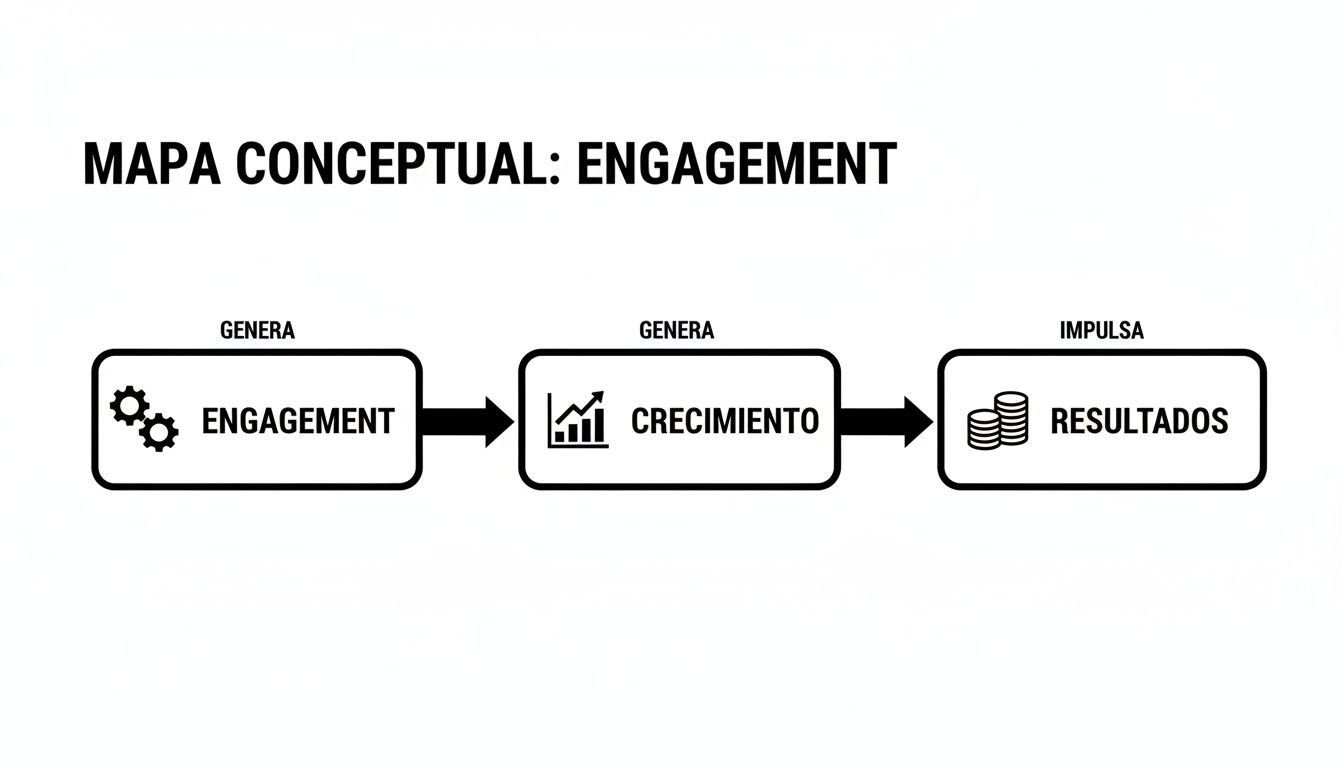
As the diagram shows, engagement isn't the goal, but the engine that connects user actions with business results.
In email marketing, it's easy to fall into the open-rate trap. Although it's a first filter, it doesn't guarantee interest.
The decisive metric is the click-through rate (CTR). It indicates how many subscribers not only opened the email, but acted on the message. A high CTR is proof that your communication was relevant and persuasive, prompting the user to take the next step.

Does your site attract traffic but generate few conversions? Often, the cause isn't the product or the price, but a factor that tends to be underestimated: the User Experience (UX).
Low engagement rarely comes down to what you offer, but to how you present it. A confusing or slow digital experience acts as a brake on your business, generating friction that wears out the user's patience and pushes them to leave the site before evaluating your value proposition.
Optimizing UX is one of the most profitable levers for increasing engagement and sales. It lets you maximize the return on the traffic you already have, turning passive visits into active customers without needing to change your product or your prices.
The human brain has a limited capacity to process information. A cluttered web page, with multiple options and no clear guidance, generates cognitive load. Faced with this overload, the user's instinctive reaction is to leave.
Good UX seeks to minimize that load so the path to conversion is clear and effortless. This is achieved through:
By reducing friction, you make it easier for the user to concentrate on what really matters: your message and your products.
This isn't theoretical. In a recent project, we detected that users weren't interacting with key content because of a poor visual hierarchy. The content was valuable, but it was poorly presented.
By redesigning the structure, improving the order of information, and highlighting the relevant elements, interaction with critical sections of the site increased significantly. This was reflected in greater time on site and more high-value actions, such as adding products to the cart, confirming that the problem wasn't the content, but its presentation.
A professional UX audit can identify these same growth opportunities in your business. If you're interested in exploring this approach, learn how a UX audit can capture more leads.
Many content strategies focus on virality, measuring success in spikes of surface-level interaction. However, from a business standpoint, the most profitable content isn't the kind that generates the most noise, but the kind that solves a real customer problem in a clear, applicable way.
The goal isn't for a user to like something; it's for them to think, "this is exactly what I needed." Strategic engagement seeks to generate moments of clarity that move the customer to the next stage of their decision process.
The content that generates the best interactions per follower is the kind that addresses real user problems clearly and applicably. Rather than generic content, practical approaches work better—with examples, insights, and an easy-to-scan structure. The goal isn't to generate interaction for its own sake, but to help the user move forward in their decision process.
For your content to be an investment rather than an expense, it must meet three fundamental principles:
When content meets these criteria, interaction is transformed. Users don't just consume it; they save it, share it with their teams, and, most importantly, act on it.
We've established what engagement is, how to measure it, and the levers to improve it, such as UX and valuable content. The next level, the one that separates leading brands, is mastering context.
The most effective engagement isn't forced. It happens naturally when you orchestrate a relevant and timely experience: the right message, to the right person, through the right channel, at the right moment.
When you achieve this synchrony, your brand stops interrupting and starts solving. Engagement becomes the logical consequence of a well-executed strategy, not a goal in itself.
The campaigns with the best engagement tend to be those aligned with a concrete user need at the right moment. Instead of seeking interaction volume, we prioritize relevance and context. When the message, the channel, and the experience are well connected, engagement increases naturally and translates into better commercial results.
Mastering context means moving from a logic of mass audiences to one of precise segmentation, based on user behaviour:
By mastering the synchronization of message, channel, and moment, engagement stops being a tactical metric and becomes the result of a business strategy that puts the customer at the centre, driving profitable, sustainable growth.
To conclude, we answer some of the most common strategic questions business leaders ask when connecting engagement with results.
Instead of looking for a universal benchmark, it's more strategic to focus on the trend of your own metrics. Are they improving month over month? And, fundamentally, does that increase translate into growth in business KPIs, such as leads or sales?
As a reference, on a platform like Instagram in LATAM, an engagement rate against reach above 1.5% can be considered positive given the current saturation. However, on your website, metrics such as time on page above two minutes or a product click rate of 10% are far more powerful indicators of interest.
Yes, and it's often the most efficient strategy. The key lies in optimizing the User Experience (UX) to maximize the value of the content you already have. Actions such as improving load speed, restructuring information so it's more intuitive, or making your calls to action (CTAs) more visible can have an immediate impact on user interaction. Many times, the problem isn't the content, but the barriers that prevent people from interacting with it.
The relationship is direct and increasingly important. Search engines like Google interpret user behaviour signals to determine the quality and relevance of a page. High engagement acts as a vote of confidence.
A high amount of time on site or a low bounce rate signal to Google that your content satisfies the user's search intent. This can improve your organic ranking, creating a virtuous cycle: a UX and content strategy that improves engagement not only increases conversions, but also boosts your visibility in search results.