










Solutions
Explore how to grow

Conversion Rate Optimization, or CRO, is more than a technical discipline; it's a business philosophy centred on one powerful idea: turning digital visits into measurable commercial results. Instead of chasing only more traffic, CRO focuses on maximizing the value of every visitor you already have, turning potential into profitability.
At Bigbuda, we're a digital agency specialized in CRO with a focus on results.
At Bigbuda, we can help you with conversion optimization (CRO).

For a business leader, adopting a CRO mindset means shifting the focus from volume to efficiency. It's the transition from an acquisition strategy to one of intelligent optimization, where every digital asset works to generate the maximum possible return.
Think of it as a retail operation. You have two paths to increase sales: invest massively in advertising to attract more people to the store, or analyze the behaviour of those who already come in, improve the product layout, optimize the signage, and train staff to resolve questions effectively.
CRO is precisely this second approach, applied to your digital ecosystem. Instead of relying exclusively on buying traffic (SEO, SEM, social media), you concentrate on perfecting the experience within your platform. The goal is for every visit, which already cost time and money to acquire, to have the maximum probability of becoming a profitable customer.
Acquiring new traffic is an increasingly competitive and costly battle. If your business's growth depends solely on increasing visit volume, you're building on unstable foundations. CRO changes the rules of the game by maximizing the value of the traffic you already have.
CRO isn't a one-off tactic, but a mindset of continuous improvement. It consists of deeply understanding your customers to break down the barriers that prevent them from converting, thereby building a digital asset that works more intelligently for your business.
To understand the strategic difference, this table compares the traditional "more traffic" approach with the CRO strategy.
This table compares the traditional mindset centred on acquisition with the strategic approach of CRO, which seeks to optimize the efficiency of existing traffic. The goal is to show business leaders why CRO offers a more sustainable and scalable return on investment.
Strategic CriterionTraffic Focus (Traditional)CRO Focus (Strategic)Main GoalIncrease the number of visitors to the website.Increase the percentage of visitors who take a valuable action (purchase, registration).Key MetricSessions, unique users, search rankings.Conversion rate, Average Order Value (AOV), Revenue per Visitor (RPV).Main InvestmentSEO, SEM, social media advertising.Data analysis, user research, experimentation (A/B tests), experience optimization.ROI SustainabilityDecreasing. The Acquisition Cost (CPA) tends to increase with competition.Increasing and cumulative. Each improvement permanently optimizes the digital asset's efficiency.Business ImpactGenerates reach and potential customers with uncertain efficiency.Directly impacts revenue, profitability, and customer experience.
As the table shows, CRO not only generates better results, but also builds a more resilient and profitable business over the long term.
Adopting this approach allows companies to:
Taking the step toward CRO means evolving from a "more visits" mindset to a "better results with the visits I have" one. For marketing directors, eCommerce owners, and general managers, it's the key to unlocking growth that doesn't depend exclusively on inflated advertising budgets. If you want to go deeper, we invite you to improve your results with CRO.
In the digital environment, it's easy to get lost in a sea of data. Metrics like visits, clicks, and impressions, often called "vanity metrics," can indicate reach, but they don't guarantee profitability or business growth.
A strategic CRO approach, by contrast, focuses on Key Performance Indicators (KPIs) directly tied to the company's financial health and growth potential. These are the true pulse of your digital operation and the foundation for informed decision-making.
For any leader, monitoring these KPIs is essential for identifying where value is being lost, which initiatives really work, and where the greatest optimization opportunities lie.
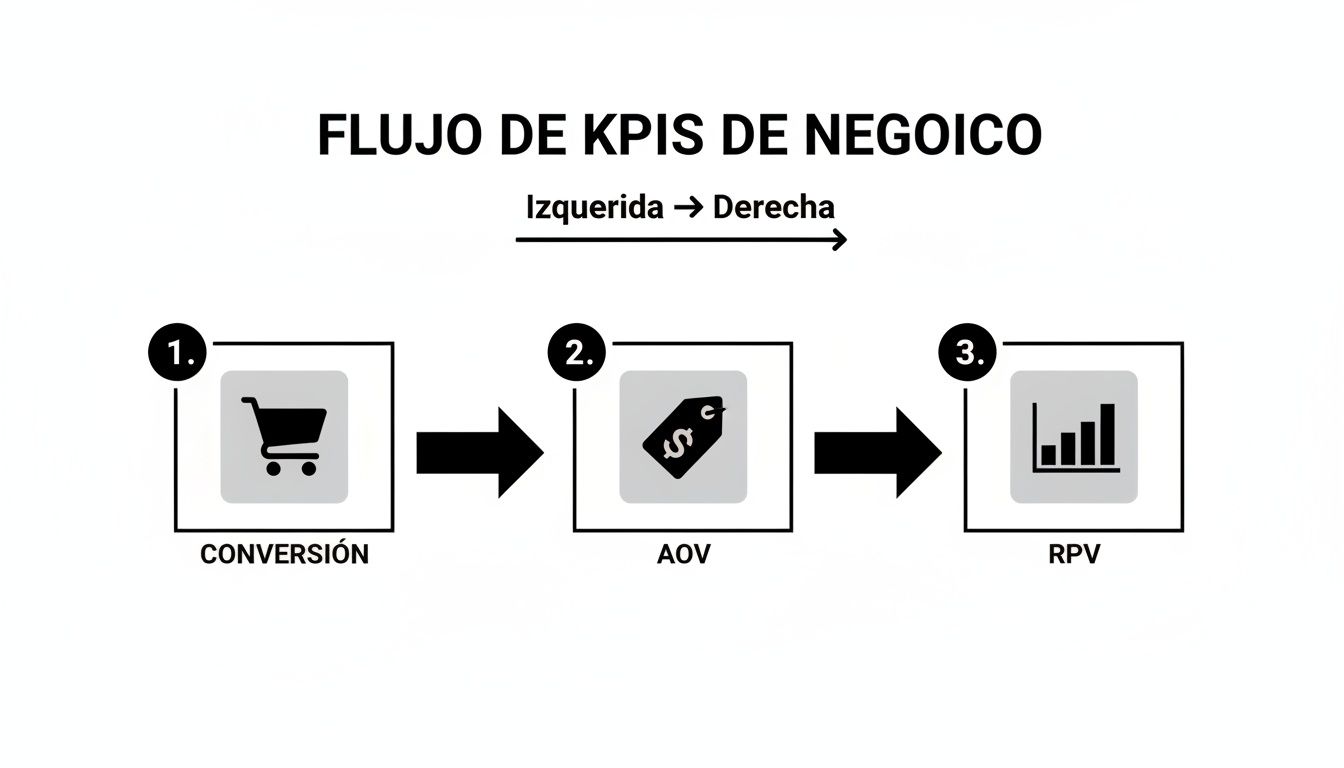
Although the Conversion Rate is the central KPI of CRO, it doesn't tell the whole story. A complete business view requires looking at a set of interconnected metrics that reflect the health of the entire funnel.
Let's imagine an eCommerce store that raises its conversion rate from 1% to 1.5%. That's a great achievement. But if, at the same time, its CRO strategies increase AOV by 10% through product recommendations and bundles, the impact on revenue multiplies exponentially.
A strategic CRO approach doesn't chase a single metric. It seeks the optimal balance between getting more conversions, increasing the value of each one, and eliminating revenue leaks in the process. The result is compound, sustainable growth.
Understanding these metrics lets you prioritize intelligently. If your cart abandonment rate is 80%, it's clear that the initial efforts should focus on optimizing the checkout, not on redesigning the home page. Fixing that revenue leak will have a much faster and more powerful return on investment. To visualize this data clearly, it's key to know how to build a digital conversions dashboard.
Analyzing these KPIs transforms the conversation about digital performance: it's no longer about "we got more traffic," but "how do we make every visit more valuable?" That's the mindset that sets apart the companies that lead their markets.
Success in CRO isn't a product of intuition or isolated aesthetic changes. Behind every sustained improvement lies a rigorous methodology, a systematic process that turns hypotheses into certainties and traffic into revenue. Leading companies don't leave results to chance; they follow a disciplined optimization cycle.
This process is what differentiates applying generic "best practices" from building a real competitive advantage. It works as a learning engine that lets the business constantly adapt to customer expectations, ensuring that every investment in marketing, design, and technology generates the maximum possible return.
The CRO methodology is an iterative process that moves away from opinions and anchors itself firmly in evidence. It begins with a deep research phase to understand not only what users do, but, more importantly, why they do it.
This cycle, which repeats continuously, can be broken down into four key stages:
This structure eliminates guesswork. Every change to your digital platform is justified with data, ensuring that resources are invested only in actions that demonstrate a positive impact on the business's KPIs.
To build an accurate diagnosis, CRO integrates two types of information that complement each other.
A KPI dashboard lets teams quickly spot drops in performance and focus optimization efforts where they matter most.
The true strategic insight of CRO emerges when you cross both types of data. Quantitative analysis can tell you that 70% of users abandon a product page, but qualitative analysis reveals that they do so because they can't find information about shipping costs.
This dual approach lets you formulate much more powerful hypotheses. Instead of a generic "let's change the button colour," a solid, evidence-based hypothesis would sound like this: "We believe that by making shipping information visible on the product page, we'll reduce the user's uncertainty and increase the 'add to cart' rate by 15%."
For companies looking to maximize the return on their advertising investment, optimizing conversions is essential. Those that apply structured CRO methodologies manage to recover sales that were being lost at various points in the customer journey. By implementing A/B and multivariate tests, they achieve constant improvements that let them scale their sales without increasing the budget. To explore further, you can read about how to apply CRO in an eCommerce store.
Finally, artificial intelligence is accelerating this cycle, automating the analysis of complex patterns and enabling real-time personalization that was previously unthinkable. This makes CRO a decisive strategic tool for the growth of any digital business.
A successful optimization strategy isn't based on isolated actions, but on a balanced system. Think of it as a three-legged stool: if one fails, the whole structure weakens. These legs are the pillars that determine whether your marketing investment turns into real growth or simply becomes another expense.
For a business leader, understanding these pillars is key to identifying the true levers that drive profitability in the digital operation.
User Experience (UX) is the invisible architecture of profitability. It's not about aesthetics, but about the ease, intuitiveness, and absence of frustration with which a customer finds what they need and completes a valuable action.
Bad UX is the digital equivalent of a cluttered store, with checkouts that don't work and inaccessible staff. The result is abandonment. By contrast, good UX eliminates friction and guides the user naturally through the funnel, removing any obstacle that generates doubt or distrust.
An investment in UX isn't a spend on design, it's a direct investment in the efficiency of your sales engine. Every unnecessary click, every confusing form, and every second of doubt is a revenue leak that a CRO strategy seeks to seal.
Load speed isn't a technical detail, it's a critical business factor that directly impacts customer trust and, therefore, sales. In today's digital environment, patience is a scarce resource. The data is clear: a delay of just 1 second in a page's load can reduce conversions by up to 7%.
Speed is a sign of professionalism and respect for the customer's time. A slow site projects an image of being unserious or insecure, undermining trust even before the user sees the product.
Optimizing performance is no longer an option, but a requirement for competing in today's market.
You can have the fastest, easiest-to-use site, but if your message doesn't connect, doesn't convince, and doesn't direct the user toward action, there will be no conversion. This pillar is where the art of communication meets the science of consumer behaviour.
It comes down to three crucial elements:
The real impact happens when these three pillars work in synergy.
This table summarizes how each pillar directly influences key KPIs, helping leaders justify the investment in these areas.
Optimization PillarMain ImpactKey Metrics AffectedUser Experience (UX)Reduces friction and frustration during the customer journey.Abandonment rate, Conversion rate, Time on site.Load Speed (Performance)Builds trust and satisfies the modern user's impatience.Bounce rate, Conversion rate, SEO ranking.Message and PersuasionCommunicates value and guides the user toward the desired action.Conversion rate, Average Order Value (AOV), Click-Through Rate (CTR).
As a leader, your role is to ensure that your design, technology, and marketing teams collaborate to strengthen these three pillars simultaneously. That's where true sustainable growth lies.

Artificial Intelligence (AI) has stopped being a futuristic promise and become a strategic partner in Conversion Rate Optimization (CRO). For business leaders, its value lies not in being just another tool, but in its ability to amplify human capabilities and unlock new growth opportunities.
The true power of AI in CRO lies in its ability to process massive volumes of data that no human team could analyze, discovering behavioural patterns invisible to the naked eye. This reveals connections between demographic data, browsing histories, and the actions that lead to a conversion, uncovering optimization opportunities that previously remained hidden.
The big change AI introduces is the ability to deliver mass, real-time personalization. Intelligent systems can adapt each user's experience, showing them the precise content, offer, or message they need at that moment to move forward in their journey.
This goes far beyond basic personalization. With AI, it's possible to:
AI's role isn't to replace the CRO strategist, but to empower them. AI takes care of large-scale data analysis, freeing the expert to concentrate on creativity, hypothesis formulation, and the business decisions that generate value.
AI is also revolutionizing experimentation. AI-powered testing platforms can run complex multivariate tests automatically, distributing traffic intelligently to find the winning combinations much faster than traditional methods.
This accelerated learning cycle lets companies adapt at an unprecedented pace. If you want to explore how these technologies are applied, you can learn more about our CRO methodology that incorporates Artificial Intelligence.
For business leaders, the message is clear: integrating AI into the CRO strategy is no longer an option, but a necessity for staying competitive. Companies that do will better understand their customers, make more accurate decisions, and build the advantage that will define the market leaders of the coming years.
Considering Conversion Rate Optimization (CRO) as a project with a beginning and an end is a strategic mistake. For its impact to be deep and sustainable, CRO must be a working philosophy that permeates the entire organization, transforming the business into a constant learning machine.
For leaders, the challenge is cultural, not technical. It's about fostering an environment where curiosity, experimentation, and data-driven decisions are the norm, encouraging fluid collaboration between departments that have traditionally operated in silos.
CRO doesn't thrive in silos. Its success is born from the synergy between marketing, design (UX), development, and analytics. When marketing detects a drop in conversion, it needs UX to devise a solution, and development to implement and measure it. If these teams don't collaborate, initiatives die before they start.
The solution is to create multidisciplinary teams or "squads." By bringing together specialists with different skills around a common goal, communication barriers are removed and the vision is unified. Success becomes the project's, not a department's.
A culture of optimization takes off when the question "why did conversion drop?" transforms into "how can we, together, improve it?" It's a fundamental shift from looking for someone to blame to finding solutions as a team.
For this model to work, it's crucial to define shared KPIs that transcend each area's metrics. Instead of marketing being measured only by traffic, the whole team should answer for business metrics like conversion rate or revenue per visitor (RPV).
It's impossible for a culture of experimentation to flourish without clear, visible support from leadership. Leaders must be the main promoters of this change, not only by allocating resources, but also by protecting the team from the "failure" inherent in the experimentation process.
Leadership support manifests in three key actions:
When teams feel that leadership values learning over always being right, the fear of making mistakes disappears and gives way to innovation. This psychological safety is the true engine that accelerates the cycle of continuous improvement.
CRO raises questions, especially when considering the investment of time and resources. Here we address the most common doubts from business leaders, with answers focused on strategic impact and commercial results.
It's one of the most common confusions. SEO and CRO are two complementary engines that drive business growth, but each serves a distinct function.
SEO is responsible for attracting quality traffic from search engines like Google, ensuring your business is found. CRO, on the other hand, ensures those visitors convert once they reach your digital platform, optimizing the experience to guide them toward a valuable action.
There's no point in attracting thousands of visits (SEO) if no one converts (CRO). It would be like filling a leaky container. A solid digital strategy needs both to turn opportunities into real revenue.
Although specific optimizations can generate a quick impact, the real power of CRO manifests over the medium and long term. It's not a switch that produces immediate results, but the building of a continuous learning system.
Generally, it's possible to observe a measurable impact on business KPIs within the first 3 to 6 months of implementing a structured CRO program. The most significant value is that the learnings are cumulative: each improvement builds on the previous one, generating a compound effect on revenue.
CRO isn't a project, it's a mindset of continuous improvement that becomes a sustainable competitive advantage.
Not necessarily. Success in CRO doesn't depend on the size of the investment, but on its strategic focus. You can start with a limited budget, prioritizing the highest-impact opportunities and using accessible analysis and experimentation tools.
In fact, the return CRO generates tends to be very high, since its goal is to maximize the value of the traffic you already have. Every small increase in the conversion rate makes your entire marketing investment (social media, Google Ads, etc.) more profitable.
Absolutely not. Any business with a digital goal can benefit from CRO. If your website seeks to generate a specific action, CRO will help you achieve it more efficiently.
The principles apply to various business models:
In essence, CRO is for any company that wants its digital presence to work more effectively toward its business goals.
At Bigbuda, we help companies build a culture of optimization that turns traffic into profitable growth. If you want to know how we can boost your results, visit our website.
Related reading: OKR: What It Is and How to Use It as the GPS · What is a CTA?: The strategic engine of digital growth
Related article: 9 examples of high-conversion landing pages.