










Solutions
Explore how to grow

In Chile, Reels concentrate a disproportionate share of attention within Instagram. That fact alone changes the discussion for any eCommerce that wants to grow profitably.
At Bigbuda we are a social media agency in Chile with a focus on results.
The question is no longer about what an Instagram Reel is as an isolated format. What matters is understanding it as a distribution asset that brings product, brand, and offer closer to the right user at the moment the platform still grants them reach.
For a business leader, this is not about posting videos just because. It is about using a format that reduces friction in discovery, accelerates consideration, and feeds the funnel with more qualified traffic.
If your brand still runs Instagram as a static showcase, it competes with outdated logic. In eCommerce, that translates into lower organic visibility, more dependence on paid, and less commercial efficiency.
Instagram has already redefined how attention is won within the platform. For a Chilean eCommerce, continuing to treat Reels as a secondary format means losing reach, raising acquisition costs, and leaving sales on the table.
Reels arrived on Instagram years ago and changed the consumption standard. The user now rewards fast, visual pieces that are easy to understand in seconds. That behavior directly affects a brand's ability to generate discovery, sustain interest, and push a commercial action.
It used to be enough to post in the feed, reinforce with ads, and maintain a presence. Today that approach delivers little. Organic visibility is distributed under a different logic, and short video occupies a significant part of that distribution.
For an online store, Reels serve a concrete function within the business:
The central point is strategic. Reels accelerate the entry of users into the funnel and improve the efficiency of the content that does need to deliver a return.
If your audience consumes Instagram in vertical format and your brand keeps posting as if the network were a static showcase, the problem is not the platform. It is a strategy that is already outdated.
Many marketing teams still evaluate Instagram with presence metrics. They post to look active, not to move business indicators. That criterion is weak.
The right approach is to measure which format generates more qualified discovery, more intentful interaction, and more contribution to the purchase journey. If you need to sort out that difference, it is worth reviewing how to interpret engagement with a business focus.
When a brand ignores Reels, it depends more on ads to make up for visibility, takes longer to install offers, and loses speed against competitors that do use vertical content as a growth engine. In CRO, that matters because every point of friction at the top of the funnel ends up affecting conversion, revenue, and ROI.
Instagram prioritizes content that retains attention and generates clear signals of interest. That is why a Reel matters less for its format and more for its ability to win distribution within the platform.
Yes, it is still a short vertical video, designed for mobile consumption and with native editing tools. But for an eCommerce, that technical definition adds little. The right read is different. A Reel works as a discovery piece that Instagram can push beyond your current follower base if it detects potential for response.
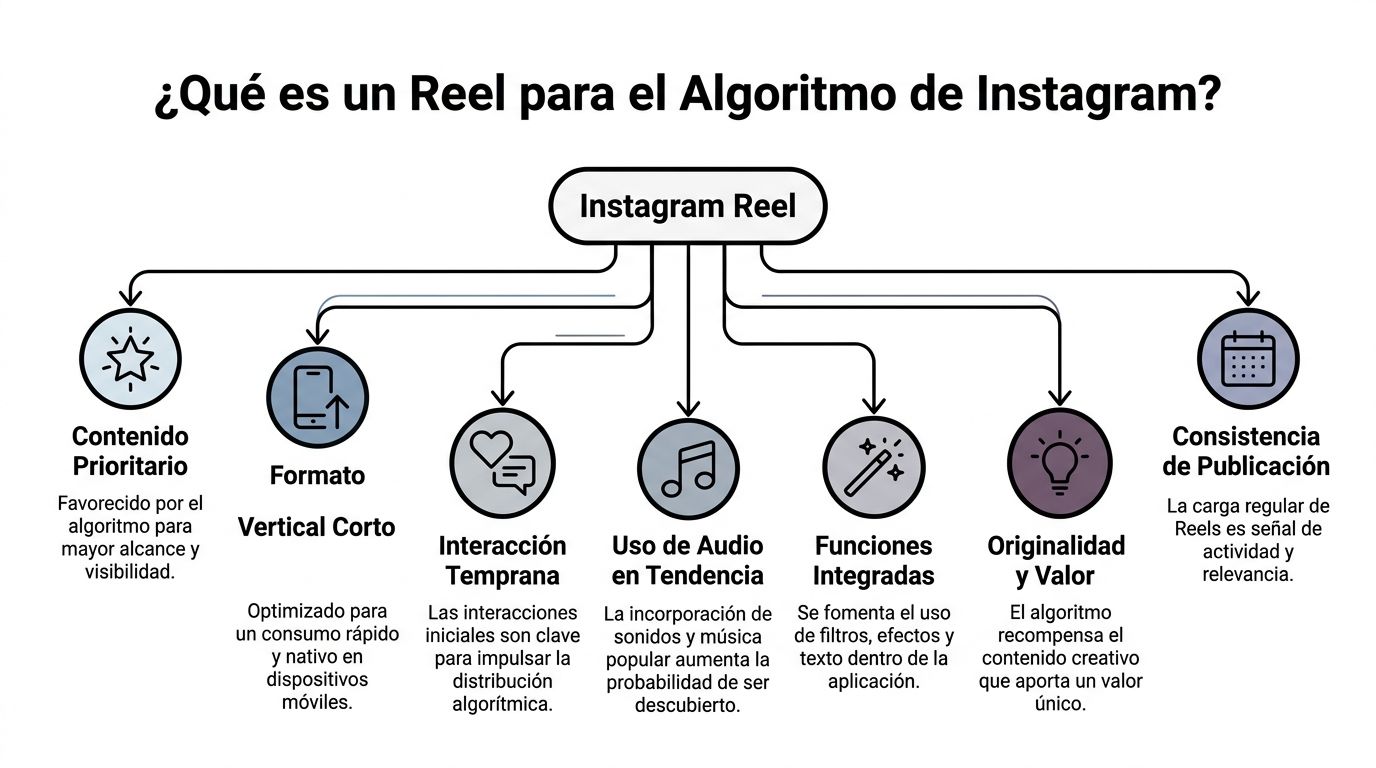
Instagram evaluates behavior, not brand intent. It does not care whether your team wanted to “make content.” It cares whether the user stopped, watched, replayed, saved, or shared.
The most useful signals tend to be these:
This changes the conversation for the business. A Reel does not compete only for attention. It competes for profitable distribution.
Many brands in Chile still measure Instagram with surface-level metrics. That approach confuses visibility with results. If you need to sort out that difference, it is worth reviewing how to interpret engagement with a business focus.
From a CRO logic, the Reel serves a concrete function in the upper and middle parts of the funnel. It attracts new traffic, pre-qualifies interest, and accelerates the move toward a click, a product visit, or a commercial action. If that piece achieves good retention and participation, Instagram expands its reach. And if it also connects with a clear offer, it starts to move sales, not just interaction.
An effective Reel is measured by its contribution to the purchase journey. If it improves retention, distribution, and commercial response, it is doing its job.
Most brands use these three formats as if they were interchangeable. They are not. Each one does a different job within the user journey.

In Chile, Reels reached an average reach 35% higher than Stories in 2024, according to the figure cited in this analysis. The strategic read is simple. Reels work better for reaching new people. Stories remain more useful for activating those who are already inside your ecosystem.
Use them when the goal is expansion.
They work best for:
If you want to open a market, the Reel is the entry point.
Stories work better as a relationship format. Less new reach, more proximity.
They serve to:
Brands that understand that role well usually combine Reels to attract and Stories to mature intent. To complement that logic of ephemeral, close-up formats, this read on Instagram Live can help.
Feed video has a different task. Its value lies in permanence and in the context of the profile.
Think of it as an asset for:
FormatMain jobBest momentReelsDiscoveryWhen you need to grow reachStoriesRelationship and activationWhen you already have accumulated attentionFeed videoBrand deepeningWhen you want to leave more stable context
The common mistake is not using a format badly. It is asking each format for a result it was not designed to deliver.
Measuring Reels only by views is a quick way to lose money. A serious business must read them within the funnel.

When they are well integrated, Reels can intervene from acquisition all the way to the sale. They do not replace the website, ads, or the CRM. They make them work better.
At this stage, the goal is relevant visibility. Not just any visibility.
A Reel can present a problem, show a product in context, and leave a clear promise in seconds. That reduces the distance between impression and comprehension. For an online store, that early compression is worth a lot because it better filters the traffic that will later click.
Here the format gains another function. To educate without sounding like a spec sheet.
The best consideration Reels do not just show the product. They show what changes when someone uses it, which objection it resolves, and why it is worth paying attention to. In categories where the user compares, that layer of context can accelerate decisions.
A good consideration Reel does not seek to entertain on its own. It seeks to make the user understand more quickly why they should buy.
At the conversion stage, the question is direct. Does it move sales or not?
There are solid signals that it does, when there is real integration with the commercial strategy. Reels Ads campaigns for Chilean Shopify stores have shown a ROAS of 4.2x, and GEO-optimized Reels for Santiago achieve conversions 31% higher than Stories, according to WSI UP.
That does not mean any Reel sells. It means the format can perform very well when it connects message, audience, context, and conversion destination. That is where the logic of what CRO is comes in. It is not about publishing more. It is about reducing friction between attention and intent.
Do not settle for vanity metrics. Review at least these questions:
If the answer is no, the problem is not the format. It is the connection between content and conversion.
A Reel that converts is not born of isolated creativity. It is born of a business hypothesis. Every second must justify its presence.
Most brands fail for a simple reason. They produce content to fill a calendar, not to move behavior. That generates correct but irrelevant pieces.
Before producing, define what job the Reel must do.
Do not mix incompatible objectives. A Reel designed for awareness is not evaluated the same as one designed to push traffic to a category. Clarity of objective orders the script, the pacing, and the CTA.
Three frequent intentions:
The first seconds are not a creative detail. They are an economic filter. If the piece does not install tension, novelty, or immediate relevance, the user keeps scrolling.
A good hook does not need spectacle. It needs precision. It can open with an objection, a contradiction, a visible result, or an uncomfortable question your customer is already asking themselves.
If the start does not make it clear why someone should stay, the rest of the content does not matter.
Many Reels show product but explain nothing. That weakens intent.
The most useful structure for business usually includes:
The call to action must be integrated into the logic of the Reel, not added as a closing tag. Sometimes it works in text, sometimes in voice, sometimes in the visual edit. What matters is that it does not force the user to guess the next step.
It is also worth thinking of the Reel as a learning piece. If a brand detects that certain angles retain better or generate more qualified clicks, it should use that information to adjust the rest of its content, ads, and pages ecosystem.
The best way to work with Reels is not to ask for “ideas.” It is to create a content system based on business objectives.
There is one especially important point. There is a knowledge gap about the optimal length of Reels, with references to 90 seconds, 3 minutes, and even 15 minutes for some accounts. That is why a serious CRO strategy must test different durations and measure their impact on completion rate and engagement, as Tiendanube notes.
Reel TypeBusiness ObjectiveHook Example (First 3s)Strategic CTA ExampleProduct discoveryAttract a new qualified audience“If you sell this without explaining that, you're losing sales”“See the full collection at the link in the profile”Use demonstrationReduce purchase uncertainty“This is what it looks like in real use, not in a catalog photo”“Check the product page and compare variants”Frequent objectionAccelerate consideration“The doubt that most stalls this purchase isn't the price”“Come in and check whether this product fits your case”Social proofBuild trust“This is what people usually notice after using it”“Find out why it became one of the most asked-about”LaunchGenerate immediate traffic“The new arrival is already available and this is what changes”“Come in now before availability changes”Category educationImprove traffic quality“Most people choose wrong because they compare wrong”“See the full guide on the website”
Do not publish a version of each type out of obligation. Prioritize according to your bottleneck.
If your problem is low reach, start with discovery. If you attract visits but they do not convert, focus on objections, demonstration, and social proof. If you sell well but lack scale, combine launch with category education.
Test variables that really change behavior:
You do not need more content. You need content with clear hypotheses.
The dominance of vertical video has already redefined how people discover brands, evaluate products, and make decisions within social media. Failing to adapt to that is not conservatism. It is inefficiency.
Understanding what an Instagram Reel is from a business perspective forces you to leave behind the idea that it is only about visibility or entertainment. A well-integrated Reel can attract new audiences, prepare purchase intent, and push measurable results within the funnel.
The brands that will grow best on Instagram will not be the ones that post the most. They will be the ones that connect content, distribution, and conversion with discipline. That is the difference between producing pieces and building a growth system.
If your eCommerce receives traffic but does not convert as it should, at Bigbuda we help turn attention into sales with a digital strategy centered on CRO, business-oriented content, and continuous performance optimization.
Related article: Instagram Live: From Content Channel to Strategic Growth Engine
Technically it is a short vertical video designed for mobile consumption with native editing tools, but for an eCommerce that definition adds little. The useful reading is that a Reel works as a discovery piece Instagram can push beyond your current follower base if it detects potential for response. It competes for profitable distribution.
Instagram evaluates behaviour, not brand intent. The most useful signals are initial retention in the first seconds, early interactions such as saves, shares and comments, complete or repeated viewing, native execution of captions, audio, pacing and editing, and message clarity, since a quickly understood benefit reduces friction and raises the probability of response.
Use Reels for expansion: launches needing fast visibility, product discovery, positioning in front of cold audiences and social validation. Stories work better as a relationship format, with less new reach and more proximity, for short-term promotions, answering objections and moving traffic from current followers. In Chile, Reels reached an average reach 35% higher than Stories in 2024.
They can, when there is real integration with the commercial strategy. Reels Ads campaigns for Chilean Shopify stores have shown a ROAS of 4.2x, and GEO-optimised Reels for Santiago achieve conversions 31% higher than Stories. That does not mean any Reel sells; the format performs when it connects message, audience, context and conversion destination.
Around a business hypothesis, not isolated creativity. A useful structure includes a visible problem the user recognises quickly, a concrete change showing what improves or gets avoided, proof of credibility through real use or demonstration, and a next action. The opening is an economic filter: if the start does not justify staying, the rest does not matter.
There is a knowledge gap on optimal length, with references to 90 seconds, 3 minutes and even 15 minutes for some accounts. That is why a serious CRO strategy must test different durations and measure their impact on completion rate and engagement, alongside hook type, CTA type and narrative style.