










Solutions
Explore how to grow

In Chile, social media advertising already operates at a national scale. DataReportal reported 17.9 million social media user identities in January 2024, equivalent to 89.0% of the total population, which turns this channel into real acquisition infrastructure, not a marketing experiment (figure cited by Semrush).
At Bigbuda we help you with social media management.
That figure changes the conversation. If a company invests well, it can build a growth machine. If it invests poorly, it scales waste at the same speed. That is the double edge of social media advertising in a mature market: the volume is there, but margin does not appear by magic.
The most common mistake is still treating this channel as a confusing mix of visibility, trend and commercial urgency. One month it chases reach. The next, leads. Then, sales. Without a decision framework, budget fragments, attribution becomes blurry, and the team ends up optimizing metrics that do not pay salaries.
The right way to look at this channel is different. Not as an isolated line of spend, but as an investment portfolio with assets of different risk, different roles and different return horizons. Some platforms capture intent. Others create discovery. Some convert today. Others prepare tomorrow's conversion. But none compensate for a poor post-click experience.
If you run an eCommerce, a B2B operation or a brand in expansion, your problem is not “making ads.” Your problem is deciding where to put capital, how to measure it, and when to stop buying more traffic in order to extract more value from the traffic you already paid for.
Social advertising in Chile no longer competes for a marginal spot within the digital mix. It competes for strategic budget, for executive priority and for direct impact on revenue. When a channel has mass coverage, it stops being a tactical test and becomes a business decision.
That has a simple consequence. Every success multiplies, but so does every error. Poor targeting does not just create noise. It produces the wrong traffic. A weak message does not just lower engagement. It weakens acquisition efficiency. A mediocre landing page does not just convert less. It destroys the return on a budget that has already been spent.
Mass scale does not forgive improvisation. The larger the audience, the more expensive it is to operate without financial judgment.
In that context, talking about social media advertising as if it were only creative, community management or brand presence falls short. The right conversation is more uncomfortable and more useful. Which part of the budget really generates cash? Which campaigns bring valuable customers? Which platform deserves more capital and which only consumes internal attention?
Many companies still treat social campaigns as isolated actions. Meta is switched on for the season. TikTok is tested under competitive pressure. LinkedIn is hired because “the business is B2B.” The problem is not using those channels. The problem is operating them without portfolio logic, without a commercial hypothesis and without a clear relationship between traffic, experience and conversion.
A profitable social advertising program needs three things:
Without that system, budget becomes a recurring bet. With that system, it becomes a growth asset.
| Decision | Likely outcome |
|---|---|
| Investing under competitive pressure | More spend, little clarity |
| Investing for a business objective | Better capital allocation |
| Optimizing only ads | Partial improvement |
| Optimizing ads and experience | Better profitability |
The opportunity in Chile is enormous. So is the cost of operating with a superficial view. That is why the discussion is no longer whether it is worth being present. The discussion is whether your company is prepared to turn reach into profit.
The discussion about social media changed the day digital stopped being a complement. IAB Chile reported that digital advertising investment reached 360.662 million pesos in 2023, equivalent to 41.7% of the country's total advertising investment (reference cited here). That means the real fight for attention and conversion no longer happens on the periphery of the business. It happens in digital.
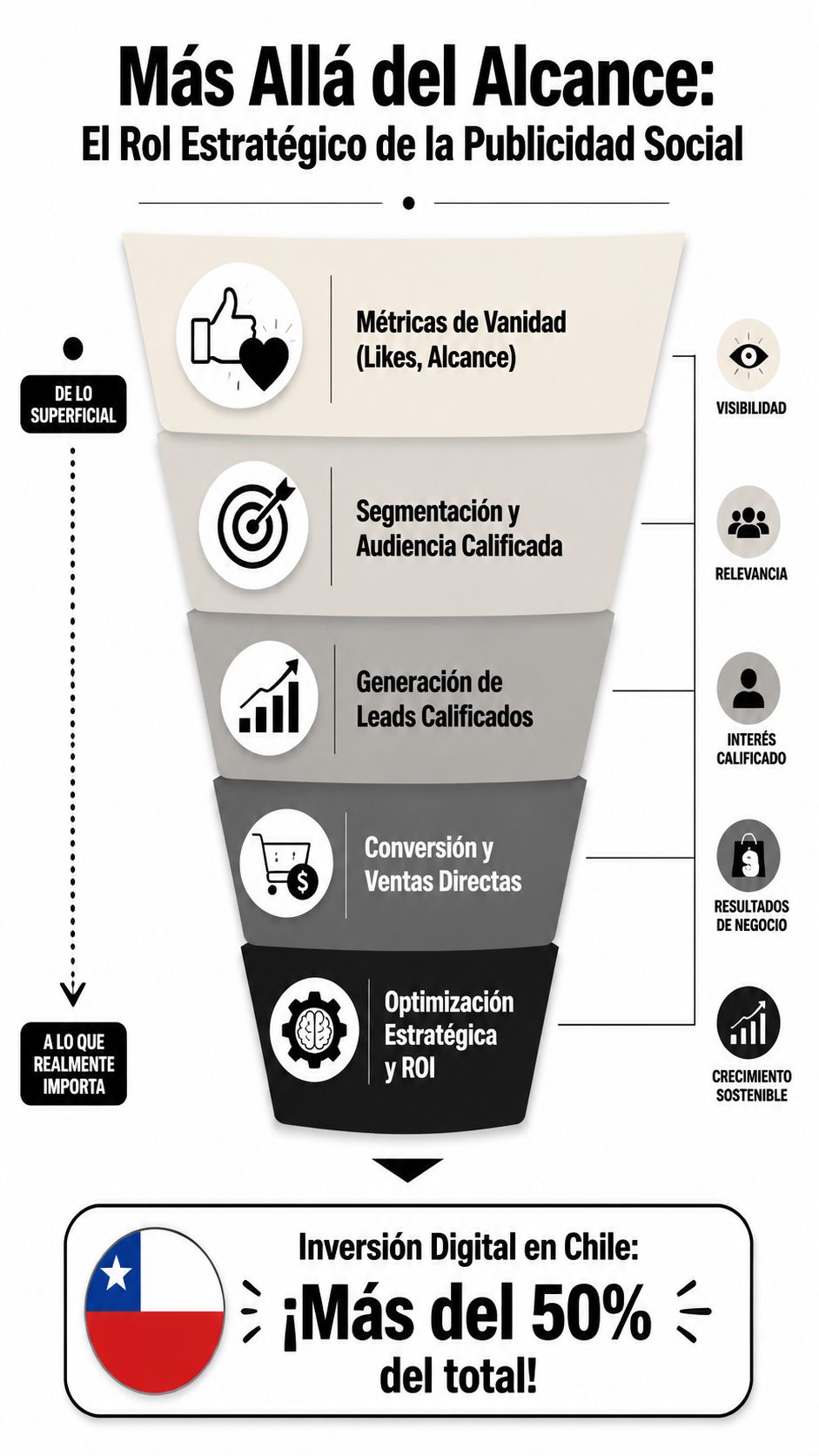
If your team still presents campaigns based on reach, likes or views, it is reporting activity, not impact. Those metrics have diagnostic value. They help detect whether the message is entering the market. They do not help defend budget before leadership, finance or the board.
Social advertising must answer business questions. Does it bring sales? Does it reduce acquisition cost compared to other channels? Does it accelerate the commercial pipeline? Does it improve lead quality? Everything else is context, not result.
This also forces branding into its correct place. Brand building matters, but not as an excuse to avoid accountability. In practice, a well-designed performance campaign already builds brand because it installs message, repetition, recall and value proposition in the right audience.
Practical rule: if a campaign cannot be connected to revenue, opportunities or expected profitability, it does not deserve incremental budget.
Not every campaign needs to close a sale immediately. But every one must answer to a measurable objective. An eCommerce company needs to read the channel through transactions, order value and recurrence. A B2B company should read it through commercial lead quality and pipeline progress. A brand in an expansion stage can justify discovery campaigns, but only if they are integrated into a subsequent conversion sequence.
A specialized guide on social media measurement insists on linking performance to CTR, conversions and ROI, using platform analytics, Google Analytics and link tracking, instead of stopping at raw visibility (see social media measurement guide). That point seems basic, but it still separates companies that buy exposure from those that buy results.
Three executive implications:
If a brand is evaluating amplifying trust and social credibility, a complementary layer can come from creators, but under business logic and not just visibility. That conversation becomes more useful when you understand the role of an influencer agency in a growth strategy.
Social advertising has stopped being a “presence” channel. Today it is an extension of the funnel. And funnels are not judged by how much noise they make, but by how much return they produce.
Allocating social budget without portfolio logic destroys profitability. Facebook, Instagram, TikTok and LinkedIn do not compete for internal sympathy or user volume. They compete for a share of the marketing capital, and every peso must justify itself by its contribution to revenue, margin and useful learning.
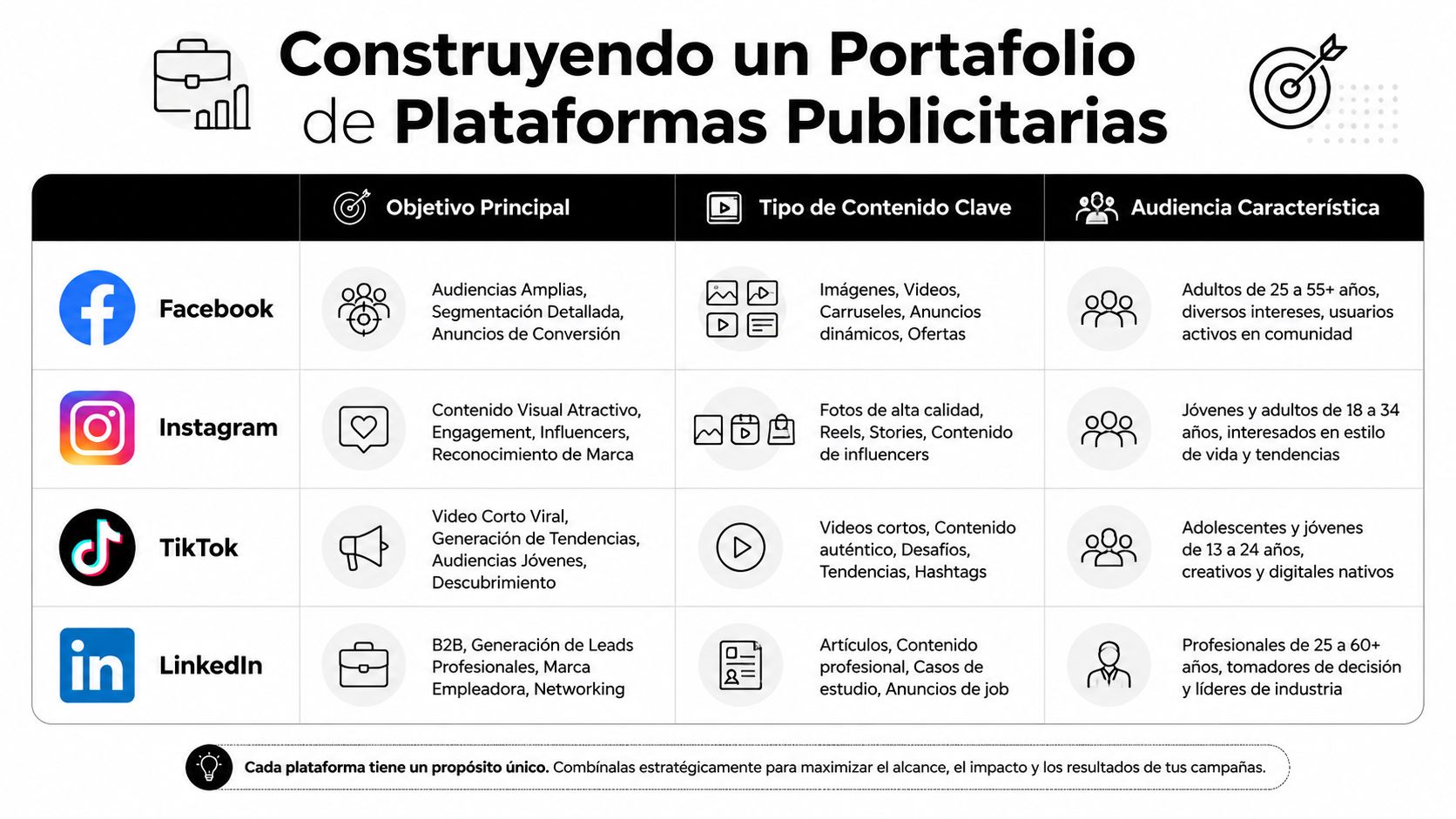
Meta is usually the most efficient starting point for building an advertising operation with discipline. Within the social adoption landscape already cited, Facebook and Instagram still offer a useful combination of scale, retargeting and iteration speed.
Its real value lies in operational stability. It lets you test audiences, offers, formats and sequences at a cadence other platforms do not always sustain. That reduces waste, because the team learns faster what converts and what only generates clicks.
In eCommerce, Meta delivers when the catalog is competitive, the offer is clear and the post-click experience does not block the purchase. In demand generation, it works well if the ad promises something concrete and the page or form ask only for the necessary information. If those elements fail, the platform is not to blame. The problem is in the conversion architecture.
TikTok serves a different function. It is useful for discovering demand, opening conversation and testing narratives quickly. It is an exploration platform, not a cheap copy of Meta.
That makes it valuable for brands with visible differentiation, demonstrable products or categories where the user is not yet actively searching. It also raises the risk of wasting budget if the company measures success by reach, views or traffic without intent.
The rule is simple. TikTok deserves investment when there is a clear hypothesis about which story can create interest and a subsequent path to convert that interest into revenue. Without that bridge, the account grows and the cash does not.
LinkedIn has less scale and a higher cost per impact. Even so, it can be the most profitable channel in the portfolio if the business sells high tickets, consultative cycles or solutions that depend on role, industry and decision level.
Here it does not pay to chase volume. It pays to buy precision. One right lead with budget capacity and a real problem is worth more than a hundred cheap registrations with no chance of closing.
That is why LinkedIn must be evaluated with harder business metrics. Lead quality, meeting rate, pipeline progress and closing speed. If it is measured as a mass platform, it looks expensive. If it is measured as a channel for entering the right accounts, it usually justifies itself.
Instagram shares advertising infrastructure with Meta, but it does not play the same role in every business. In categories where visual perception influences the decision, it can drive consideration and direct response more strongly than Facebook. Fashion, beauty, food, design, fitness and aspirational products usually fall here.
The frequent mistake is treating Instagram as additional inventory where the same asset is recycled. That degrades performance. The platform demands creative adapted to its visual and social consumption context.
A healthy portfolio does not seek total presence. It seeks intelligent concentration.
| Platform | Role within the portfolio | Main risk |
|---|---|---|
| Meta | Capture, remarketing, constant learning | Creative saturation |
| TikTok | Discovery and latent demand | Lots of clicks, little intent |
| High-value leads in B2B | Low volume, higher cost | |
| Visual consideration and direct response | Dependence on format |
The executive decision should follow this logic:
Poor management appears when a company splits budget by trend, the platform's commercial pressure or the team's preference. Good management assigns each channel a concrete job within the funnel and reviews its real contribution after the click. If you want to order that decision with more operational judgment, it is worth reviewing this guide on how to structure a social media advertising strategy.
The right thesis is this. Social media advertising is not managed as a list of channels. It is managed as an investment portfolio. And a serious portfolio does not reward activity. It rewards return.
Most companies segment to find people. The companies that grow segment to validate hypotheses. That difference seems minor, but it changes the entire economics of a campaign.
If you sell a supplement, a software, a financial service or a B2B solution, useful targeting does not end at age, location or job title. It begins when you identify the problem that triggers purchase, the user's mental context and the main objection that blocks conversion. That is where the creative angle appears. Not as an aesthetic piece, but as a commercial thesis.
The right question is not “who do we show this ad to.” The right question is “which version of the problem are we putting in front of which audience.”
A good segmentation system tests combinations like these:
With that logic, segmentation stops being an advertising setting and becomes real-time market research.
An important gap in the market is measuring the creative angle beyond CTR. That point matters more at scale. For Chile, it has been noted that DataReportal reported 14.4 million social media users in January 2025, equivalent to 73.6% of the total population, and that small message improvements can move relevant volume (reference for the argument).
The implication for leadership is clear. It is not enough to ask which ad generates the most clicks. You have to ask which angle generates better sessions, more useful forms, more profitable sales or less commercial friction. CTR may signal attention. It does not prove intent or quality.
HubSpot also recommends measuring engagement as interactions over impressions or reach, and considers an engagement rate of 2% to 3% on most platforms to be good, in addition to using per-post UTMs to attribute conversions accurately (HubSpot guide). Use it as a diagnostic reference, not as a trophy.
The winning message is not the one that attracts the most curiosity. It is the one that attracts the right curiosity and turns it into business.
A practical way to organize this is to separate tests by variable. One block changes the problem being emphasized. Another changes the promise. Another changes the proof. Another changes the type of landing page. If you mix everything at once, you learn nothing.
For teams that still approach this discussion from the angle of formats and posts, it can help to review more applied approaches on how to advertise on Instagram. But the executive priority is not in “making pieces.” It is in building a system that identifies which narrative moves revenue without raising the budget.
A poorly managed advertising budget behaves like an emotional fixed cost. It is approved under commercial pressure, executed out of inertia and defended with activity reports. That logic destroys profitability.
The useful question is not how much to spend. It is how much capital to allocate to achieve an acceptable return within an acceptable timeframe, at an acceptable level of risk. When framed that way, the conversation changes completely.
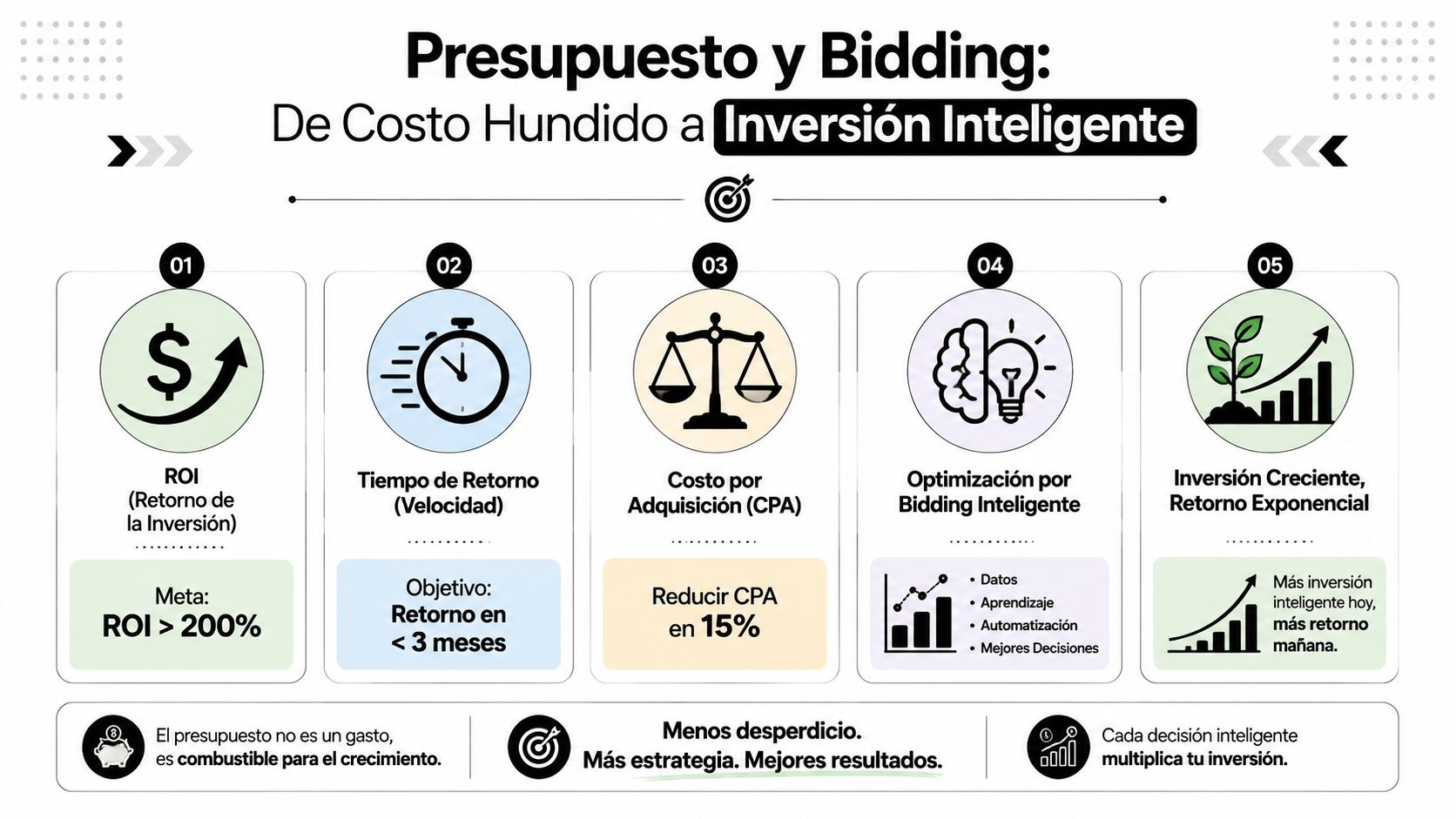
Every campaign needs an investment thesis. Not an arbitrary amount. A thesis. That means defining which economic result justifies entry, how much learning time you are willing to tolerate and which signals force you to stop, adjust or scale.
A director should demand, at a minimum, answers to these questions:
Bidding is not a technical checkbox. It is a declaration of priority. If you seek volume, you accept more dispersion. If you seek efficiency, you restrict learning. If you seek value, you need a better business signal.
Scaling a mediocre campaign only buys more inefficiency. Stopping a promising campaign too soon is also costly. The difference lies in the right reading.
Scale when you observe consistency between message, audience and commercial result. Not when an asset “looks good.” Not when there are positive comments. And not when the team is excited.
Stop or restructure when you see any of these patterns:
| Signal | Strategic reading |
|---|---|
| Lots of clicks, little action | Intent or post-click problem |
| Good engagement, low sales | Appealing creative, weak proposition |
| Abundant leads, poor quality | Poorly calibrated targeting or offer |
| Stable cost, deteriorating margin | Campaign sells, but is not worth it |
A disciplined company does not discuss budget as if it were an inevitable expense. It manages it as growth capital. That requires tolerating tests, but not tolerating blindness. It requires accepting initial volatility, but not romanticizing campaigns with no clear payback.
If the team cannot explain why a campaign deserves more budget, it is not yet ready to scale it.
A significant part of the social advertising budget is lost after the click. Not because of targeting or bidding. It is lost because the company buys expensive attention and sends it to an experience that does not convert.
The discussion about social media advertising fails when it ends at the ad. If the user lands on a slow, confusing or generic page, the problem is no longer about media. It is about profitability.
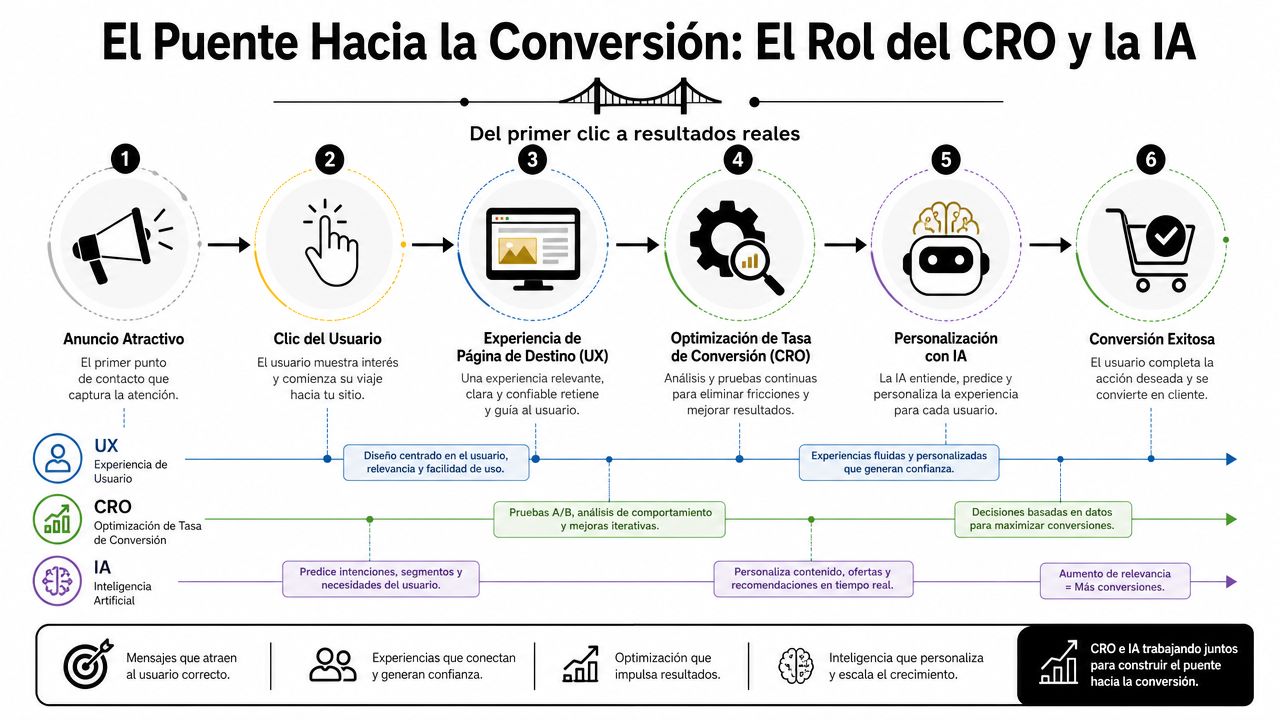
The pressure to produce more ads usually masks a more profitable decision: improving the conversion of the traffic you are already paying for. It is in the post-click experience where a strong promise meets a weak execution, and that breakdown destroys margin.
For marketing leadership and commercial management, the reading is simple:
Social advertising must be managed as an investment portfolio. The ad buys the opportunity. The page decides whether that opportunity produces return or becomes a sunk cost.
A useful framework to audit the post-click stage:
This video helps you understand the connection between traffic and conversion from a broader perspective:
AI adds value when it improves business decisions and accelerates real optimization. Generating copy in bulk does not solve a weak offer or a poorly structured page. Its impact appears when it helps detect friction, prioritize tests and adapt experiences according to intent.
Useful applications at this stage:
If you paid to attract the right user, but received them with a generic experience, you bought premium attention to take it to an empty store.
It also pays to demand more from providers. An agency that only buys traffic manages part of the problem. A team that connects media, UX, testing and AI manages the complete result. Bigbuda, for example, works on digital advertising, web development and CRO across Shopify, WordPress and Webflow with a focus on improving conversions from the same traffic. That approach usually marks the difference between campaigns that generate clicks and campaigns that produce profit.
The company that understands this point stops evaluating ads as isolated pieces. It starts managing each click as an asset that must deliver.
A profitable campaign is approved with investment criteria, not with creative enthusiasm. If the team cannot defend the objective, the measurement and the scaling logic before going live, it is not yet ready to spend.
This checklist helps treat social media advertising as a portfolio. Each campaign competes for capital. Each click must demonstrate return or generate useful learning to reallocate budget with greater precision.
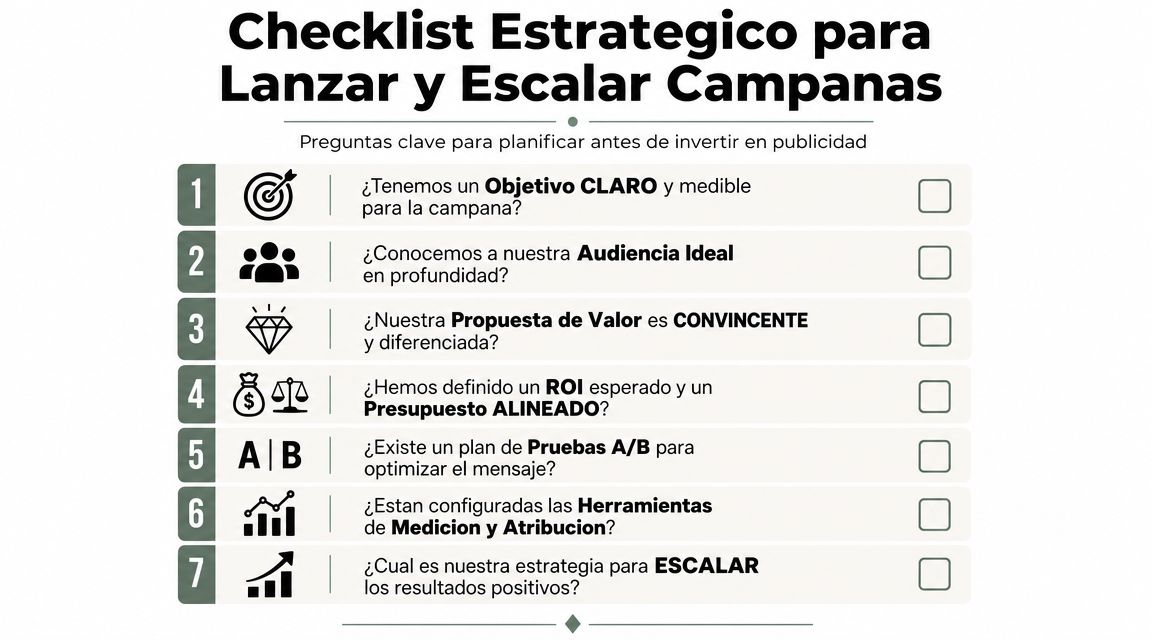
Review them as capital decisions with risk, return horizon and exit criteria.
Scaling demands evidence. If the account still depends on improvised adjustments, additional budget only amplifies inefficiencies.
Look for these signals:
| Maturity signal | What it indicates |
|---|---|
| Consistent message between ad and landing page | Less friction and better continuity of intent |
| Winning audiences identified | Budget allocated where there is probable return |
| Conversion aligned with margin | Growth with real financial room |
| Reliable attribution | Decisions based on performance, not opinions |
| Creatives and tests in reserve | Lower risk of fatigue and greater iteration capacity |
A campaign ready to grow does not need long explanations. It needs clear numbers, controlled friction and an obvious path to convert more without destroying margin.
Bigbuda can contribute at this point with an approach that connects media buying, UX, CRO and artificial intelligence. For a company already investing in social media, that integration reduces the typical error of managing ads, site and conversion as separate silos.
Meta works as the portfolio's base asset for capture, remarketing and continuous learning. TikTok is an exploration asset for discovery and latent demand. LinkedIn buys precision when customer value offsets its higher cost. Instagram drives visual consideration and direct response in categories where perception influences the decision.
When there is consistency between message, audience and commercial result, not when an asset looks good or the team is excited. Look for a coherent message between ad and landing page, identified winning audiences, conversion aligned with margin, reliable attribution, and creatives and tests held in reserve to avoid fatigue.
Lots of clicks with little action points to an intent or post-click problem. Good engagement with low sales suggests appealing creative over a weak proposition. Abundant but poor-quality leads indicate badly calibrated targeting or offer. A stable cost with deteriorating margin means the campaign sells but isn't worth it.
Whether the objective is expressed as a business metric, the audience has clear economic value, the value proposition is understood in seconds, measurement is closed end to end before launch, the post-click experience can convert, each variable has a hypothesis, and there are explicit stop and scaling rules.
Not on its own. Generating copy in bulk doesn't solve a weak offer or a poorly structured page. AI adds value when it improves decisions: personalizing message blocks by intent, prioritizing which pages or funnel steps have the greatest economic impact, summarizing objections and abandonment patterns, and producing variants faster.
Reach, likes and views have diagnostic value: they show whether the message is entering the market. They don't defend budget before leadership or finance. Social advertising has to answer whether it brings sales, reduces acquisition cost, accelerates the pipeline or improves lead quality. Everything else is context, not result.