










Solutions
Explore how to grow

The most repeated advice about influencer marketing is still the worst. “Find creators aligned with your brand and let authenticity do the rest.” That works for gaining visibility. It doesn’t work for building a profitable channel.
At Bigbuda we help you with AI for businesses in Chile.
If you run an eCommerce, a B2B brand with demand generation, or a digital business with expensive traffic, you don’t need more reach on its own. You need attributable sales, reusable content, and a measurement structure that lets you decide where to put the next dollar. That’s where an influencer agency stops being a talent intermediary and becomes a growth operator.
The problem isn’t hiring influencers. The problem is hiring badly. Many companies choose by name, follower count, or feed aesthetics. Then they discover they had no selection criteria, no well-secured contract, and no business traceability. The result is predictable: a lot of noise, little learning, and zero clarity on return.
In Chile, we’re no longer facing an experimental channel. We’re facing a channel that has matured and demands professional management. The difference between a decorative campaign and a campaign that moves cash usually lies less in the creator and more in the agency that designs, negotiates, controls, and connects execution with CRO and paid media.
Continuing to treat influencer marketing as pure branding is a budget-allocation mistake. In an environment where capturing traffic costs more and converting it remains difficult, a well-chosen influencer agency can become a performance channel, not just an awareness line item.
In Chile, the influencer marketing market reached 25 million dollars in 2023, with a compound annual growth rate of 18% since 2019. In addition, 65% of local brands invested in these campaigns in 2024, with an average ROI of 5.2x, according to data cited by Statista. That changes the conversation. It’s no longer about “trying influencers.” It’s about deciding whether you’ll manage the channel with discipline or keep evaluating it with the wrong criteria.
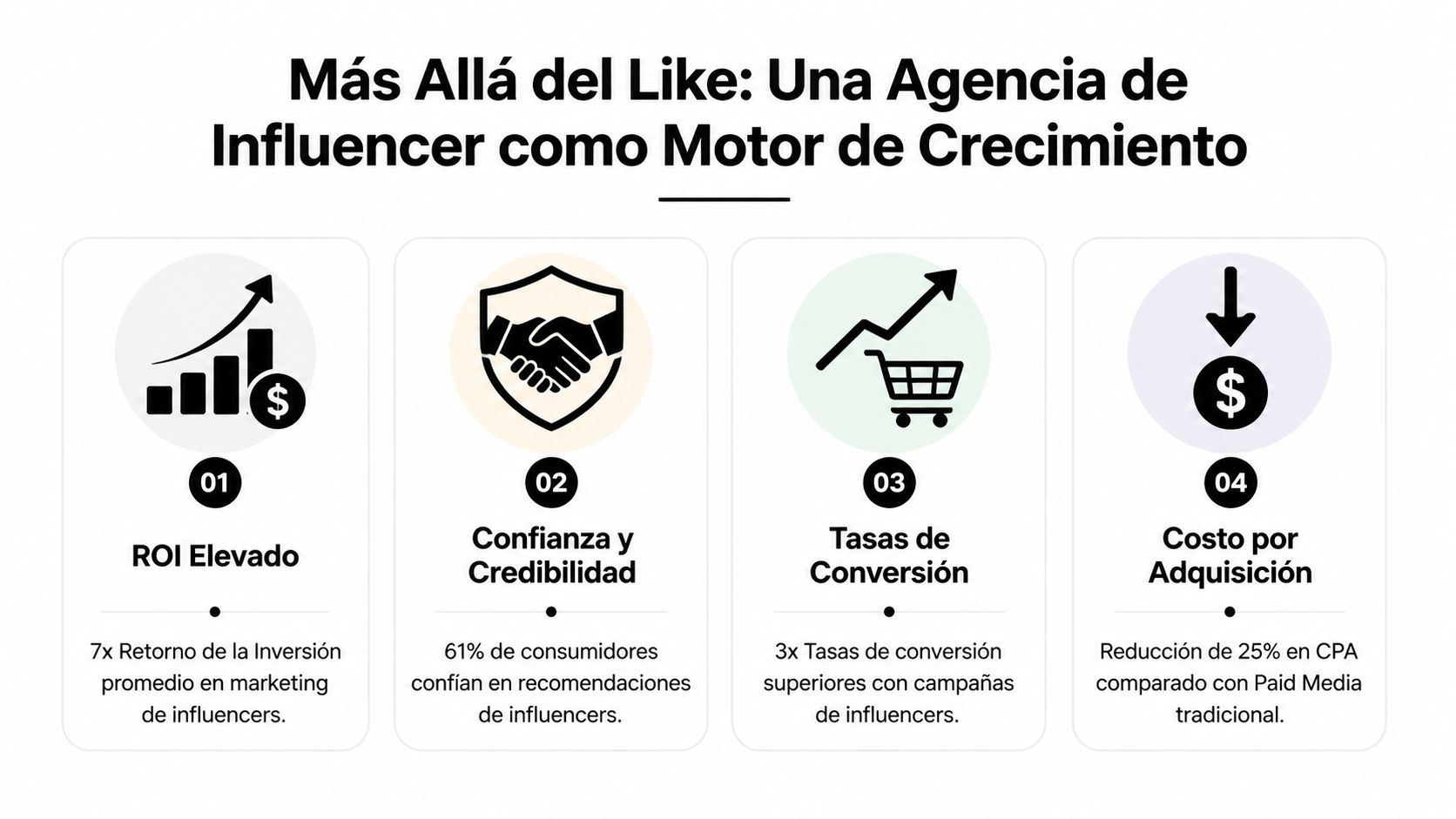
A serious company doesn’t hire an agency to “get posts.” It hires a structure capable of:
A well-managed campaign doesn’t start on Instagram. It starts on the income statement.
The most expensive mistake is evaluating this channel as if it were public relations. The brands that do it best integrate it into their acquisition and conversion system. They use creators to open trust, move traffic with intent, and produce social proof that then strengthens other levers.
Practical rule: if your influencer agency can’t speak fluently about attribution, UGC reuse, and profitability by cohort, it isn’t operating as a strategic partner.
Even seemingly soft metrics like engagement only matter when they help predict business. If you want to sharpen that criterion, it’s worth reviewing how to interpret engagement in real-performance contexts.
The conclusion is simple. An influencer agency shouldn’t sell borrowed fame. It should sell a combination of transferred trust, qualified traffic, and content with commercial utility.
Choosing an agency by its list of well-known names is a bad sign. For eCommerce, what matters isn’t who they know. It matters how they think, what they measure, and how they make decisions when a campaign underperforms.
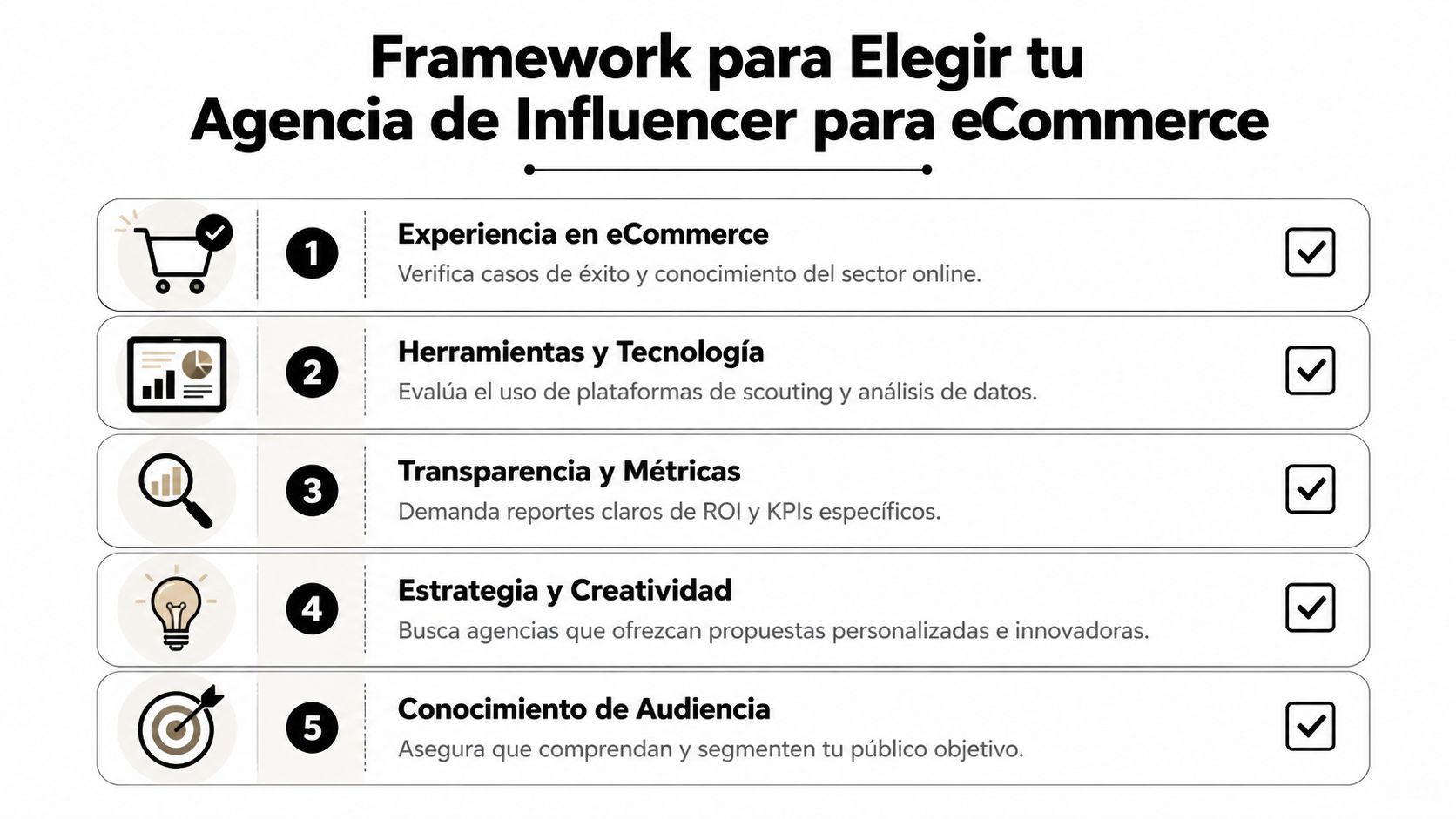
Campaigns with ROI above 3x apply SWOT analysis on social media to identify audiences and prioritize influencers with engagement above 5%, versus a national average of 3.2%. In addition, micro-influencers with 10k to 50k followers tend to generate 60% more conversions in local eCommerce, according to the market-adapted guide from Prismalia for Chile. That data matters for one reason: a good agency doesn’t buy size. It buys fit.
Don’t ask “which influencers do you work with?” Ask this:
If the answers are vague, you already have your answer.
A useful criterion is to observe whether the agency speaks about business naturally. A mature agency mentions UTMs, codes, conversion windows, buyer cohorts, traffic quality, and reusable assets. An immature agency talks about “perfect matching,” “authentic connection,” and “organic reach” without landing anything.
To see an example of how other brands think about this channel in audiovisual format, it’s worth reviewing this context:
If you sell fashion, cosmetics, supplements, technology, or B2B products, the logic changes. Not because Instagram changes, but because the decision cycle, purchase frequency, and main objection change. The right agency must know whether your bottleneck is in trust, differentiation, proof of use, or commercial urgency.
Don’t choose an agency that shows you celebrities. Choose one that can explain why a certain profile converts better in your category.
In eCommerce, the best agency is usually the one that can tell you “this creator isn’t right for you,” even if they have many followers. That filter saves more money than any negotiation can recover.
Most failed campaigns aren’t ruined at the post. They’re ruined much earlier. They’re ruined when the company hands over an imprecise brief, approves a generic contract, and expects the agency to “figure it out as it goes.”

In Chile, ambiguous briefs cause 40% of influencer campaign failures. In addition, 37% of campaigns fail due to a lack of post-launch follow-up, which can underestimate ROI by up to 25%. There’s also a direct relationship between contractual clarity and commercial results: contracts that specify CTAs can increase sales by 12%, according to Under One Marketing.
A useful brief doesn’t just describe the brand. It defines the business problem. If an agency receives “we want awareness and fresh content,” it will most likely deliver a likeable campaign that’s hard to measure. If it receives a clear objective, the design changes completely.
Your brief should contain, at minimum:
If the brief doesn’t set a priority, the agency improvises. And when the agency improvises, the company ends up evaluating creativity because it can no longer evaluate business.
Many brands sign agreements focused on the number of pieces, dates, and payments. That’s insufficient. The contract must protect future use of the content and the ability to react if performance doesn’t follow.
Include these points:
Executive criterion: if the content isn’t contractually available for amplification, you’re paying for a short-lived asset.
There’s a bad idea floating around: the looser the relationship, the more authentic the content will be. Not always. Authenticity doesn’t depend on chaos. It depends on the creator having room to interpret an idea within a clear commercial framework.
Campaigns that work usually have a simple combination. Few objectives, sharp messages, fast approval paths, and well-closed legal conditions. That doesn’t strip the influencer of creativity. It saves the brand from paying for improvisation.
Likes, comments, and impressions are useful for describing activity. On their own, they’re not useful for deciding future investment. If your influencer agency still reports mainly on reach, it’s optimizing the presentation, not the result.
Campaigns managed by Chilean agencies achieve an average engagement rate of 4.2%, double that of self-managed campaigns. In addition, eCommerce clients reported a 23% increase in conversion rates and an average ROAS of 6.1x, according to benchmarks adapted to the Chilean market published by HypeAuditor. The correct reading of that data isn’t “engagement matters more.” It’s another: when a professional agency better manages selection and control, the impact reaches the business.
Look at reach to add context. Look at impressions to understand distribution. But don’t confuse that with performance.
The mature conversation begins when the report answers these questions:
If a dashboard doesn’t help move budget between winners and losers, it’s not an executive dashboard. It’s a pretty file.
| Type of Metric | Specific KPI | Why it matters for the business | Desirable Benchmark (eCommerce) |
|---|---|---|---|
| Visibility | Reach and impressions | They help contextualize content distribution, not prove profitability on their own | Evaluate together with clicks and conversion |
| Interaction | Engagement rate | Works as a signal of attention and content affinity with the audience | 4.2% in agency-managed campaigns |
| Traffic | CTR to landing or product page | Measures the content’s real ability to move users to the site | Should be reviewed by creator and by piece |
| Conversion | Post-click conversion rate | Indicates whether the generated traffic has intent and whether the destination experience supports it | 23% uplift reported after the campaign |
| Profitability | ROAS | Summarizes the campaign’s commercial return against spend | 6.1x in benchmarks adapted to the Chilean market |
You don’t need an endless report. You need traceability. The minimum baseline includes UTMs by creator, differentiated codes when it makes commercial sense, and a consolidated view by campaign, creator, piece, and destination.
An executive dashboard should show, at minimum, performance by influencer, by content format, by destination landing page, and by conversion window. If it also integrates cost, attributable revenue, and comparison across cohorts, even better. For those who make decisions with data, a useful reference is how to structure visualization and reading in Looker Studio Pro.
Most mistakes appear after the click. A creator can do great work and still end up with poor performance if the traffic lands on a generic homepage, a confusing product page, or a poorly presented offer.
That’s why a serious reading of the channel doesn’t separate social from onsite. An ROI-oriented influencer agency doesn’t just deliver platform results. It delivers a complete business reading. That includes which creator attracted better buyers and which destination closed the intent best.
An isolated influencer campaign competes for budget. An integrated campaign multiplies value. That difference defines whether the channel grows or ends up cut.

The right way to think about an influencer agency isn’t as a post provider. It’s as a generator of three simultaneous assets: trust, qualified traffic, and content usable across other channels.
The creator’s content shouldn’t be exhausted in organic. If a piece shows a good qualitative response, product clarity, or the ability to overcome objections, it has value for paid media. There a clear competitive advantage appears: content created by influencers tends to feel less advertising-like and more credible.
That improves the relationship between message and attention. Not because the platform changes, but because the user perceives more natural social proof.
The classic mistake is sending all traffic to the homepage. That dilutes intent. The click coming from an influencer needs continuity between message, offer, and destination experience. If the content’s promise doesn’t appear clearly on the page, interest cools.
A more profitable logic connects each collaboration to a landing or product page designed for that context. Same language, same focus product, same objection resolved. If you want to dig deeper into that logic, it’s worth reviewing how CRO applied to digital businesses works.
The influencer opens the door. The page decides whether the visit turns into revenue or into a bounce.
When a brand finds a creator, a message angle, and a piece that generate a response, it should think about amplification. Paid media lets you extend that content to similar audiences, remarketing, or cold segments with signals resembling the real buyer.
The compound effect appears when each channel feeds the other:
That turns a one-off campaign into a system. And systems last longer than trends.
The theory sounds good until you have to put up budget. That’s why it’s worth looking at two typical scenarios. Not as decorative stories, but as decision models.
A niche online store wants to push a new line with low brand familiarity. Instead of betting everything on one big creator, it works with an agency that assembles a group of micro-influencers from the right segment. The logic isn’t based on celebrity. It’s based on affinity, audience quality, and the ability to explain real product use.
The agency negotiates content with a commercial focus, defines codes by creator, and organizes UTMs by piece and by landing page. It also requires usage rights to reuse the best UGC in paid campaigns.
The strategic result of a case like this isn’t just the initial sale. Very valuable signals also appear:
The campaign stops being an event. It becomes transferable learning.
Another company does the opposite. It chooses influencers by follower count, approves a generic brief, and sends traffic to the homepage. The contract doesn’t make usage rights or CTAs clear. The final report shows views, likes, and some positive comments. The important question goes unanswered: “Did this sell or not?”
That mistake usually comes from three poor decisions:
Most disappointing campaigns don’t fail because of the influencer. They fail because the company never designed a structure to turn interest into results.
You don’t need to get into the operational detail of each post. You do need to ask for clarity on the campaign’s business model. Before approving, it’s worth having a concrete answer to this:
An influencer agency that can’t answer that isn’t managing growth. It’s coordinating collaborations.
Hire an agency when you need speed, selection judgment, and analytical control that your team doesn’t yet have. In-house management can work if you already have processes, access to creators, negotiation capacity, and a clear measurement infrastructure. If you don’t have that, in-house tends to look cheaper until you start paying for learning with real budget.
For eCommerce, it’s often better to start with micro-influencers. You saw earlier that in Chile profiles with 10k to 50k followers tend to convert better in e-commerce contexts, according to the reference cited in the selection section. Not because they’re magic, but because they usually have more specific communities and a more credible recommendation.
Ask for methodology, not just a list of talent. A serious proposal should explain how they select profiles, how they validate the audience, how they structure the brief and contract, how they measure impact, and how they make decisions if initial performance doesn’t follow.
There’s no universal timeline. It depends on the ticket, the purchase cycle, the category, and the quality of the traffic you already have. What’s reasonable is to demand early quality signals. For example, clarity on useful clicks, response to the offer, and the quality of the content produced. Strong return usually comes when the program stops being a one-off action and starts integrating with remarketing, CRM, and site optimization.
Choosing by ego. If your team gets more excited about the influencer’s name than about the campaign’s commercial logic, it already started badly. The right agency helps you lower that anxiety and prioritize creators with fit, not glamour.
The content usage rights. Many brands underestimate this. A good video or creator testimonial can keep generating value long after the original campaign if you incorporate it into ads, landings, product pages, and remarketing sequences.
The immature way to buy influencer marketing is simple. Choose names, approve content, publish, and wait. The profitable way is different. Select with data, hire rigorously, measure with commercial logic, and integrate the channel with the rest of the digital system.
That requires more discipline, but it also produces something far more valuable than visibility. It produces accumulable learning. You know which creator brings useful traffic, which message resolves objections, which piece deserves amplification, and which destination converts best. That information makes each subsequent campaign start better than the last.
A well-managed influencer agency doesn’t compete with CRO or paid media. It boosts them. When teams understand that relationship, the channel stops looking like an add-on and starts working as a growth lever with real revenue impact.
If you’re evaluating this channel for your eCommerce or your digital operation in Chile, the right criterion isn’t “who has the most reach.” It’s “who can demonstrate more economic value with less waste.” That’s the difference between a pretty campaign and a smart investment.
If you want to turn influencer marketing into a performance channel and not another hard-to-justify expense, talk to Bigbuda. Its approach combines digital strategy, CRO, analytics, and multichannel integration to help brands turn traffic and content into profitable growth.
Related article: Essential SEO in site guide for leaders in 2026