










Solutions
Explore how to grow

The most repeated advice about on-site SEO is still wrong. It is presented as a list of technical adjustments, almost like a maintenance task, when in reality it defines how much value a company extracts from the traffic it already has and how much it depends on continuing to buy visits.
If you want to dig deeper, take a look at our web positioning (SEO).
A CEO does not need to know how to configure every tag. They need to understand something more important. If your site is not aligned with how your customers in Chile search, compare and decide, your website is not a strategic asset. It is a sunk cost with good looks.
The problem is not just visibility. It is commercial efficiency. A site can receive visits, even have a known brand, and still lose revenue because it structures its pages poorly, responds badly to search intent or creates unnecessary friction on mobile. That is where on-site SEO stops being a marketing discipline and becomes a business decision.
Continuing to treat on-site SEO as a list of isolated adjustments is a bad business decision. A site does not grow because it has tidy metadata. It grows when its structure, its content and its performance respond precisely to what the customer searches for, compares and needs to move forward.
That point matters more in Chile than in many generic guides. Here search intent has clear local nuances. A user who types "quote management software" does not search the same way as one looking for "price sme software chile" or "electronic invoicing sii." If the site does not interpret those differences and translate them into useful pages, it loses commercially valuable demand even while still receiving visits.
Leadership should look at on-site SEO with a simple criterion. Is the website helping to capture high-intent demand and convert it into revenue, or is it just published?
The pressure to grow without spiking acquisition cost is not solved by buying more traffic. It is solved by making the site convert the demand that already exists better. That is the real contribution of well-executed on-site SEO.
When a website is well designed for business:
Practical rule: if the site does not improve coverage of relevant searches, traffic quality and conversion, there is no strategy. There is loose execution.
Many management teams still evaluate their site by design, brand storytelling or the number of published pages. That analysis falls short. A competitor with a less flashy website, but better connected to user intent, can take the commercial opportunity before your team even enters the conversation.
That happens every day in competitive markets in Chile, especially in services, education, health and ecommerce. The company that organizes its pages better, answers real questions and removes friction at decision moments gains visibility and gains business.
On-site SEO serves a concrete function within commercial strategy. It turns the website into a channel that helps sell, filter demand and sustain growth with less dependence on paid media. That is the discussion a CEO should have. Not how many tags are missing, but how much growth your current site is leaving on the table.
Most projects start poorly for a simple reason. They begin by correcting symptoms, not understanding the system. A serious on-site SEO diagnosis does not look for a long list of errors. It looks to identify where visibility, trust and conversion are being lost.
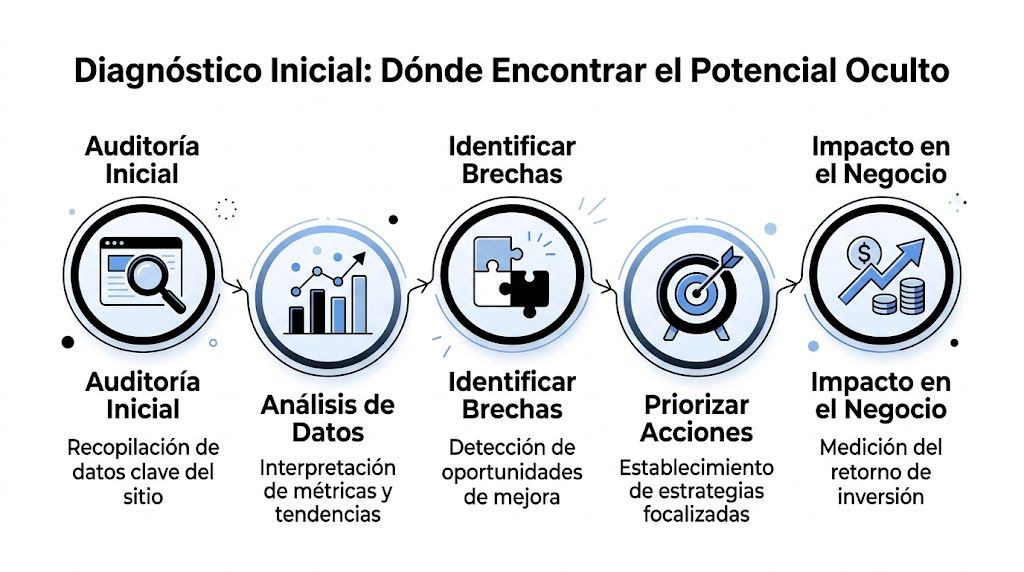
If you lead marketing, eCommerce or growth, you do not need to review every line of the technical report. You need to demand clear answers to three questions:
The technical audit matters because it reveals invisible losses. Products that do not index. Categories that compete with each other. Slow templates. Pages that load, but do not perform.
According to the information cited by SEOQuantum on SEO strategy and initial audit, a technical audit with Google Search Console and Screaming Frog makes it possible to detect indexing errors present in 65% of Chilean sites, and the same material notes that 45% of .cl domains fail Core Web Vitals. That combination does not describe a technical detail. It describes a commercial bottleneck.
A director should not ask for "a report of errors." They should ask for a map of impact:
Search Console is not only for specialists. Read well, it works as a dashboard of commercial friction.
Observe these signals with executive judgment:
| Indicator | What it reveals for the business | The right question |
|---|---|---|
| Coverage and indexing | Whether strategic pages are off Google's radar | Which business lines are invisible? |
| Queries and impressions | Whether the brand is competing for relevant searches | Are we covering the right demand? |
| Organic CTR | Whether the result convinces before the click | Is our proposition understood in the SERP? |
| Pages with a drop in clicks | Whether there is competitive deterioration or intent misalignment | What changed in market, content or UX? |
The classic mistake is reviewing isolated rankings. The useful criterion is another. Identify which pages are close to performing better and which are wasting intent with a poor experience or the wrong message.
A site can have "optimized" content and still lose business because the right page does not exist, is not understood or does not advance the commercial conversation.
The second layer of the diagnosis is uncomfortable but decisive. Many companies do have pages about their products or services. The problem is that they wrote them from inside the organization, not from the customer's head.
That shows quickly. Titles that talk about internal capabilities. Descriptions that list attributes without context. Categories designed for operations, not for search. Product pages that describe the product but do not resolve key doubts.
A good diagnosis must detect gaps like these:
Here is the point many technical reports omit. On-site SEO does not fail only because of code or metadata. It also fails when the user experience breaks the continuity between search, arrival and conversion.
Review these questions strictly:
If the answer is uncertain, the hidden potential is already identified. You do not need more traffic. You need a clearer, more accessible website better aligned with intent.
When the diagnosis is done well, it stops being a technical document. It becomes a plan to recover poorly captured demand, lost revenue and wasted digital authority.
The technical base defines how much growth your site can capture and how much it lets slip away. It is not an isolated development front. It is the infrastructure that connects search intent, real experience and commercial result.
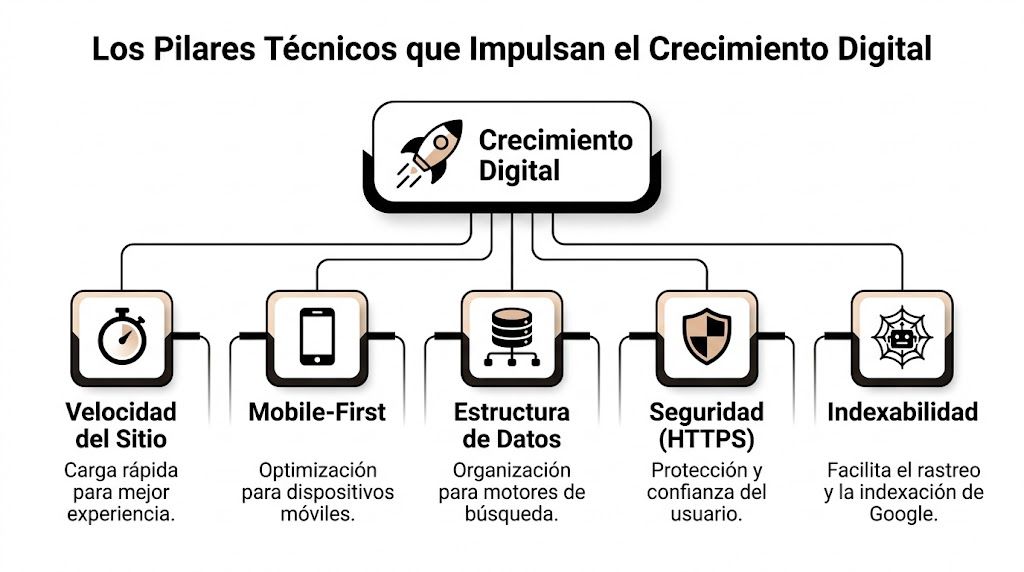
In the Chilean market, this point is frequently underestimated. Many companies fix tags, improve some texts and expect organic growth. The problem lies elsewhere. If the page is slow, if Google crawls the best-selling URLs poorly or if the mobile version makes it hard to advance, demand exists but does not turn into business.
Performance is not measured to win an audit. It is improved to reduce abandonment and sustain the right intent at the right moment.
That matters more on mobile, where much of the traffic arrives with less patience, less time and a more concrete need. In that context, every extra second delays the understanding of the offer, makes comparison harder and cools conversion. If your team needs a practical reference to prioritize improvements, review this web performance guide for eCommerce.
The recommendation is clear. First optimize the pages that capture high commercial-intent demand. Categories, product pages, services, landing pages and contact pages. Improving speed on secondary content before resolving those assets is poor prioritization.
A published page is not always a visible page. If Google does not find it clearly, does not interpret it well or considers it weak against a similar URL, that section of the business loses presence right where it should concentrate demand.
The problems repeat across many sites:
Here it pays to be strict. Every strategic URL must have a concrete commercial function. Capture searches, sustain evaluation or push conversion. If it does not fulfill one of those three tasks, it is superfluous or needs a redesign.
Google does not reward sites for accumulating technical implementations. It rewards clarity. That is why schema markup and well-resolved semantics matter so much in complex services, large catalogs and companies with several locations or business lines.
The goal is not to "have schema." The goal is to express precisely what the company sells, where it operates, how its offer is organized and what type of page the search engine is seeing. That clarity improves content interpretation and avoids fuzzy signals that later affect visibility.
In executive terms, these pillars sustain different results:
| Technical pillar | Visible impact | Business impact |
|---|---|---|
| Speed | Faster load and less abandonment | Better use of traffic and more progress toward conversion |
| Indexability | Greater presence of useful pages in search | More coverage of relevant business lines |
| Structured data | Better understanding of content by Google | A clearer offer and more competitive visibility |
Designing first for desktop and adapting later is still an expensive mistake. In on-site SEO, mobile must order the hierarchy, the content and the action elements from the start.
That changes concrete decisions. Fewer decorative blocks. Fewer sliders nobody needs. Less unnecessary weight on the first load. More focus on messages, trust proof, comparability and next steps. If a person searches from their phone for a solution in Santiago, Viña or Concepción, they do not want to explore a design piece. They want to understand quickly whether this company solves their need and how to move forward.
HTTPS, well-resolved redirects, a stable server and the absence of errors are not maintenance details. They are trust signals for users and for search engines.
An unstable site conveys disorder. A site with technical errors on key pages cuts the journey short before the content does its job. And a site that forces reloading, going back or hesitating loses commercial value even with good initial ranking.
The function of this technical layer is concrete. To let the right pages compete, to let the user advance without friction and to let the company grow on an orderly base, instead of fixing structural problems every few months.
The most expensive mistake in on-site SEO is not technical. It is editorial. Many companies keep producing content to "cover keywords" when they should build pages that resolve decisions.

That keyword-centric approach still dominates because it looks orderly. A term is defined, a page is optimized, content is published and ranking is expected. The problem is that this logic ignores how people buy. Searches express needs, objections, urgencies and context. If the page only repeats terms, it does not accompany any decision.
The reference from Nancy Burgess on SEO gaps in SMB sites raises a point that is seen every day in Chile: most companies structure their pages around what they want to tell, not around what the customer needs to know. That same material adds that undocumented local studies show that more than 60% of recent web redesigns fail to improve conversions because they optimize keywords without mapping user intent. The figure matters less than the reality it describes. The redesign fails when it improves form but not commercial clarity.
Review an average product page and you will see the problem. Specification abounds. Decision is missing. Features appear, but not answers to essential questions like compatibility, trust, delivery, real use or differences between options.
In B2B the same thing happens in another disguise. Service pages tend to talk about methodology, track record or internal capabilities before explaining the customer's problem, the cost of not solving it and the kind of result they can expect.
Content that does convert changes the order of priority:
This point is critical. Many brands in the region use imported frameworks, standardized texts or flat translations. The result is content that is correct in theory, but weak in local context.
Search language in Chile has its own nuances. So does the way price, delivery, trust and availability are compared. Good on-site SEO does not treat those differences as wording details. It treats them as conversion variables.
When a page aligns with local intent, it stops sounding "optimized" and starts sounding useful.
The right decision is not to produce more pages. It is to design fewer useless pages and more decisive ones. For that, a simple strategic-reading matrix helps:
| Type of page | Common mistake | Correct approach |
|---|---|---|
| eCommerce categories | List products without context | Help compare and guide the choice |
| Product pages | Describe attributes | Resolve doubts that stall the purchase |
| B2B services | Talk about the company | Talk about the problem and its implications |
| Informational content | Educate with no commercial exit | Educate and connect with a next action |
A team that works this layer well does not ask first "which keyword do we target." It asks "which decision do we want to unblock."
Many teams separate SEO, UX and conversion as if they were disciplines in tension. That is a misreading. When a page is better understood, better prioritized and better answers intent, it helps the user and helps the search engine at the same time.
To deepen that relationship between clarity, design and performance, it helps to review the strategic view on UX and UI applied to digital growth.
A simple example. If a category page answers well what it includes, who it is for, how to choose and what differentiates one option from another, it improves semantic interpretation and also the probability of purchase. There is no conflict there. There is alignment.
This video illustrates well why clear communication weighs as much as visible optimization.
The best sign of maturity in on-site SEO is that the content stops looking "made to rank." It feels natural, precise and commercially useful. It explains without inflating. It convinces without exaggerating. It orders the decision without forcing it.
That requires editorial discipline. Less obsession with keyword density. More work on argument structure, customer language and information hierarchy.
If your site attracts visits but does not convert as it should, review this first. In many cases, the problem is not the traffic. It is that the page talks about you when it should help the customer decide.
A poorly structured website wastes authority. It can have good content, external links and valuable pages, but if the architecture does not guide well, the user gets lost and Google distributes attention inefficiently.

Web structure serves two functions at the same time. It organizes how the business presents its offer and defines how the search engine interprets priorities. If both functions are not aligned, on-site SEO loses power even when the rest of the work is solid.
Many companies build their navigation around how the business is organized internally. That generates menus logical for the company, but confusing for the market. The customer does not think in org charts. They think in problems, categories, solutions and context of use.
A strategic structure orders the site by topics and decision paths. Not by internal convenience.
Three criteria help correct this:
Internal linking does not serve only to "pass authority." It serves to make clear to Google which pages matter and to take the user toward the next piece of useful information.
A good internal linking system does three things:
| Function | For the user | For Google |
|---|---|---|
| Orientation | Helps discover related content | Shows topical relationships |
| Priority | Highlights higher-value pages | Signals strategic URLs |
| Continuity | Reduces dead ends in navigation | Improves crawling of the site |
This is especially relevant when a company works with topic clusters, pillar pages or commercial support content. Without coherent internal links, that ecosystem stays fragmented.
A strong isolated page performs less than a solid page integrated into a logical structure.
Here a false separation usually appears. Some teams work on on-site SEO on one side and authority or digital reputation on the other. In practice, both fronts depend on each other.
The guide from Straight North on off-site optimization argues that, for B2B companies in Chile, visibility depends on an integrated strategy. It also notes that a company can optimize structure and metadata, but if it ignores third-party validation and E-E-A-T signals, the results will be limited. The right reading for leadership is direct. The authority earned outside the site is only capitalized well when, inside, there is an architecture capable of channeling it toward business pages.
That is why it is worth thinking of web structure as a system for conducting trust:
You do not need to approve wireframes. You do need to demand a logic. The site architecture must answer these questions:
When those answers do not exist, the company has a published site, but not a platform organized to grow.
On-site SEO loses value when it is measured with decorative metrics. Isolated rankings, sessions without context or reports full of technical terms do not help make business decisions. What matters is whether organic visibility is generating better demand, better conversion and better commercial efficiency.
The right reading is simple. If the site attracts more relevant organic traffic, converts better and strengthens pages that sustain sales or leads, the strategy works. If it only increases impressions with no commercial impact, there is activity, but no progress.
You do not need to expand the dashboard. You need to make it more demanding.
Prioritize these indicators:
SEO should not be reported as isolated visibility. It should be reported as a contribution to revenue, pipeline or acquisition efficiency.
Serious work is not executed as a one-off campaign. It is organized in phases, with different priorities and different success criteria.
| Phase (Timeframe) | Main Focus | Success KPIs |
|---|---|---|
| Phase 1 | Technical foundations and diagnosis of key pages | Better indexing coverage, correction of critical frictions, site stability |
| Phase 2 | Restructuring of architecture and content by intent | Greater visibility of strategic pages, better organic traffic quality, more interaction on key pages |
| Phase 3 | Consolidation of topical authority and continuous optimization | More qualified leads or organic sales, better organic conversion, greater commercial efficiency of the channel |
This roadmap does not need to be fixed to a rigid calendar to be useful. What matters is the order. First technical base and real visibility. Then content and structure aligned to intent. Afterward, continuous optimization with a business reading.
Effective leadership in on-site SEO does not intervene in every adjustment. It defines priorities, aligns teams and demands traceability between action and impact.
That means asking for:
When those fronts work separately, the site improves in pieces and performs less than it could. When they operate with a single logic, the website starts to function as a compound asset.
If your team needs a broader view on how to integrate organic positioning and paid demand within the same growth system, this reading on SEO and SEM in digital marketing helps order priorities.
It is not "how do we climb positions." It is "how do we make the website capture the right demand better and convert it with less friction." That question forces you to look at on-site SEO with more ambition and less technical language.
Companies that make that shift will not only rank better. They will build a digital operation less dependent on improvisation, less exposed to rising acquisition costs and far more prepared to compete in environments where search, AI and the purchase decision are increasingly connected.
If your site already receives traffic, but is not producing the commercial impact it should, Bigbuda can help you evaluate that gap from a strategic perspective, uniting on-site SEO, user intent, performance and conversion to turn the website into a real growth asset.
Related reading: Voice Search Strategies for Companies in Chile · What benchmarking is: drive your digital growth
Related article: Effective Web Positioning Services: 2026 Guide
It is a growth strategy. A site does not grow because it has tidy metadata. It grows when its structure, its content and its performance respond precisely to what the customer searches for, compares and needs to move forward. Treating it as isolated adjustments is a bad business decision.
The pressure to grow without spiking acquisition cost is not solved by buying more traffic. It is solved by making the site convert the demand that already exists better. Well-executed on-site SEO captures commercially relevant demand and turns the website into an asset rather than a permanent media expense.
Not by correcting symptoms. A serious diagnosis does not look for a long list of errors; it identifies where visibility, trust and conversion are being lost. That means technical health that reveals invisible losses, real relevance to customer intent, and the experience that breaks continuity between search, arrival and conversion.
Many brands in the region use imported frameworks, standardized texts or flat translations. The result is content that is correct in theory but weak in local context. Search language in Chile has its own nuances, as does the way price, delivery, trust and availability are compared.
You do not need to approve wireframes, but you do need to demand a logic. The architecture must answer which pages represent your main commercial bets, which topics you need to dominate in search, how authority flows from informational content toward pages that generate business, and whether navigation helps people choose.
Do not expand the dashboard; make it more demanding. Prioritize organic traffic quality, meaning what kind of queries and pages bring visitors with useful intent; organic conversion, meaning how that traffic performs in sales, leads or valuable actions; and coverage of strategic pages across the portfolio or key offer.