










Solutions
Explore how to grow

The most repeated recommendation in search marketing is still the wrong one: “split the budget between SEO and SEM and optimize each channel separately.” That tidies up the org chart. It does not tidy up growth.
At Bigbuda we help you with organic web positioning.
When a Chilean company separates SEO from paid performance, it ends up running two blind systems. One team buys traffic without learning, in a structured way, which intent converts. The other creates organic assets without using real signals of commercial demand. The result is not neutral. It is a hidden cost that accumulates in budget, time, and executive focus.
In Chile, organic traffic accounts for 58% of the average monthly traffic to websites, and that strategic weight becomes even more evident when 99% of users do not go past the first page and the CTR of the first position reaches 39.8%, according to SEO statistics compiled by SE Ranking. If your search operation is not designed as a single system, you are leaving out the largest structural source of visibility while paying to fill gaps that should not exist.
The problem is not using SEM. The problem is using it to compensate for the lack of an organic strategy. Nor is it enough to “do SEO” if the business then fails to accelerate commercial learning with paid campaigns. The CEO who looks at each channel separately sees reports. The CEO who integrates them sees an acquisition economy.
That changes three critical decisions:
Most companies do not lose money by investing in search. They lose it by doing so with disconnected teams, agencies, or reports.
SEO and SEM are often managed as if they were two distinct business lines. One chases rankings. The other chases clicks and immediate conversions. That separation seems logical on a spreadsheet, but in practice it destroys efficiency. Keywords get duplicated, landing pages cannibalize each other, conversions are misinterpreted, and budget is allocated with a partial view of the customer's real journey.
When paid and organic traffic do not share data, the company pays to learn twice. First, it buys clicks to discover demand. Then, it funds content or SEO improvements without connecting that learning to validated purchase intent. That cycle generates internal friction and, worse still, wrong investment decisions.
A typical symptom is this: the Ads team celebrates profitable campaigns on branded or high-intent searches, while the SEO team works on informational topics with no clear relationship to revenue. Both produce activity. Neither builds a cumulative advantage.
Profitable search does not come from “having SEO” and “having SEM.” It comes from running both as a single engine of acquisition, measurement, and learning.
An executive committee does not need two dashboards competing with each other. It needs a single read of the business. That means dropping the question “which channel performs better” and starting to ask something more useful: which combination of organic assets, paid coverage, and intent learning reduces the total acquisition cost and strengthens future growth.
There is a deep difference between buying demand and building presence. The first approach answers to the quarter. The second builds margin. The right SEO and SEM marketing strategy does not force you to choose. It forces you to integrate.
Think of SEO and SEM as a flywheel. Not as two separate levers.
SEM accelerates the start. It delivers immediate visibility, market signals, and fast commercial feedback. SEO takes that learning, turns it into owned assets, and reduces future dependence on paid budget. Then, those organic assets improve the site's overall relevance and strengthen the performance of paid traffic. The system feeds itself.
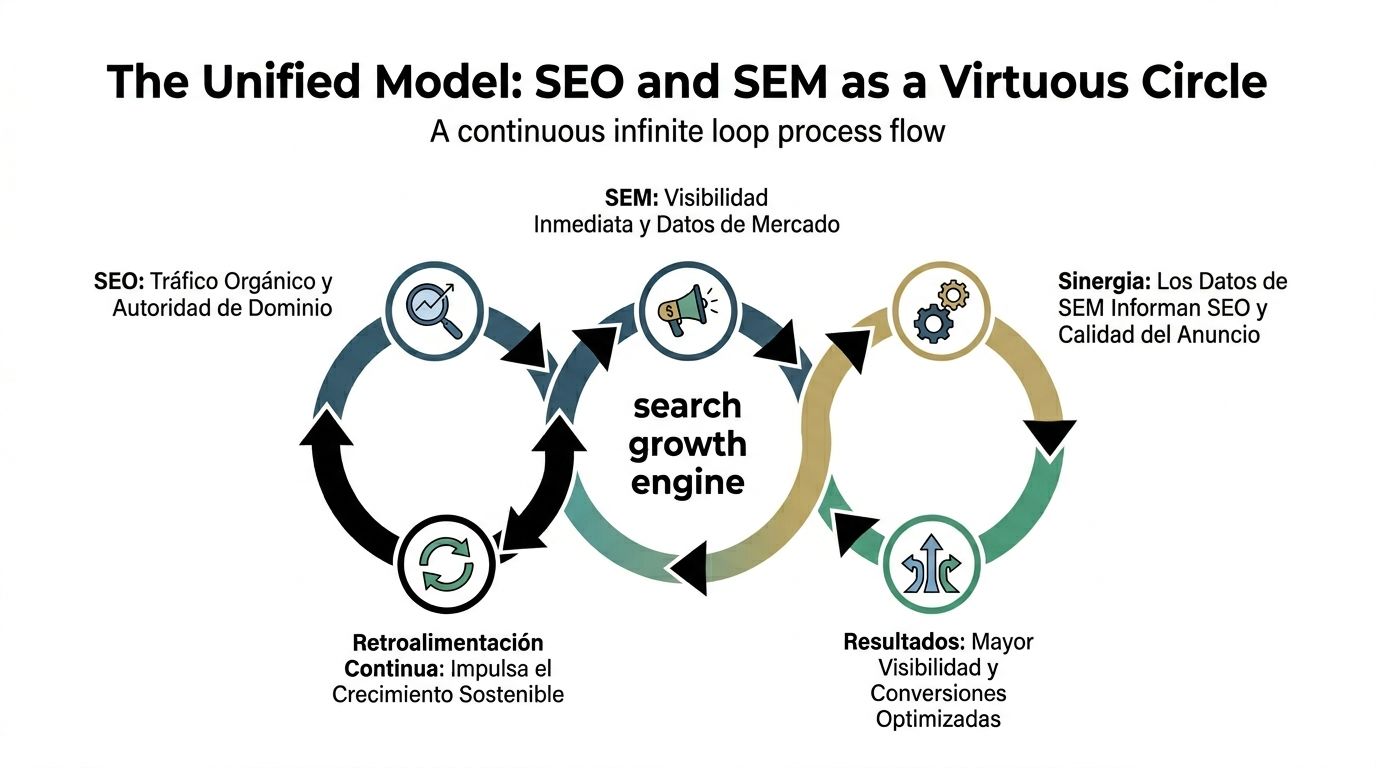
Paid campaigns serve something more important than generating fast sales. They serve to discover market language, real intent, and commercial friction. A term may look attractive in keyword research and move no business. Another may have less apparent volume, yet bring far more decided buyers.
That learning is worth more than the click. Because it lets you decide which topics deserve to become categories, service pages, strategic content, or authority hubs.
In a mature operation, SEM is not limited to “bringing results now.” It works as a market laboratory. If a commercial query proves traction, SEO should turn it into a defensible asset. If an organic landing page proves resonance, SEM can amplify it and capture more demand with less improvisation.
The classic mistake is using Ads as a permanent crutch. That produces fragile growth. Every month starts from zero.
SEO does the opposite. It creates a base of discovery and trust that does not disappear when advertising investment stops. That base does not replace SEM, but it does change its role. It stops being the only acquisition engine and becomes a more precise accelerator.
When that happens, paid campaigns can focus on tasks with better strategic returns:
Most teams organize search by specialty. The best ones organize it by information flow.
A unified system answers questions like these:
If SEO does not learn from SEM, it advances slowly. If SEM does not learn from SEO, it becomes expensive.
It does not look like two agencies reporting separately. It looks like a shared decision-making table. Search Console, Google Ads, GA4, CRM, and executive reporting connected under the same business logic.
In that model, the conversation stops being tactical and becomes financial. Every query, page, or campaign is evaluated by its ability to generate profitable growth today and reduce dependence tomorrow. That is the real heart of well-managed SEO and SEM marketing.
Most search dashboards are designed to justify channels, not to steer the business.
The problem starts when each team shows its own star numbers. SEO presents visibility, rankings, and organic clicks. SEM shows impressions, CPC, conversions, and advertising return. All of that can be useful, but it remains insufficient if it does not answer the question that matters: what is improving the total acquisition economy.
A CEO should not accept a report where each area wins separately while the total margin worsens. The right read requires distinguishing operational indicators from business results.
MetricIsolated View (Channel)Integrated View (Business)Organic trafficSEO success by volumeDemand quality and contribution to the pipelineCPCAd-buying efficiencyReal acquisition cost within the total mixCTRSignal of relevance per pieceA partial indicator of intent and messageRankingsPositioning progressAbility to capture profitable demandLast-click conversionsThe final channel's winAn incomplete read of the customer journeySite qualityA separate technical topicA variable that affects visibility, bounce, and conversion
An integrated read requires uniting acquisition, behavior, and commercial-result data. That includes GA4, CRM, consistent tagging, and event governance. If that foundation is still disorganized, it is worth reviewing a more rigorous approach to measurement with Google Tag Manager and data architecture.
Last click rewards the channel that closes, not the system that built the intent. In search, that frequently penalizes SEO. A user may discover the brand organically, come back days later via a branded search, and convert after an ad. If the company assigns all the value to the final paid click, it ends up underinvesting in the asset that generated the initial trust.
That mistake is expensive. It leads to over-buying high-intent traffic that in many cases was already influenced by prior brand presence, content, or positioning.
There is no need to complicate the dashboard with dozens of indicators. You need to order priorities.
If your report does not connect search with revenue, margin, and opportunity quality, you are not measuring growth. You are measuring activity.
The technical side is not a secondary topic for the web team. It impacts the performance of both fronts. Technical synergy matters because sites with optimized Core Web Vitals can lower the mobile bounce rate by up to 22%, which affects both positioning and the effectiveness of paid traffic, according to this reference on technical SEO and SEM.
That point changes the conversation. Speed, stability, and experience are no longer “site improvements.” They are search profitability variables.
The fixed split of the budget between SEO and SEM is a bad habit. It does not respond to company stage, commercial pressure, brand maturity, or the quality of the digital asset.
The right allocation is dynamic. It changes over time. A company just looking for traction should not invest the same way as an established brand with relevant organic authority. The search budget has to follow a logic of maturity.
If the business is launching a category, entering a new market, or needs to validate demand, SEM should take the lead. Not out of dogma, but because it delivers immediate learning.
In retail eCommerce in Chile, Google Ads campaigns optimized with AI can reduce CPC by 28%, with an average CPC in fashion of CLP 450, and the use of RLSA can increase CTR by 41%, according to this reference on SEO and SEM applied to digital marketing. The strategic point is not the isolated data. It is what it enables you to do: buy learning with greater precision and less waste.
That requires executive discipline. The initial SEM budget is not justified by direct sales alone. It is also justified by the quality of the insights it will deliver to the complete system.
For a broader view of growth models and connected channels, it is worth evaluating approaches to performance-oriented digital marketing.
Once the business better understands which searches attract valuable demand, continuing to put all the weight on Ads is inefficient. In this phase, part of the budget should gradually migrate to organic assets that capitalize on that knowledge.
Here the key questions change:
This shift is not romanticism for SEO. It is a margin decision. The paid channel must continue, but with a more surgical role.
At a stage of greater maturity, SEO becomes a stable base of visibility and discovery. SEM does not disappear. It changes function. It moves to defending critical positions, capturing demand peaks, accelerating commercial campaigns, and competing in zones where the business needs tactical control.
In that phase, the company stops thinking “how much do I spend on SEO and how much on SEM” and starts deciding “where it makes sense to buy, where it makes sense to build, and where it makes sense to do both.”
This video sums up the logic of integration well from a business perspective.
In eCommerce, the system is usually evaluated with a strong focus on commercial return, ticket, repurchase, and profitability per category. In B2B, the conversation shifts toward lead quality, commercial speed, and contribution to the pipeline.
The mistake is applying a single framework to both. Search is not managed the same way when the buyer decides in minutes as when they require multiple interactions and internal validation.
A smart budget does not start with a percentage. It starts with a growth thesis and adjusts according to commercial evidence.
An integrated strategy does not live in a deck. It lives in concrete decisions about what to learn, what to scale, and what to stop funding.
You do not need to get into technical tutorials to understand what separates a profitable system from a disorganized one. The core is using each channel to make the other better.
Search term reports, performance by topic group, and the response per commercial message deliver something many SEO plans do not have at the start: intent validation with business context.
When a company detects queries with signals of purchase, comparison, or urgency, it should no longer treat them as simple keywords. It should turn them into priorities for architecture, content, and positioning.
That changes the editorial conversation. Content stops responding only to search volume and starts responding to economic value.
Many brands do the opposite of what is sensible. They send paid traffic to weak transactional pages while their best organic assets remain isolated.
If a page already captures attention, trust, or relevant interaction, it can work as a strategic entry point for paid campaigns. Not because “it is content,” but because it has already passed a first test of relevance. The system improves when the company stops separating “SEO pages” from “SEM pages” as if they served different universes.
In Chile, this point is no longer optional. 68% of mobile searches are local, and businesses with complete, optimized Google My Business profiles see up to a 35% increase in visits from local SEM campaigns, according to this analysis on how to combine SEO and SEM for local results.
That forces you to leave behind the generic logic of search. If the business operates by region, delivery, coverage, or physical presence, search must reflect that commercial reality.
Profitable search does not scale by publishing scattered pieces or launching disconnected campaigns. It scales when the business organizes its demand into clear clusters: categories, problems, commercial territories, customer segments, and moments in the journey.
That structure delivers several advantages:
GA4, Search Console, Google Ads, Merchant Center, CRM, and visualization tools are not “the marketing team's stack.” They are the foundation for search to work as a business system.
Some companies also bring in external support when they need to organize this ecosystem. One option is to work with teams that connect SEO, AEO, GEO, ads, and performance into a single operating logic. For example, Bigbuda offers that kind of integration as part of its digital growth approach.
The high-impact tactic is not to publish more or bid more. It is to design a circuit where every click, query, and page improves the next decision.
Search is no longer moving toward a scenario where the winner is simply whoever ranks better. It is moving toward one where the winner is whoever occupies more of the decision surface.
That shift has two executive consequences. First, depending only on classic organic traffic is riskier than before. Second, continuing to run SEO and SEM as silos is unsustainable.
With the expansion of AI Overviews in 2025, organic clicks are estimated to drop by up to 28% for eCommerce in markets like Chile, which makes it necessary to combine SEM with AEO, according to this analysis on the difference between SEO and SEM and their use in online marketing. The conclusion is direct: traditional organic visibility is no longer enough. You have to build presence in paid results, in AI-generated answers, and in owned assets with enough authority to be citable.
The old debate about which channel “is better” loses meaning. In an environment with more zero-click searches, more synthesized answers, and more advertising automation, the company needs a coverage system, not a set of isolated tactics.
That means leadership must demand three things:
SEO, SEM, and AI-assisted answer signals must be evaluated together. Not because they are the same, but because they compete for the same business result: useful visibility that ends in business.
Companies that do not build thematic authority, brand consistency, and reusable search assets will depend more and more on paid media to sustain volume. That pressures costs and weakens margin.
The era of AI-powered search requires reviewing messages, formats, content structures, and paid coverage more frequently. Not to “follow trends,” but to defend commercial presence in a much more volatile search interface.
The opportunity is not only to adapt. It is to get ahead.
Companies that integrate their SEO and SEM marketing operation today will arrive better positioned for the next cycle of changes. They will have better data, a more honest read of ROI, less dependence on isolated decisions, and more capacity to move budget with judgment.
Those that keep reporting by channel will continue optimizing fragments while total profitability erodes.
If you want to dig deeper into how organic visibility changes in this new layer of AI-generated answers, this analysis on the future of SEO for AI engines offers a good starting point.
The right decision is not to choose between SEO and SEM. It is to design a unified search system that captures current demand, builds future authority, and withstands the interface shift that is already happening.
If your company is investing in search but still measuring channels instead of growth, it is worth opening a strategic conversation. At Bigbuda we work with companies that need to organize SEO, SEM, data, and conversion into a single system to grow with more control and less waste.
Related reading: Search Engine Marketing and SEO: A Unified Strategy
Related article: The importance of customer loyalty
It pays to learn twice. First it buys clicks to discover demand, then funds content without connecting that learning to validated purchase intent. In practice keywords get duplicated, landing pages cannibalize each other, conversions are misinterpreted and budget is allocated with a partial view of the customer's real journey.
Like a flywheel. SEM accelerates the start, delivering immediate visibility and fast commercial feedback about market language, real intent and friction. SEO takes that learning, turns it into owned assets and reduces future dependence on paid budget. Those assets then improve overall site relevance and strengthen paid traffic performance.
Blended acquisition cost for the whole search system, conversion rate by search intent, commercial value by query group, brand versus non-brand share, and time to conversion. Rankings without revenue context, paid clicks without subsequent quality, total traffic without intent segmentation and unvalidated leads tend to inflate without providing direction.
In three phases. When launching a category or validating demand, SEM leads because it delivers immediate learning. Once commercial evidence exists, part of the budget migrates to organic assets that capitalize on it. At maturity SEO becomes the stable base and SEM defends critical positions, captures demand peaks and accelerates campaigns.
Last click rewards the channel that closes, not the system that built the intent. A user may discover the brand organically, return through a branded search and convert after an ad. Assigning all value to that final click leads companies to over-buy high-intent traffic already influenced by prior content and positioning.
No. With AI Overviews expanding, traditional organic visibility no longer suffices. Companies need presence in paid results, in AI-generated answers and in owned assets authoritative enough to be citable. That requires a single search model, an owned-asset policy and an experimentation discipline that reviews messages and formats more frequently.