










Solutions
Explore how to grow

The most repeated advice about social media advertising is still the least useful for a serious eCommerce: post more, target better and raise the budget when a campaign "is doing well." That logic explains why so many brands buy clicks but do not build growth.
At Bigbuda we are a sales-oriented social media management with a focus on results.
The problem is not only in the ad. It is in the whole system. A company invests in Meta, TikTok or LinkedIn, gets traffic, sees acceptable reach or CTR metrics and still does not achieve a proportional improvement in sales. So it adjusts creatives again, changes audiences, tries another offer and repeats the cycle. That is not a strategy. It is a wheel of diminishing returns.
Social media advertising no longer operates in an empty environment. Since the launch of Facebook Ads in 2007, the channel went from being an early opportunity to a saturated terrain. In Chile, 45% of SMEs already invested in social ads in 2012 and the figure climbed to 80% in 2023, according to Digital Group's historical review of Facebook and Meta Ads. When almost everyone is present, the advantage no longer comes from "being there." It comes from designing a better commercial system.
A CMO or eCommerce manager should not evaluate this channel as a tactical media line. They should see it as a growth architecture with four connected pieces: platform, audience, economic model and post-click experience. If one fails, the rest loses efficiency.
Most brands try to fix a business problem with more distribution. They almost always need better conversion, not more impressions.
That change of approach matters because it redefines where the real leverage is. Not in the boost-post button. Not in chasing likes. Nor in obsessing over slightly finer targeting if the user then lands on a weak experience.
Scaling investment without scaling conversion destroys margin. That is the uncomfortable truth many teams avoid because the advertising dashboard usually looks reasonable while the cash does not improve at the same pace.
Many brands still operate social media advertising as if it were an extension of the content calendar. They boost posts, celebrate interactions and then are surprised when the business does not take off. That approach confuses visibility with performance.
In an eCommerce, every campaign should answer a simple financial question: does this traffic turn into profitable revenue or just into activity? If the team cannot answer it clearly, it is buying exposure, not growth.
There is a structural reason behind this. As more companies compete for the same attention, improvisation stops working. In Chile, the mass adoption of the channel already happened. The space professionalized and mediocre execution is punished faster.
Raising investment can amplify results. It can also amplify inefficiencies. If the offer does not connect, if the audience is poorly built or if the post-click experience does not sustain the intent, the additional budget only accelerates the waste.
It is worth looking at social media advertising as a value chain:
Board rule: if the team reports campaign activity but cannot explain how that activity improves margin, acquisition or repeat purchase, the channel is still being managed as a cost.
What scales is not paid media on its own. What scales is a system that learns. One that uses behavioral signals, clear financial objectives, a disciplined creative structure and a coherent commercial experience between ad, product and checkout.
That is the difference between an ad account that "generates traffic" and a predictable growth engine.
It is not worth being everywhere. It is worth investing where the purchase decision moves. That difference seems obvious, but many brands still distribute budget by trend, not by strategic function.
In Latin America, spending on social media advertising will exceed 5 billion dollars in 2024, with an average CTR of 1.36%, above the global 1%. In addition, Instagram is used by 71% of Chilean companies, and Meta's platforms concentrate a regional potential audience of more than 618 million users, according to Semrush's analysis of digital advertising statistics. The message for leadership is not "Meta is still big." The message is another: where there is scale, there is also more competition for attention and a lower margin for error.
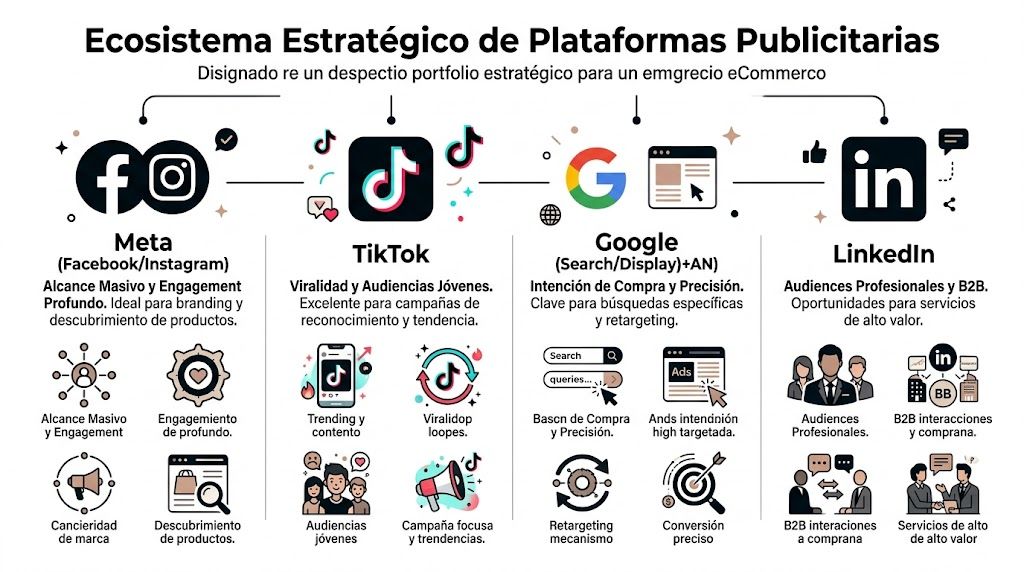
Meta should not be evaluated only as a reach channel. It works well when a brand needs to combine discovery, remarketing and scaling on purchase signals. Instagram, by its visual nature, tends to push better in categories where aesthetics and demonstration matter.
TikTok serves another function. It does not replace Meta. It opens demand, accelerates attention and can introduce products with cultural speed. If the business sells to young segments or depends on impulse, it makes sense as an expansion channel. If the business needs a more rational explanation or a longer consideration cycle, the role changes.
LinkedIn does not compete for the same budget as Instagram. It competes for B2B acquisition budgets, qualified lead generation and the positioning of high-value solutions. For a company with complex selling, that is more relevant than raw volume.
Google is not a social network, but any serious executive committee should read it within the acquisition portfolio. It captures existing intent. Social media creates or accelerates intent. Search collects it.
The right way to think about the mix is by commercial function, not by popularity:
| Platform | Main Strategic Role | Key Audience (Chile) | Ideal For... |
|---|---|---|---|
| Meta (Facebook/Instagram) | Discovery, consideration and remarketing | Broad consumer audiences and companies active on Instagram | B2C eCommerce, catalog, retention and scaling |
| TikTok | Demand generation and cultural attention | Young segments and visual categories | Launches, momentum, products with demonstration potential |
| Google (Search/Display) | Intent capture and demand reinforcement | Users actively searching | Complementing social with existing demand and retargeting |
| B2B acquisition and authority | Professional decision-makers | High-ticket services, qualified leads, account-based marketing |
A platform is not chosen for its formats. It is chosen for the moment of decision it dominates best.
If the team compares platforms only by CTR or CPC, it is looking at a small part of the problem. The right thing is to compare them by session quality, subsequent conversion, value of the acquired customer and ability to scale without eroding profitability.
For brands that depend heavily on Instagram as a commercial channel, it is worth reviewing this approach to how to advertise on Instagram with strategic judgment. The point is not to use more formats. It is to allocate capital where the product's intent and narrative have the highest probability of closing a sale.
Most companies treat targeting as a campaign adjustment. That is shortsighted. The audience is not just a filter. It is a cumulative asset.
A brand that depends on broad interests and basic demographics buys borrowed efficiency. A brand that builds audiences from its own behavior creates an advantage that others cannot easily copy. That is where the true value of the Meta Pixel and the Conversions API comes in.
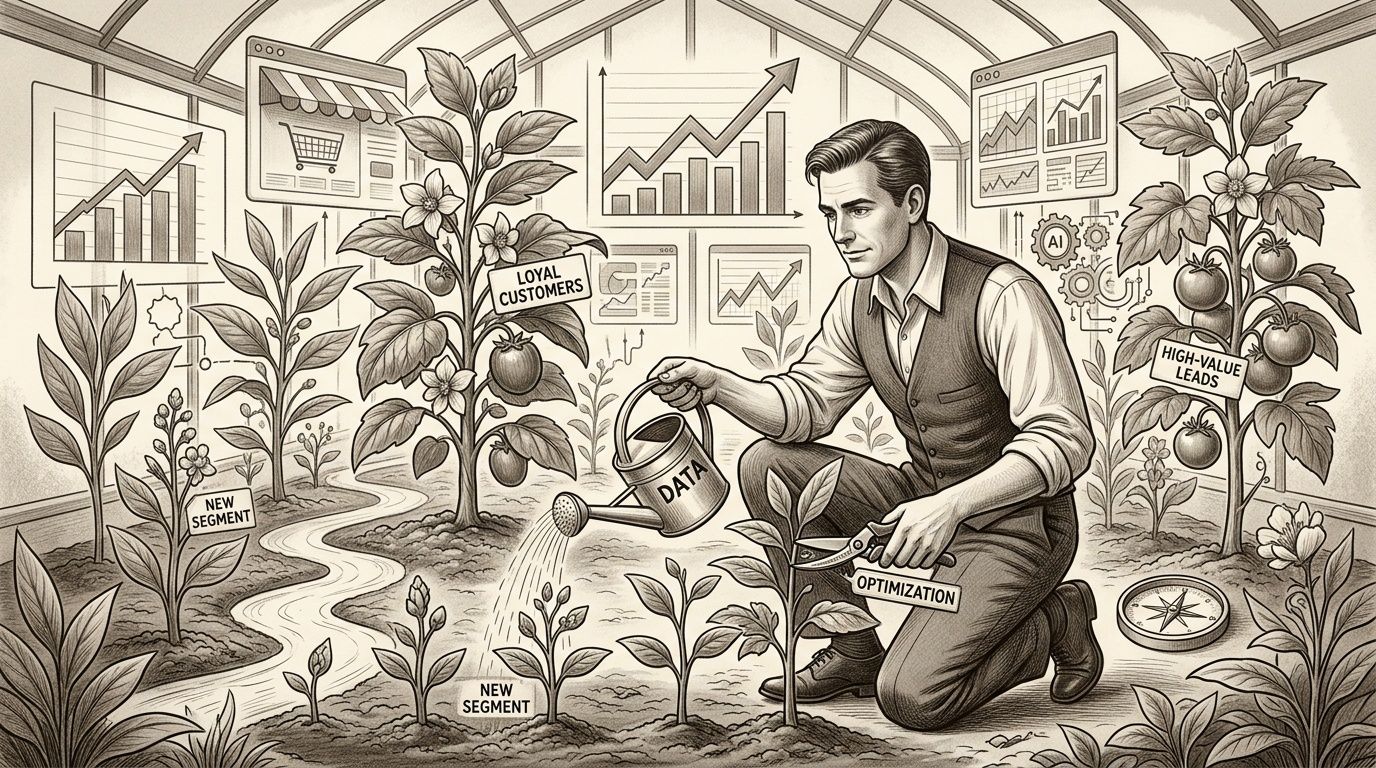
Age, gender and location are still useful. But they are no longer enough to sustain a competitive advantage. What makes the difference is connecting real site behavior with the advertising platform.
According to the analysis on targeting and retargeting with Meta, implementing the Meta Pixel and the Conversions API can raise ROAS from 2.5x to 4.2x in Shopify campaigns in Chile. The same analysis indicates that pixels with more than 10,000 weekly events allow machine learning to predict conversions with 85% accuracy.
That changes the leadership conversation. The ad account stops depending only on marketing assumptions and starts learning from real business signals.
Not all audiences are worth the same. A list of general visitors is better than nothing. But it is not worth the same as a segmentation created from clear commercial intent.
It is worth prioritizing these groups:
When a company improves its source signals, it also improves the quality of the growth it can buy.
Many companies install tools and assume they have already solved the problem. They have not. The Meta Pixel, GA4 and the Conversions API are not an advantage on their own. The advantage appears when the team decides which events matter, cleans up low-quality signals and aligns tracking with its commercial priorities.
An eCommerce on Shopify, WordPress or Webflow should ask itself something elementary: are we teaching the platform who our best customers are or just sending it noise? The quality of that answer defines how much the account can scale without deteriorating efficiency.
The advertising budget should not be defined by intuition or by internal pressure. It should be modeled as a capital allocation decision. If the company does not know how much it can pay to acquire a customer or what return it needs, it is not buying growth. It is gambling.
The right conversation does not start with "how much do we invest this month." It starts with three variables: margin, target CPA and target ROAS. That forces the team to operate with financial reality.
If the board prioritizes market penetration, it can tolerate a lower return in the short term. If it prioritizes profitability, the model changes and paid media must protect efficiency before volume. If it seeks to move inventory or accelerate a category, the allocation becomes a portfolio decision, not a fixed rule.
The key is to separate budgets by function:
| Business objective | Investment logic | Type of evaluation |
|---|---|---|
| Gain volume | Higher tolerance for variation | New customers and speed of learning |
| Defend profitability | Greater discipline on CPA and ROAS | Margin and return by cohort |
| Expand category | Controlled exploratory budget | Demand signals and traffic quality |
Advertising automation does not replace judgment. It amplifies it. If the team feeds the algorithm with confusing objectives, poor signals and weak creatives, AI will scale disorder.
According to the analysis on predictive optimization in social ads for Chile, AI can generate a 35% increase in conversion rates, and campaigns that use Advantage+ and machine learning models reduce CPA by 28%, from CLP 8,000 to 5,700 on average, compared with manual bidding.
That improvement does not turn the platform into autopilot. It turns it into a useful algorithmic partner once the company has already defined economic constraints and quality standards.
You do not need to dive into Ads Manager buttons to make good decisions. You do need to ask better questions and demand better reports.
A healthy budget does not chase only efficiency. It buys useful learning and then turns it into profitability.
Creativity is not an ornament of performance. It is an economic variable. The right message lowers friction, improves click quality and helps the algorithm find better buyers. A mediocre message attracts cheap traffic that does not convert.

Most teams evaluate creativity with criteria that are too subjective. If the board likes it, it is approved. If the video looks premium, it is pushed. That method produces elegant pieces, not necessarily profitable ones.
Social media advertising demands congruence between the message and the customer's level of awareness. You do not speak the same way to someone who has just detected a problem as to someone already comparing alternatives. Nor does the same angle work for an aspirational product and a utilitarian one.
A useful structure to order the creative portfolio is this:
Many teams still confuse engagement with commercial performance. Not every comment is worth it. Not every view brings a sale closer. What is relevant is the engagement that improves brand recall, qualified clicks or intent.
If you want to dig deeper into that difference, it is worth reviewing this take on what engagement is and why it should not be read superficially.
The best ad is not the most internally celebrated. It is the one that attracts the right buyer with a promise that can then be fulfilled on the site.
The other critical discipline is rotation. Creative fatigue is not an operational nuisance. It is a business signal. When a piece loses the ability to capture attention or starts attracting less qualified clicks, the account becomes more expensive even though the audience is still valid.
A mature team does not look for "the winning ad" to exploit it indefinitely. It builds a library of angles, formats and tests with a strategic reading.
An example of the kind of material worth using to align marketing and business is this:
Not as a piece. As a learning system.
Good creative governance includes reviewing messages by segment, the relationship between promise and post-click experience, and criteria for retiring pieces before they erode efficiency. In other words, creativity with portfolio discipline, not with the logic of an isolated campaign.
This is the point most brands underestimate. The campaign can be flawless and still fail. All it takes is sending the traffic to a page that does not sustain the ad's promise.
For an eCommerce, social media advertising does not end at the click. That is where the part that defines whether the spend turns into revenue or evaporates in bounce, friction and abandonment really begins.
According to the data cited by MarketiNet on eCommerce campaigns in Chile, 68% of eCommerce social media campaigns lose up to 45% of conversions due to unoptimized landing pages, and those pages show average bounce rates of 72% on local Shopify sites. If a company already invests constantly in acquisition, that data matters more than any minor tweak in targeting.
It is not just about design. It is about commercial continuity. The user clicks because the ad promises something. If the page does not reflect that promise clearly, conversion drops even when the traffic is correct.
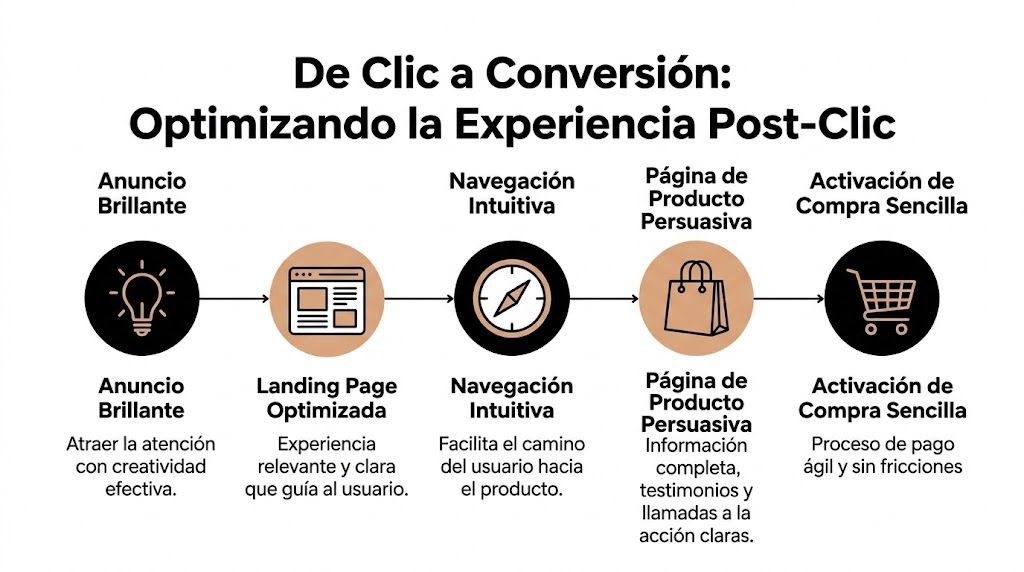
Companies that manage paid media and site as separate worlds tend to pay twice for the same mistake. First they buy the click. Then they lose the sale to a poor experience.
The most common breaking points are known to any manager who reviews sessions with commercial intent:
| Friction point | Effect on business | Strategic decision |
|---|---|---|
| Inconsistent message between ad and page | Immediate loss of trust | Align promise, offer and narrative |
| Unclear value proposition | Less progress toward product or checkout | Prioritize commercial clarity |
| Weak or absent social proof | Drop in purchase intent | Reinforce visible trust |
| Confusing navigation or heavy checkout | Purchase abandonment | Reduce operational friction |
Profitable decision: before raising the budget, check whether the arrival experience justifies the click you are already paying for.
A mature company does not separate paid media from conversion optimization. It integrates them. If the landing page, the product page or the checkout have friction, the solution is not always to redo campaigns. Often the smartest path is to improve the commercial experience that receives the existing traffic.
That applies on Shopify, WordPress and Webflow. It also applies to internal teams and external partners. For example, an agency like Bigbuda works precisely on that connection between paid campaigns, post-click behavior and conversion optimization on eCommerce sites. What matters is not who does it. What matters is that the company stops measuring acquisition disconnected from conversion.
To dig deeper into that logic, it is worth reviewing this guide on landing pages for campaigns focused on converting. The right reading for a leader is not tactical. It is financial: if the company already buys traffic, the arrival experience is one of the most direct assets to improve return without depending on more budget.
Social media metrics tend to create an illusion of control. There are dashboards full of numbers, variations and charts. But they often do not answer the only question that matters: what part of this investment actually moves the business?

Reach, impressions, views and likes can be useful as operational signals. They should not lead an executive conversation. The board needs to see metrics that allow it to decide where to invest more, where to cut and what kind of growth it is buying.
It is worth splitting the dashboard into two levels:
If a team reports only the first group, it is reporting activity. It is not managing investment.
A company that sells across multiple devices and with several touchpoints cannot depend on a simplistic last-click reading. That distorts decisions. Social media often initiates interest, influences consideration and another channel captures the close.
That is why the dashboard should allow, at least, a comparative reading between platforms, campaigns and subsequent behavior on the site. Not to complicate the analysis. To avoid wrong decisions based on incomplete attribution.
An isolated metric rarely answers a business question. A well-built measurement system does.
An executive social media advertising report should be brief, comparative and actionable. Not a platform export.
| Business question | Main KPI | Strategic use |
|---|---|---|
| Which channel acquires best? | CPA and conversion rate by channel | Budget redistribution |
| Which campaigns scale without hurting margin? | ROAS and efficiency evolution | Expansion decisions |
| Which messages bring higher-value buyers? | Average value and post-click quality | Creative prioritization |
| Where is the sale lost? | Drops between click, session and purchase | Coordination between media and site |
What matters is not having more metrics. It is having fewer, but connected to a real decision.
Social media advertising stopped being a cheap experiment years ago. Today it demands portfolio judgment, data governance and a complete commercial reading. The company that keeps treating it as boosting posts or as a succession of separate campaigns will keep buying activity with irregular return.
The change of mindset is more demanding, but also far more profitable. First, you have to stop thinking of platforms as storefronts and start treating them as distinct functions within the acquisition system. Second, targeting must evolve from basic parameters toward audience assets built with real behavior. Third, budget and bidding have to respond to financial objectives, not to operational habit. Fourth, creativity must be managed as a learning discipline. And fifth, the sale must be analyzed where it really happens, in the post-click experience.
That last point separates the brands that scale from those that just rotate campaigns. If a company buys traffic but does not optimize the arrival, the product page and the purchase flow, it will never see the full potential of its investment. The most profitable improvement is not always in getting more clicks. Often it is in better converting the ones it already pays for.
For 2026 and the coming years, the standard will keep rising. Automation and AI will make media buying more efficient, but they will not solve a weak proposition, poor measurement or an incoherent experience. Those remain business decisions.
The roadmap is clear. Audit your data stack. Review the real role of each platform. Order the budget by economic objective. Demand decision-oriented reports. And treat post-click conversion as an integral part of paid media, not as a separate project.
If your company wants to transform social media advertising into a more predictable growth system, Bigbuda can support that process by connecting digital strategy, paid campaigns, web experience and conversion optimization for eCommerce and B2B/B2C businesses in Chile.
Related reading: Digital Marketing Plan: A Guide to Increase Conversions · Digital marketing strategies: A growth guide for 2026 · Maximize Your Growth with Marketing Services
Related article: How to Advertise on Instagram: 2026 Strategic Guide
Because scaling investment without scaling conversion destroys margin. More budget amplifies results, but it also amplifies inefficiencies: if the offer doesn't connect, the audience is poorly built or the post-click experience doesn't sustain intent, the extra spend only accelerates the waste. What scales is a system that learns.
By commercial function, not popularity. Meta covers discovery, consideration and remarketing for B2C eCommerce and catalogue. TikTok generates demand and cultural attention for launches and products with demonstration potential. Google captures existing intent. LinkedIn serves B2B acquisition, high-ticket services and qualified leads. Choose the platform whose decision moment you need.
Not all audiences are worth the same. Prioritize cart abandoners who already showed concrete purchase intent, recurring buyers useful for exclusions and cross-sell, higher-value buyers for modelling profitable acquisition, and frequent visitors who never buy, which help identify friction or a weak proposition. Owned behaviour beats basic demographics.
After the click. The article cites data on Chilean eCommerce where 68% of social campaigns lose up to 45% of conversions because of unoptimized landing pages. The usual breaking points are an inconsistent message between ad and page, an unclear value proposition, weak social proof and a confusing navigation or heavy checkout.
Not by intuition or internal pressure. Start from margin, target CPA and target ROAS, then separate budgets by function: gaining volume tolerates more variation, defending profitability demands discipline on CPA and ROAS, and expanding a category needs a controlled exploratory budget. Keep exploration and exploitation as distinct allocations.
Split the dashboard in two. Operational indicators such as CTR, frequency, cost per intermediate result and engagement serve the team. Leadership needs business indicators: ROAS, CPA, conversion rate by channel, value of the acquired customer and contribution to revenue. Reporting only the first group is reporting activity, not managing investment.