










Solutions
Explore how to grow

Your team has already done much of the work. It invested in content, improved the site, launched campaigns, and started seeing more organic sessions. But sales are not taking off, leads are not improving, and every meeting ends with the same question: do we need more traffic or do we need better decisions?
At Bigbuda we help you with web positioning (SEO).
That is the right question. And that is where hiring SEO experts stops being an operational task and becomes a business decision. If you choose someone who only knows how to move rankings, you will buy activity. If you choose someone who understands intent, profitability, platform, and conversion, you will buy judgment.
Many companies in Chile are at that point. They have an eCommerce on Shopify, a corporate site on WordPress, or a B2B operation on Webflow with acceptable visibility, but without a clear connection between organic positioning and commercial results. The problem is usually not a lack of effort. It is usually the lack of a partner who reads the organic channel as part of the full funnel.
The most expensive mistake in SEO is thinking that the objective is to attract more visits. It is not. The objective is to attract relevant demand and convert it into business.
That completely changes who you should hire. A technical profile can talk for hours about tags, internal linking, and backlinks. A strategic expert, by contrast, will ask you about margin, priority category, lead quality, commercial cycle, and purchase friction. That profile understands that a visit without intent is not worth much, and that the right visit on the right page can change the entire performance of the channel.

The market does not treat SEO as an add-on. It treats it as growth infrastructure. The global SEO market will reach 83.9 billion dollars in 2026, with projections toward 148.86 billion dollars in 2030, according to the projections compiled by Mas Leads Digital. That does not mean every company is doing good SEO. It means the channel is already at the center of digital investment.
For a serious business, that has a simple consequence. Hiring SEO experts does not consist of delegating “Google.” It consists of bringing in a capability that impacts acquisition, brand positioning, and commercial efficiency.
Practical rule: if your provider only talks about visibility and never about revenue, it is optimizing one part of the problem and leaving the entire risk to you.
When the team celebrates increases in traffic without looking at quality, it starts making bad decisions. It approves content that does not sell, scales categories with low profitability, and overvalues reports that explain nothing about the business. The channel grows in appearance, but does not improve the bottom line.
That is why it is worth looking at SEO together with conversion, message, and site architecture. If you want to dig deeper into that integrated view, this guide on on-site SEO and strategic site optimization helps you understand why isolated visibility is rarely enough.
The best SEO experts understand three layers at the same time:
If you are hiring, change the criterion. Do not look for the one who promises more traffic. Look for the one who can explain which traffic is worth winning, which pages should capture it, and how that growth will impact sales or leads.
Many professionals know how to execute SEO. Few know how to direct it as a growth lever. That difference defines whether your investment will generate a compounding improvement or one more cycle of pretty reports.

In Chile, 68% of eCommerce managers report conversion rates below 2.5% despite high traffic, and 75% of searches for “SEO experts Chile” ask about SEO that increases sales, according to the analysis cited by Natzir on the CRO plus SEO gap in the local market. That figure matters because it shows a concrete gap: there is demand for profitable growth, but there is a surplus of profiles focused only on acquisition.
A valuable expert does not avoid the technical. They master it. But they do not stop there.
When you interview candidates, listen to how they frame the problem. If they start by talking about “moving up positions” without asking about categories, average ticket, funnel, or lead quality, you already know how they will work afterward. They will optimize the channel as if it existed in a vacuum.
A strategic profile usually asks questions like these:
Isolated SEO has become insufficient. If your business sells online, you need someone who can talk with content, analytics, development, paid media, and sales. Not because they will execute everything, but because they need to see the full system.
A consultant who does not understand the full funnel ends up optimizing pages that attract visits and distract the business.
That is especially important in eCommerce and B2B. In both cases, the organic channel is not worth raw volume. It is worth its ability to bring in users with better intent and less dependence on paid media.
Do not accept abstract speeches. Ask for evidence of method, of prioritization, and of how they connect SEO with real performance. If you need a framework to compare approaches, review this view of effective web positioning services. It lets you distinguish between an offer based on tasks and an offer based on impact.
CriterionWhat you should hearBusiness understandingTalks about margin, demand, categories, attribution, and profitabilityIntent readingDifferentiates informational, comparative, and transactional searchesPrioritization abilityExplains what they would do first and what they would leave outIntegration with conversionRelates landing pages, message, and friction to organic resultsExecutive clarityTranslates SEO decisions into business language
You do not need to hire the most technical person on the market. You need to hire the person who best turns complexity into the right decisions.
Most interviews for SEO experts fail for a simple reason. The client asks questions that are too general, and the candidate answers with learned theory.
Do not ask “how do you do SEO?”. Ask how they think about real problems. That is where you can tell who knows how to prioritize, who understands platforms, and who only repeats frameworks.
Start with business scenarios, not tasks.
Area of EvaluationKey QuestionBusiness priorityIf you had to choose between improving category traffic or blog traffic, how would you decide what to prioritize and why?Quality over volumeTell me about a situation in which more traffic did not mean better results. What did you fix first?Platform-specific approachHow would your approach change for an eCommerce on Shopify versus a B2B site on Webflow?Relationship with salesWhat signals would you use to know whether the organic channel is bringing real purchase intent?Managing expectationsWhat would you not promise in an SEO proposal and why?
The answer you are looking for is not a perfect recipe. You are looking for a mental structure. A good candidate delimits the problem, explains dependencies, and grounds the conversation in impact.
A modern SEO does not work only with a snapshot of rankings. They work with series, patterns, and accumulated behavior. Modern SEO experts use historical Google position data to group keywords by intent and difficulty, predict how long positioning similar terms will take, and project compound gains, as explained by Keyword.com in its analysis of SEO forecasting with historical data.
With that in mind, ask this way:
If the candidate does not use history, patterns, and context, they will sell you snapshots. And snapshots are good for presenting reports, not for directing investment.
Here you are not looking for creativity. You are looking for discipline.
A serious professional should be able to answer something like this: “There was a traffic opportunity we did not pursue because it had no commercial fit,” or “we would not recommend certain types of links even though they promise to speed up results.” When someone never talks to you about limits, they usually do not have a sense of risk either.
You do not need a closed roadmap. You do need to see how they organize reality. A good answer usually includes diagnosis, prioritization, reasonable quick wins, technical dependencies, and a clear hypothesis of impact.
Before hiring, share the minimum context. Platform, objective, main categories, commercial cycle, and core problem. Then ask: “Where do you see the most friction for SEO to generate business here?”. That answer is worth more than a lecture on ranking factors.
There are signs of superficiality that are very easy to detect:
Hiring well does not consist of validating deep technical knowledge. It consists of validating whether that person can make good decisions in an uncertain environment, with real commercial pressure, and without hiding behind jargon.
The market of SEO experts is full of noise. And the noise often sounds very convincing when a business needs results urgently.

In Chile, only 22% of SEO agencies publish public performance metrics, and searches for “SEO success cases Chile” increased by 40% in the last year, according to the reference compiled by WhitePress on the lack of verifiable benchmarks and transparency. If the market asks for more evidence and most still hide results, you already know where the risk is.
Do not negotiate with these signals. Discard them.
The lack of methodological clarity is not sophistication. It is opacity.
There are providers who fill dashboards with impressions, ranked keywords, and Search Console screenshots. That can be useful as context. Not as the central truth of the project.
What you need to see is the relationship between visibility, business pages, traffic quality, and subsequent performance. If the report does not help you decide budget, focus, or priority, it is decoration.
This video summarizes well why many SEO promises sound better than what they actually sustain over time:
Be wary of anyone who accepts everything. A good partner sets limits. It says no to tactics that compromise the brand, to shortcuts that do not withstand review, and to objectives that have no basis.
That includes rejecting decisions the client wants to hear. For example, chasing high-volume keywords that have no clear commercial intent, or pushing a category without a real ability to convert.
Ask for three things in the same conversation:
If they cannot answer clearly, you are not facing SEO experts. You are facing a sales operation with SEO vocabulary.
The most common mistake after hiring is measuring poorly. If you measure poorly, you reward the wrong work, sustain poor decisions, and cut initiatives that did make sense.
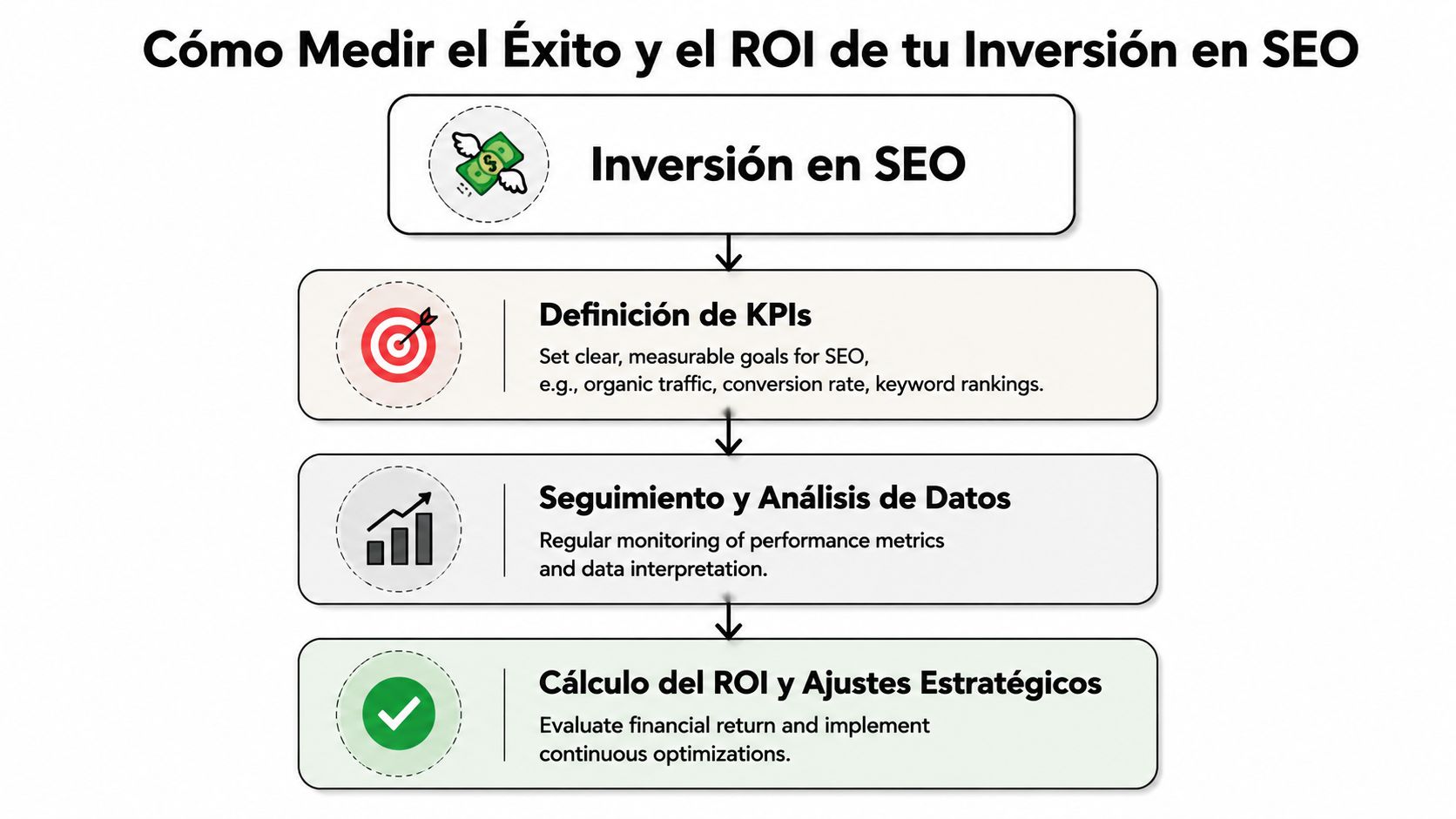
A methodology tested in Chile proposes SMART goals such as +20% in eCommerce revenue in 6 months via top 3 rankings for sector keywords. It also notes that optimized Shopify sites achieve +40% organic traffic in the first year, but that real performance depends on integrating CRO, where conversion can increase by 18% with A/B testing, according to the reference cited by AgenciaSEO on SEO strategy and business metrics. The lesson is clear: traffic and revenue are not the same, and the second indicator rules.
The right metrics depend on the business model, but there is a fixed principle. SEO must report business results, not just organic activity.
Do not ignore rankings, impressions, or clicks. But put them in their place. They are intermediate indicators.
Checkpoint: an improvement in visibility without an improvement in business is not a partial success. It is a hypothesis that has not yet been validated.
Make the monthly or quarterly reporting answer four questions:
QuestionWhat the report should showWhat grewDemand, pages, or intent groups that gained tractionWhat business it generatedRevenue, leads, or progress toward the commercial goalWhat limited the resultTechnical friction, conversion, content, or trackingWhat decision comes nextConcrete priorities for the next cycle
If your measurement is not well set up, the entire project becomes a matter of opinion. That is why it is worth reviewing the site's instrumentation and the quality of the data. A useful foundation for that conversation is in this guide to Google Tag Manager and tracking governance.
You do not need perfect attribution to make good decisions. You do need consistency. If the organic channel starts capturing better sessions, pushes more profitable categories, and converts better, the business will notice. If only visibility charts go up, you are still in the activity phase, not the return phase.
Here an important clarification fits. Not all SEO results arrive at the same pace. Some improvements have a fast impact. Others require maturation. That is why the most valuable indicator is not a loose metric, but a logical chain between priority, execution, captured demand, and commercial result.
And yes, there are providers who understand that way of working. Bigbuda, for example, proposes a combined offering of SEO, AEO, GEO, and conversion-oriented optimization for businesses on Shopify, WordPress, and Webflow. The relevance of that approach is not in the service label, but in the fact that it forces you to measure the channel by impact, not by vanity metrics.
Hiring SEO experts is not delegating an isolated discipline. It is deciding who will influence how your company captures demand, organizes its digital presence, and turns visibility into results.
If you run an eCommerce, a B2B business, or a brand that competes in demanding categories, you do not need a provider that “does SEO.” You need a partner who understands search intent, business architecture, technology platform, and conversion friction. That combination is what separates teams that grow with control from those that only accumulate traffic.
You also need maturity to buy well. That means asking better questions, demanding transparency, distrusting easy promises, and measuring with executive judgment. Rankings matter. Visibility matters. But both lose value if they are not connected with revenue, leads, or profitability.
Today's SEO no longer lives only in the technical realm. It touches brand, content, analytics, product, and digital experience. That is why the best expert is not the one who masters the most terms. It is the one who can read your entire ecosystem and tell you, clearly, what is worth doing first, what risk to avoid, and how you will know whether the investment is working.
That is the view worth adopting. Less obsession with “coming up first.” More focus on capturing better demand, converting it better, and sustaining that growth with a smarter digital structure.
If your company needs to organize that vision and connect SEO with real growth, Bigbuda can be a good starting point to evaluate a more integrated strategy across visibility, site performance, and conversion.
Related article: Your digital marketing advisory to grow in 2026
A technical profile can discuss tags, internal linking and backlinks for hours. A strategic expert asks about margin, priority category, lead quality, commercial cycle and purchase friction. They read three layers at once: real demand versus curiosity, platform context, and the profitability of the click rather than the click itself.
Ask about real scenarios instead of 'how do you do SEO?'. How would they choose between category and blog traffic? When did more traffic not mean better results? How does the approach change for a Shopify store versus a B2B site on Webflow? What would they never promise, and why?
Discard anyone guaranteeing the number one position, selling a 'secret method' they can't explain, arguing that what matters is simply showing up, or promising lots of metrics disconnected from sales. Buzzword language, obsession with volume and identical answers for eCommerce, B2B and media are equally reliable signs of superficiality.
By business results, not organic activity. In eCommerce: revenue attributable to organic, organic conversion rate, performance by category, revenue per SEO landing page and traffic quality by intent. In B2B: qualified leads from organic, form or demo conversion rates, and which pages generate pipeline rather than sessions.
No, but keep them in their place. Rankings, impressions and clicks are intermediate indicators, useful as context rather than as the central truth of a project. An improvement in visibility without an improvement in the business isn't a partial success; it's a hypothesis that hasn't been validated yet.
Four questions. What grew: which demand, pages or intent groups gained traction. What business it generated: revenue, leads or progress toward the commercial goal. What limited the result: technical friction, conversion, content or tracking. And what decision comes next: concrete priorities for the following cycle.