










Solutions
Explore how to grow

Your dashboard shows more sessions, more clicks, and more spend. The problem is that the commercial result is still nearly the same. Flat sales. Low-quality leads. An internal team that works more, reports more, but doesn’t manage to move the needle on the bottom line.
Need help with this? Check out our AI for businesses in Chile.
That scenario is no longer an anomaly. It’s the symptom of a poorly focused strategy. Many companies still treat marketing as a traffic-buying machine, when they should really treat it as a performance system. If every new campaign demands more budget to sustain the same level of sales, you don’t have a volume problem. You have an efficiency problem.
The right conversation is no longer “how do we bring in more visits.” The right conversation is “how do we make the current digital asset produce more margin, more qualified customers, and less waste.” That’s where digital marketing consulting stops being an add-on service and becomes a leadership decision.
A general manager approves a budget for Google Ads, Meta, SEO, a website redesign, and automation. Three months later, the team presents a report that looks healthy. Traffic grew. The campaigns generated clicks. The brand gained visibility. But the board asks a single question: where’s the return?

The problem is almost never a lack of activity. The problem is an excess of activity without an optimization framework. Traffic is bought toward sites that don’t convert, pages are redesigned without a clear business rationale, and results are measured with metrics that look good in a presentation but don’t help anyone decide better.
There are patterns that repeat across eCommerce, B2B, and service companies:
More traffic on a weak foundation doesn’t fix the business. It only amplifies its flaws.
If your team still treats conversion as an automatic consequence of traffic, you’re leaving money on the table. That’s why it’s worth better understanding what CRO is and why it changes site performance. Not as an isolated tactic, but as a discipline for turning digital assets into results.
Serious digital marketing consulting starts there. Not from the promise of “running more campaigns,” but from a harder question: which part of your digital commercial system is holding back profitability.
A traditional agency executes. A strategic consultancy decides what’s worth executing, what should stop, and where the real leverage is.
That difference seems semantic, but it isn’t. An agency can manage campaigns, design pieces, and deliver reports. Strategic digital marketing consulting operates closer to the table where business decisions are made. Its job isn’t to increase activity. Its job is to increase performance.
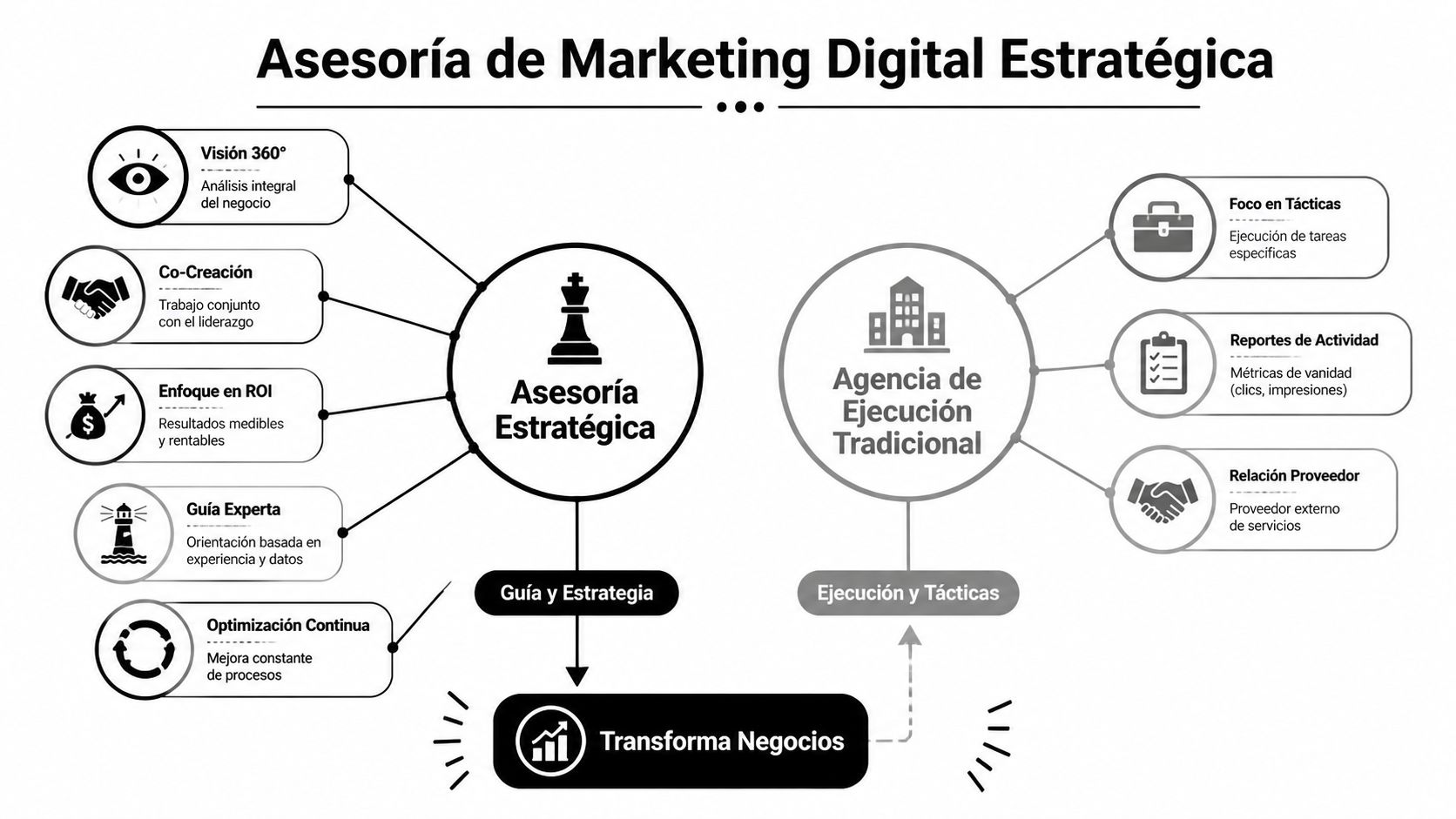
Think of this as the difference between hiring a construction crew and hiring the person who designs the project.
The crew builds what it’s told to build. If the blueprint is wrong, it will quickly build something inefficient. The strategic advisor questions the blueprint before spending. They look at structure, sequence, sunk cost, operational risk, and expected return. In digital marketing, that means reviewing the entire system: acquisition, site, offer, measurement, automation, and conversion.
In a less competitive market, just being present was enough. In Chile, that changed. The digital marketing market reached roughly 1.2 billion dollars in 2023 and grew at a compound annual rate of 18% between 2015 and 2023, driven by internet penetration above 90%. In that environment, CRO and GEO-SEO become critical levers for differentiation, as this analysis on digital marketing statistics in Chile shows.
It’s not about having an opinion on campaigns. It’s about directing the performance of the digital business.
A solid consultancy does at least five things:
Practical rule: if a provider talks a lot about channels and little about the economic model, they’re not advising. They’re selling execution.
For leaders who want to organize that broader vision, this guide on business-oriented digital marketing strategies offers a good framework. The question isn’t which channel to use. The question is which system will let you grow without increasing waste.
Digital marketing stops being chaotic when it’s understood as a system. Not as a collection of loose services. Not as five providers defending their channel. A growth system works when each component improves the performance of the next.
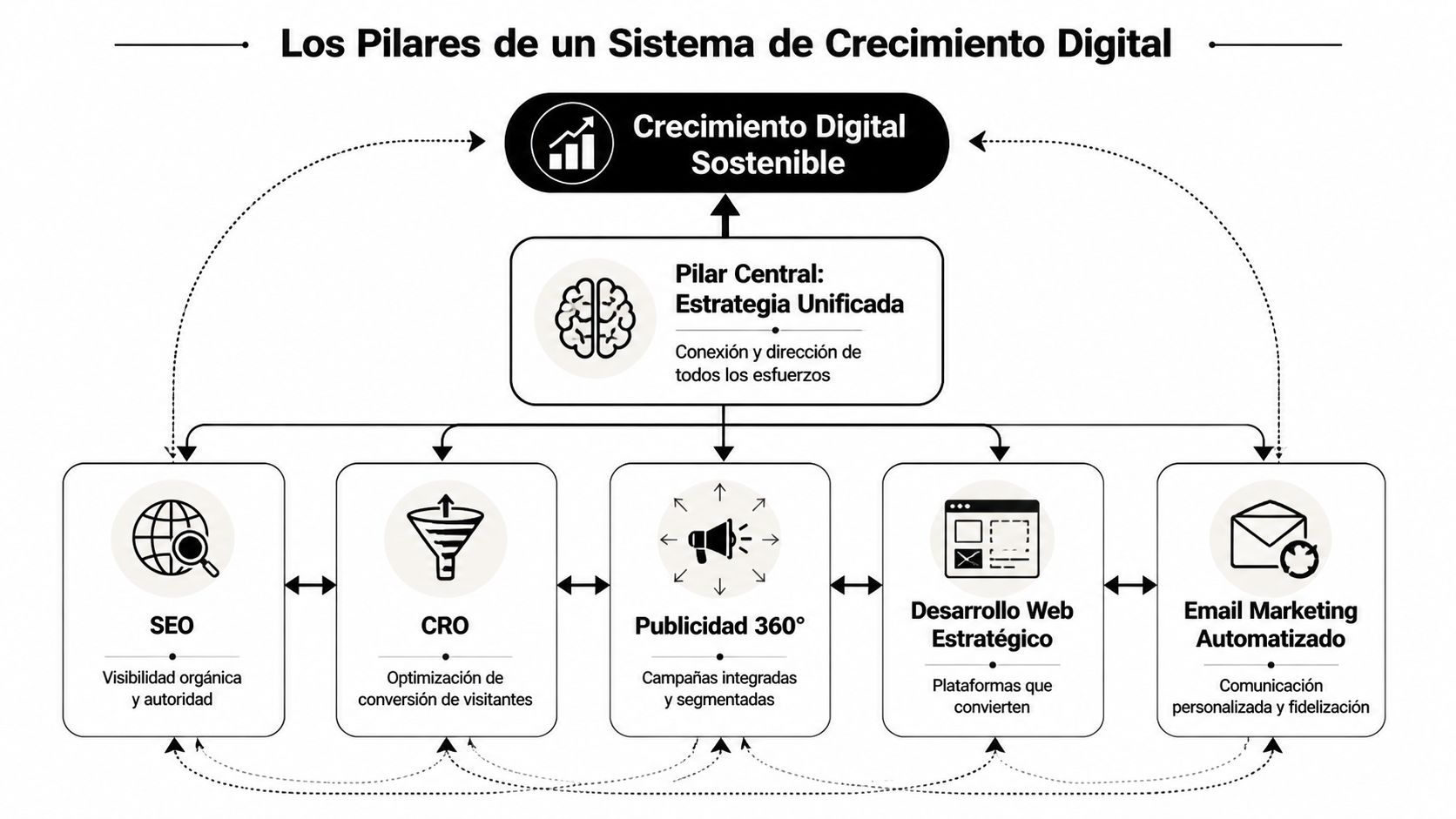
Many teams treat the website as a content repository or an institutional showcase. That approach is costly. Your site is where the return of everything else is realized or destroyed.
If you buy traffic and the site doesn’t convey clarity, trust, and commercial continuity, you’re paying to send users into unnecessary friction. If you invest in SEO and the pages don’t hold intent or convert, the visibility is worth less than it seems. If you automate email but send traffic to weak experiences, you’re only accelerating a leak.
It’s not helpful to see them as separate areas. It’s better to see them as a performance chain.
When one of those pillars fails, the others start compensating with budget for what should be solved with system design.
Many companies do this backwards. First they scale ads. Then they look at conversion. Then they discover the redesign didn’t help. Later they try to fix data tracking. That sequence isn’t just inefficient. It also makes decision-making opaque, because no one knows which variable actually generated the result.
Digital marketing consulting with judgment brings order:
A strong channel on a weak infrastructure creates the illusion of growth. A well-connected system creates defensible growth.
The commercial director stops debating whether “SEO works” or whether “Meta brings bad leads.” That’s a false debate. Channels don’t perform on their own. They perform according to the context that receives them.
Governance also changes. Marketing, sales, and product stop operating as islands. They start sharing a common logic: attract the right demand, convert it better, and increase the value captured per interaction. That’s where a more stable competitive advantage appears, more stable than a single successful campaign.
Not every company needs a consultancy right away. Some are still at a stage where good execution is enough. But there are moments when buying tactics without direction becomes an expensive decision.

The first is simple. Your traffic grows, but the business doesn’t follow. If acquisition improves and the cash flow doesn’t reflect that improvement, the failure is in conversion, value proposition, experience, or measurement.
The second sign appears when each quarter demands more budget to sustain the same result. That indicates deteriorating efficiency. Pushing investment without fixing the foundation only increases dependence.
The third sign is uncomfortable. You did a redesign and nothing important happened. This occurs because many design decisions are made for aesthetics, not for performance. A new site can look better and sell the same or worse.
There are two additional scenarios where consulting stops being optional:
If no one governs the entire system, each provider improves their report and you worsen your return.
It’s worth looking at this conversation from a leadership perspective. The problem isn’t whether the agency “does good work.” The problem is whether there’s a clear growth hypothesis, serious prioritization, and a way to measure economic impact.
A more executive take on this decision is also well summarized in this video:
If you need to produce pieces, activate campaigns, or solve defined tasks, an agency may be enough.
If you need to correct structural inefficiency, organize priorities, reduce investment risk, and build a more stable growth engine, you need digital marketing consulting. Not because your company is more sophisticated, but because your margin for error is already too expensive.
A good marketing report shouldn’t start with clicks, impressions, or reach. It should start with the financial impact of the decisions. If that isn’t clear, your team is measuring activity, not performance.

Not all indicators are useful for making decisions at the CEO or commercial director level. The ones that matter tend to be these:
A well-built executive dashboard in tools like GA4, Looker Studio, HubSpot, or a commercial CRM shouldn’t show only channel data. It should connect investment, site performance, opportunity generation, and closing. If you need to structure that visibility better, this guide on Looker Studio Pro for teams that want to decide with data helps organize the conversation.
Improving conversion has an effect that many underestimate. It doesn’t just generate more sales. It also reduces the relative cost of acquiring each result.
Think of a simple example, without rigid market numbers. If you currently need a certain amount of paid visits to reach your commercial goal, a conversion improvement reduces the amount of traffic needed to reach that same goal. That means less pressure on ad spend, less dependence on more expensive auctions, and more margin to reinvest.
Executive tip: optimization is worth more when it reduces required spend, not just when it increases visible results.
The common mistake is asking each channel to “prove its ROI” separately. That distorts reality. Optimization acts on the entire system. An improvement in site experience can raise the performance of campaigns, SEO, email, and remarketing at the same time.
Use this framework to evaluate return:
| Indicator | Executive question |
|---|---|
| CAC | Are we paying less for each qualified customer or lead? |
| Conversion | Is the site capturing more value with the same traffic? |
| Dependence on paid media | Can we sustain results without inflating ad spend? |
| Speed of decision | Do we know what works quickly enough? |
| Commercial quality | Is sales receiving better opportunities? |
The real return of digital marketing consulting isn’t in producing more reports. It’s in making the system more efficient, more readable, and less vulnerable to impulsive decisions.
Theory is worth little if it doesn’t change decisions. In Chile there are already clear signals of where the opportunity lies when a company stops chasing traffic out of inertia and starts optimizing existing assets.
In Chilean eCommerce there’s a recurring problem: stores with reasonable visit volume, recent redesigns, and commercial performance below expectations. The blind spot is usually in the combination of local intent, site experience, and conversion.
In that context, the most underrated angle is the integration between CRO and GEO-SEO. According to the analysis from Angular Marketing on the Chilean market and this combined approach, Chilean eCommerce tends to operate at low average conversion rates, and many redesigned stores don’t improve their performance because the UX isn’t localized or designed to capture demand more efficiently. The same analysis offers a reading that runs counter to consensus: optimizing existing traffic can produce a higher ROI than continuing to buy new visits.
The implication for a CEO is direct. If your store already generates demand, the best decision isn’t always to increase ad spend. Often it’s better to review friction, local relevance, perceived speed, continuity between ad and page, and commercial architecture. There, digital marketing consulting brings business judgment, not just execution.
When the site doesn’t convert well, every additional dollar on traffic looks more like a penalty than an investment.
In B2B the problem is usually even more expensive, because volume can look acceptable while the generation of qualified opportunities remains below what’s needed. In Chile, B2B companies with more than 10,000 monthly visits often convert below 0.8%. Applying AI to A/B testing and UX personalization can raise that rate to 2.5% and generate savings of up to 30% in ad spend, according to this analysis on CRO with AI in Chilean B2B companies.
This changes the whole discussion. If a B2B company already has traffic, the central problem isn’t visibility. It’s the ability to capture intent with enough commercial precision.
The executive recommendation is clear:
In this type of scenario, providers like HubSpot Solutions Partners, consultancies specialized in B2B growth, or CRO teams working on WordPress and Webflow can help. Bigbuda is one of the firms that works that approach, combining UX, data, continuous experimentation, and AI applied to digital performance.
The principle is the same in both cases. First you fix the system. Then you scale.
Most companies evaluate their providers poorly. They ask about price, general experience, or which platforms they manage. That’s not enough. A tactical provider can answer those questions well and still be incapable of improving the business.
When you evaluate digital marketing consulting, use questions that force them to show method, economic thinking, and the ability to prioritize.
| Question for the Provider | Weak Answer (Tactical Focus) | Strong Answer (Strategic Focus) |
|---|---|---|
| How do you detect where the biggest growth opportunity is? | “We review campaigns and propose quick improvements.” | “We audit acquisition, conversion, offer, data, and friction points to prioritize where the commercial impact is greatest.” |
| What do you do when traffic grows but sales don’t? | “We adjust ads and publish more content.” | “We validate traffic quality, message coherence, site experience, and closing capacity before scaling investment.” |
| How do you connect UX with business results? | “We design so the site looks more modern.” | “We relate experience changes to lead quality, conversion, CAC, and commercial speed.” |
| What is your experimentation methodology? | “We try a few ideas and see what happens.” | “We work with hypotheses, prioritization, baseline measurement, and impact analysis to scale useful learnings.” |
| What do you report to the executive team? | “Impressions, clicks, reach, and tasks completed.” | “System efficiency, bottlenecks, impact on conversion, dependence on ad spend, and recommended decisions.” |
| How do you manage the risk of investing in the wrong thing? | “We start with several actions to move fast.” | “We sequence by impact and reduce uncertainty before committing budget at scale.” |
A solid answer usually includes three elements:
If the provider talks to you almost exclusively about channels, pieces, posts, campaigns, or volume, they’re still in execution mode. If they talk about leverage, sequence, risk, learning, and return, they’re already on another level.
The right provider doesn’t start by asking how much you want to invest. They start by asking where value is being lost today.
Be wary of three signals:
The best evaluation doesn’t look for the most enthusiastic provider. It looks for the most disciplined one. The one who can tell you what they wouldn’t do, what they’d fix first, and why.
Serious digital growth isn’t bought by accumulating channels. It’s built by fixing the system you already have. That’s the difference between companies that chase results and companies that make them repeatable.
If your organization keeps responding to every problem with more ad spend, more content, or more tasks, you’re operating on tactical reflexes. That can work for a while. Then comes budget fatigue, CAC pressure, and the feeling that you’re working a lot to advance little.
The way out isn’t to do more of the same with better reports. It’s to improve the productivity of the entire digital asset. That requires direction, prioritization judgment, measurement discipline, and the ability to learn faster than the competition.
Well-focused digital marketing consulting fulfills exactly that function. It refocuses the conversation from vanity metrics toward business decisions. It changes the question from “how much traffic can we buy” to “how much value can we extract from the traffic we already have.” And, above all, it reduces the risk of continuing to invest in a system that isn’t ready to scale.
In 2026, growing won’t depend only on visibility. It will depend on efficiency, adaptation, and executive clarity. The companies that understand this will defend their margin better and scale with less waste.
If you want to review your digital growth with a business lens, Bigbuda can help you detect where value is being lost and which decisions have the most impact on conversion, efficiency, and scalability.
Related article: Influencer Agency: Hiring and ROI Guide for 2026
A traditional agency executes. A strategic consultancy decides what is worth executing, what should stop and where the real leverage is. It operates closer to the table where business decisions are made, and its job is not to increase activity but to increase performance.
At least five things. It diagnoses the whole system instead of channels in isolation. It prioritizes by economic impact. It reduces the risk of scaling traffic toward a site that already loses conversions. It orders the growth sequence, efficiency before scale. And it creates a learning discipline.
When traffic grows but the business does not follow, when each quarter demands more budget to sustain the same result, when a redesign changed nothing important, when the digital operation is too fragile to scale, or when several providers each optimize their part and nobody is accountable for the total result.
CAC, how much it costs to acquire a real customer. LTV, the economic value that customer leaves over time. Conversion rate, read as a multiplier of efficiency. ROAS, useful only when interpreted together with margin and customer quality. And speed of learning, how quickly a failed hypothesis gets corrected.
Because a conversion improvement reduces the amount of traffic needed to reach the same commercial goal. That means less pressure on ad spend, less dependence on more expensive auctions and more margin to reinvest. Optimization is worth more when it reduces required spend, not only when it increases visible results.
Ask questions that force them to show method and economic thinking. How they detect the biggest growth opportunity. What they do when traffic grows but sales do not. How they connect UX with business results. What their experimentation methodology is. And how they manage the risk of investing in the wrong thing.