










Solutions
Explore how to grow

The most repeated recommendation in digital marketing is still wrong: open more channels, publish more content, and increase investment as an automatic reflex of ambition. That isn’t strategy. It’s activity.
At Bigbuda we’re a digital agency in Chile focused on CRO with a results-driven focus.
A board doesn’t need more activity. It needs a system that turns budget into measurable growth. If your company already invests in media, content, automation, or performance, the right question isn’t “what tactic is missing,” but which part of the commercial engine is holding back the return. In 2026, the best digital marketing strategies won’t be the loudest. They’ll be the most integrated, the ones that connect acquisition, conversion, retention, and continuous learning.
The real opportunity is to stop treating marketing as a collection of campaigns and start managing it as an operational asset. That changes everything: where budget is allocated, how performance is measured, what technology is adopted, and which initiatives are prioritized first.
The most expensive mistake in digital marketing isn’t under-investing. It’s continuing to inject budget into a system that doesn’t decide well. In Chile, digital investment has stopped being an early bet and has become part of companies’ habitual spending, as the advertising-investment analyses from IAB Chile show. The competitive difference is no longer in “being in digital.” It’s in how capital is allocated across acquisition, conversion, retention, and technology to produce real return.
That change requires a board discussion, not a tactical conversation between channels. If the company buys traffic, publishes content, automates emails, and still doesn’t improve margin, share, or commercial speed, the problem is in the investment logic. Bigbuda sees this frequently in diagnostic processes: companies with an active digital presence, but without a clear thesis about where the business grows and what friction is holding back that growth.
The symptom is often confused with the cause. SEO, ad spend, or the content team gets blamed, when the failure is in system coordination. A serious digital strategy orders priorities before opening new initiatives. It also protects the return of the assets the company already paid for. Traffic, database, organic positioning, automations, landing pages, and commercial data.
More budget on a poorly prioritized structure only accelerates the waste.
The right question for a CEO is different: what constraint is limiting growth today? Sometimes demand is lacking. Many times there’s excess demand and a lack of conversion. In other cases, the acquisition cost is acceptable, but the sales cycle destroys efficiency or retention doesn’t sustain the margin. Without that reading, the company ends up financing activity instead of building advantage.
The leap from tactics to strategy forces you to set three executive decisions:
This criterion changes the investment sequence. A company with enough traffic doesn’t gain more by buying additional visits. It gains more if it improves CRO, shortens funnel friction, better integrates marketing and sales, or uses automation and AI to increase commercial productivity. That’s usually where the most profitable growth is.
That’s why a digital marketing plan oriented toward business decisions must work as a capital-allocation instrument, not as a list of campaigns. That’s the point at which marketing stops being a debatable cost center and starts operating as a lever for ROI, market share, and competitive advantage.
A strategy useful for leadership doesn’t look like a campaign calendar. It looks more like a system of decisions. If that system is well designed, every dollar invested in acquisition strengthens conversion, every conversion improvement increases the return of existing traffic, and every advance in retention improves total profitability.
The right framework has five connected pieces. They don’t operate as silos. They operate as a value chain.
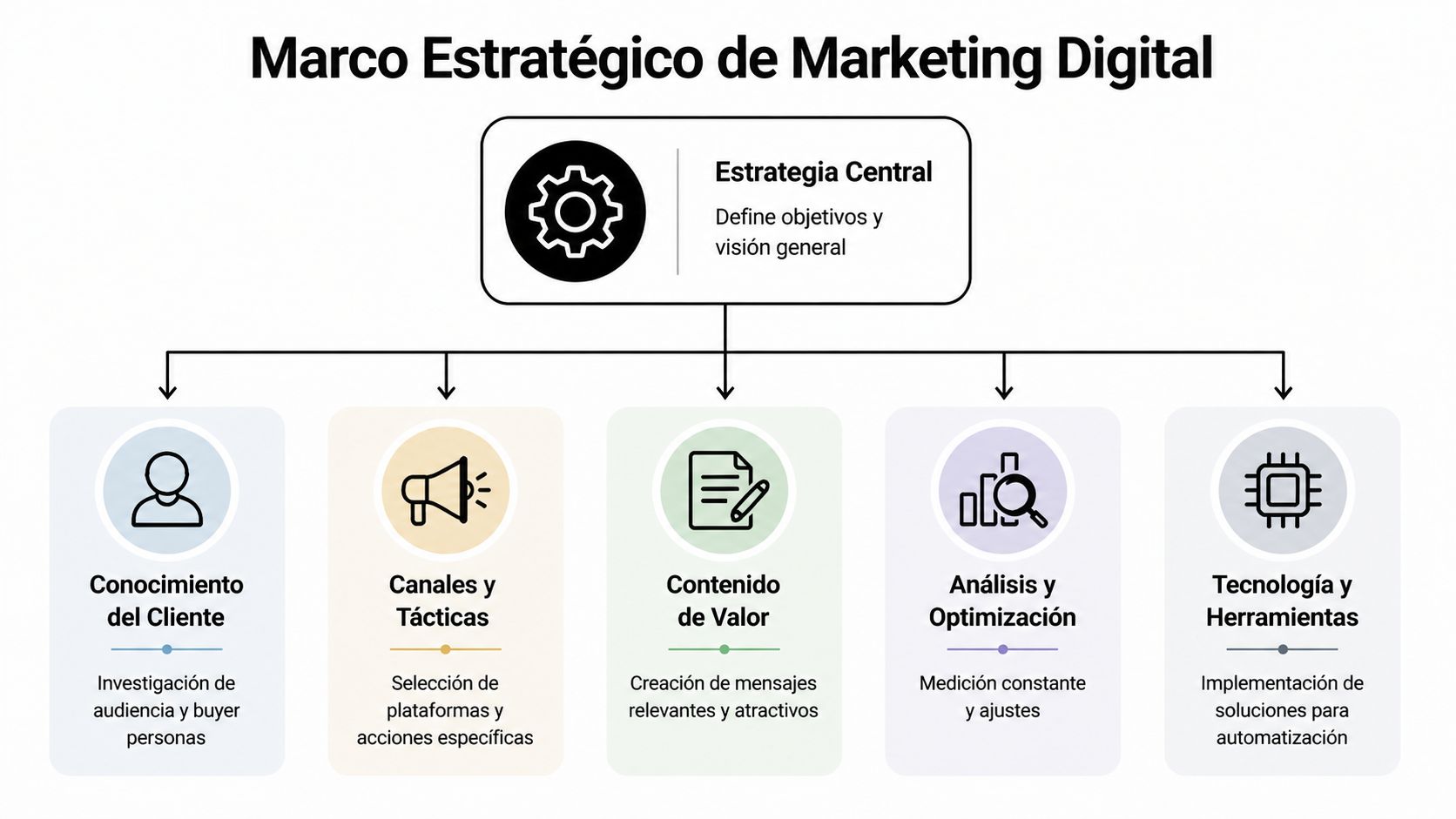
Every discussion about digital marketing strategies should start with a single question: what has to happen in the business to consider that marketing is working? If the answer is vague, everything else will be too.
The core strategy sets four decisions:
If this isn’t agreed on, the teams optimize in different directions. Paid Media chases volume. SEO chases visibility. CRM chases opens. Sales chases an immediate close. The result is misalignment.
The second piece isn’t “buyer persona” as a cosmetic exercise. It’s an operational understanding of the buyer. What objections block the decision. What signals show real intent. What content accelerates trust. What frictions delay the close.
Practical rule: if your team knows the channels better than the customer, the strategy is still immature.
This is where many companies fail. They invest in attracting audiences without having defined what commercial problem they solve better than the competition and why someone should choose them now. Without clarity in the value proposition, not even the best media mix fixes profitability.
Attraction isn’t worth much if the traffic lands on a weak experience. Interaction isn’t worth much if it doesn’t prepare a decision. Conversion isn’t worth much if retention then falls. The framework must be read as a circuit.
A simple way to govern it is this:
| Stage | Leadership question | Risk if it fails | Key decision |
|---|---|---|---|
| Attraction | Are we reaching the right demand? | Irrelevant traffic | Choose channels by intent, not by trend |
| Interaction | Does the proposition generate attention and trust? | Bounce, abandonment, low useful engagement | Adjust message, content, and sequence |
| Conversion | Can the user decide without friction? | Weak leads or lost sales | Prioritize experience, offer, and clarity |
| Loyalty | Does the relationship extend in value? | Excessive dependence on acquisition | Activate CRM, repeat purchase, and post-sale content |
Most organizations overfund the first row and underinvest in the other three. That’s where margin is destroyed.
Technology isn’t a decoration. It’s the layer that allows you to automate, attribute, and learn. CRM, analytics, heatmaps, testing, dashboards, and personalization tools don’t serve on their own. They serve when they help make better investment decisions.
That’s also why it’s worth reviewing a broader approach to a business-oriented digital marketing plan. The value isn’t in having more tools. It’s in having a framework that gives them purpose.
If a company wants to grow with control, it needs to operate this system with discipline. Not as a sum of areas. As a single engine.
The question “which channels should we be on” is almost always poorly framed. The useful question is different: which channels drive our business model with the least possible friction.
An eCommerce doesn’t evaluate channels the same way as a B2B company with long cycles. A brand with existing demand shouldn’t invest the same way as a company that needs to educate the market. The right channel depends on the combination of intent, timeframe, and internal capacity.
Use three filters before approving investment:
A popular channel isn’t necessarily a strategic channel. Popularity and profitability are rarely synonyms.
The mistake of many management teams is to spread budget “to be present.” That produces superficial coverage. It’s better to dominate fewer fronts with a clear thesis than to open too many with scattered execution.
| Digital Channel | Main Objective | Ideal for Model | Speed of Impact | Scalability Potential |
|---|---|---|---|---|
| SEO | Capture demand with intent | eCommerce, B2B, services with active search | Medium | High |
| Paid Media | Generate demand and capture existing intent | eCommerce, lead generation, launches | High | High, if conversion follows |
| Email marketing | Retain, nurture, and increase value per customer | eCommerce, B2B, businesses with an active database | Medium | High |
| Social media | Build attention, consideration, and community | Brands with a visual component or recurring affinity | Variable | Medium |
| Expert content | Educate, differentiate, and support complex sales | B2B, consultative services, technical categories | Medium to low | High and cumulative |
The right reading of this matrix isn’t tactical. It’s financial. SEO and content usually build compound assets. Paid Media accelerates. Email captures value from the installed base. Social media strengthens visibility and consideration, but shouldn’t always lead the budget.
If your company faces one of these scenarios, the priority changes:
For those comparing the role of SEO and SEM within a single growth strategy, the decision shouldn’t be one or the other. It should be based on the balance between immediate capture and the building of medium-term advantage.
The right priority doesn’t come from the channel. It comes from the business’s economic bottleneck.
More budget on ad spend doesn’t fix an eCommerce that converts poorly. It only buys inefficiency at a larger scale.
If your store already receives enough traffic to detect patterns, the next investment should focus on improving the performance of the asset you already paid for. That decision changes the management logic. The focus stops being “bring more visits” and becomes “extract more revenue per session, per user, and per channel.” A good part of the margin is decided there.

In practice, CRO, load speed, and mobile experience usually produce a faster impact on revenue than an immediate media expansion. The reason is simple. When conversion improves, so does the return of SEM, email, remarketing, and organic traffic. The same volume starts to perform more.
Many committees still evaluate eCommerce with a single question: how much more to invest to sell more. That view ignores the critical point. Profitable growth depends on how much value the site captures before demanding new budget.
When CAC rises and advertising efficiency falls, the problem is rarely solved just with more investment. It’s solved by correcting frictions that erode revenue every day.
The levers with the greatest economic effect tend to concentrate in three areas:
The most underrated asset in eCommerce is the ability to better convert the traffic already gained. That’s the difference between an operation that buys sales and one that builds competitive advantage.
The priority isn’t to redesign for aesthetics or add tools because they’re trendy. The priority is to install an experimentation discipline with clear economic impact. Every test must answer a business question: how to raise conversion rate, average ticket, recurrence, or margin per order.
A profitable eCommerce optimizes before scaling.
AI is starting to change this discipline because it accelerates analysis and prioritization. It lets you detect abandonment patterns, segment behaviors, and define which hypothesis is worth testing first. Its value isn’t in automating on its own. Its value is in reducing the time between detecting a loss and correcting it.
A serious eCommerce operator can combine GA4, Hotjar, VWO, Shopify Analytics, or CRM automation to decide where to intervene first. They can also lean on specialized teams. Bigbuda, for example, addresses this front from a logic of conversion, speed, and continuous experimentation on platforms like Shopify, WordPress, and Webflow, directing investment toward the best performance of existing traffic.
The right conversation doesn’t start with channels. It starts with bottlenecks.
These are the questions a CEO or board should put on the table:
If no one can answer with evidence, the company isn’t managing growth. It’s reacting to the month’s results.
The eCommerce that will win in 2026 won’t be the one that spends the most. It will be the one that integrates acquisition, conversion, analytics, and AI into a single decision framework to extract more value from its current assets and better defend its margin.
In B2B, the problem isn’t getting forms. The problem is generating commercial conversations that have a real probability of closing. That’s why a modern lead strategy can’t depend on a single tactic or on isolated volume metrics.
Companies that sell complex services, technical solutions, or higher-ticket contracts need a coordinated combination of content, intent positioning, and targeted paid. It’s not enough to “be on LinkedIn” or publish articles. You have to build a path of trust.

The most sensible model in B2B usually has three layers:
Each one depends on the other. Content without distribution doesn’t reach. Traffic without a proposition doesn’t convert. A lead without nurturing doesn’t mature.
For companies that sell in specific geographic markets, the integration between local positioning and paid media stops being tactical and becomes financial. According to the analysis on marketing trends from ESADE, integrating GEO-SEO with SEM campaigns on Google Ads can generate 40% more qualified leads for B2B businesses in Santiago, where 55% of mobile searches include local terms.
That data matters because it shows something deeper. When the strategy reflects geographic context, intent, and commercial relevance, the channels stop competing with each other. They start reinforcing each other. Local search improves perceived quality, reduces dispersion, and makes it more likely that sales receives opportunities close to the target market.
In B2B, precision is worth more than volume. An irrelevant lead only takes up commercial time.
Don’t ask for more leads before reviewing these questions:
If marketing and sales don’t share these answers, the funnel fills up, but the pipeline doesn’t improve.
Mature B2B lead generation is no longer measured only by cost per registration. It’s measured by contribution to the business. The ability to open the right accounts. The speed to move prospects toward a serious conversation. The quality of the context with which sales enters that conversation.
Digital marketing strategies for B2B should look less like a form factory and more like an architecture of trust. When that happens, every digital interaction better prepares the commercial work and protects the pipeline’s profitability.
A full dashboard doesn’t equal a well-managed company. If the team reports impressions, clicks, followers, and opens, but can’t explain impact on revenue, margin, or customer quality, the measurement is still decorative.
Leadership doesn’t need more metrics. It needs fewer metrics, better connected. The function of analysis isn’t to describe activity. It’s to help decide where to invest more, where to cut, and what to correct before scaling.

There’s a clear difference between observing marketing and governing it. Observing marketing is looking at reach. Governing it is connecting that reach with pipeline, sales, margin, and retention.
The executive dashboard should answer, at minimum, these dimensions:
| Dimension | Useful question for leadership |
|---|---|
| Acquisition | Which channels bring demand with the best intent? |
| Conversion | Where are we losing value within the site or funnel? |
| Profitability | Which investment sustains an acceptable return? |
| Retention | What part of growth depends on repeat purchases or expansion? |
| Learning | What hypotheses did we test and what decision did we make from the result? |
Without this structure, marketing ends up optimizing noise.
The media conversation usually stays in CTR, CPM, or CPC. That’s insufficient. The business happens after the click. And if the subsequent experience fails, the budget is already lost.
According to the analysis on digital performance and speed published by Comunicare, in Chile sites with load times above 3 seconds experience a 32% higher bounce rate on mobile audiences, directly affecting post-click conversions in SEM campaigns and ROAS.
That data should be enough to change a common practice: evaluating campaigns without evaluating experience. An ad can be well targeted and a message can be correct. If the site loads slowly or creates friction, the investment erodes where it’s most expensive to recover.
Optimizing doesn’t mean “adjusting things.” It means installing a culture of testing and learning. The most solid organizations don’t bet everything on an internal opinion. They formulate hypotheses, test, measure, and scale what works.
Executive criterion: don’t fund digital changes that don’t have an impact hypothesis or a validation mechanism.
That applies to landing pages, messages, navigation paths, forms, campaigns, and retention sequences. CRO practice comes in here as a business discipline, not just a UX one. If you need a deeper conceptual reference on that approach, it’s worth reviewing what CRO really implies within a digital strategy.
Don’t ask for a longer report. Ask for better answers:
Mature digital marketing strategies are distinguished by this. They don’t report a lot. They learn fast. And they turn that learning into a cumulative advantage.
You don’t need to redo all your marketing tomorrow. You need to organize the right conversation inside the company. If these questions don’t have a clear answer, the problem isn’t tactical. It’s a management problem.
If most of these answers are ambiguous, you don’t need to add more tactics. You need to redesign the prioritization logic.
This checklist isn’t meant to evaluate creativity. It’s meant to evaluate operational maturity.
Digital marketing has stopped being an experimental front. Today it’s growth infrastructure. Treating it as a list of disconnected tactics is an expensive decision, because it scatters budget, fragments data, and reduces the capacity to learn.
The digital marketing strategies that really build advantage aren’t the ones that multiply channels. They’re the ones that connect acquisition, conversion, retention, and measurement under a single economic thesis. That’s where maturity appears. When every action responds to a business priority, every channel plays a clear role, and every improvement is validated with data.
Artificial intelligence, automation, and analytics platforms will keep gaining ground. But technology alone solves nothing. What solves things is a leadership able to prioritize well, measure with judgment, and optimize with discipline. That combination creates something far more valuable than a successful campaign. It creates a predictable system for growing.
In 2026, the advantage won’t be in doing more marketing. It will be in better managing the performance of the entire digital ecosystem. That change of focus will separate companies that simply invest from those that truly capitalize on their investment.
If your company needs to move from isolated campaigns to a more profitable digital system, Bigbuda can be a useful partner to organize priorities, strengthen conversion, and connect marketing with measurable business results.
Related article: Digital Marketing Plan: A Guide to Increase Conversions
It is not under-investing. It is continuing to inject budget into a system that does not decide well. More budget on a poorly prioritized structure only accelerates the waste. The competitive difference is no longer being in digital, but how capital is allocated across acquisition, conversion, retention, and technology.
Three: define the economic result marketing must move, whether revenue, margin, market share, pipeline, or retention; identify the main constraint of the commercial system, such as traffic quality, conversion rate, acquisition cost, closing speed, or repeat purchase; and allocate budget according to expected marginal impact on existing assets.
Apply three filters before approving investment: alignment with the commercial model, time to impact, and real scalability. A popular channel is not necessarily a strategic one. It is better to dominate fewer fronts with a clear thesis than to open too many with scattered execution.
Not more reach. Review conversion and experience first. In ecommerce, CRO, load speed, and mobile experience usually produce a faster impact on revenue than expanding media, because when conversion improves so does the return of SEM, email, remarketing, and organic traffic. A profitable ecommerce optimizes before scaling.
It needs three connected layers: authority, through content that translates expertise into trust; intent capture, with SEO and SEM oriented to concrete problems; and nurturing and closing, through remarketing, email, and commercial follow-up. Content without distribution does not reach, traffic without a proposition does not convert, and a lead without nurturing does not mature.
Not a longer report, but better answers. Which channel contributes revenue and not just traffic? Which part of the funnel is limiting total return? Which recent experiment changed a budget decision? Which investment would we stop making if we looked only at contribution to the business?