










Solutions
Explore how to grow

Investing more and selling the same usually looks like a channel problem. In practice, it almost never is. The problem is usually in the plan.
If you want to go deeper, check out our best digital marketing agencies in Chile.
Many companies reach that point with a familiar feeling. The team launched campaigns, uploaded content, improved frequency on social media, activated email, opened new ad groups, and even redesigned the site. Traffic goes up, reports fill with activity, but the cash flow does not change at the expected pace. Then rushed decisions appear: raise the budget, switch agencies, pause channels that were actually contributing, or chase metrics that look good in a presentation but do not improve the business.
A serious digital marketing plan should not function as a list of actions. It should function as a growth system. That changes the whole conversation. It is no longer about "doing marketing," but about deciding where to put resources, which levers have a real impact on revenue, and which frictions are preventing the same traffic from producing more results.
In Chile, that discussion stopped being optional a while ago. Since 2010, digital advertising spending in Chile has grown exponentially, reaching 250 million dollars in 2022. With internet penetration above 90% and 65% of digital traffic being mobile, companies that do not adapt their digital marketing plans to prioritize the mobile experience and conversion are losing a significant share of the market (economía3 on the evolution of digital marketing).
That data matters for a simple reason. If the market is already investing heavily and the user is already buying, comparing, and evaluating from digital, a generic plan penalizes you twice. It makes you lose budget and also strategic time.
A weak plan does not fail for lack of activity. It fails because it does not connect investment, user intent, and conversion into a single logic.
The difference between a decorative plan and a useful one lies in the starting point. The first organizes channels. The second organizes business decisions. The first distributes budget. The second defines what must happen for the business to grow profitably.
There is a very common version of the digital marketing plan that looks organized and still destroys value. It has broad objectives, mixes awareness with performance without hierarchy, distributes budget out of habit, and measures success with indicators that do not explain revenue. On paper it looks complete. In results, it leaks everywhere.
When a company defines its digital year based on reach, impressions, followers, or raw session volume, it makes decisions with partial signals. Those signals can serve as context. They are not enough to direct investment on their own.
The effect appears quickly:
A marketing director notices it when every committee ends in the same question: "if we are doing so much, why don't we see that impact on sales or qualified leads."
A traditional digital marketing plan usually answers which actions to execute. A growth plan answers something more uncomfortable and more useful: which barriers prevent better conversion of the traffic that already exists, and which sequence of decisions has the highest return.
That difference matters especially in companies on Shopify, Webflow, or WordPress, because commercial performance does not depend only on the channel that brings the visit. It depends on the entire system: message, speed, architecture, credibility, capture, follow-up, and learning ability.
Practical rule: if your plan does not help you decide what to stop, what to redesign, and what to scale, it is not a plan. It is a task list.
The local environment is mature enough to demand a higher standard. More digital investment, more competition, and more mobile behavior mean less room to experiment without method. The opportunity is large, but "being in digital" is no longer enough.
The teams that grow healthily are not necessarily the ones that open the most channels. They are the ones that understand how their customer moves, detect the points where value is lost, and prioritize a clear sequence of improvements. That includes marketing, but also the offer, the experience, and measurement.
A good digital marketing plan does not start with paid media. It starts with diagnosis.
Most plans are born too late. They start when someone asks for campaigns, budget, or a quarterly goal. They should start earlier, when the business is still asking hard questions about where it is losing margin, what kind of customer it wants to attract, and which part of the commercial system is not supporting growth.
A strategic audit is not a collection of Analytics screenshots. It is useful when it lets leadership answer three things: which assets it has, how aligned they are with the commercial goal, and where the bottlenecks are.
In that review, it is worth looking at four layers at once:
The poorly built buyer persona stops at age, job title, and district. The useful one digs into the real job the customer is trying to get done.
For an eCommerce, that means distinguishing between someone who compares prices, someone who wants speed, someone who needs trust before paying, and someone who responds to a clear value proposition. For a B2B business, it means separating the user who researches, the buyer who compares vendors, and the decision-maker who needs to justify the investment within their organization.
That exercise changes everything because it organizes messages, expectations, and channels. It also avoids a frequent mistake: speaking to everyone the same way and then blaming the channel for low conversion.
SMART objectives remain useful for a concrete reason. They force you to translate intent into operational commitment. According to HubSpot data for Latin America, companies that document their SMART objectives are 42% more likely to succeed in their digital campaigns, achieving measurable results in 90 days compared to the 6 months it takes those with vague goals. A documented plan can lead to 40% online sales growth in the first year (HubSpot's guide to creating a digital marketing plan).
The point is not to use the acronym. It is to formulate objectives that force you to choose.
A weak goal says "improve digital presence."
A useful goal says "prioritize profitable growth in the line with the best margin, improving conversion and demand quality next quarter."
When the plan moves into operation, clarity matters more than inspiration. That is why it is worth connecting the plan's objectives with an execution framework. If the team already works with cross-cutting goals, this approach fits well with an OKR structure applied to business and marketing.
A practical way to validate whether an objective is well stated is to review it with this filter:
Control questionWhat it revealsIs it tied to revenue, profitability, or commercial quality?If not, it can turn into activity without impactDoes it have a deadline and an owner?If not, no one really prioritizes itDoes it force a choice of focus?If it tries to cover everything, it dilutes resourcesDoes it allow deciding what not to do?If it discards nothing, it does not bring order
Leadership criterion: a good objective does not only define what you want to achieve. It also defines where you will not spend energy.
There are three mistakes that appear again and again.
A well-built digital marketing plan does not start with campaigns. It starts with a diagnosis that forces you to look at business, demand, and conversion as a single conversation.
Channels do not compete with each other. Poorly designed plans compete against the customer's real journeys.
When a company treats SEO, paid media, email, and content as isolated pieces, it ends up overacting the channel that can be measured fastest. That usually pushes budget toward immediate acquisition, while the mechanisms that convert, retain, or recover demand are neglected.
Designing a conversion-oriented channel ecosystem means deciding what each one does within the full journey. Not all of them must sell immediately. But all of them must justify their place within the system.
In Chile, that demands a well-integrated multichannel logic. Email marketing can generate an average ROI of 42:1, and with 14 million monthly active users on social media, paid campaigns on these platforms account for 40% of local digital spending (history of digital marketing and regional context). The lesson is not "you have to be everywhere." It is that the combination matters more than isolated presence.
It is not advisable to start by asking "which channel should we activate." It is better to start by asking "how does this audience buy and what friction does it have before deciding."
In an online store, the relationship between channels is usually more direct. Paid social can generate discovery and demand. SEO can capture stable intent, especially in categories and collections. Email can absorb abandonment, repurchase, and retention.
The common mistake is to put all the pressure on paid ads. That works for a while. Then the cost of acquisition rises, the catalog competes against similar offers, and the business becomes too dependent on buying traffic.
A healthier architecture distributes functions:
In consultative-sale businesses, the journey is less linear. The person who arrives from search is not always ready to talk with sales. They may be understanding the problem, comparing approaches, or seeking internal validation.
There the ecosystem changes. Content and SEO usually fulfill a function of authority and capture. LinkedIn Ads or segmented paid media can accelerate reaching relevant accounts. Automation helps avoid losing interest between the first contact and the commercial conversation.
The strategic point is this: in B2B, a channel rarely closes on its own. What converts is the sequence.
A misaligned channel system usually shows clear symptoms:
SignalWhat it usually indicatesHigh session volume with low intentBroad targeting or an imprecise propositionAbundant but weak leadsEasy form, generic message, or poorly calibrated promiseGood ad performance, poor commercial closeLanding, offer, or follow-up do not keep upStrong dependence on a single channelOperational risk and low growth resilience
If a channel seems to "not work," first check whether it is fulfilling the right role within the journey. Often the problem is not the channel. It is the expectation.
Some teams overdiversify too early. They want SEO, Meta Ads, Google Ads, email, automations, video, influencer marketing, remarketing, editorial content, and partnerships, all at the same time. The result is usually dispersion.
A strong ecosystem is built in layers. First, demand capture is secured. Then conversion. Then retention. Only then is it worth scaling sophistication.
To organize that conversation, it helps to distinguish between capture channels, maturation channels, and closing channels. It also helps to review the strategic difference between SEO and SEM within the growth mix, because many companies discuss them as substitutes when in reality they fulfill different functions.
After defining functions, it is worth aligning the team with a visual view of the flow between channels and conversion.
When there is pressure for results, prioritization improves if it is done with three simple filters:
There is no universal mix. There is an ecosystem that fits the type of purchase, the platform, and the company's maturity. A conversion-oriented digital marketing plan designs that ecosystem from the start, not after results disappoint.
A strategy without a calendar becomes a wish. A budget without logic becomes a habit. The roadmap exists to avoid both.
The most expensive mistake at this stage is turning the plan into a horizontal list of tasks. When everything starts at once, nothing gets enough attention. Businesses that advance with more consistency tend to operate in short waves, with concrete priorities and visible owners.
A quarter is a horizon short enough to demand focus and long enough to generate learning. It lets you organize sequence, not just volume of work.
A useful 90-day roadmap usually includes three blocks:
That order seems basic, but it changes the quality of execution. Many companies try to optimize before properly defining their promise or their success criteria.
When a company says "this year we will put so much into social and so much into search," it has already made a decision without answering the important question: what part of the investment should capture demand, what part should help convert it, and what part should protect its value after the first purchase or contact.
Thinking about the budget by function forces a more mature conversation. For example:
Budget functionWhat it coversAcquisitionDemand generation and intent captureConsiderationContent, trust assets, nurturingConversionSite improvements, messages, forms, testsRetentionEmail, CRM, repurchase, loyalty
This approach avoids one of the most common problems: spending almost everything on acquisition and leaving without resources the points where profitability is really won or lost.
There are two types of spending that tend to be undervalued in plans: work on the platform and the optimization layer. Because they do not always produce an immediate volume chart, some companies postpone them. They later end up paying that cost in lower media performance and a worse buying experience.
For sites on WordPress, Webflow, or Shopify, that means the budget decision should not separate marketing and platform as if they were different worlds. If the site does not keep up, campaign spending loses efficiency.
A smart budget does not try to win only more traffic. It tries to improve the return of each visit, each lead, and each commercial opportunity.
Before closing a roadmap, it is worth having leadership and marketing put five agreements in writing:
That last point is key. A mature digital marketing plan does not treat the budget as something fixed. It treats it as an investment hypothesis.
Most plans fail for one uncomfortable reason. They behave as if the work ended when execution begins.
In reality, the launch is just the moment when you can finally learn. If the team does not enter measurement, adjustment, and testing mode, the plan stays frozen in assumptions. And assumptions, sooner or later, collide with the market.
An excess of data can do as much harm as its absence. When the team monitors too many numbers, it ends up reacting to noise. What matters is to define a short set of KPIs that connect behavior, conversion, and business.
That becomes even more important in the local market because there is a real gap of measurement frameworks contextualized for Chile. Many companies have general planning structures, but no clear criterion for deciding which indicators deserve attention according to their business model.
The evidence available in Chile points in a clear direction. Chilean companies that implement continuous experimentation in their plans achieve an average ROAS of 5.2x, versus 2.8x for those that do not. In addition, a load time over 3 seconds can reduce sales by 40%, and CRO together with technical optimization can increase the conversion rate by up to 28% (document on the phases of the digital marketing plan and benchmarks).
That data does not say every company should run a hundred tests. It says something more useful: sustained improvement does not come from guessing better, but from learning faster.
The logic is similar on any platform. The most relevant friction points change.
The question is usually commercial. Which part of the product, cart, or checkout experience is holding back the decision. Sometimes the problem is in the clarity of the offer. Other times in trust signals, perceived costs, or information hierarchy.
The quality of the initial message usually matters a lot. On B2B or services sites, small changes in value proposition, hero structure, social proof, or calls to action can change lead quality more than volume.
The challenge usually mixes content, performance, and capture. Forms, key pages, contact paths, and site speed can affect both brand perception and the real ability to convert interest into opportunity.
Field observation: the first useful experiment is rarely the most creative. It is usually the one that fixes an obvious friction no one had prioritized.
AI does not replace strategic judgment. It amplifies it when the team already knows what question it is trying to answer.
It can help detect patterns, group behaviors, accelerate hypotheses, personalize messages, and reduce operational time in analysis. What it does not do on its own is define what is worth optimizing. That remains a business decision.
Many conflicts among management, marketing, and sales appear because each area looks at different indicators. This comparison helps separate activity from real growth.
Business ModelVanity Metric (to avoid)Growth KPI (to prioritize)DTC eCommerceTotal sessionsConversion rate by channeleCommerce with repurchaseNew followersRevenue per customer and retentionB2B servicesForms submittedQualified leads and commercial advance rateBrand in expansionRaw reachShare of traffic with intent and contribution to pipelineBusiness investing in adsIsolated CTRROAS and conversion quality
For teams formalizing this approach, it is worth reviewing how CRO works as a growth discipline, because it lets you organize optimization as a system and not as a set of scattered adjustments.
You do not need to create a grandiose experimental culture. You need something simpler and harder: sustaining a rhythm.
A reasonable cadence includes:
The digital marketing plan stops being a static document when the company accepts this idea: each quarter you do not "execute the plan." You put a growth model to the test.
Lengthy plans usually convey seriousness. They do not always convey clarity. In many organizations, the longer the document, the less likely it is to guide real decisions.
That is why it is worth closing the strategic work in a one-page version. Not to oversimplify, but to force focus. If a leadership team cannot summarize its digital bet on one page, it probably does not yet have it clear enough.
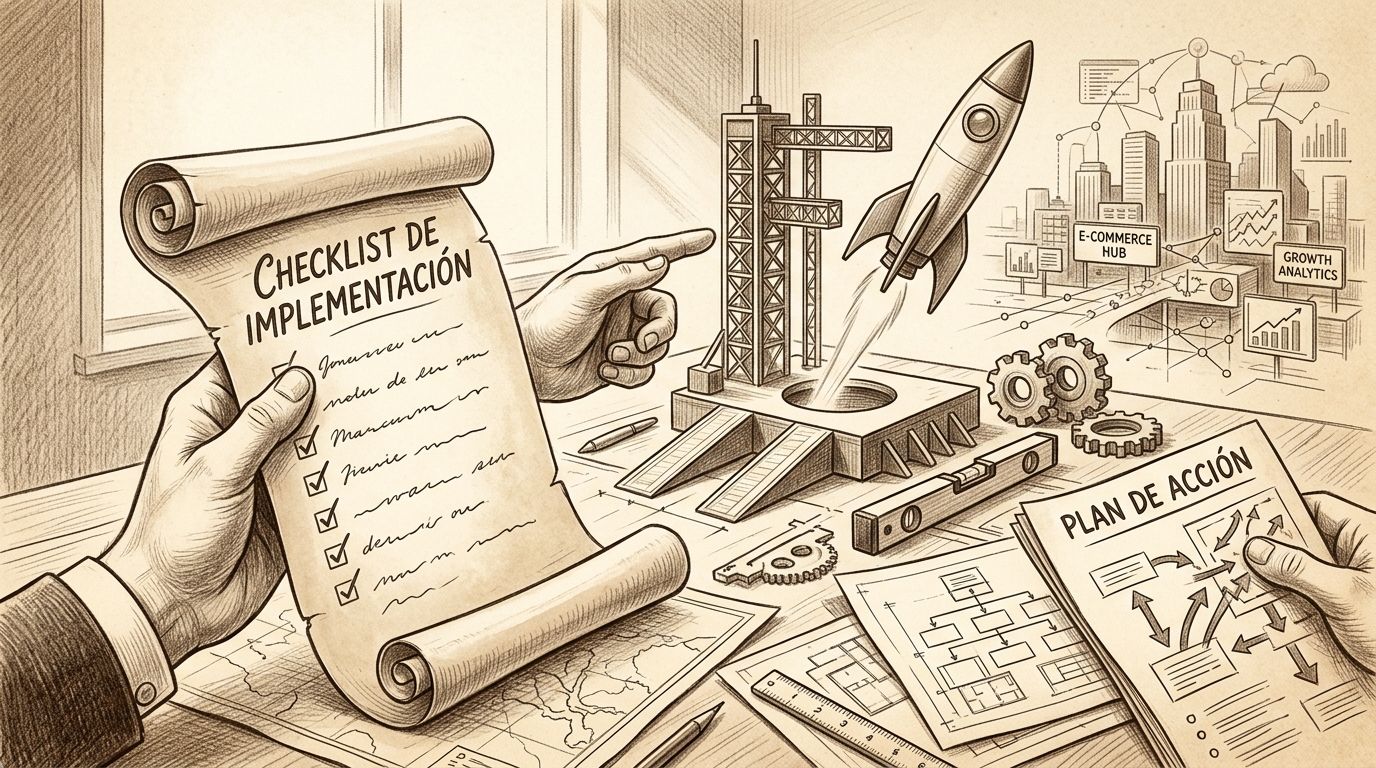
Use it as a quick review before moving budget or demanding results from the team.
A useful template does not need to fill space. It needs to answer the essentials:
BlockQuestion it must answerObjectiveWhat business result you want to moveAudienceWhich customer is prioritized and what they need to solvePropositionWhat message or promise should be clearestChannelsWhat role each one playsPrioritiesWhich initiatives go firstMeasurementWhich KPIs will decide continuity or change
A compact plan forces better thinking. It also leaves less room to hide blurry decisions behind elegant language.
There are moments when the internal team can lead this without a problem. There are also scenarios where it is worth adding an outside view, especially when there is traffic, investment, and commercial pressure, but no clarity about why conversion is not keeping up.
In that kind of context, an agency focused on data, platform, and experimentation can function as an additional strategic layer. Bigbuda works precisely at that intersection of marketing, digital experience, and measurable growth, especially in Shopify, Webflow, and WordPress environments.
The point is not to delegate judgment. It is to accelerate the quality of decisions.
If your company already invests in digital but still does not convert at the level it should, Bigbuda can help you organize the plan, prioritize better, and turn traffic into results with a growth logic, not improvisation.
Related article: What growth marketing is and how it is applied.
A weak plan does not fail for lack of activity. It fails because it does not connect investment, user intent, and conversion into a single logic. Plans built on reach, impressions, followers, or raw sessions direct budget with partial signals, producing more traffic, more campaigns, and less clarity.
A traditional plan answers which actions to execute. A growth plan answers which barriers prevent better conversion of the traffic that already exists, and which sequence of decisions has the highest return. A practical rule: if your plan does not help you decide what to stop, redesign, and scale, it is a task list.
Four layers at once: business and offer, including margin and ticket priorities; channels and acquisition, evaluated by intent rather than volume; digital assets such as site, landing pages, forms, automations, CRM, and content; and internal capacity, because a strategy that exceeds the team's ability to sustain it is born overestimated.
Not by channel, but by function. Decide what share should capture demand, what share should help convert it, and what share should protect its value afterwards: acquisition, consideration, conversion, and retention. This avoids spending almost everything on acquisition and leaving the points where profitability is won without resources.
Ninety days works well: short enough to demand focus, long enough to generate learning. A useful quarterly roadmap includes three blocks: diagnosis and definition to establish a baseline, prioritized deployment of the initiatives most likely to move the business, and review and reallocation to decide what to scale, correct, or stop.
It depends on the model. A DTC ecommerce should watch conversion rate by channel instead of total sessions; a store with repurchase, revenue per customer and retention instead of new followers; B2B services, qualified leads and commercial advance rate instead of forms submitted; a business investing in ads, ROAS and conversion quality.