










Solutions
Explore how to grow

OKRs, or Objectives and Key Results, are much more than a trendy acronym. Think of them as your business's GPS: a system designed to help companies stop coasting on inertia and start moving forward with a clear, measurable purpose.
If you'd like to go deeper, check out our digital marketing service.
Unlike annual goals that tend to gather dust in a document, OKRs connect long-term vision with concrete, tangible quarterly actions. Their value lies not in being a new way to measure, but in being a strategic framework for making better growth decisions.
In a digital market this fast-paced, operating without a clear system of objectives is like sailing without a map or a compass. Many companies fall into the trap of "execution for execution's sake," where teams are incredibly busy but no one knows for certain whether all that effort is making a real impact on business results.
This is where the OKR methodology marks a turning point. It isn't just another to-do list, but a framework that forces the organization to answer two brutally simple yet very powerful questions:
This combination is what makes the system work. The Objective gives you the inspiring "what," and the Key Results give you the measurable "how," ensuring that every effort is tied directly to a business result.
The real power of OKRs lies not in the software you use to track them, but in the cultural shift they bring about. They drive a culture of transparency and focus, where every person in the company, from the CEO to the specialist, knows what the priorities are and how their work contributes to them.
This naturally breaks down the silos that hurt organizations so much. Suddenly, the marketing, product, and sales teams not only work together but pursue the same measurable results.
For example, a marketing team might have the typical goal of "publishing 20 blog articles a month." That's an activity metric, not an impact one. With OKRs, the focus changes completely:
Objective: Become the undisputed go-to source in our niche.
Key Results:
The difference is stark. The first approach only celebrates that the team "was busy." The second celebrates a real impact on the business. By adopting OKRs, you stop applauding effort and start celebrating results. It's a shift similar to measuring Net Promoter Score; as we explain in our article on what NPS means, the focus is placed on a result that reflects real value for the customer, not on internal metrics.
For an OKR to work, you have to understand that it isn't two separate parts, but a formula with two ingredients that need each other. On one hand, we have ambition; on the other, evidence. Separating them is the fastest way for the strategy to remain just a document.
The Objective (O) is your statement of intent. It's that inspiring, qualitative goal that gives the whole team a clear direction. Think of the Objective as a news headline: it should be memorable, ambitious, and tell you where you're going, without getting into the details of how to get there. It's the destination, not the map.
Then come the Key Results (KR). If the Objective is the destination, the Key Results are the road signs that confirm you're on the right track. They're purely quantitative and measurable. They aren't tasks, but the milestones that, once reached, irrefutably prove you met your Objective.
This relationship isn't accidental; it's a hierarchy that descends from the most abstract to the most concrete. Everything is born from the company's vision, which inspires the Objectives. In turn, each Objective comes to life through its Key Results.
An Objective without Key Results is just a nice wish. A Key Result without a clear Objective is simply a metric floating in the air, with no purpose at all.
This diagram makes it very clear: strategy flows from vision to measurable action.
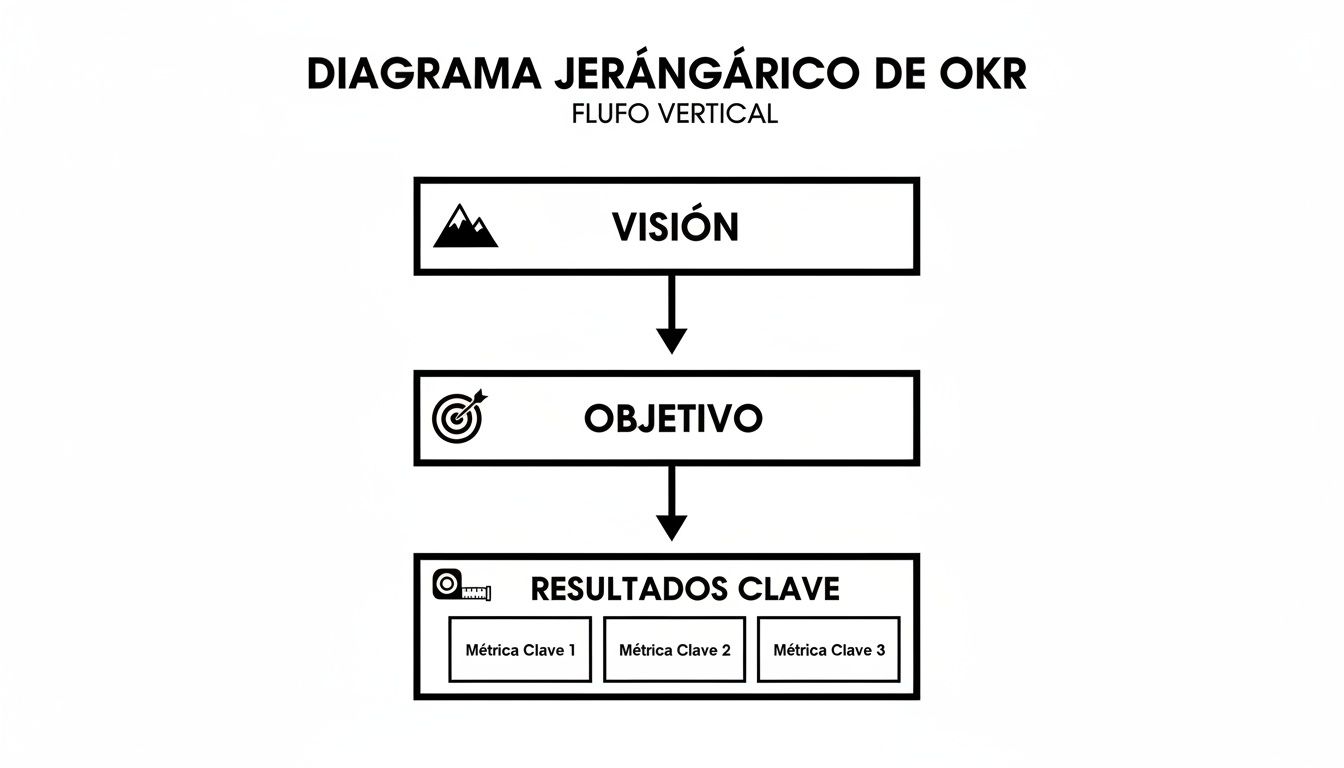
As you can see, each level brings a different kind of clarity. The vision is the long-term north star. The objective translates it into a motivating goal for the quarter. And the key results ground it in tangible evidence that leaves no room for debate.
A classic mistake is confusing Key Results with a to-do list. A KR isn't "launch three new social media campaigns." That's a task. A well-crafted KR would be "increase qualified leads from social media by 25%." The first measures effort; the second, impact.
For an OKR to truly move the needle, its two parts must be perfectly aligned and obsessed with generating value, not with completing tasks.
This duality is precisely what makes OKRs so powerful. They force you and your team to stop thinking about "being busy" and start concentrating on the indicators that truly reflect a positive change in the business.
In the world of eCommerce and conversion optimization (CRO), it's all too easy to fall into the "activity" trap. Teams drown in an endless list of tasks: change a button's colour, tweak some copy, launch a new image. The problem is that these actions, on their own, often lack a strategic north star, and their real impact on the business gets lost or, worse still, isn't even measured.
This is exactly where OKRs change the rules of the game. This system forces teams to set aside the "doing for the sake of doing" mindset and focus exclusively on the results that matter. The question is no longer "which tasks did we complete?" but "what tangible impact did we generate?"
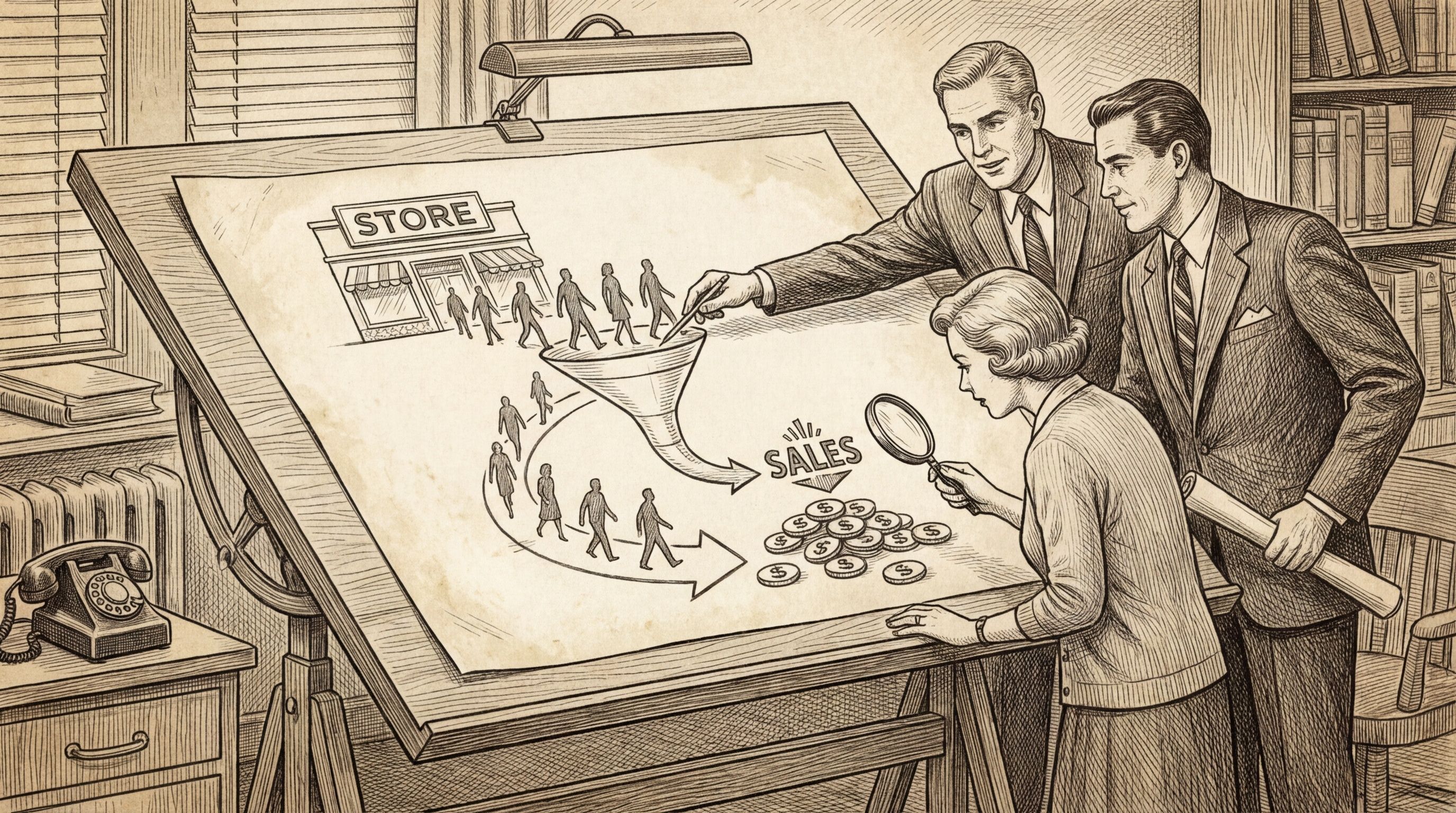
Think of it this way: you have an eCommerce store that attracts traffic but struggles to turn those visits into sales. The traditional approach would lead to a list of tasks like "redesign the product page." With OKRs, the shift in perspective is radical.
The objective becomes ambitious and centres on what the customer actually experiences:
Objective: Increase the ecommerce conversion rate by optimizing the buying experience.
And here's the key. The Key Results (KR) force the team to define in numbers how that "optimization" will be measured in user behaviour:
With these OKRs on the table, every initiative—whether an A/B test, a speed improvement, or a UX tweak—must justify how it helps move one of those metrics. Changing the button colour stops being an isolated task and becomes an experiment designed to impact, for example, KR3. If it doesn't work, it's discarded and something else is tried.
For companies that invest heavily in traffic but don't see a clear return, OKRs are the perfect compass. They allow you to focus all your resources on what truly moves the needle on conversion.
At Bigbuda, we use OKRs as a tool to align focus and execution, especially in performance-oriented projects. Rather than implementing a rigid methodology, we adapt the approach to define clear objectives tied to real results. The main outcome is greater clarity on priorities and a better ability to measure impact, avoiding efforts that don't generate direct value.
This method fosters a culture of data-driven experimentation, which is the heart of CRO. If you want to dig deeper into how constant optimization can transform your business, we recommend reading our article on what CRO is and why it's crucial for your digital strategy.
At the end of the day, OKRs ensure that every dollar invested and every hour worked is devoted to the only thing that matters: turning visits into revenue and sustainable growth.
Theory only comes to life when we put it into practice. To truly understand how OKRs stop being a concept and become an execution tool, the best thing to do is analyze concrete examples that any business leader can adapt to their own reality.
The following scenarios aren't copy-and-paste formulas, but rather templates for strategic thinking. Their real value lies in showing how an inspiring objective connects with results that measure a tangible change in user behaviour and, therefore, in the business.
In eCommerce, the objective is never simply to "sell more." The challenge is to optimize every point of the customer journey. That's why a good OKR focuses on a specific friction point that's holding back growth.
Objective: Master the mobile buying experience and turn it into our main sales channel.
Notice that each key result is an impact metric, not a task. The team has full autonomy to decide how to hit those figures, whether by optimizing images, simplifying forms, or adding a new payment method. The goal is the "what," not the "how."
When it comes to B2B marketing, lead quality always beats quantity. A well-crafted OKR should reflect this priority, concentrating on attracting prospects who genuinely match the ideal customer profile.
Objective: Position our brand as the leading solution in our niche and attract high-quality leads.
For a product team, especially in a SaaS model, retention and engagement are daily bread. OKRs should revolve around how to get existing users to extract more value from the platform.
Here, the focus isn't on acquisition, but on adoption. The aim is for users not only to stay, but to actively use the features that deliver the most value, which directly impacts the business's long-term health.
Objective: Increase the adoption and recurring use of our key features.
Thinking of OKRs as a project you 'implement' and then forget is the first mistake. In reality, this is a living system, a constant cycle that connects planning, execution, and, above all, learning. The challenge is to find a rhythm that keeps teams focused without drowning them in bureaucracy. We don't want to create a new layer of reporting, but a framework that fosters autonomy and accountability.
Most companies that manage to master OKRs do so by operating in quarterly cycles. Three months is that sweet spot: it's long enough to see real progress on ambitious goals, but short enough to stay agile and react to market changes. At the end of each cycle, you don't just review what was achieved; you also fine-tune the compass for the next one.
For OKRs not to end up as a nice statement of intent in a document, tracking is essential. A good cadence combines meetings at different levels to keep a pulse on progress without falling into micromanagement.
At Bigbuda, we review OKRs periodically, generally on a weekly basis for operational tracking and monthly for strategic adjustments. This rhythm lets us stay focused on execution without losing the ability to adapt to new data or changes in user behaviour.
At the end of each quarter comes the key moment: the retrospective. This session is the true heart of the improvement cycle and has two clearly defined parts.
This cycle of defining, executing, measuring, and learning is what truly turns OKRs into a growth tool. If you manage multiple digital properties and need to centralize that measurement, our article on how to use Google Tag Manager (GTM) to keep all your data in one place may be helpful.
Implementing OKRs is much more than adopting a new acronym; it's a deep cultural change. Many teams start off enthusiastically, only to watch that energy fizzle out within a few months. The reason? Almost always, they fall into the same predictable traps.
The first and most common of these missteps is turning OKRs into a simple to-do list. Teams simply write down what they had already planned to do (their day-to-day activities) and present it as a Key Result. This completely distorts the system, which isn't about measuring how much you work, but what impact you generate.
The key to avoiding this is to always distinguish between "outputs," which is the work you do, and "outcomes," which is the value you create with that work. "Publish 4 blog articles" is an output; "increase organic traffic by 20%" is an outcome.
Then comes the dual problem of focus and ambition. On one hand, there's the temptation to define too many objectives at once. When everything is a priority, in reality nothing is. Teams end up scattered, trying to make progress on ten different fronts and, in the end, failing to make meaningful progress on any of them.
The flip side is the opposite extreme: setting goals that are too conservative. If your OKRs only reflect what you were going to do anyway, they're not adding any real value. A good OKR should make you a little uncomfortable; it should push the team to think differently and step out of its comfort zone.
To navigate these two challenges, here are some practical pointers:
By avoiding these mistakes, OKRs stop being a bureaucratic exercise and become what they truly are: an engine that aligns the entire organization toward measurable, strategic growth.
To wrap up, I want to address the doubts that always arise when business leaders and department heads first consider using OKRs. These are the direct, practical answers you need to decide whether this is the right path for your team.
The confusion between OKRs and KPIs is, by far, the most common. Think of it this way: imagine your company is a car on a road trip.
KPIs (Key Performance Indicators) are your dashboard. They show you the speed, the engine temperature, the fuel level. They're vital for knowing whether the car is running well right now. Their job is to monitor the system's health.
An OKR, on the other hand, is your GPS. It doesn't tell you how the car is doing now; it sets an ambitious destination—say, "reach another city before nightfall"—and charts the route to get there. While KPIs keep the engine running, OKRs push you to reach new places.
This is where many people stumble: the temptation to want to do it all. The real power of OKRs lies in extreme focus. That's why the recommendation I always give is for each team to commit to no more than 1 to 3 Objectives per quarter.
And for each of those Objectives, define between 2 and 5 measurable Key Results. This limitation forces you to do the hardest thing: prioritize. Forcing that conversation about what's really important ensures that all the team's energy points to the few levers that will generate the greatest impact.
Not at all. In fact, this is perhaps the most important mindset shift the methodology demands. OKRs, especially the boldest ones, are designed to stretch the team's capabilities, to have them explore how far they can go.
Achieving 70% of a truly ambitious goal usually generates far more value and learning than meeting 100% of a conservative, predictable objective.
The real failure isn't falling short of a number. The failure is not learning anything in the process. The system doesn't seek perfection in the score, but constant progress and the strategic learning that moves the business forward. The focus isn't on hitting a number, but on generating real impact on business results.
At Bigbuda, we use OKRs for exactly that: to turn traffic into business results, ensuring that every action we take contributes to our clients' growth. If you're looking for a partner that connects your company's vision with execution focused on conversion, learn about our methodology here.