










Solutions
Explore how to grow

Many teams are stuck in the same scene. Traffic rises, the campaign report shows clicks, the team celebrates Google rankings, but the business doesn't feel a proportional improvement in sales, margin or commercial speed. The problem usually isn't a lack of activity. The problem is that SEO and SEM are managed as silos, with different budgets, metrics and expectations.
At Bigbuda we help you with web positioning (SEO).
That separation no longer makes sense. If a company in Chile depends on search to be discovered, evaluated and chosen, then search engine marketing and seo must operate as a single economic system. One builds durable presence. The other captures immediate intent. One reduces future dependence on pay-per-click. The other buys learning and demand today.
The right decision is not "SEO or SEM." That question impoverishes the conversation. The useful question is another: how to combine both to lower blended CAC, protect profitability and measure real revenue, even when the sale ends up happening over WhatsApp, by phone or in store.
Most companies don't have a channel problem. They have a mental model problem. They keep treating organic as an editorial project and paid search as an isolated performance machine. Then they're surprised when the reports don't match the bank balance.
A CEO shouldn't ask how many keywords climbed or how many clicks the campaign bought. They should ask something harder: what share of the search investment is building an asset and what share is capturing demand that's ready to convert. That shift seems semantic, but it redefines budget allocation.
When SEO and SEM are managed separately, three expensive mistakes appear:
Rule of thumb: if your SEO team and your Google Ads team don't share the same business questions, you don't have a search strategy. You have two to-do lists.
The way out is not technical. It's executive. You have to treat search as a portfolio with two instruments. One delivers speed. The other delivers stability. One helps validate messages, offers and categories. The other makes every future visit cost less.
That's what separates a brand that "does digital marketing" from a brand that builds competitive advantage.
Your team launches campaigns, traffic rises and the pipeline moves. Even so, CAC doesn't drop, the brand keeps depending on Google Ads and every month part of the growth gets bought again from scratch. That pattern doesn't indicate an isolated execution problem. It indicates that SEO and SEM are being managed as separate channels, instead of as a single economic system.

In Chile, search matters because it concentrates decisions. HubSpot, citing data from DataReportal, notes that 32.9% of internet users aged 16+ discover new brands, products and services through search engines, and its compilation also reports that Google dominated the global share of the search engine market in April 2024, with a share close to 90% according to HubSpot's marketing statistics.
For leadership, the conclusion is simple. Search engines don't just bring visits. They filter options, rank competitors and define who enters the commercial conversation with an advantage. If your company doesn't occupy that space with the right mix of paid and organic presence, a competitor will.
SEO should be seen as an investment that creates an asset. It improves the probability of capturing future demand without paying for every click, strengthens visibility in strategic categories and reduces fragility in the face of rising paid media costs. Its return doesn't arrive first as volume. It arrives first as accumulated efficiency. If you want to reinforce that foundation, it's worth reviewing how on-site SEO impacts business performance.
SEM serves a different and entirely valid function. It buys immediate presence right when intent exists, lets you validate offers, measure message sensitivity and accelerate sales in categories where waiting six months costs too much. It doesn't replace SEO. It funds it, informs it and, used well, saves it from mistakes.
The right question is not which of the two "is worth more." The right question is what percentage of the budget should capture demand today and what percentage should reduce the cost of capturing it tomorrow.
| Approach | What it contributes to the business | Main economic impact | Risk if it operates alone |
|---|---|---|---|
| SEO | Sustained presence in relevant searches | Lowers marginal CAC over time | Slower growth in phases of commercial pressure |
| SEM | Immediate coverage and intent data | Accelerates acquisition and tests demand | Direct dependence on budget |
| Combined system | Stability plus speed | Improves the blended return of search | Lower visibility of the real contribution if measurement is fragmented |
The central point is this. SEO and SEM don't compete for budget. They serve different functions within the same acquisition portfolio.
When the two are coordinated, SEM identifies which queries, offers and pages truly convert. SEO takes that learning and turns it into a more stable source of demand. That's where competitive advantage appears. The company buys less transitory growth and builds more profitable growth.
Your team closes the month with sales under pressure, CAC rises and the board demands profitable growth, not just more traffic. In that scenario, deciding between SEO and SEM as if they were separate channels leads to poor capital allocation. The right decision starts from the company's economic moment and from the timeframe in which you need a return.
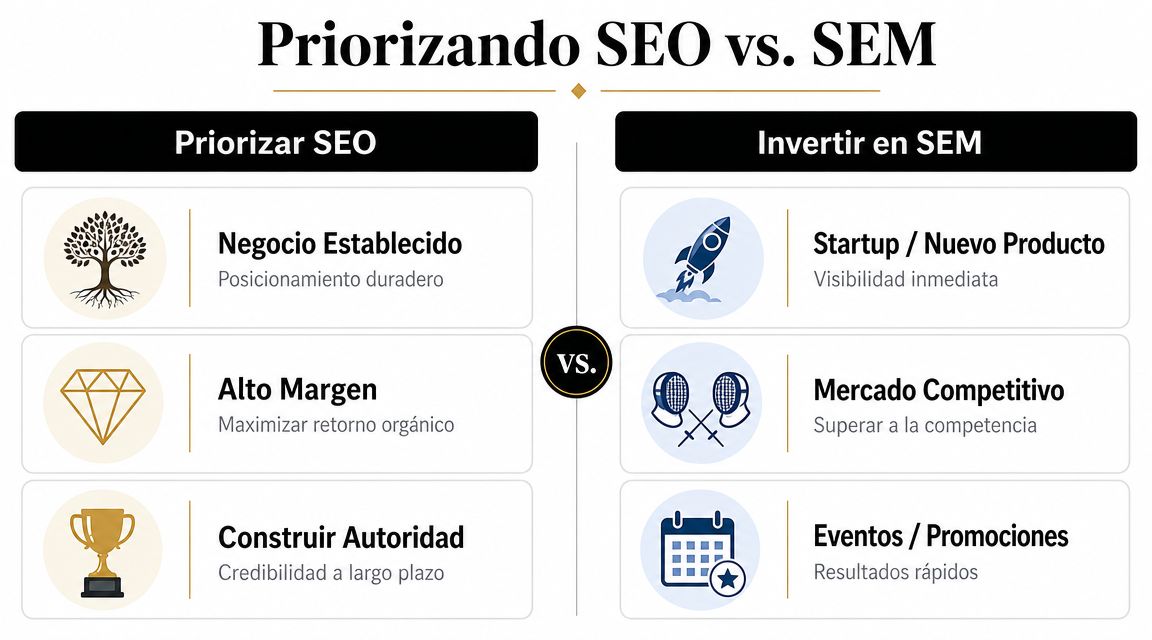
SEO should lead when the company has already validated its offer and needs to lower the marginal cost of acquisition. Also when the purchase decision involves comparison, research or several visits before converting. There, organic plays a clear financial role. It captures demand at different stages without paying for every click and improves the accumulated return of the search channel.
It's also worth prioritizing when the category is won through trust and consistency. In Chile, that matters more than many teams admit, especially in services, healthcare, education, real estate and B2B. If the brand appears consistently in informational, comparative and transactional searches, it enters the evaluation with more commercial advantage and less friction in sales.
Prioritize SEO in these cases:
SEO takes longer. It also leaves a more profitable foundation.
SEM should lead when the business needs speed, control and fast evidence to decide. If you launch a new line, enter a different area, activate a promotion or need to defend searches with high commercial intent, paying for immediate visibility is usually the best decision.
It's also the right channel when you still don't know which message, offer or page converts best. Instead of waiting months to learn, SEM gives you intent data and commercial response within weeks. That reduces the cost of getting it wrong.
SEM should go first when one of these situations occurs:
Below you have a visual reference that summarizes that logic. Then contrast it with your P&L, your target payback and your current investment mix.
The useful discussion is not which channel "wins." The useful discussion is which combination lowers your blended CAC and protects future growth. That's why it's worth looking at the economics of both markets. Grand View Research projects the SEO market through 2030 and Statista estimates global search advertising spend through 2029, two clear signals that companies keep investing on both fronts because they serve different functions within the same acquisition system (Grand View Research, Statista).
The return logic points in the same direction. The statistics compiled by Exploding Topics show that PPC can accelerate direct return, while a meaningful share of companies still identifies organic traffic as their best-ROI marketing source. That combination is not a contradiction. It's the foundation of a healthy portfolio.
SEM buys speed and learning. SEO improves the profitability of growth over time.
A CEO shouldn't ask for an ideological answer. They should ask for a capital allocation that's consistent with three variables: commercial urgency, available liquidity and return horizon. If you need results this quarter, SEM should carry more weight. If you want to defend margin over the next twelve months, SEO needs a serious share of the budget. If you operate in Chile and also sell with online impact and offline closing, the right mix matters even more, because fragmented measurement tends to underestimate the real value of appearing in search several times before the sale.
The final question stays the same, but it must be answered with numbers. What proportion of the budget should capture demand today and what proportion should reduce the cost of capturing it tomorrow.
The platform is not a technical detail. It's part of the profitability model. A poor architecture raises acquisition costs, limits indexing and lets the channel's learning go to waste. A well-organized architecture lets SEO and SEM reinforce each other.

In eCommerce, Shopify usually works best when the business uses SEM to test demand and SEO to consolidate categories and product pages with sustained potential. The sequence is logical. Paid search detects which queries, product lines and messages generate real intent. Then organic takes what was learned and turns it into stable presence.
That changes the conversation with management. The category page stops being "content." It becomes a commercial asset. The product page stops being an operational burden. It becomes a piece of demand capture with a direct impact on revenue and efficiency.
For those evaluating that logic from a broader perspective, this guide on digital marketing for eCommerce helps explain how acquisition, platform and conversion connect.
In B2B and in models where content educates before it sells, WordPress and Webflow usually play a different role. There SEO has room to capture informational, comparative and evaluation searches. SEM, meanwhile, can concentrate on queries with higher commercial intent and direct them to experiences focused on lead generation.
The strategic difference lies in not treating the site as a simple container. A poorly governed WordPress becomes slow, inconsistent and hard to scale. A well-structured Webflow can deliver editorial speed and brand control, but if the architecture doesn't keep up, that advantage dilutes.
Three leadership decisions change the system's performance:
The right platform doesn't "do SEO" or "improve SEM" on its own. What it does is let every peso invested in search yield more or less return.
This is where concrete solutions come in. Tools like Shopify, WordPress, Webflow, Google Ads and GA4 require an integrated reading. There are also partners that connect platform, content, performance and conversion. Bigbuda, for example, works precisely at that intersection of web development, SEO, CRO and digital advertising for businesses that need profitability and not just traffic.
Many teams still discuss search engine marketing and seo as if the problem were only attracting visits. It isn't. Traffic without conversion is not a victory. It's a cost with good presentation.
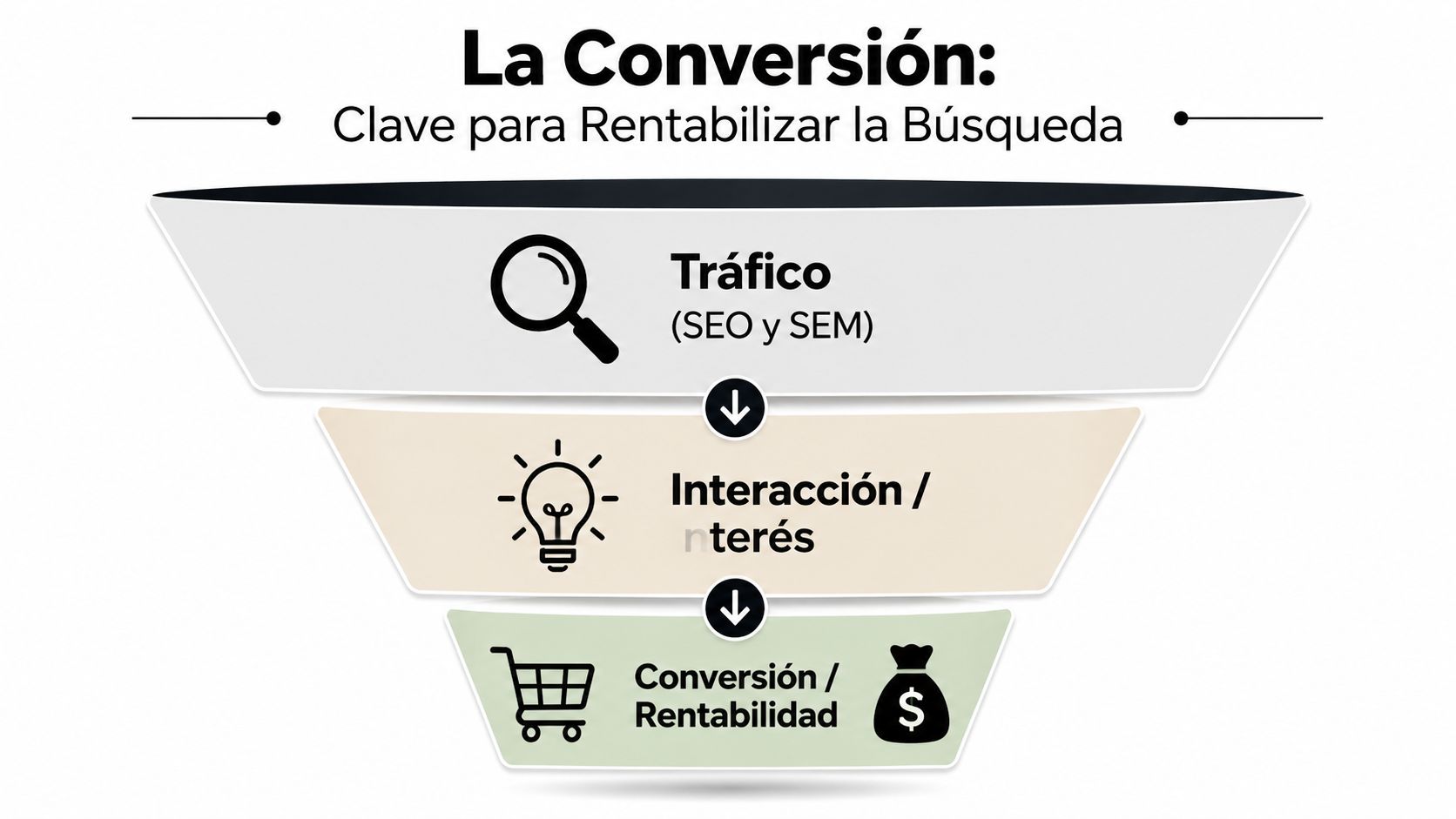
A business can have an active search strategy and still waste money every day. It happens when the user lands on a generic, slow, unconvincing page that's poorly aligned with the intent that brought them there. That breakdown destroys return both in organic and in paid.
From leadership, the conversation about conversion must leave the aesthetic terrain. It's not about "redesigning a landing" because it looks dated. It's about preventing the company from buying visits or earning organic visibility only to lose them to an experience that doesn't help people decide.
There are clear signs of waste:
SEM profitability doesn't depend only on the bid. Better alignment between ad, keyword and landing page improves Quality Score and reduces effective CPC. A slow or unspecific page raises the bounce rate and wastes budget, as Adobe Business explains in its analysis on search engine marketing.
That point is often underestimated because it seems technical, but it's financial. When the page experience is more relevant, the business doesn't only convert better. It also protects advertising margin. And when organic content responds precisely to intent, it improves the probability that the visit advances in the commercial process.
A company doesn't scale in a healthy way by buying more traffic. It scales when it better converts the traffic it already manages to attract.
The executive conclusion is simple. Conversion is the bridge between visibility and economic value. If that bridge is weak, it doesn't matter how sophisticated the search investment is.
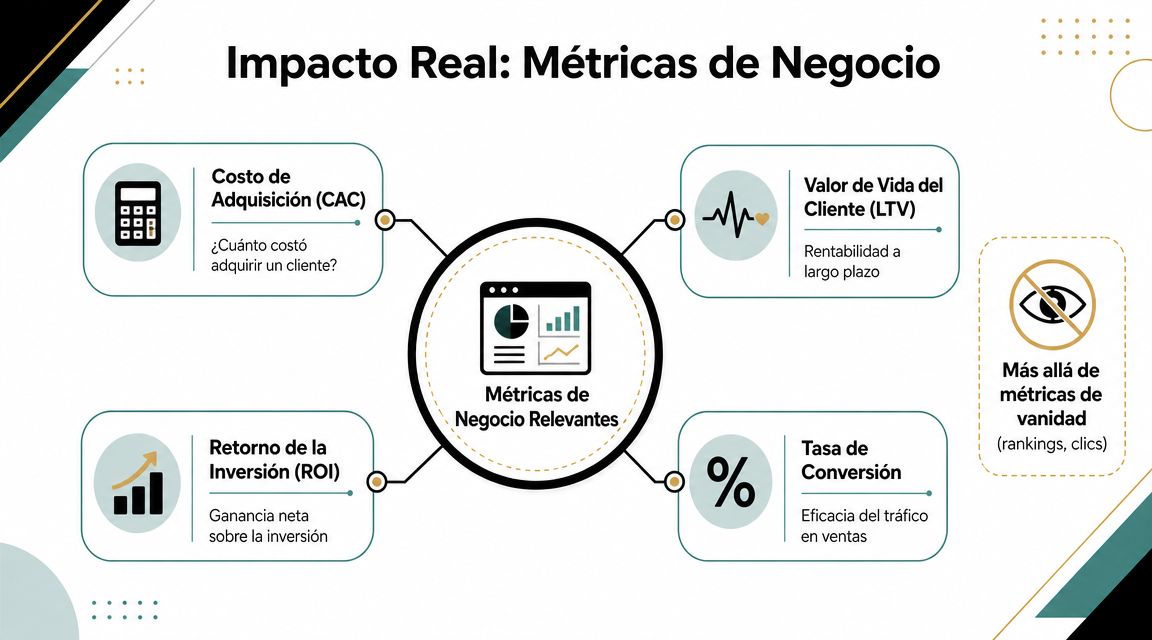
Traditional dashboards are reassuring, but they don't explain the business. Rankings, impressions and clicks can show intense activity while sales, profitability and commercial efficiency remain stagnant.
In Chile, a critical gap appears when the sale doesn't end online. The conversion tends to fragment across channels and that makes last-click ROAS underestimate the contribution of organic, especially when the lead closes over WhatsApp, by phone or through assisted sales, as Carnegie Higher Ed argues in its analysis on SEO and PPC.
That has political consequences inside the company. Paid search receives more credit than it deserves because it appears at the end of the journey. SEO receives less than it generates because it often initiates, educates or sustains the evaluation before the conversion.
If the goal is to measure the business, you have to change the dashboard. "What happened on the site" isn't enough. You have to connect marketing with closed revenue.
A useful dashboard for leadership should prioritize:
| Metric | Question it answers | Risk if viewed alone |
|---|---|---|
| CAC | How much it cost to acquire a customer | It can hide customer quality |
| LTV | How much value it leaves over time | Without CAC it doesn't tell profitability |
| ROI | Whether the investment generates profit | It can arrive late if attribution is poor |
| Conversion rate | How well it transforms demand | It doesn't show economic value per customer |
It's also worth abandoning a common practice. Rewarding teams for clicks, sessions or rankings without connecting them to pipeline and sales pushes them to optimize the wrong indicator.
If sales closes by phone or WhatsApp, and marketing doesn't import those closes into the measurement system, the board is deciding with incomplete information.
The answer is not a miracle metric. It's integration. GA4, Google Ads, CRM, forms, site events and offline closes must talk to each other. Tools like Google Tag Manager and its strategic use in measurement help organize that operational layer, but the important decision is a management one: defining which event represents real value and how that data is returned to the system.
A company that's mature in search does three things well:
When that integration exists, search stops being a collection of digital metrics. It becomes a discipline of capital allocation.
The synergy between the two channels is not elegant theory. It shows up in concrete business decisions.
A B2B company enters a new category. It doesn't know precisely which language converts best or which promise generates more quality leads. Instead of waiting months for organic to deliver signals, it launches paid search campaigns with different groups of queries and messages.
Then it observes which terms attract useful meetings, not just forms. That information feeds into the editorial roadmap, the solution pages and the content architecture. SEM didn't just buy leads. It bought strategic clarity.
Now think about an eCommerce that already dominates organically certain relevant category searches. Keeping the same budget pushing on all those terms may not be the smartest play. The company can reallocate part of that investment to more competitive queries, new lines or searches with more specific intent.
The point is not to switch off campaigns out of organic pride. The point is to use SEO coverage to relieve budget pressure where the brand already has solid presence and redirect capital where the incremental return can be greater.
A portfolio logic looks like this:
There are also situations where it's worth appearing twice. Once as an ad. Once as an organic result. That double presence is not redundancy. It's screen control, an increase in trust and competitive defense.
In contested categories, that combination helps the brand occupy more mental and visual space at the moment of evaluation. To the user, the company looks more visible and more stable. For the business, that can mean less leakage to competitors that do understand the full game.
The conclusion is clear. SEO and SEM perform better when they inform each other. When they operate in isolation, each channel learns less and costs more.
Continuing to debate SEO versus SEM is a waste of executive time. That conversation belongs to a less mature stage of digital marketing. Today the advantage isn't in picking a side. It's in designing a system where both serve a different and complementary economic function.
SEO builds the foundation. SEM accelerates capture. Conversion turns visibility into margin. Attribution connects marketing with real revenue. When those pieces are organized, the company stops chasing traffic and starts managing growth with more precision.
That matters especially in Chile, where many companies operate with tighter budgets and with commercial closes spread across web, WhatsApp, phone calls and assisted sales. In that environment, improvising the search mix is expensive. The right discipline is to treat search as an investment portfolio, not as a list of tactics.
The teams that understand this compete better. Not because they shout louder on Google, but because they allocate budget better, learn faster and measure with more honesty. That's where the channel's true profitability appears.
If your company needs to organize SEO, SEM, measurement and conversion within a single growth logic, Bigbuda can help you turn that mix into a more profitable and less fragmented system.
Related article: Google Ads Agency: Hire Your Strategic Partner
No. That question impoverishes the conversation. The useful one is how to combine both to lower blended CAC, protect profitability and measure real revenue. SEO builds durable presence and lowers marginal CAC over time; SEM captures immediate intent and buys learning. They serve different functions in the same acquisition portfolio.
When the offer is already validated and the company needs to lower its marginal acquisition cost. Also with long buying cycles where the buyer compares and returns, in categories won through trust and consistency, and in businesses with broad geographic coverage or multiple offerings. SEO takes longer but leaves a more profitable foundation.
When the business needs speed, control and fast evidence: launching a line, entering a new area, defending transactional searches under aggressive competition, or working within short commercial windows such as cyber sales and seasonal campaigns. It also fits when the ticket or offer is still unvalidated, since it returns intent data within weeks.
Because in Chile many sales don't close online. When the lead finishes over WhatsApp, by phone or through assisted sales, last-click ROAS underestimates organic's contribution. Paid search gets more credit than it deserves for appearing at the end, while SEO often initiates, educates and sustains the evaluation beforehand.
Yes. SEM profitability doesn't depend only on the bid. Better alignment between ad, keyword and landing page improves Quality Score and reduces effective CPC, while a slow or unspecific page raises bounce rate and wastes budget. Relevance looks technical, but it's financial: it protects advertising margin.
Connect marketing to closed revenue: CAC, LTV, ROI and conversion rate read together rather than in isolation. A mature operation also distinguishes micro-conversions from real sales, imports offline closing signals from phone or WhatsApp, and evaluates channels as a portfolio instead of rewarding clicks, sessions or rankings.