










Solutions
Explore how to grow

In Chile, eCommerce no longer needs more noise. It needs more performance. Online sales reached US$9.7 billion in 2022, but the average conversion rate is 2.5%, below the global 3.5%, which makes clear an efficiency gap far more important than the usual obsession with attracting more visits, according to Shopify's ecommerce analysis.
At Bigbuda we help you with an online store that sells.
That data changes the conversation. If your store already receives traffic, your main problem is probably not demand. It is friction. It is the site architecture. It is a messy mix of channels that compete with each other instead of amplifying results. In a more mature market, continuing to buy traffic without fixing the system is an expensive way to hide inefficiencies.
Digital marketing for ecommerce stopped being a collection of separate tactics. Today it operates as an economic system. Organic search, paid campaigns, automation, platform, analytics and the purchase experience all have to work as a single mechanism oriented to profitability. If one piece fails, the rest loses power. If they align, growth stops depending on raising the budget month after month.
The companies building real advantages are not the ones that "show up more." They are the ones that convert better, retain better and allocate every invested peso better. That is the key shift. The focus should no longer be acquisition at any cost. It should be integrated profitability.
The Chilean market has already proven itself. The serious discussion now is not whether selling online works, but which growth model remains profitable when acquisition costs rise, competition professionalizes and the consumer compares more.
For years, many brands grew with a simple logic: more budget on Google Ads, Meta Ads and promotions, more sales. That formula can still move the needle in the short term, but it loses power when the store converts little, the proposition does not differentiate and the site creates friction. In that scenario, every additional peso buys volume, but not necessarily profitability.
Mature eCommerce does not reward whoever invests most in visibility. It rewards whoever best transforms each visit into margin, recurrence and customer value.
The hidden opportunity is in the system. Not in the isolated channel. A truly solid digital marketing strategy for ecommerce connects acquisition, platform and conversion so that performance multiplies. That means looking at the whole business and not just the campaigns dashboard.
Many organizations still operate with teams, agencies or vendors that work separately. The paid team buys traffic. The web team maintains the store. The CRM team sends emails. The result is usually predictable: each front optimizes its metric and no one optimizes the overall result.
That model generates waste. A slow landing page degrades campaign return. A poorly structured catalog reduces the value of SEO. A weak checkout turns remarketing into a patch, not a growth engine.
The brands that will sustain growth in 2026 will be the ones that understand something simple. The digital business scales better when each component improves the performance of the others. That creates an advantage harder to copy than a creative campaign or an aggressive seasonal offer.
The old equation was linear. More traffic, more sales. The new one is systemic. Channels, platform and conversion are not parallel fronts. They are multipliers.
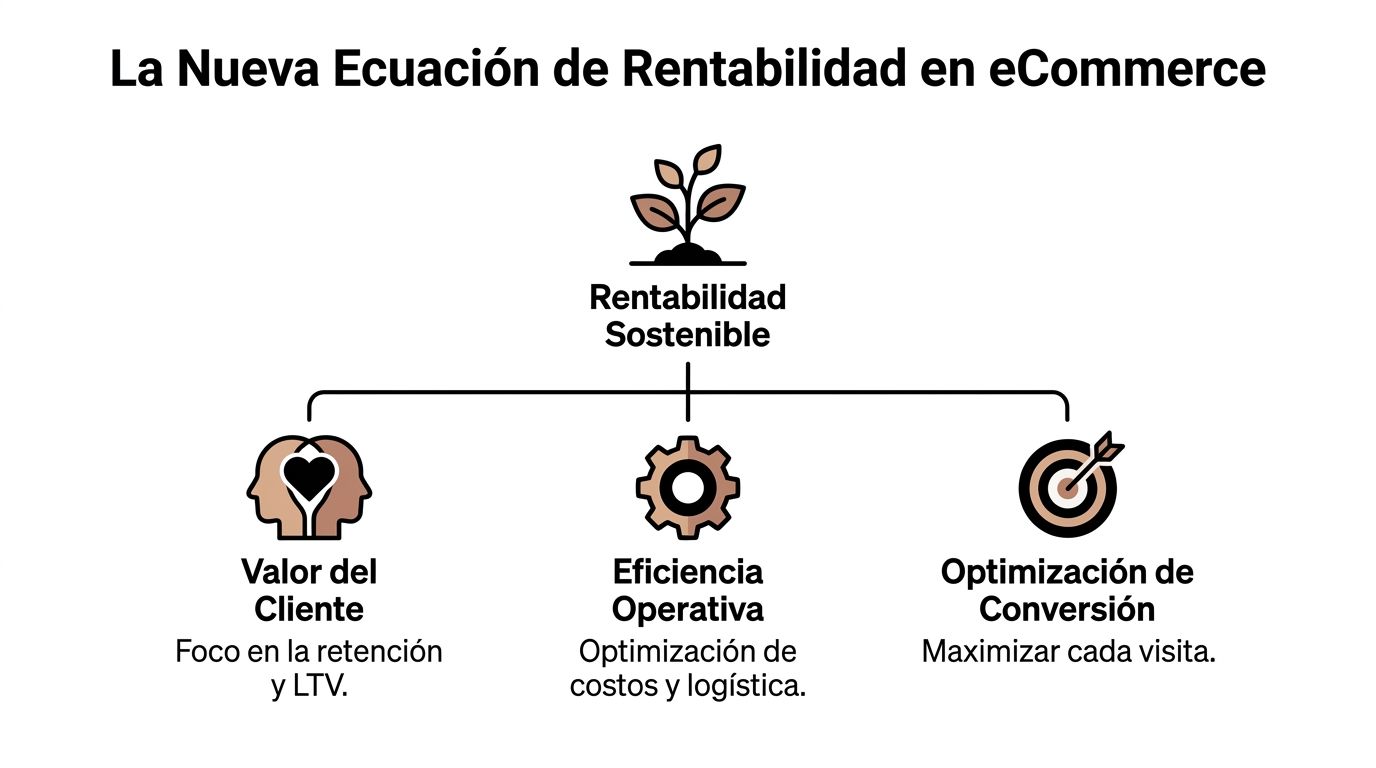
When a company invests only in acquisition, it buys visits for a system that may not be ready to convert them. When it invests only in redesign, it improves a storefront that may not receive qualified traffic. When it focuses only on retention, it limits the impact if the initial base does not grow with quality. Sustainable profitability appears when those three layers integrate.
Channels have an economic function, not a decorative one. Search, paid media, social, CRM and content should be evaluated by their ability to bring demand with intent and by their contribution to total customer value. If a channel delivers volume but requires permanent discounts to close sales, it can inflate revenue and destroy margin.
The platform is not just infrastructure. It is a commercial lever. If the site is slow, rigid or hard to adapt, it limits campaign impact, reduces organic visibility and complicates any serious attempt at personalization or experimentation. A weak stack makes everything else expensive.
This is where the real efficiency of the business is defined. The conversion engine is the ability to turn traffic into revenue and then into recurrence. It does not depend on a single isolated improvement. It depends on a continuous discipline of reducing friction, clarifying the proposition, building trust and keeping consistency across the purchase journey.
Leadership rule: if a peso invested in traffic does not improve its return because the store converts poorly, the problem is not in the channel. It is in the whole equation.
Think of this as a performance chain:
| Component | If it improves | What effect it produces |
|---|---|---|
| Acquisition | More qualified visits arrive | Increases the probability of conversion and lowers waste |
| Platform | The site responds and scales better | Improves experience and makes it easier to capture demand |
| Conversion | More visits end in purchase | Each channel becomes more profitable without depending on more spend |
The leadership implication is clear. Your growth plan should not allocate budget by discipline. It should allocate it by impact on the total equation. That view changes investment priorities.
This approach is more demanding. It is also far more profitable.
Channel management in eCommerce usually fails for a simple reason. Channels are evaluated separately. That leads to myopic decisions. A channel can look efficient in its own dashboard and still hurt business profitability if it attracts the wrong customer, cannibalizes existing demand or requires promotions that erode margin.
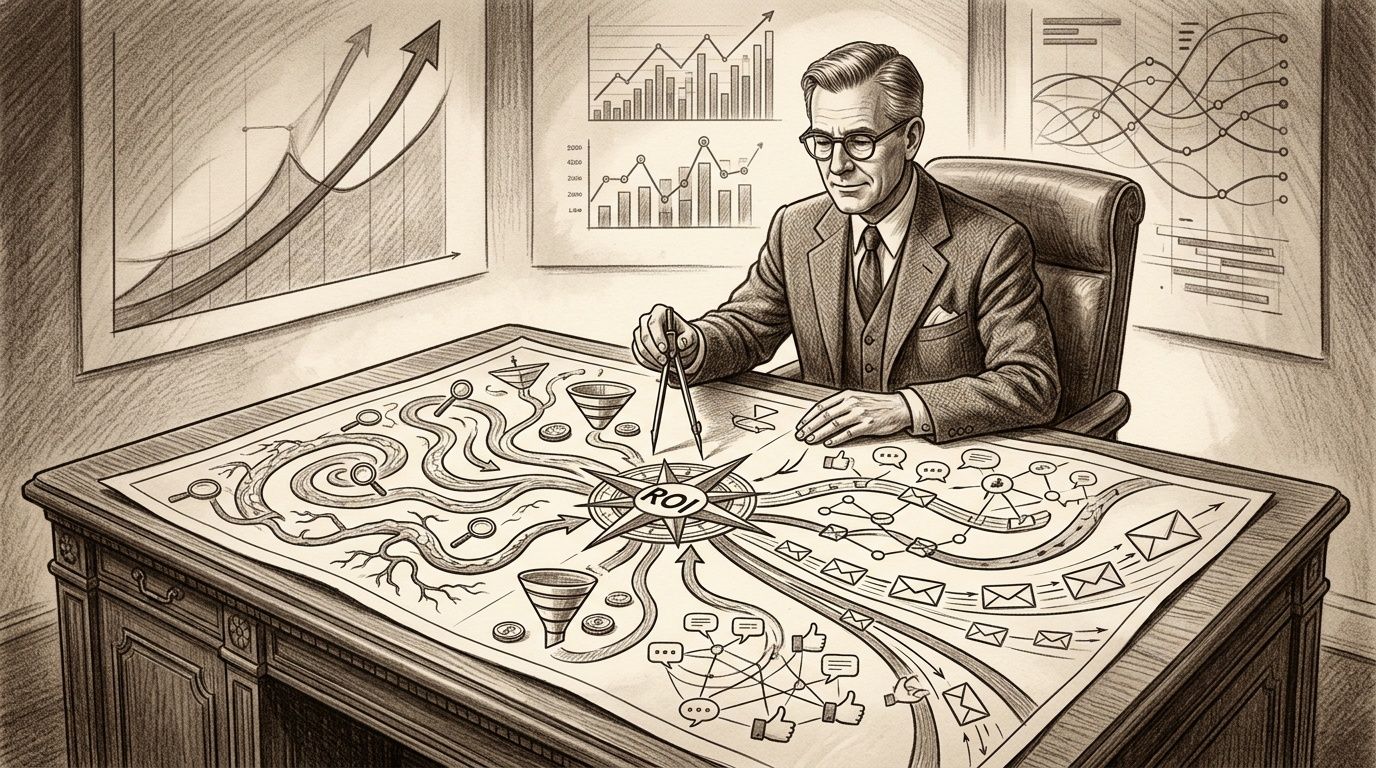
In digital marketing for ecommerce, channels should be managed as an investment portfolio. Some capture immediate demand. Others build assets. Others defend recurrence. The mistake is asking all of them for the same function.
Search remains the most valuable terrain because it captures existing demand. But within search there are deep differences. Buying clicks is not the same as building organic visibility around commercial intent, local context and useful answers.
In Chile, only 15% of eCommerce stores actively optimize for GEO-SEO, even though 72% of local searches result in a visit or purchase within 24 hours, according to the analysis of digital marketing for SME ecommerce from Retrazos. That gap is not tactical. It is strategic. It means many brands keep competing for the same paid inventory while leaving open a layer of local demand with high intent.
Do not prioritize organic because "it is cheaper." Prioritize it when you want to build a source of demand that is less dependent on auctions and more aligned with real intent. GEO-SEO is especially relevant for companies competing across regions, logistics coverage, physical stores or searches with local context. AEO, in turn, gains weight when discovery passes through answers generated by search engines and assistants.
A useful reading for leadership is this:
These are not fads. They are complementary layers of visibility.
Paid advertising remains key. The problem appears when it becomes the only commercial engine. If a brand depends on paid to sustain every new sale, it is exposed to cost variations, competitive pressure and creative fatigue.
Paid media works best when it fulfills three concrete roles:
If paid media is solving problems the store should solve, the business is paying for its own friction.
A well-managed paid channel does not replace organic, CRM or experience. It accelerates them.
To complement this view, it is worth reviewing this audiovisual approach to acquisition strategy and digital positioning.
Many companies underestimate CRM because they associate it with "sends" and not with unit economics. That is a leadership mistake. Email, automations and owned audiences serve to raise value per customer, defend margin and reduce dependence on paid media.
Social media also needs a more mature reading. In some businesses it works as branding and social proof. In others, as a direct driver of demand. The key is not to force attribution where it does not exist, but to define its role within the system.
| Question | Decision it enables |
|---|---|
| Does this channel capture intent or interrupt it? | Defines the type of message and the conversion expectation |
| Does it build an asset or just buy attention? | Helps balance short and long term |
| Does it attract profitable customers or just promotional buyers? | Protects margin and LTV |
| Does it feed other channels with data or audiences? | Improves overall synergy |
The leaders who win do not split budget out of habit. They allocate it according to the strategic role of each channel within a profitable growth architecture.
Most stores lose money before the final payment. Not because the product is bad or because traffic is lacking, but because the journey buys too much friction. In Chile, the cart abandonment rate reaches 47% and that represents annual losses of US$2.5 billion in potential sales, according to the analysis of ecommerce metrics and profitability from Cyberclick.
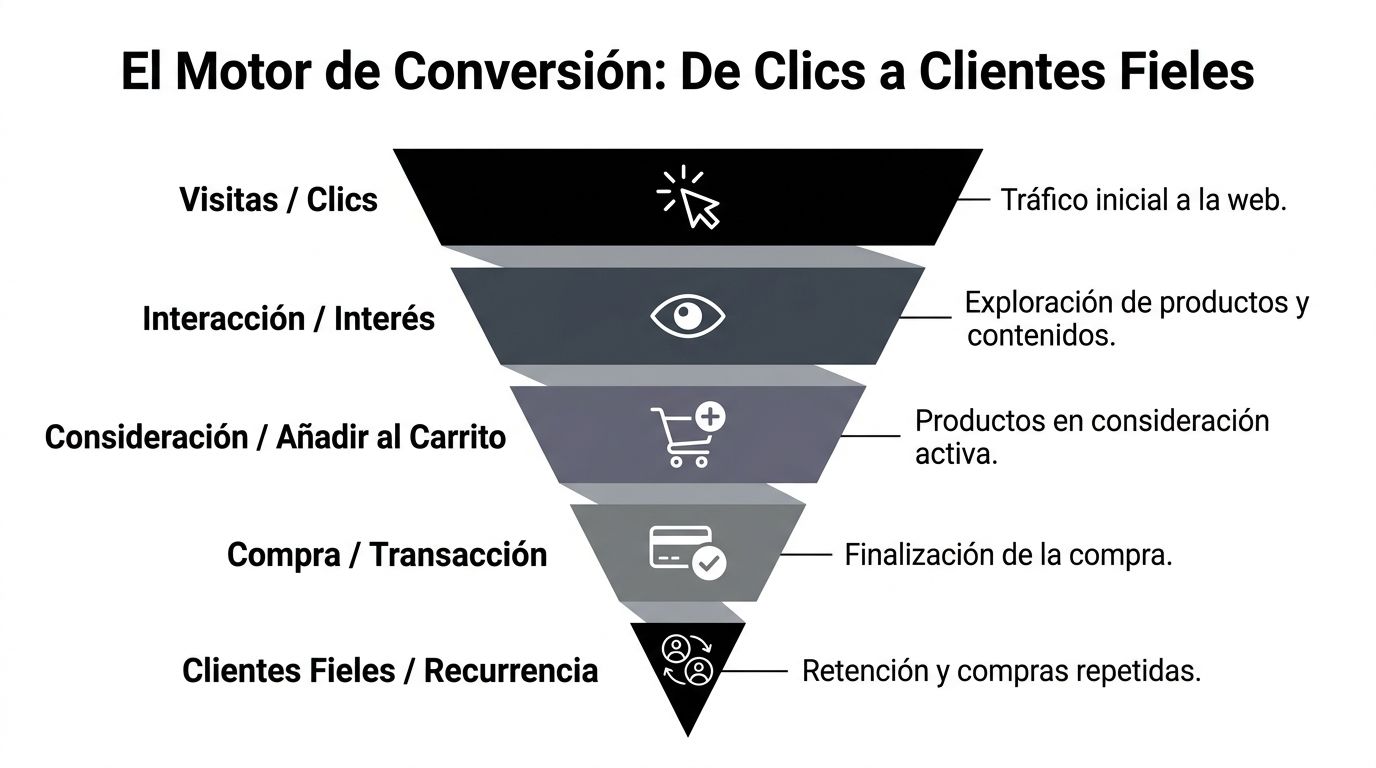
That data forces a decision. Stop treating conversion as a minor adjustment and start managing it as a revenue engine. CRO is not about changing buttons or running loose experiments. It is a business discipline for detecting where value drops and removing that friction systematically.
When conversion is treated as a secondary problem, three things happen at the same time:
A mature company does not ask only how much traffic arrived. It asks how much demand it wasted.
A serious conversion program combines behavioral data, a reading of the commercial context and orderly experimentation. Tools like heatmaps, session recordings, funnel analytics, post-purchase surveys and channel segmentation make it possible to detect real patterns, not internal opinions.
The conversion engine starts when the team stops debating preferences and starts observing behavior.
For teams that want to deepen the conceptual approach, this guide on what CRO is helps organize the framework from a business perspective.
You do not need to redesign everything to capture impact. The biggest opportunities tend to concentrate in a few critical points:
Product pages
If the value proposition is not clear, if the key information is scattered or if trust is not built quickly, the user postpones the decision.
Checkout
Every extra step, every doubt and every inconsistency raises friction. Checkout is not an administrative formality. It is the stage where the value already created is confirmed or lost.
Trust signals
Visible policies, reputation, logistical clarity and brand consistency reduce anxiety. In sensitive categories, that weighs more than an additional promotion.
Consistency between ad and destination
If the campaign promise does not match the experience of the landing page or product page, conversion drops even when the click was correct.
The funnel does not end at the transaction. A well-managed conversion engine prepares the repurchase. That requires continuity between the first purchase, subsequent communication, support and brand experience. When that continuity exists, each new customer is worth more and the business depends less on constantly acquiring volume.
Many boards still see the platform as a technical and operational decision. That is a limited reading. Web architecture defines how much the business can grow without breaking, how much it can adapt without internal friction, and how much efficiency it extracts from each channel.
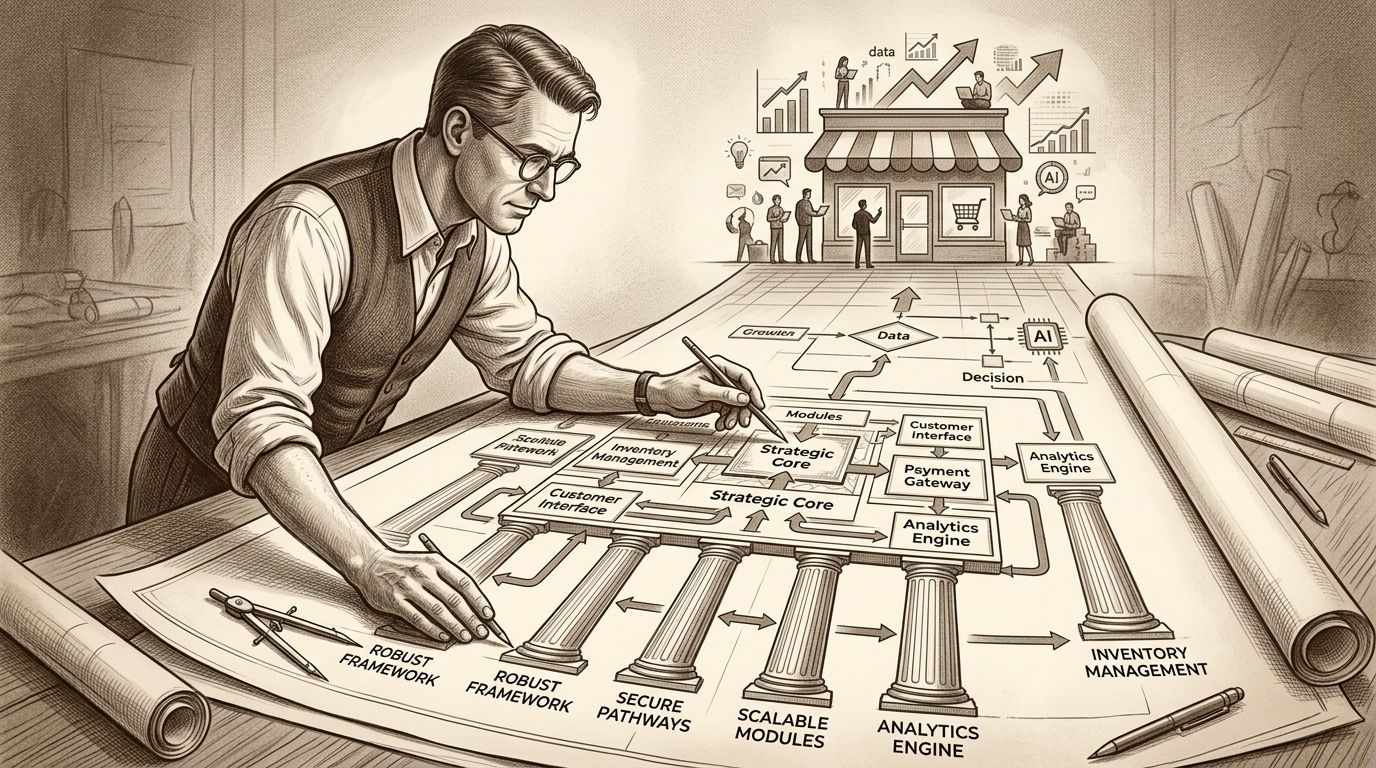
A store on Shopify, WooCommerce, Webflow or a hybrid stack does not compete on design alone. It competes on responsiveness, stability, commercial flexibility and the ease of integrating data, automations and content. That base conditions the return of everything else.
When the web architecture is weak, the impact spreads fast. The marketing team takes longer to launch campaigns. The commercial team cannot adjust messages with agility. The content team hits limits when scaling categories, landing pages or search-oriented structures. The analytics team works with fragmented data.
That has a real cost. It does not always show up as a visible line in the budget, but it shows up in slowness, dependence on third parties, initiatives that get postponed and opportunities that are not capitalized on.
A cheap platform that limits sales ends up being an expensive platform.
The right question is not "what CMS does the competition use." The right question is whether your platform enables the strategy the business needs to execute over the coming years. That includes internationalization, automation, personalization, launch speed and the ability to experiment without slowing down the whole team.
To organize that evaluation, it is worth starting with a clear conceptual base on what a CMS is and how its choice impacts structure, governance and commercial scalability.
| Criterion | Why it matters |
|---|---|
| Commercial flexibility | Allows adapting categories, landing pages and messages without excessive friction |
| Integrability | Makes it easier to connect marketing, data and operations |
| Scalability | Prevents growth from forcing a rebuild too soon |
| Governance | Reduces dependence on slow or unclear processes |
A solid architecture does not just support the present. It increases the company's strategic speed. It allows better testing, faster learning and coordinating digital marketing for ecommerce with a less reactive logic. In competitive markets, that capability is worth as much as the budget.
Many stores have full dashboards and empty clarity. They report traffic, impressions, reach, sessions and engagement. Then they close the month without a convincing explanation of why profitability rose or fell. The problem is not a lack of data. It is an excess of metrics without hierarchy.

Shopify stores that prioritize ratio metrics like sales per unique visitor, aiming to beat the 2.5% benchmark in Chile, achieve a ROAS up to 4 times higher without increasing traffic, according to the digital marketing guide for ecommerce from The Power Business School. The lesson is simple. Metrics that relate investment, traffic quality and business result are far more useful than raw metrics.
Vanity metrics are not useless. They are insufficient. They serve as context, but not as a compass. More sessions do not imply a better business. More impressions either. Even more sales can be bad news if they were achieved with margin deterioration or with low-recurrence customers.
CAC
Serves to understand how much it costs to acquire a customer and how it changes by channel, category or period.
LTV
Provides a long-term perspective. Helps decide how much a customer is really worth and how much can be invested to acquire them.
Conversion rate by segment
It is not enough to look at a general average. It matters to compare by traffic source, device, category and cohort.
Repeat purchase and value per customer
Essential to distinguish between transactional growth and sustainable growth.
A good dashboard does not show everything. It shows the right sequence of cause and effect. For example:
| Stage | Useful KPI | What question it answers |
|---|---|---|
| Acquisition | CAC by channel | Where are we paying too much for low-quality demand? |
| Conversion | Sales per unique visitor | How well do we monetize current traffic? |
| Retention | LTV or repurchase | Does the acquired customer offset the initial investment? |
| Efficiency | Ratio of investment to return | Are we scaling profitability or just volume? |
Executive reading: if a metric does not help decide where to put the next peso, it probably does not deserve a leading role in the meeting.
Every company needs a guiding metric. It will not always be the same. For some it will be value per customer. For others, acquisition efficiency. For others, revenue per visitor. What matters is that it aligns teams and prevents each area from optimizing for incompatible goals.
Without that discipline, the business becomes excellent at reporting activity and mediocre at managing growth.
Automation is not an elegant extra for when the business "is already in order." It is the layer that allows scaling without adding manual complexity at the same rate that sales, channels and data grow. If the foundations already exist, automating accelerates. If they do not, automating only amplifies the chaos.
In Chilean eCommerce, implementing intelligent omnichannel with AI can boost LTV by 28% and reduce the bounce rate by 22% by unifying data and anticipating customer needs, according to the analysis of digital marketing trends for 2026 from Addis. The relevant idea is not technological. It is strategic. Unifying data and activating consistent responses improves the value of each customer.
The first layer should focus on flows with direct economic impact and low ambiguity. Not for trend's sake, but because they help demonstrate return and discipline the team.
Recovery of unclosed demand
Incomplete carts, high-intent navigation and abandonment signals cannot go unanswered.
Post-purchase orchestration
Confirmation, follow-up, education and activation for the next relevant action.
Behavior-based segmentation
Not all customers have the same value, the same urgency or the same propensity to repurchase.
These automations are important because they connect marketing, experience and operations. They are not simply "messages." They are programmed decisions.
When the base already works, the next step is to move from reactive automations to predictive ones. That is where prioritization models, audience scoring, content recommendations and cross-channel coordination come in.
Useful automation does not replace judgment. It codifies it so the business responds with consistency and at scale.
A serious digital marketing team for ecommerce should ask whether its systems allow it to recognize intent signals and act on them without depending on daily manual work. If the answer is no, growth will require more people to sustain repetitive tasks that a good data architecture could resolve.
Do not start with the tool. Start with the value flow.
For teams evaluating this evolution, a useful reading is this guide on marketing automation with AI that sells, because it grounds how to connect automation with commercial results and not just operational efficiency.
The company stops operating by isolated campaigns and starts operating by system. Messages become more coherent. Data flows better. The customer receives a more continuous experience. And the team can spend more time on strategic decisions instead of putting out fires.
In this kind of context, specialized vendors like Bigbuda can take part as a support option to integrate CRO, automation, web architecture and digital strategy within a single operating framework. The point is not to outsource by reflex. The point is to prevent critical areas from continuing to work disconnected.
Digital marketing for ecommerce is no longer won with more activity. It is won with a better system. That is the difference between growing by pushing and growing with structure.
Companies that keep operating in silos will feel more and more pressure. More dependence on paid. More difficulty sustaining margin. More problems turning traffic into valuable customers. By contrast, those that align channels, platform, conversion, measurement and automation will build a far more defensible base.
Your next decision should not be to launch another campaign out of inertia. It should be to diagnose where profitability is being lost today. Maybe it is in a poorly allocated channel mix. Maybe in an architecture that slows commercial speed. Maybe in a purchase experience that still forces you to "buy more traffic" to compensate for what the site does not resolve.
The right priority is simple. Optimize the whole system before scaling spend. That is where lasting growth appears, because it does not depend on a single lever or a single season. It depends on a better-designed model.
If your eCommerce already generates traffic but does not convert, retain or scale as it should, Bigbuda can help you evaluate that whole system and prioritize the levers that truly improve digital profitability.
Related reading: Digital Marketing Plan: A Guide to Increase Conversions · Digital marketing strategies: A growth guide for 2026 · Leads in marketing: a guide to converting more without traffic · Maximize Your Growth with Marketing Services
Related article: A CRO checklist for ecommerce that actually sells.
Online sales reached US$9.7 billion in 2022, but the average conversion rate is 2.5%, below the global 3.5%. That gap matters more than the usual obsession with attracting more visits: if your store already receives traffic, the main problem is probably friction, not demand.
Optimized acquisition channels, a high-performance platform and a conversion engine. They are not parallel fronts but multipliers. Investing only in acquisition buys visits for a system that may not convert them; investing only in redesign improves a storefront that may not receive qualified traffic.
In Chile the cart abandonment rate reaches 47%, which represents annual losses of US$2.5 billion in potential sales. That forces a decision: stop treating conversion as a minor adjustment and start managing it as a revenue engine, detecting where value drops and removing that friction systematically.
CAC by channel, LTV, conversion rate by segment rather than a general average, and repeat purchase or value per customer. Shopify stores that prioritize ratio metrics such as sales per unique visitor, aiming to beat the 2.5% benchmark in Chile, achieve a ROAS up to 4 times higher without increasing traffic.
Only 15% of eCommerce stores in Chile actively optimize for GEO-SEO, even though 72% of local searches result in a visit or purchase within 24 hours. That gap is strategic: many brands keep competing for the same paid inventory while leaving a layer of high-intent local demand open.
Start with the value flow, not the tool. The first layer should cover recovery of unclosed demand such as incomplete carts, post-purchase orchestration and behavior-based segmentation. Implementing intelligent omnichannel with AI in Chilean eCommerce can boost LTV by 28% and reduce the bounce rate by 22%.