










Solutions
Explore how to grow

A CMS, or Content Management System, is much more than the software for creating and managing a website. It's the architecture on which your entire digital operation is built and scaled. Choosing one isn't a technical decision, but one of the most critical for the business, with a direct impact on agility, profitability, and the ability to compete in the market.
Need help with this? Discover our digital marketing service.
Reducing the CMS to a simple tool is a strategic mistake. Think of it as the foundation of a building. A solid base lets you build, remodel, and support a massive flow of visitors without the structure weakening. A poorly chosen base becomes a burden that holds back growth and makes every new project more expensive.
Choosing a CMS can't be relegated to the technical team. It's a strategic conversation that should involve marketing, sales, and operations leaders, because its consequences play out in areas critical to growth.
Selecting the CMS defines the company's agility, operating costs, and future competitiveness. It's not about which platform is "best," but which one best supports the long-term business strategy.
The question isn't which technology is trendy, but which architecture drives your business goals. Understanding the differences turns a technology cost into a competitive advantage. The ideal architecture depends on the business model, the sales channels, and the growth vision.
The traditional, or monolithic, architecture merges the backend (content management) and the frontend (visible design) into a single system. Platforms like WordPress are the classic example. Their strength lies in simplicity and speed of implementation. For many businesses, especially those operating in a single digital channel, a well-implemented traditional CMS is the most cost- and time-efficient solution.
However, this integrated structure can limit flexibility if the business scales toward a complex omnichannel strategy or requires very deep customization.
The following diagram shows how the CMS works as the foundation that supports both the content and the entire structure of a digital business.
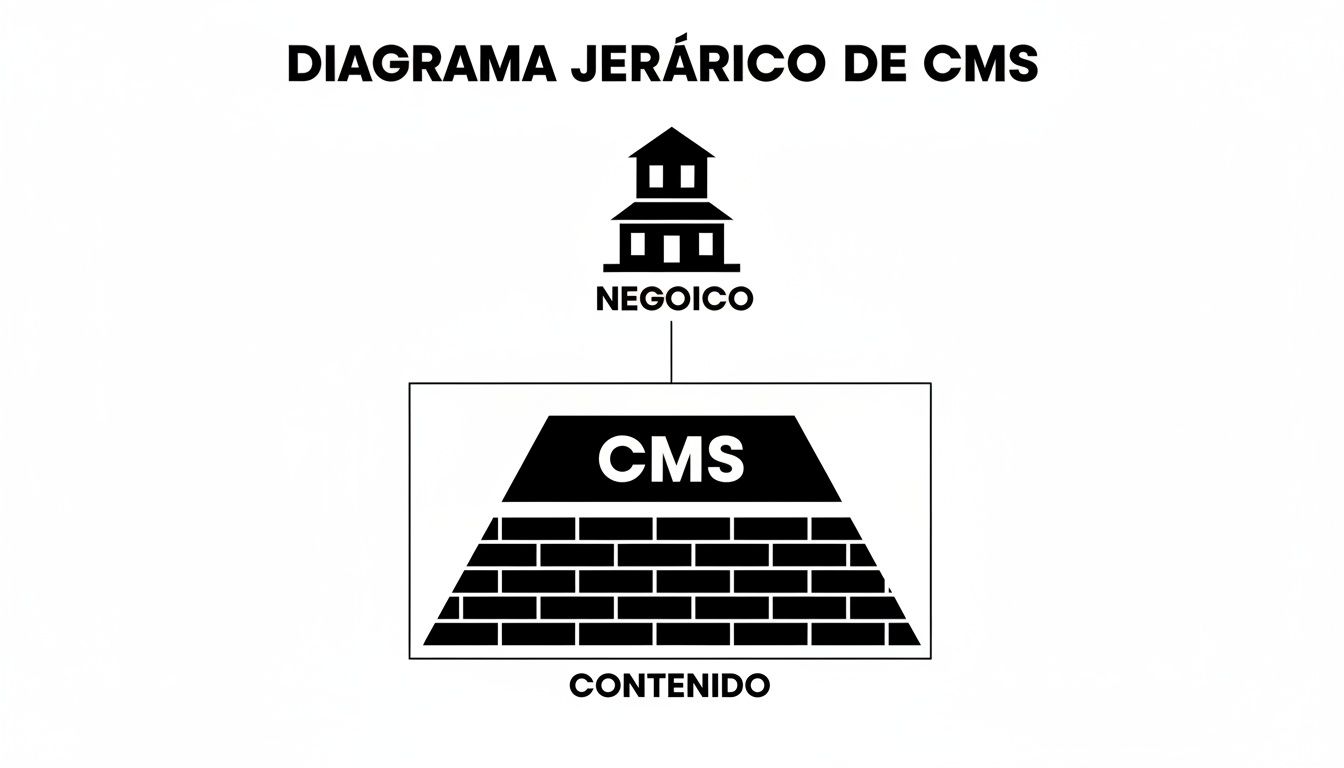
As you can see, a poor CMS choice compromises the entire structure. It limits the potential of what you want to build on top of it.
The headless or decoupled architecture separates the "brain" (backend) from the "body" (frontend). The CMS becomes a central content repository that distributes it through an API to any platform: a website, a mobile app, an IoT device, or a screen in a physical store.
This flexibility is its greatest strategic advantage, ideal for complex digital ecosystems and companies that want to create a consistent, highly personalized user experience across multiple touchpoints.
The decision between a traditional CMS and a headless one comes down to the level of business complexity. A headless architecture makes sense when you manage multiple channels, need deep personalization, or have advanced technical requirements. It's not about using the newest technology, but the one that best fits your project's growth and commercial goals.
For companies with an omnichannel vision, the headless approach avoids duplicating efforts and centralizes content management, ensuring total consistency.
Finally, there are platforms designed exclusively for selling. Solutions like Shopify or WooCommerce (which runs on WordPress) are optimized for conversion. They natively integrate critical functions like catalogues, shopping carts, payment gateways, and inventory management. Their focus on security and a frictionless checkout process directly impacts customer trust and, therefore, sales.
The choice between these options depends on the balance you're after between control and speed. Platforms like Drupal offer almost unlimited customization, but with greater implementation complexity. You can dig deeper into this topic in our article on the advantages of Drupal for custom projects.
A website's speed isn't a technical detail; it's a business factor that determines whether or not you sell. Every second of load time is a potential customer lost. In this scenario, the CMS architecture acts as the engine that drives speed and, therefore, the business's ability to turn visits into revenue.
A slow, overloaded CMS, or one built on an inefficient architecture, can sabotage your entire marketing and SEO strategy. It's the recipe for increasing your bounce rate and damaging the user experience, hurting your ranking on search engines like Google, which prioritize speed.
Your CMS is like the chassis of a race car: without a solid base, the engine's power is useless.
A website's performance is a business indicator, not an IT problem. We see it constantly: a deficient web architecture holds back companies with enormous potential. A slow site doesn't just create unacceptable friction for the user; it translates directly into economic losses.
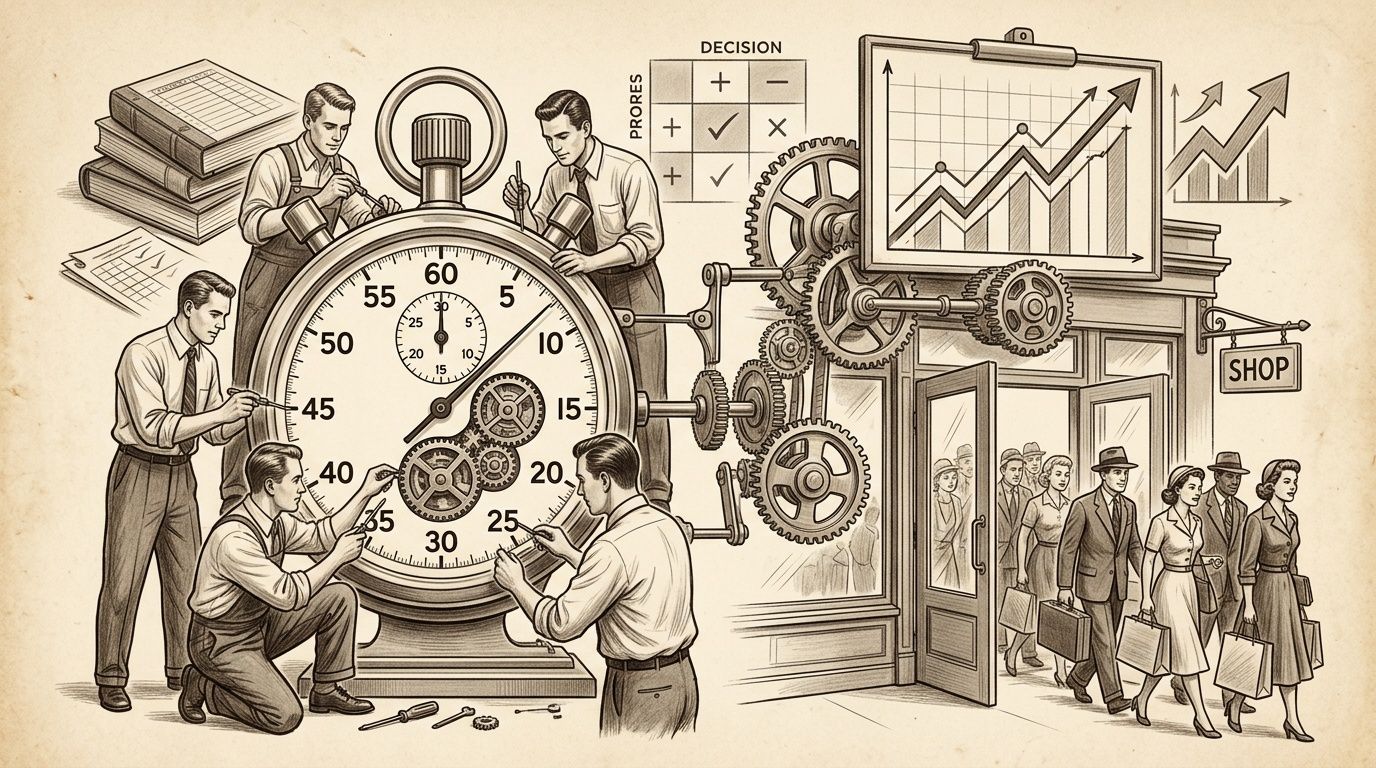
The figures are clear. A well-optimized site can cut its load times by more than 50%. This is key, because every second of delay can cost up to 7% of conversions. In a market where most mobile users abandon a site if it's slow, optimization isn't an option, it's a strategic obligation.
More than the name of the CMS, what really matters is a well-executed technical implementation and an architecture designed for performance. We've seen across many projects how migrating from a poorly optimized CMS to a more efficient platform drastically reduces load times.
The real impact doesn't come from the CMS itself, but from a technical implementation and architecture focused on performance. The key lies in eliminating unnecessary dependencies, optimizing assets, and aligning the site's structure with the business's real needs.
The factors that most influence this optimization are:
In the end, the important question isn't just what a CMS is, but how yours is built to win. A strategic implementation transforms it from a simple content manager into an asset that drives conversion. If your site uses WordPress, for example, there are specific techniques to improve its speed and performance.
Personalization on a high-performance site isn't a simple greeting with the customer's name. The real competitive advantage lies in configuring the CMS to respond in real time to each user's behaviour and needs, transforming a static digital storefront into an active conversion engine.
Instead of showing everyone the same thing, a personalized site adapts the content, offers, and messages to guide the user toward purchase. It becomes an expert salesperson who understands the context and acts accordingly.

Often, the highest-impact personalizations are functional and almost invisible to the user, but they're designed with a single goal: to eliminate friction and accelerate the purchase decision.
Imagine the CMS detects that a user has reviewed several products but hasn't added anything to the cart. Instead of a generic banner, the system can dynamically show them a comparison guide, testimonials, or a first-purchase discount. This is a strategic response to a clear behavioural signal.
A well-configured CMS lets you adapt the experience:
The most profitable personalization happens at the key moments where a customer is won or lost. This is where the CMS's intelligence delivers a direct return on investment.
One of the most relevant personalizations isn't visual, but strategic: adapting the CMS to respond to user behaviour. This includes dynamic content structures, variations in presentation according to the funnel stage, and optimizations at critical points like forms or checkout. These implementations allow the site to be not static, but responsive to user intent. You can learn more about how strategy drives technology in our vision of digital growth.
For example, in an eCommerce store, an abandoned cart can trigger an automated email with an incentive to complete the purchase. On a contact form, if the system already knows the user, it can auto-fill fields to simplify the process.
Understanding what a CMS is means realizing that it's not just about publishing content. It's about deploying an intelligent system that adapts to every interaction, and it's that responsiveness that sets a high-performance website apart.
There's no "perfect" CMS that's universally superior. What does exist is the platform that aligns with your business model, your operating capacity, and your growth ambitions. Making this decision is a strategic exercise that can define the ceiling of your digital operation.
The right choice comes from answering business questions, not from comparing feature lists. Will this platform support aggressive growth over the next three years? Will it be easy to integrate with our CRM or ERP? Will it give the marketing team autonomy, or create a constant dependence on developers?
Before considering names like Shopify, WooCommerce, or Webflow, it's crucial to be clear about your priorities as a business.
It's key to understand that there's no single CMS for every eCommerce store. In projects oriented toward rapid growth, we tend to lean toward Shopify for its stability and speed of implementation. For cases that require more control or customization, we evaluate WooCommerce or headless solutions.
The decision always centres on how the CMS will impact conversion, not just on its ease of use. You can see more about how we apply this philosophy in our digital growth strategy.
Shopify, for example, is excellent for businesses that prioritize speed and stability, minimizing the technical load. Its app ecosystem lets you scale features in a straightforward way.
The fundamental question isn't "Which CMS is best?" but "Which CMS will make my business sell more and grow sustainably?" Technology should be an enabler of commercial strategy, not an obstacle.
On the other hand, platforms like WooCommerce, which runs on WordPress, offer almost unlimited control and customization. This flexibility is ideal for business models with unique requirements, but it demands greater technical responsibility in security, maintenance, and performance. If you want to dig deeper into these differences, you can read our analysis on which is the better fit between Webflow and WordPress.
An informed choice isn't based on following the latest trend. It's about an honest analysis of your goals, your resources, and the direct impact the platform will have on your profitability.
When it comes to choosing or evaluating a CMS, the same questions always come up. Here we answer the most common ones from a business perspective.
The clearest sign is when your current CMS becomes a brake on growth. It's time to consider a migration if you recognize yourself in these problems:
If your team answers "we can't" to the ideas that could grow the business, your CMS has stopped being an ally and become an anchor.
The CMS is the backbone of your SEO strategy, with a far deeper impact than just letting you change titles. A well-chosen and well-configured platform directly influences the factors Google values.
On a technical level, the CMS defines load speed, correct mobile display, the generation of sitemaps, and the structure of URLs. A system with messy or slow code will cost you in visibility and organic traffic.
Strategically, a good CMS gives your teams the autonomy to manage metadata, create optimized content, and execute complex SEO tactics without depending on a developer. That agility is key to staying competitive in search results.
A content management system isn't a technology expense, but a central, strategic piece that sets the pace of your business. Your site's speed, your marketing team's autonomy, and your ability to scale operations depend directly on this platform.
The question every leader should ask isn't whether their CMS works, but: Is it a catalyst or a brake on reaching our goals? Honesty in that answer will determine your ability to compete and grow. A platform aligned with your strategy becomes the engine that lets you accelerate. The decision you make today isn't about software; it's about the growth you want to secure for tomorrow.
At Bigbuda, we don't just build websites; we design conversion engines that truly drive a business's growth. If you're evaluating which CMS is ideal for you, or you feel your current platform is holding you back, we can help you make the right decision to maximize your investment. Discover how we turn traffic into results with our methodology.