










Solutions
Explore how to grow

Your team posts. Replies to comments. Keeps the social channels alive. But when you look at the business, the uncomfortable question remains intact: is this helping to sell more, retain better or convert with less friction?
At Bigbuda we are a professional social media management service with a focus on results.
That is where many companies in Chile get it wrong with the figure of the freelance community manager. They treat it as an operational need, when in reality it is a commercial architecture decision. If the role only sustains presence, it becomes a cost. If it captures customer signals, organizes insights and feeds conversion decisions, it becomes a useful piece of the growth system.
The decision is not minor. A freelancer can give you speed, focus and flexibility. An agency can give you integration, more analytical depth and connection with CRO, UX, automation and performance. Choosing poorly does not only affect social media. It also affects the quality of your market feedback, the speed of commercial response and the clarity with which you prioritize content, campaigns and digital improvements.
The dilemma is not whether your brand needs a digital presence. That is already settled. The problem is another: how to turn that presence into a useful source of demand, learning and competitive advantage.
Many companies hire a community manager when they feel pressure to “stay active.” It is an understandable but limited reaction. Posting more does not fix a poor value proposition, does not clarify purchase objections and does not organize the relationship between marketing, support and sales. Without that bridge, social media generates noise, not intelligence.
In Chile, the freelance community manager usually comes in as flexible support to solve speed and execution. That can work at first. The risk appears when the company expects business impact without having designed an attribution framework, objectives and a connection with commercial metrics.
Practical rule: if the role is not connected to conversion, retention or customer learning, you are buying activity, not growth.
A CEO should not only ask who will post. They should ask who is going to interpret market signals, what decisions that learning will influence and how the effect on the business will be measured. That completely changes the conversation.
The good news is that the role can indeed contribute much more than visibility. It can detect recurring objections, identify topics that unblock sales, capture real customer language and feed priorities for content, product and CRO. But that requires judgment, not just craft.
The community manager is no longer a moderator with an editorial calendar. It is a function closer to a translator between the market's conversation and the business's decision-making.
The clearest sign of that professionalization is that the category of public relations specialists, which includes functions tied to community management, projects 6% growth between 2022 and 2032, according to the figure cited by Upwork on online community managers. What is relevant for Chile is not just the number. It is what it implies: the market expects more strategy, more analysis and less purely mechanical work.
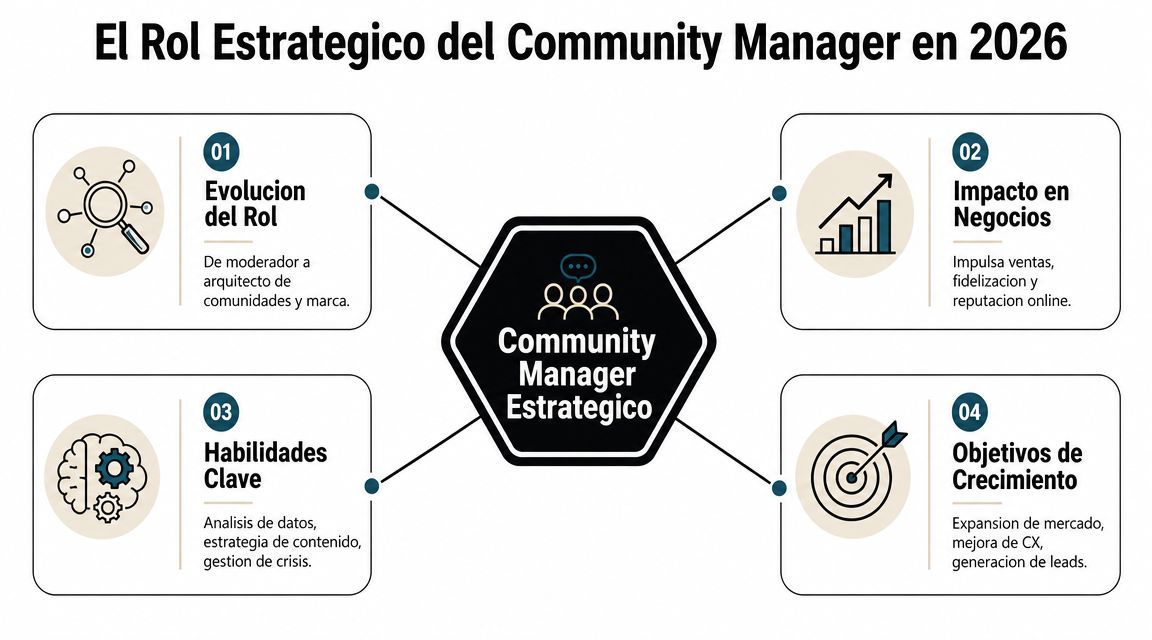
If you run eCommerce or B2B, there are three assets that a good community manager can build:
When that information is organized, it stops being “social media management” and becomes input for growth. That is especially important in companies that already invest in traffic and need to improve performance without continuing to buy visits blindly.
Indeed and industry marketplaces describe the community manager as a profile that today combines community building, customer interaction and skills ranging from copywriting and content to interpreting metrics. In parallel, the freelance standard includes visual creation, editorial planning and statistical analysis, as BeFreelancr summarizes in its freelance community manager guide.
That means it is not advisable to evaluate this role by its ability to “keep the social channels active.” It is better to evaluate it by how it connects four layers:
A modern community manager is not the brand's megaphone. It is a market sensor with potential impact on conversion.
If the candidate cannot explain how their work influences acquisition, retention or traffic quality, they are still operating in an old version of the role.
In eCommerce, this role only adds value if it improves a business decision. If it does not help sell better, detect friction before it escalates or adjust messages based on real purchase intent, you are paying for presence, not growth.

Training in marketing, communication or content helps. It does not decide the hire. What decides it is whether the person can turn scattered conversations into useful signals for revenue, retention and commercial efficiency.
These are the capabilities you should actually require:
The least visible skill is usually the most profitable. Judgment.
A competent freelance community manager does not only moderate. They help organize market signals so that marketing, eCommerce, support and sales correct course before losing conversions. There the true return of the role appears, even if attribution is not always perfect in the analytics dashboard.
The decision does not depend on the volume of posts. It depends on the level of integration your business needs to grow.
| Scenario | Freelance community manager | Broader structure |
|---|---|---|
| Brand at an early stage | Can work if you need focus, speed and closeness to the brand | Can be more than necessary |
| eCommerce with multiple channels | Tends to fall short if you also need analysis, user experience and commercial coordination | Fits better if you are looking to improve conversion and consistency across channels |
| B2B with a consultative cycle | Can sustain presence and capture market questions | Lacks connection with nurturing, sales and conversion optimization |
| Business with sensitive reputation | Works if they have already handled real crises and response protocols | Requires more structured coordination between teams |
The typical leadership mistake is loading a single hire with community, content, service, analysis, paid social and internal alignment. That model looks cheap at first and turns out expensive later. It delays decisions, weakens the quality of learning and concentrates too much operational risk in a single person.
Executive criterion: hire a freelancer if you need to solve a concrete function quickly. Choose a broader structure if you need to connect the customer's voice with CRO, digital experience and growth decisions.
The right comparison is not “freelancer versus social media agency.” The useful comparison is freelancer versus an integrated growth system.
If your company only needs presence, a freelancer can solve a lot. If your company needs social media to influence conversion, lead quality, digital experience and commercial prioritization, the discussion changes completely.
A well-chosen freelance community manager can bring focus, speed and closeness to the brand. It is usually a good option when you need a specialist who operates autonomously, maintains tone and captures customer signals without too much management layer.
An agency with a CRO focus works differently. It does not observe social media as an end, but as a source of friction, intent and language that must connect with the site, landing pages, automation, paid media and experience. If you need context on this approach, it is worth reviewing how conversion rate optimization, or CRO, works.
The central point is simple. The freelancer solves a function. The agency builds a system.
| Criterion | Freelance Community Manager | CRO Agency (e.g. Bigbuda) |
|---|---|---|
| Main objective | Execute and manage the community with a specific focus | Integrate community with conversion, UX, content and performance |
| Analytical depth | Depends heavily on the individual | Usually relies on complementary profiles |
| Scalability | Limited to their time and operational capacity | Easier to expand by discipline or channel |
| Dependence | High. If they leave, context is lost | Lower. Knowledge is more distributed |
| Integration with site and funnel | Possible, but not always natural | Normally part of the service |
| Startup speed | High | Medium, with more initial diagnosis |
| Suitability for small companies | Very good if the scope is clear | Can be excessive if there is not enough traction |
| Suitability for complex growth | Falls short if other capabilities are missing | Much more aligned |
Ask yourself these questions:
If your answer is that your main pain is posting, moderating and maintaining consistency, the freelancer makes sense.
If your answer is that your real pain is attribution, prioritization, conversion and coordination between marketing, site and sales, an agency is usually the better decision. The reason is not aesthetic. It is operational.
Many companies ask a community manager to justify budget, prove impact and improve results without giving them access to data, team or structure. That ends badly. The role ends up being evaluated by intuition, not by impact.
Talking about rates without talking about the collaboration model misses the point. What defines value is not only how much a freelance community manager charges, but what responsibility they take on, with what autonomy they work and what type of decisions they can sustain.
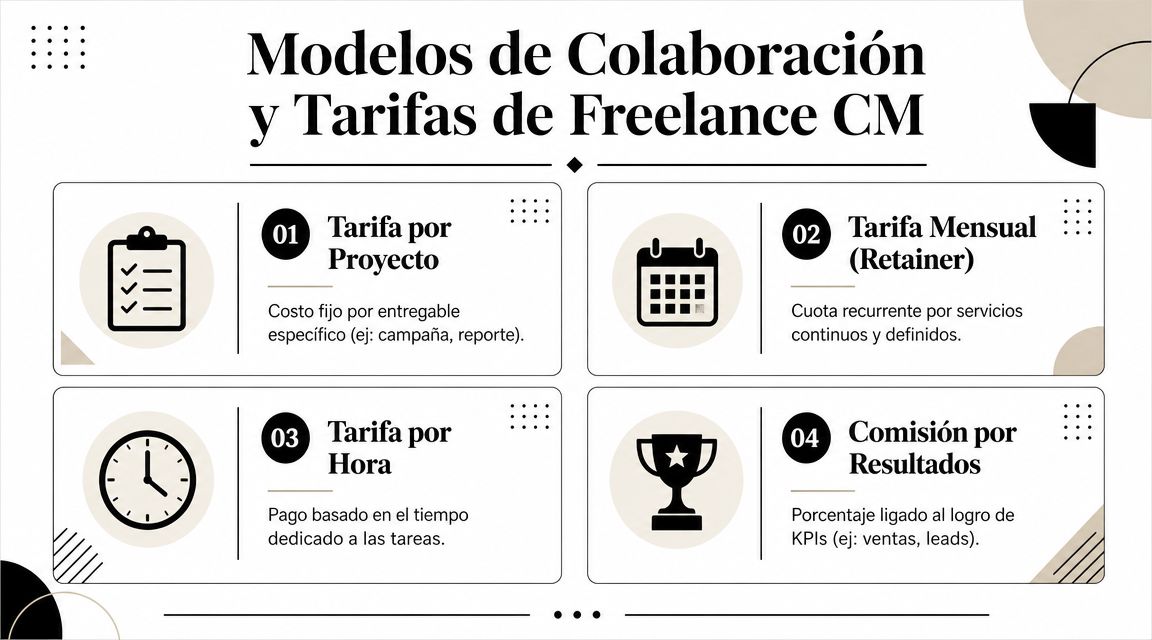
In practice, the most reasonable arrangements are these:
Not all of them work for every business. In eCommerce with constant operations, the retainer usually works better because it allows a stable relationship between community, content, support and analysis. On the other hand, for a company that has not yet validated whether the channel deserves investment, a short project may be enough.
The difference in fees usually comes from analytical capacity. Not from the number of posts. Industry sources point out that profiles specialized in social listening or data analytics can charge considerably more because they bring reading, reporting and optimization, not just tactical execution, as BSB Education highlights in its analysis of the community manager profile.
That changes the purchase logic. You are not paying only for time. You are paying for a mix of:
| Model | When it is advisable | Main risk |
|---|---|---|
| Project | When the scope is closed | That there is no continuity of learning |
| Monthly | When you need operation and continuous improvement | That it becomes routine without judgment |
| Hourly | When you are looking for one-off support | Difficult to align expectations |
| Performance | When there is clear traceability | Attribution conflicts |
What is expensive is not a strategic profile. What is expensive is a cheap profile that leaves no learning, does not connect with the business and forces you to start over every few months.
If a senior freelancer talks to you about intent tagging, reporting by channel, correlation with traffic and reading assisted conversions, you are looking at a serious proposal. If they only talk about grids, copy and posting frequency, you are buying a narrower service.
Tools do not make anyone strategic. But they do reveal the level of maturity of the profile you are evaluating.
Modern community management combines data analysis and marketing strategy, and relies on tools like Meta Business Suite, Hootsuite and Google Analytics to measure reach, engagement and traffic, adjusting the strategy in real time, according to Workana and its review of community manager tasks and skills. What matters is how it connects those metrics with business objectives.
It is reasonable to expect operational mastery in three groups:
Publishing and coordination
Meta Business Suite, Hootsuite or Buffer. Not for convenience, but because they organize the calendar, flows and consistency.
Analytics and traffic
Google Analytics, native dashboards and well-thought-out UTMs. If the candidate cannot read the traffic from social toward owned assets, they cannot sustain a serious conversation about impact.
Listening and monitoring
Social listening tools or mention monitoring. Here it matters to detect topics, tone, urgency and improvement opportunities.
In more connected teams, it is also advisable for the community manager to know how to work with collaborative systems. Platforms like Slack for internal coordination between areas help ensure that community insights do not stay trapped in marketing and reach support, sales or product.
When you interview, look for these signals:
A high-impact professional does not show off tools. They use them to shorten the distance between the customer's voice and business action.
The biggest problem with this role is not hiring it. It is measuring it poorly.
Many teams still evaluate community management with comfortable metrics because they are easy to see and simple to report. But the underlying problem remains open: how to translate community activity into pipeline, retention or revenue. That attribution gap is well identified in Contra and its analysis on hiring community managers.
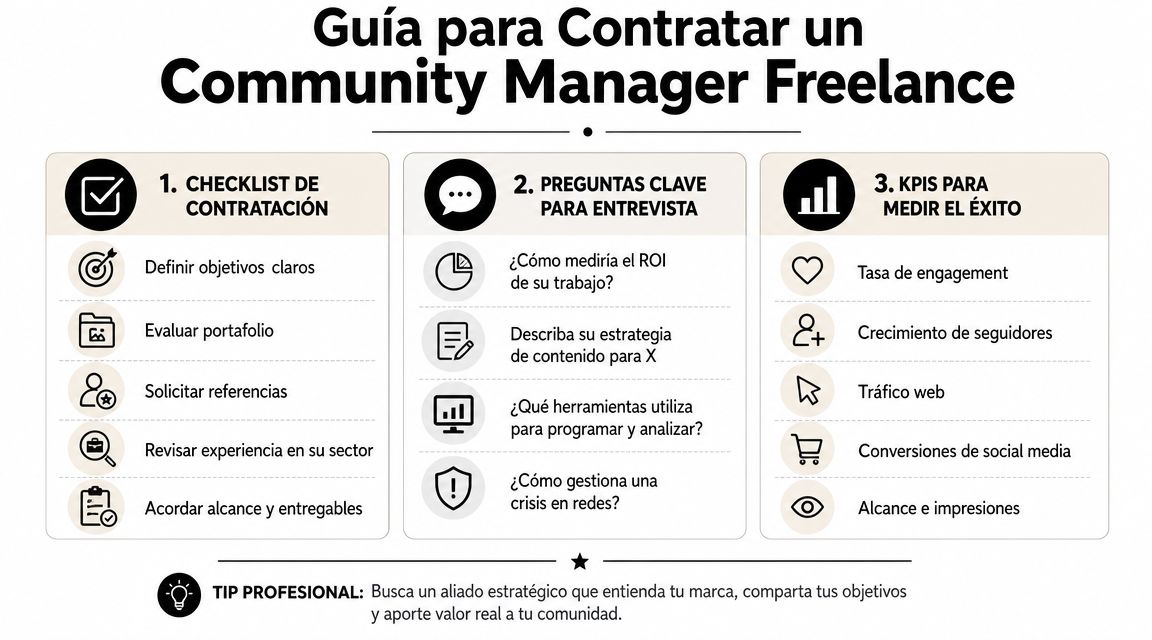
In an interview, do not focus first on the visual portfolio. Start with strategic thinking.
Ask questions like these:
It is also worth asking for examples of judgment, not just published pieces.
“Show me a business recommendation you made based on community data or conversations.”
Whoever answers that well understands the role. Whoever goes back to talking only about copy, grids and design is still at the tactical layer.
Not all indicators need to go to the management level. But you should require an executive layer connected to the business. If you want to organize the framework, it helps to first understand what engagement means and why it is not enough on its own.
The most useful KPIs usually group as follows:
Interaction quality
Sentiment, type of inquiry, recurring objections, topics of greatest friction.
Response efficiency
Response time, resolution rate or correct routing to support or sales.
Contribution to the funnel
Social traffic to key pages, assisted conversions, forms started from social, clicks to WhatsApp or intent assets.
Actionable learning
Weekly findings, proposed hypotheses, decisions made based on the community.
| Review this | Positive signal | Warning signal |
|---|---|---|
| Portfolio | Includes context and decisions | Only shows designs |
| Reporting | Proposes actions | Lists metrics |
| Commercial judgment | Understands the funnel and objections | Talks only about visibility |
| Coordination | Can work with several areas | Operates in isolation |
| Analytical maturity | Connects signals with the business | Confuses activity with results |
The right hire does not depend on the longest résumé. It depends on whether that person can help you learn faster from the customer and act better on that learning.
Hiring a freelance community manager can be a very good decision. But only when you are clear about what problem you want to solve.
If you need consistency, closeness to the audience and a specialized layer of operation, a solid freelancer can generate a lot of value. If you need community, site, acquisition and conversion to work as a system, the decision should no longer rest on a single person.
The mistake is not choosing freelancer or agency. The mistake is asking either of the two options for a result they cannot produce on their own. A freelancer does not replace a growth architecture. An agency also does not compensate for a company without focus, without clear objectives and without the discipline to measure.
The best decision usually coincides with the maturity of the business. Simpler companies can advance well with independent talent. Companies with ambitions to scale need integration, cross-functional reading and a model that connects the customer's voice with decisions about conversion, content and digital experience.
If today your social media generates activity but not clarity, you do not need more posts. You need better judgment to turn community into growth.
If your team already generates traffic, conversations and customer signals, but still cannot transform that into better conversions, Bigbuda can help you organize that connection between community, site, UX and commercial growth from a strategic perspective.
Related article: Network Security for eCommerce: 2026 Strategic Guide
More than presence. The role should capture customer signals, organize insights and feed conversion decisions. In eCommerce and B2B it can build three assets: objection signals from comments and messages, customer language to fine-tune commercial messages and landing pages, and content prioritization based on what moves useful attention.
Reading metrics with business judgment, social listening with conversion value, content prioritization by funnel stage, responsiveness aligned with the commercial objective, and reporting that helps you decide. The least visible skill is usually the most profitable: judgment. Training in marketing or communication helps, but it does not decide the hire.
Hire a freelancer if you need to solve a concrete function quickly, such as consistency, closeness to the audience and a specialized layer of operation. Choose a broader structure if you need to connect the customer's voice with CRO, digital experience and growth decisions across multiple channels.
Per project, useful for launches, community audits, response protocols or reporting designs. Monthly retainer, the most logical format when you need continuity and cumulative learning. Hourly, useful for one-off support or mentoring. Performance-based is attractive in theory but delicate, because poorly defined attribution generates conflicts.
The difference in fees usually comes from analytical capacity, not from the number of posts. Profiles specialized in social listening or data analytics can charge considerably more because they bring reading, reporting and optimization, not just tactical execution. What is expensive is a cheap profile that leaves no learning.
Group them in four blocks: interaction quality, covering sentiment, type of inquiry and recurring objections; response efficiency, including response time and correct routing to support or sales; contribution to the funnel, such as social traffic to key pages and assisted conversions; and actionable learning from weekly findings and decisions.