










Solutions
Explore how to grow

At first glance, Slack looks like a simple chat app. However, for business leaders, this tool represents a fundamental shift in how information is managed and decisions are made. It is not just an email replacement, but a digital operations hub where conversations, data, and workflows come together to accelerate growth.
At Bigbuda we help you with digital marketing services.
Instead of the chaos of email chains and information fragmented into silos, Slack proposes a channel-based model that transforms communication from an operational obstacle into a strategic asset. Its value lies not in chatting faster, but in turning every interaction into actionable knowledge.

For a marketing director or a business owner, email is synonymous with slow decisions and a lack of visibility. Each inbox is an island, and connecting the dots between scattered conversations consumes valuable time. Slack was designed to tear down these barriers, centralizing communication in transparent, contextual spaces.
Ironically, the tool was not born of a calculated plan, but of a fortunate failure. In 2009, the Tiny Speck team created an internal chat tool to coordinate the development of a video game. The game failed, but their communication system proved to be an invaluable asset. They refined it and in 2013 launched it as Slack, an acronym that reveals its strategic purpose: "Searchable Log of All Conversation and Knowledge." The full story is a masterclass on how to pivot toward a bigger opportunity.
This is where Slack makes the strategic difference. It is not just about streamlining communication, but about turning it into a business intelligence engine.
#strategy-q4, #new-product-launch, or #cro-experiments offer a 360° view of progress, debates, and blockers. As a leader, you can get immediate context without needing to call a meeting.In essence, Slack transforms the interactions that used to die in an inbox into a living, searchable archive. It is the engine that lets teams react faster to market opportunities and align around key growth objectives.
To understand this paradigm shift, let's analyze how the two work philosophies compare from a leadership perspective.
This table does not compare features, but rather the impact on agility, visibility, and decision-making capacity in a competitive digital environment.
| Strategic Criterion | Email-Based Model | Slack-Based Model |
|---|---|---|
| Strategy Visibility | Fragmented and private. Key information is trapped in inboxes. | Centralized and transparent. All stakeholders see the history and current status. |
| Decision Speed | Slow. Requires forwarding and meetings to align teams. | Fast. Decisions are made in context, with the right information and people present. |
| Access to Knowledge | People-dependent. Knowledge is lost when someone leaves the company. | Institutionalized and accessible. A searchable knowledge base is created for the entire business. |
| Business Data Integration | Disconnected. Alerts from Google Analytics or Shopify flood the inbox without context. | Native and contextual. Key notifications appear in specific channels, ready to be discussed. |
| Organizational Culture | Encourages siloed work and formal, reactive communication. | Promotes open collaboration, proactive problem-solving, and transparency. |
While email retains its role in external communication, Slack offers a decisive competitive advantage for internal collaboration and strategic execution. It allows leaders to lead with context, accelerating the pace of the entire organization.

For Slack to become a growth engine, it is crucial to understand its three strategic pillars: channels, threads, and integrations. These are not just chat features, but tools designed to structure information and accelerate decision-making.
Channels act as permanent, themed meeting rooms, eliminating the confusion of a generic inbox. Their power lies in organizing communication around business objectives.
#project-redesign-q3 centralizes conversations, files, and decisions, offering total transparency and making it easier to track progress.#marketing becomes the coordination center for campaigns, while in #sales metrics are shared and wins are celebrated, aligning the team with KPIs.#client-shoetopia ensure smooth communication and create a clear record of every interaction and decision.Within channels, conversation threads are the second key component. They allow a specific discussion to be isolated without interrupting the main flow of the channel, which stays clean for an overview. The main channel acts as an executive summary, while the threads contain the detailed analysis.
A thread transforms a dialogue that would otherwise be lost in an email chain into a piece of organized, contextual knowledge. Decisions are documented where they were made, ready to be consulted in the future.
Finally, integrations are the true efficiency multiplier. They connect the business tools you already use (Asana, Google Analytics, CRM, etc.) directly with Slack channels. Instead of jumping between platforms, critical notifications appear where the team is already collaborating, turning data into a trigger for immediate action.
Slack's true power emerges when it is applied to specific business challenges, such as managing an eCommerce or coordinating a digital agency. It becomes an operations hub that connects data with people, enabling decisions that directly impact results.
For example, a channel called #ecommerce-performance can receive automatic notifications from Shopify about every sale, but also alerts about abandoned carts or traffic spikes. The marketing team sees this information in real time and can react instantly, whether by adjusting an ad campaign or detecting an anomaly in the conversion funnel without waiting for a weekly report.
Likewise, a channel like #website-health, integrated with monitoring tools, can alert the technical and SEO team if site speed drops or an indexing issue is detected. This makes it possible to fix the problem before it affects conversions or organic ranking.
In practice, Slack stops being a place to talk and becomes an engine to optimize. The discussion about an A/B test or an improvement in the user experience happens right next to the relevant data, accelerating not only execution but also the learning cycle and return on investment.
This ability to align teams is a competitive advantage. Digital productivity studies show that a strategic Slack implementation can reduce response times by up to 35%. At Bigbuda, we have seen how this alignment impacts business results: by coordinating CRO and advertising teams, we have helped B2B clients generate 28% more qualified leads because everyone works on the same real-time data. You can review a detailed analysis of these productivity findings.
In the end, centralizing these conversations ensures that everyone, from the brand strategist to the performance specialist, is aligned around a common goal: improving the conversion rate. In fact, understanding what CRO is and how it is applied is the first step toward capitalizing on this collaborative way of working.
Every investment in technology must be justified by a clear return. With Slack, the value is not an abstract promise; it is reflected in productivity, efficiency, and agility metrics that directly impact financial results.
Slack's own growth is a testament to its value. In 2014, it billed 12 million dollars. By 2022, that figure soared to 1.5 billion, driven by massive adoption. The reason is simple: companies that adopt it strategically achieve measurable results, such as a reduction of up to 45% in internal email use. That recovered time translates into a renewed focus on growth initiatives. You can explore more about Slack's evolution here.
Centralizing communication not only brings order to the chaos, but also has a direct effect on key performance indicators (KPIs). It optimizes resources, accelerates decisions, and improves business results.
This infographic summarizes how better collaboration translates into tangible business metrics.
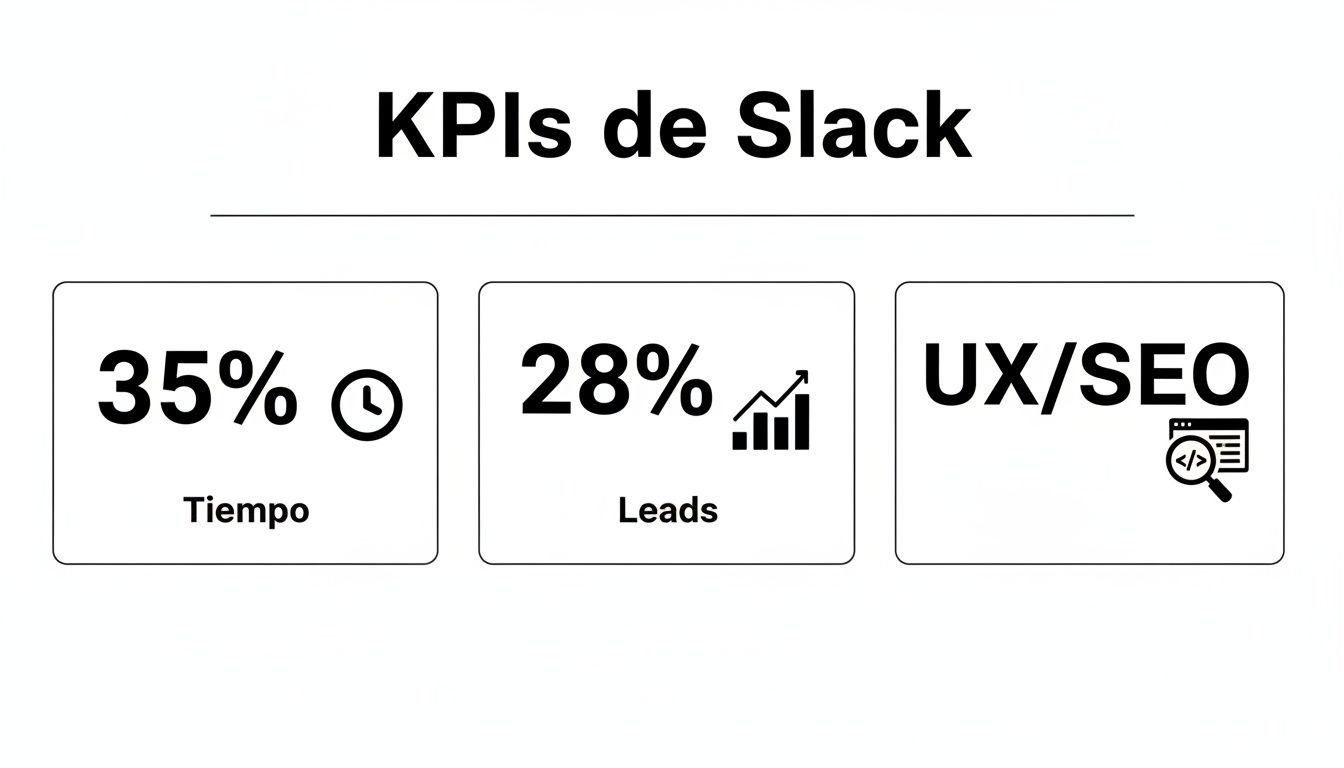
The data is clear: an aligned, agile team not only saves time. It is able to capture more business opportunities and improve the quality of its digital assets, such as user experience or SEO positioning.
Adopting Slack is a strategic decision, not a software update. It allows organizations to be more responsive and efficient, turning communication speed into a competitive advantage. To maximize this impact, it is key to visualize performance. Knowing how to leverage Looker Studio Pro to create dashboards connected to your business metrics will give you a complete view of the return on this investment.
Acquiring a Slack license is the first step. The real challenge is preventing it from becoming a noisier version of email. Without a strategic implementation, a tool designed to focus attention can end up fragmenting it.
For any leader, the goal is to turn Slack into a measurable productivity engine, not another cost line. This is achieved by establishing clear governance from the start: every channel, every integration, and every notification must serve a business purpose. Otherwise, teams will replicate the bad habits of email, creating a flow of irrelevant information that dilutes the platform's value.
A successful Slack implementation must protect the team's focus time (deep work). This is achieved by fostering a culture of asynchronous communication, where there is no expectation of an immediate response.
By defining clear rules about notification use and respecting availability hours, teams are empowered to manage communication without sacrificing the concentration needed for complex tasks.
The cornerstone of a good implementation is a well-designed channel policy. The golden rule is to use public channels by default to foster transparency, reserve private ones for sensitive information, and apply a strict naming convention (e.g.,
#proj-newsite,#team-mkt,#support-alerts). This ensures information is easy to find and context is never lost.
The smart use of automation is crucial to filter out the noise and deliver only actionable information. Instead of alerting the team about every event, you can set up workflows that only notify about critical thresholds, such as a drop in the conversion rate or an anomalous spike in acquisition costs.
For this to work, the Slack implementation must be aligned with the company's overall objectives. For example, understanding what OKRs are and how to define them provides a framework of clear goals that Slack can help execute and monitor day to day.
The real return on investment materializes when the platform stops being a place to "talk about work" and becomes the engine that drives it, connecting every conversation with a tangible business result.
When business leaders evaluate Slack, their questions go beyond features. They focus on the impact on productivity, security, and justifying the investment.
The question is not about the cost of the license, but about the opportunity cost of operating without a platform like this. Free alternatives offer basic communication, but Slack's strategic value lies in its ability to act as the central nervous system of your operation.
The return on investment (ROI) is not measured in the savings of a license, but in the speed with which teams solve problems, shorten project cycles, and react to market opportunities. It is about competitive agility, an asset whose value far exceeds the cost of the tool.
It is a valid concern, but the problem is not the tool, it is the culture of use. Without clear governance, any platform can generate noise. Success depends on establishing a culture of intentional, primarily asynchronous communication, and configuring notifications intelligently.
Unlike email, which works on a basis of interruptions, a well-implemented Slack protects focus time (deep work). It allows each person to manage information proactively instead of reacting to a constant flow of alerts.
Yes. In fact, it is often more secure than email. Slack was built with security as a pillar, offering data encryption in transit and at rest and complying with global certifications such as SOC 2 and GDPR.
Strategically, this means the company maintains granular control over who accesses what information. Segmented permissions and features like Slack Connect allow secure collaboration with external partners, minimizing the risks of phishing and data leaks inherent to email.
At Bigbuda, we understand that tools are a means, not an end. We use them to execute agile digital strategies and deliver measurable results. If you want to transform your team's communication into a growth engine for your business, visit our website and discover how we can help you.