










Solutions
Explore how to grow

Your store doesn’t go down only because of a technical problem. It goes down because of a business decision made badly, or worse, not made at all.
Need help with this? Check out our WordPress Care service.
It happens more than many CEOs want to admit. The marketing team launches a strong campaign. Paid media accelerates. Email activates the list. Traffic rises. Sales should follow. But in the middle of the peak, the site slows down, an external integration fails, a compromised access opens a door no one was watching, or a provider detects suspicious activity and blocks part of the operation. The result isn’t “an IT incident.” It’s abandoned carts, frustrated customers, eroded reputation, and an uncomfortable conversation with the board.
The underlying problem is that many companies still think about network security as if they operated inside an office with physical servers, perimeter firewalls, and teams sitting in the same building. That world no longer describes the average Chilean digital business. For most eCommerce and digital SMEs that use Shopify, WordPress, and cloud services, between 73% and 80% of traffic and operations already occur outside the traditional perimeter, as the analysis on perimeter security and new digital environments from IT Masters explains.
That changes everything.
Today the operation lives distributed. Your store is in the cloud. The team logs in from homes, coworking spaces, and mobile devices. Data travels through integrations with payment gateways, CRMs, marketing apps, ERPs, and support platforms. The perimeter is no longer a wall. It’s a mobile mosaic.
The strategic question is no longer “do we have a firewall?” The right question is “what part of our business could stop tomorrow because of an access, integration, or data flow that no one governs well?”
If you run an eCommerce, network security doesn’t compete with growth. It enables it. It protects operational continuity, sustains commercial trust, and prevents a brand that invests heavily in acquisition from losing value due to a basic breach.
An online store can look strong from the outside and still be fragile inside. The site loads well. The campaign works. The dashboard shows orders. But that apparent solidity often hides an uncomfortable reality: no one has a complete view of how access, data, and the business’s critical dependencies circulate.
In many Chilean companies, the digital stack grew in layers. Shopify or WooCommerce as the commercial core. Third-party apps for reviews, pricing, logistics, and email. A connected CRM. An agency team with permissions. A freelancer with historical access. A payment gateway. A provider who logs into the hosting. All of that adds commercial speed. It also adds risk surface.
The reality is simple. Your operation doesn’t live in “the office network.” It lives spread across platforms, users, devices, and integrations.
When that model isn’t governed with judgment, the company ends up exposed without realizing it. Not because a specific tool is missing, but because no one redefined security for a distributed business.
A security incident doesn’t hit only systems. It hits business metrics that do matter in the executive committee.
First, sales. If the store is interrupted during a commercial event, every minute counts. Then, brand. The customer doesn’t distinguish between an app, hosting, or network failure. To them, the company failed. Then comes the most expensive thing to recover: trust. When a buyer perceives disorder with their data or with service continuity, future friction rises even if the site comes back quickly.
Practical rule: if your business depends on a website to sell, capture leads, or serve customers, then network security is already part of your commercial strategy, even if you’re still treating it as support.
The common mistake is to fully delegate the topic to the technical area and review it only when something blows up. That logic works for putting out fires. It doesn’t work for building stable growth.
Most companies still account for security as a defensive expense. That’s a poor reading. In a digital business, network security protects revenue, safeguards reputation, and sustains the ability to scale without surprises.

Chile’s case is no longer hypothetical. In 2017, WannaCry hit companies in Chile such as Telefónica and Everis, within a global attack that infected 300,000 computers in 150 countries and generated estimated losses of 3.5 billion euros, according to the account of the WannaCry case and its business impact. It wasn’t just a technical episode. It paralyzed operations, exposed infrastructure weaknesses, and made clear the cost of not having a serious strategy.
For a CEO, the right reading isn’t “that happened to big corporations.” The right reading is another: if companies with significant resources suffered severe interruptions, a mid-sized company with a distributed digital operation can’t afford to improvise.
A mature security posture generates concrete advantages, even if they don’t always appear as a visible line in the P&L.
| Business impact | What network security protects |
|---|---|
| Sales | Less risk of interruptions during campaigns and commercial peaks |
| Conversion | More customer trust by operating in an environment perceived as serious |
| Brand | Less exposure to public crises from leaks or outages |
| Continuity | A more stable operation against errors, attacks, or improper access |
Well-thought-out security also organizes the company. It forces you to define access owners, review providers, reduce poorly controlled dependencies, and separate critical assets from secondary elements. That doesn’t slow growth. It makes it less fragile.
Leadership doesn’t need to get involved in configurations. But it does have to demand the right decisions.
A company that invests heavily in acquisition but tolerates basic security weaknesses is buying traffic to send it to a vulnerable operation.
The mature conversation isn’t how much it costs to protect yourself. It’s how much it costs to keep growing on a foundation that can fail at the worst moment.
Threats don’t matter for their technical name. They matter for what they interrupt. If you sell online, each type of attack has a direct translation into commercial loss, legal exposure, or brand deterioration.

The historical background matters because it explains the present. The 1988 Morris worm affected 10% of the 60,000 computers connected to the nascent Internet and was the precursor of modern DoS attacks. In Chile, similar attacks increased 300% between 2000 and 2010, and today the downtime from a DoS attack can cost an eCommerce up to USD 5,900 per minute, according to the infographic on the evolution of cybersecurity and DoS attacks.
For a digital business, that means something very concrete. A site that’s inaccessible on a commercial date doesn’t just lose sales in that instant. It also wastes investment in ad spend, burns hot audiences, and forces you to recover trust afterward.
eCommerce is a priority target. According to 2025 data for Chile, 67% of intrusion attempts are directed at e-commerce sites. That data doesn’t only speak about cybercrime. It speaks about where the money, the customer data, and operational continuity are.
Intrusions may not bring the site down immediately. Sometimes they’re worse because they’re silent. They alter access, take advantage of poorly governed integrations, or open a route for a later incident.
Main effects of an intrusion in business terms:
Ransomware doesn’t attack only files. It attacks the ability to operate. When a company depends on catalogs, orders, support, logistics, and coordination between systems, encrypting or blocking digital assets becomes a business suspension.
That impacts three layers. The first is financial. The second is relational, because customers and partners perceive disorder. The third is strategic, because the company postpones growth projects to focus on recovery.
To put the risk in perspective, it’s worth watching a visual summary of the problem:
A data leak is the kind of problem that doesn’t end when the site is back up. It continues in worried customers, legal reviews, public exposure, and a forced review of internal processes.
If a company doesn’t clearly know what data circulates, who accesses it, and through what channels it leaves, it doesn’t have a security strategy. It has a hope.
The executive priority shouldn’t be memorizing threat acronyms. It should be identifying which of them stop revenue, raise regulatory risk, or weaken the brand promise. That’s where the right agenda is decided.
A leader doesn’t need to learn how to configure tools. But they do need to understand what function each layer serves and why a single barrier isn’t enough. Modern network security works by overlapping. If one layer fails, another must contain the damage.
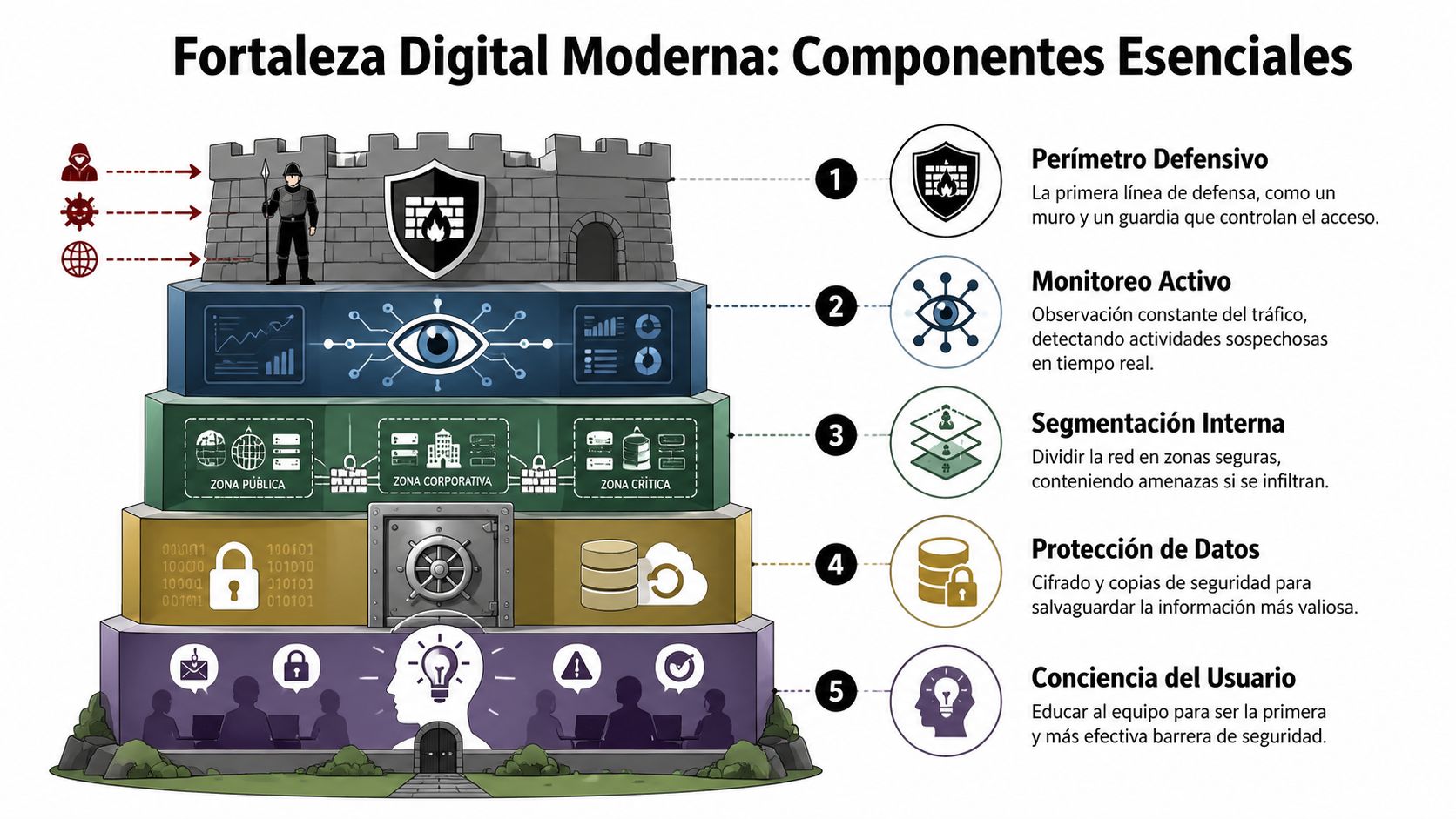
Think of the firewall as the gatekeeper. It decides which traffic makes sense and which shouldn’t pass. It doesn’t solve everything, but without that basic filter the company exposes too much from the start.
Active monitoring serves another function. It doesn’t block in silence. It observes behavior and detects anomalous signals. In digital business, that matters because many incidents don’t announce themselves with a visible outage. They show up as strange access, unusual flows, or out-of-pattern activity.
Then there’s access control. Not every person, app, or provider needs to touch everything. When a company grants broad permissions for convenience, it turns any human error or compromised credential into a cross-cutting problem.
Segmentation is one of the most valuable and least understood ideas among business teams. Its logic is simple. If something is compromised, the damage shouldn’t spread to the entire environment.
A good analogy is a ship with compartments. If water enters one section, the ship doesn’t sink entirely. In a digital operation, that means separating critical assets, limiting unnecessary traffic, and preventing a secondary integration from having a clear path to sensitive information or functions.
Useful decision: when you assess risk, don’t ask only “how do we avoid an attack.” Also ask “if something fails, how much of the operation is isolated and how much gets infected.”
Data is the most underrated asset until it’s lost or exposed. Encryption works as a language that third parties can’t easily read if they intercept the information. It doesn’t prevent every problem, but it reduces the value of exposed data and improves compliance.
Backups deliver a different promise. They don’t prevent the attack. They allow continuity to be recovered. That difference is key. A business that only thinks about blocking and not about recovery is still vulnerable.
In Chile, according to 2025 data, 67% of intrusion attempts are directed at eCommerce, and Unified Threat Management (UTM) solutions reduce response latency by 60% versus fragmented solutions, according to the reference on UTM and intrusions on e-commerce sites. The value of UTM isn’t in sounding sophisticated. It’s in integrating functions like firewall, IPS, and VPN into a coordinated layer.
That has an important business consequence. When defenses are scattered and no one governs them as a system, the company reacts more slowly. And in security, reacting slowly almost always means paying more.
Not everything is solved with technology. Teams, providers, and external collaborators are still part of the risk surface. An old permission, an app installed without review, or a credential shared for convenience can neutralize an entire technical investment.
That’s why the right architecture combines tools with governance. In WordPress environments, for example, that conversation must include stable hosting, continuous maintenance, and judgment about plugins, not just design or content. That operational layer is often left out of the commercial conversation and then comes back to bite. It’s worth reviewing it with solutions designed for continuity, such as WordPress hosting services oriented toward stability and support.
A healthy stack doesn’t try to look impregnable. It tries to be visible, governable, and resilient.
Many companies separate compliance, marketing, and security as if they were three different conversations. That’s a mistake. In eCommerce, the three things intersect every day.

In Chile, Law 21.096 on the Protection of Personal Data and standards like PCI-DSS are critical for any operation that handles sensitive information or processes payments. The point isn’t only to avoid sanctions. The point is to demonstrate that the company deserves trust.
According to the analysis on DLP, data leaks, and fines in online stores, data loss prevention breaches in eCommerce have resulted in fines of up to CLP 4 billion, and encryption and monitoring policies with DLP can reduce the risk of leaks by 78%. That changes the conversation. We’re no longer talking about “compliance” as an abstract obligation. We’re talking about financial and reputational protection.
The average user doesn’t read regulatory frameworks. But they do detect signals. Serious sites, clear processes, responsible data handling, and a purchase experience that doesn’t feel improvised.
That affects conversion indirectly, but powerfully. Trust reduces friction. Reduced friction improves willingness to buy, register, or leave data. In addition, when a brand wants to operate in different markets or serve more demanding audiences, regulatory order stops being a legal matter and becomes a commercial enabler.
There are three questions a leader should resolve:
| Question | Risk of ignoring it |
|---|---|
| What data do we really collect | Unnecessary exposure and greater regulatory burden |
| Where it travels and who accesses it | Information leaks and diffuse responsibilities |
| How we demonstrate control | Less trust and greater vulnerability in audits |
Data Loss Prevention matters because it addresses a critical point of today’s digital business. Data isn’t still. It moves between checkout, CRM, support, remarketing, and analytics tools. That transit is where many companies lose control.
An eCommerce that protects data poorly doesn’t only risk fines. It also degrades the asset that’s hardest to build: the customer’s willingness to trust again.
If your organization is reviewing this front, it’s worth better understanding the local regulatory context and its effect on digital operations in this guide on the personal data law in Chile. The value isn’t in knowing legal articles by heart. It’s in making decisions before compliance arrives forced by a crisis.
Not all platforms demand the same level of responsibility. That’s one of the most costly mistakes in eCommerce. It’s assumed that “being on a well-known platform” equals being covered. It doesn’t.
The right question isn’t which platform is more secure in the abstract. The right question is where the real responsibility falls between platform, partners, internal team, and third parties.
Shopify solves a large part of infrastructure complexity. That’s a clear advantage for teams that need commercial focus and execution speed. It reduces operational load and simplifies several technical fronts.
But it doesn’t eliminate the risk. It shifts it.
The company is still responsible for which apps it installs, what permissions it grants, how it manages internal access, what data it shares with third parties, and how it organizes its commercial flows. On Shopify, the typical mistake isn’t a server issue. It’s an ecosystem issue. Too many integrations, too much access, too little governance.
Risk signals in a Shopify operation:
WordPress and WooCommerce deliver control, flexibility, and customization capacity. They also shift much more responsibility to the business. Hosting, plugins, updates, compatibilities, performance, and maintenance are no longer secondary details. They’re a structural part of the risk.
That doesn’t make WordPress a bad choice. It makes it a choice that demands operational maturity.
A company operating with WordPress without constant maintenance usually ends up exposed in three ways. The first is outdated software. The second is dependence on plugins of uneven quality. The third is the absence of clear owners to review integrity, access, and continuity.
The useful discussion isn’t technical. It’s executive. If your site depends on WordPress to sell or capture demand, you need to treat its security as a continuous business function. Not as an occasional task. It’s worth reviewing this analysis on WordPress security if your operation is in that environment.
Webflow usually reduces operational friction compared with more open environments. It has advantages in visual governance and less dependence on classic plugins. That helps. But it doesn’t authorize carelessness.
The risk in Webflow tends to concentrate less on owned infrastructure and more on identity, access, external integrations, forms, automations, and data handling in connected tools. If a company uses Webflow as its main lead-capture site, a breach or poor governance of forms is still a business problem, even if the base platform is stable.
| Platform | What it usually covers better | Where the business risk usually remains |
|---|---|---|
| Shopify | Core infrastructure and platform stability | Apps, permissions, integrations, data governance |
| WordPress / WooCommerce | Flexibility and control | Hosting, plugins, updates, continuous maintenance |
| Webflow | Operational simplicity and visual control | Access, forms, automations, connected tools |
A leader should allocate investment according to the type of exposure, not according to a tech trend.
If the company values speed and a lighter infrastructure load, Shopify can be a good base, as long as there’s strict governance of apps and access. If the business needs flexibility, complex content, or deep customization, WordPress can be powerful, but it requires sustained operational discipline. If the priority is a more contained and well-controlled digital presence, Webflow can fit, as long as the data flow toward other platforms isn’t underestimated.
The best platform isn’t the one that promises the least work. It’s the one your organization can govern consistently without putting revenue, data, or continuity at risk.
The right strategy combines platform, responsibility model, and real level of internal capability. When those three elements aren’t aligned, the company isn’t operating a digital stack. It’s accumulating risk debt.
The fastest way to improve your posture isn’t to buy more tools. It’s to ask better questions. If leadership installs these conversations, the organization stops reacting late.
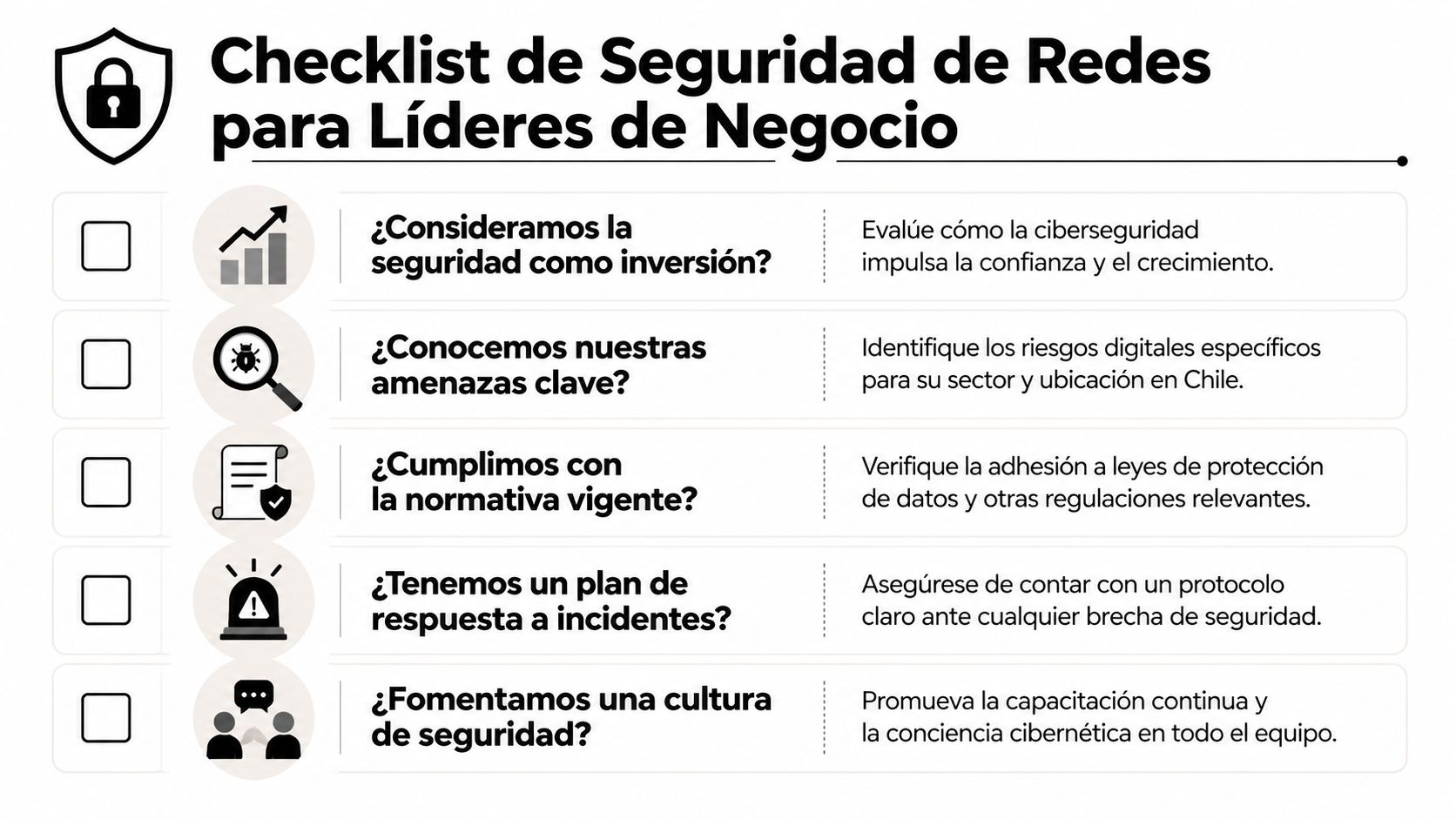
Do we know which digital assets stop sales if they fail?
Your store doesn’t depend only on the front-end. It depends on payments, integrations, access, content, analytics, and operational tools.
Is there a clear owner for each critical access and each external integration?
When everyone can touch something important, in practice no one is accountable for it.
Do we review the permissions of agencies, providers, and former collaborators on a defined frequency?
Many risks come from inherited access that remains alive through simple inertia.
Do we have a criterion for approving new apps or connections to the commercial stack?
Every integration adds potential value. It also adds exposure surface.
Don’t look for perfection. Look for control.
A mature organization doesn’t eliminate every incident. It reduces their probability, limits their scope, and responds in an orderly way when they happen.
If today your company depends on a distributed digital business, network security is no longer an optional conversation. It’s a governance decision. The only real question is whether you’ll address it before it affects revenue or after.
If your company needs to organize its digital operation, reduce exposure, and turn security, performance, and stability into a competitive advantage, Bigbuda can help you evaluate your web ecosystem with a strategic lens. The right conversation doesn’t start with tools. It starts with understanding where the commercial risk is and which investments really protect growth.
Related article: Social media advertising: A guide for eCommerce
Because an incident hits metrics that matter in the executive committee. First sales, since an interruption during a commercial event costs by the minute. Then brand, because the customer does not distinguish between an app, hosting or network failure. Security protects revenue, reputation and the ability to scale.
DoS and DDoS attacks, which stop you from selling; intrusions, since 2025 data for Chile shows 67% of intrusion attempts are directed at e-commerce sites; ransomware, which suspends the business rather than only encrypting files; and data leaks, whose damage continues long after the site is back up.
Modern network security works by overlapping layers, so if one fails another contains the damage. The firewall filters traffic, active monitoring observes behavior and detects anomalies, segmentation stops one compromise from spreading everywhere, and encryption plus backups protect data and allow continuity to be recovered.
No. The platform shifts risk, it does not eliminate it. Shopify covers core infrastructure, but apps, permissions, integrations and data governance stay with you. WordPress and WooCommerce give control while moving hosting, plugins and updates onto the business. Webflow reduces friction, but concentrates risk in access, forms and automations.
Do we know which digital assets stop sales if they fail? Is there a clear owner for each critical access and each external integration? When everyone can touch something important, in practice no one is accountable for it. Better questions improve posture faster than buying more tools.
In Chile, Law 21.096 on the protection of personal data and standards like PCI-DSS are critical for any operation handling sensitive information or processing payments. The average user does not read regulatory frameworks, but detects signals: serious sites and responsible data handling reduce friction and improve willingness to buy.