










Solutions
Explore how to grow

Chile operated for years under a framework that left most violations without an effective response, while public concern about the use of personal data was growing. The problem is no longer legal. It is strategic. That public concern and the lack of trust are part of the context that drove the regulatory change in Chile (gerencia.cl on data protection in Chile).
This is enhanced with a good digital marketing service.
For any company that depends on digital acquisition, remarketing, automation, analytics, personalization, or AI, Chile's personal data law stops being a topic for the legal department and becomes a board-level decision. Data is no longer just a commercial asset. Now it is also a material source of operational, financial, and reputational risk.
The central point is simple. Many companies still treat privacy as a footer document, a task for the web provider, or a policy that is updated "later." That logic is already outdated. From 2026 onward, the difference between growing with data and exposing yourself with data will depend on internal governance, digital architecture, and executive discipline.
Chile went from having a pioneering but aging law to a much more demanding framework. Law 21.719, published on December 13, 2024 and in force from December 1, 2026, changes how companies must capture, use, share, and safeguard personal information. It is not a minor update. It is a redesign of the operating standard for any digital business.
For the C-suite, the relevant change is not in the legal terminology. It is in three concrete impacts.
First, data management stops being a matter spread across marketing, IT, and external providers without a real owner. The new law demands traceability, clear legitimacy criteria, breach notification, and the ability to respond to data-subject requests. That forces you to define internal owners, decision processes, and controls.
Second, the law aligns Chile with stricter international standards. That matters if your company operates with global tools, sells outside the country, contracts international SaaS, or shares data with parent companies, partners, or agencies abroad. The Chilean digital business is integrating into an environment where improvisation no longer scales.
Companies that keep operating with ambiguous forms, legacy databases, poorly managed cookies, or opaque integrations will carry unnecessary exposure. In contrast, those that organize their data flows will have a clear competitive advantage: better data quality, less reputational friction, and a more solid foundation to automate without fear.
The new law does not punish the use of data. It punishes disorderly, opaque, and hard-to-justify use.
That changes the conversation. It is no longer enough to ask "what can we do with the data." The right question is "what can we sustain before customers, agency, provider, audit, and authority."
The distance between 1999 and 2026 is not legal. It is operational. In that period, companies went from simple databases to ecosystems with CRM, automation, pixels, marketplaces, CDP, cloud providers, and AI models. The old law was designed for a different kind of business.

Law 19.628, published in 1999, was outpaced by the real way data circulates today in the digital economy. The text of the new law and its legislative process reflect that change of standard, as can be reviewed in the Library of the National Congress on Law 21.719.
The central point for senior leadership is simple. Before, many companies could live with disorderly practices because the cost of not fixing them was low and the supervisory pressure was limited. That cycle is ending.
Law 21.719 establishes a specialized authority, expands control powers, and turns data management into a matter of operational discipline. That changes concrete decisions. How leads are captured. How analytics is configured. Which providers can receive data. What is documented. What gets turned off.
FactorLaw 19.628Law 21.719SupervisionWeak and reactive schemeSpecialized enforcement with control capacityEconomic riskLimited and dispersed exposureHigher fines and tougher criteria for serious violationsOperational requirementLess pressure to documentNeed for traceability, response, and internal governanceDigital impactLow focus on complex ecosystemsReal scope over eCommerce, marketing, and automation
That forces leaving behind a common mistake. Treating privacy as a policy published in the footer.
In 2026, the useful question will not be whether your company has documents. It will be whether it can prove which data comes in, what it is used for, which tool it ends up in, which provider processes it, how long it stays active, and which automated decisions rely on it.
The change hits the digital commercial operation directly.
If your team runs campaigns with custom audiences, uses conversion events, integrates forms with the CRM, syncs data with Meta or Google, applies lead scoring, or tests AI tools for support and content, it is no longer enough for it to "work." It has to be defensible.
That requires reviewing four fronts:
To ground that change in the daily operation, it is worth reviewing this guide on data protection in digital environments.
Do not treat this transition as a low-impact legal adjustment. Treat it as a redesign of your data operations.
Companies that reach 2026 with a data inventory, usage criteria, aligned contracts, documented flows, and control over international transfers will reduce commercial and reputational friction. Those that keep depending on ambiguous forms, opaque integrations, and AI tools connected without criteria will expose revenue, brand, and growth capacity.
Most companies do not need more theory. They need to understand what changes in the daily operation. The short answer is uncomfortable: quite a lot changes.
The law requires the company to be able to explain why it collects data, what it does with it, who has access, how long it keeps it, on what basis it processes it, and how it responds if something goes wrong. That affects marketing, sales, product, support, and technology.
The classic mistake is to assume that any checkbox works. It does not.
If a lead leaves their email on a landing page to download content, the company has to distinguish whether that data will be used only to deliver the resource, to nurture them by email, to segment them for advertising, or to enrich their commercial profile. Mixing all those purposes into a blurry consent is a bad idea.
In practice, that forces you to review:
On teams working with advanced analytics, it is worth reviewing how tags, triggers, and variables are implemented. A useful starting point is this perspective on Google Tag Manager and its role in digital measurement.
The obligation most underestimated by eCommerce and high-traffic sites is breach notification. Article 14 sexies requires the controller to report to the Agency, by the quickest means possible and without undue delay, any breach that causes the destruction, leakage, loss, or alteration of personal data, or unauthorized access to it, when there is a reasonable risk to the rights and freedoms of data subjects. The law does not set a deadline in days.
The same article requires keeping a record of those communications, describing the nature of the breach, its effects, the categories of data, the approximate number of affected data subjects, and the measures adopted. And when the breach affects sensitive data, data of children under fourteen, or economic, financial, banking, or commercial data, each affected data subject must also be notified in clear and simple language; if that is not possible, through a notice in a mass media outlet with national reach (Law No. 21.719, art. 14 sexies, accessed at bcn.cl/leychile on September 1, 2026).
That requirement changes operational discipline. It is no longer enough to "investigate first." You have to be able to detect, escalate, assess, and decide quickly.
A mature digital business does not just protect its data. It knows exactly where it is and who touches it.
The law also pushes you to abandon two very common bad practices.
The first is hiding complex decisions behind endless texts no one understands. The second is depending entirely on third parties to explain how data circulates. If your team cannot clearly describe what happens from the moment someone enters the site until they receive a campaign or an automated message, you are operating blind.
The new standard rewards companies that document and punishes those that improvise.
Article 14 ter requires keeping twelve pieces of information permanently available to the public on the website or an equivalent medium. It is not a recommendation: it is a duty, and total or partial failure to comply is classified as a minor infraction in article 34 bis.
This is what must be published:
Point 12 is the one most companies will overlook. It applies to anyone using algorithmic segmentation, scoring, or automated models on people's data, and it requires explaining the logic in terms the data subject can understand.
Article 14 septies qualifies the standard: the minimum requirements are determined by considering the type of data, whether the controller is a natural person or a legal entity, and the size of the company. An SME and a bank do not face the same bar, but both must cover all twelve points.
Covering these twelve points does not make a company compliant with Law 21.719: it is the duty to inform under article 14 ter and nothing more. The consent rules of article 12, the data-subject rights of articles 5 to 9, the security measures of article 14 quinquies, the breach reporting of article 14 sexies, the impact assessment of article 15 ter, and the international transfers of articles 27 to 29 remain outside it.
Source: Law No. 21.719, article 14 ter, accessed at bcn.cl/leychile on September 1, 2026.
Marketing has always wanted more data, more signals, and more automation. The new law forces it to want something additional: more internal control.
Data-subject rights are not a legal appendix. They are a real restriction on how to design experiences, campaigns, and personalization models. When a person can access, rectify, cancel, object, port their data, or challenge automated decisions, marketing stops operating in a one-way mode.

Many brands personalize banners, offers, recommendations, popups, and email sequences based on prior behavior. That can continue, but with one condition: the company must be able to sustain that logic when the user objects or asks to limit the processing.
If the growth team uses automatic rules to change CTAs, prioritize leads, or segment traffic by behavior, the question is no longer just whether it works. The question is whether the process can be explained and whether there is a reasonable way to exclude anyone who does not want to be part of that logic.
The right to portability changes another assumption of the digital business. Historically, many companies have treated accumulated data as a retention advantage. The new perspective forces you to assume that the user may want to move their information to another provider or use it in another way.
That hits:
A company that complicates the exit of data is taking an unnecessary risk.
Access, rectification, cancellation, and objection require clear processes. It is not enough to handle these requests as an exception, by email, without uniform criteria, and depending on who is available.
RightFrequent risk in marketingAccessNot knowing which exact data is spread across the CRM, the email platform, and advertising toolsRectificationCorrecting in one system but leaving the old data active in anotherCancellationRemoving from the newsletter but not from audiences or automationsObjectionContinuing to profile or personalize despite the data subject's objectionPortabilityNot having a clear format to deliver useful informationAutomated decisionsUsing scoring or segmentation without basic explanation capability
Practical rule: if marketing cannot pause, modify, or exclude a person at all the relevant points of the stack, compliance is incomplete.
The most important thing is not to "limit" marketing. It is to force it to mature. Truly solid strategies do not depend on capturing everything. They depend on making better use of what can be justified.
The conversation changes when it lands on numbers. Not for drama, but for business discipline.
Law 21.719 establishes a sanctions scheme that no serious board should treat as a marginal risk. Article 35 sets fines of up to 5,000 UTM for minor infractions (which also allow a written warning), up to 10,000 UTM for serious ones, and up to 20,000 UTM for very serious ones. If the controller does not adopt, within sixty days, the measures ordered by the Agency, a 50% surcharge on the fine applies, and in cases of repeat offenses a fine of up to three times the amount of the infraction may be applied.
The percentage of revenue (2% for serious infractions and 4% for very serious ones) applies only to companies that are not smaller-sized enterprises under Law No. 20.416 and that also reoffend, and it is calculated on annual revenue from sales and services and other activities of the business line in the last calendar year. Not on the global revenue of a group. A large company that commits a very serious infraction for the first time falls in the 20,000 UTM bracket, not the 4% (Law No. 21.719, art. 35, accessed at bcn.cl/leychile on September 1, 2026).
The figures are expressed in UTM because that is how the law sets them. The UTM is adjusted every month, so any conversion to pesos or dollars only makes sense when accompanied by the date of the value used.
Many companies approve budgets without discussion for traffic acquisition, martech, redesign, or commercial expansion, but delay investment in data governance because "it does not produce direct revenue." That reasoning no longer holds.
Non-compliance does not just expose you to sanctions. It also makes operations more expensive, forces crisis responses, erodes trust, and complicates relationships with international partners. When a company cannot justify its data processing, it also cannot scale with peace of mind.
The legal word is accountability. In executive language, it means something else: the company must be able to prove that it controls its data system.
That requires evidence. Policies aligned with real practice. A record of decisions. Defined owners. Reviewed contracts. Incident protocols. Consistent responses to data-subject requests.
Compliance without documentary proof is not compliance. It is a declaration of good intentions.
The rational decision is not to wait for an audit or an incident to arrive. It is to reduce now an exposure that already exists.
Most companies do not need to start with a large corporate program. They need to start with a serious review of their digital operation. The best approach is to treat the adaptation as a cross-cutting audit of the business, not as an isolated task for the legal area.
The most revealing data lies in the current market gap. 68% of eCommerce businesses in Chile use data-based personalization, but only 22% have privacy policies updated for the new law, according to this analysis on the personal data protection law in Chile. In other words, many companies already operate with commercial sophistication but with weak governance.
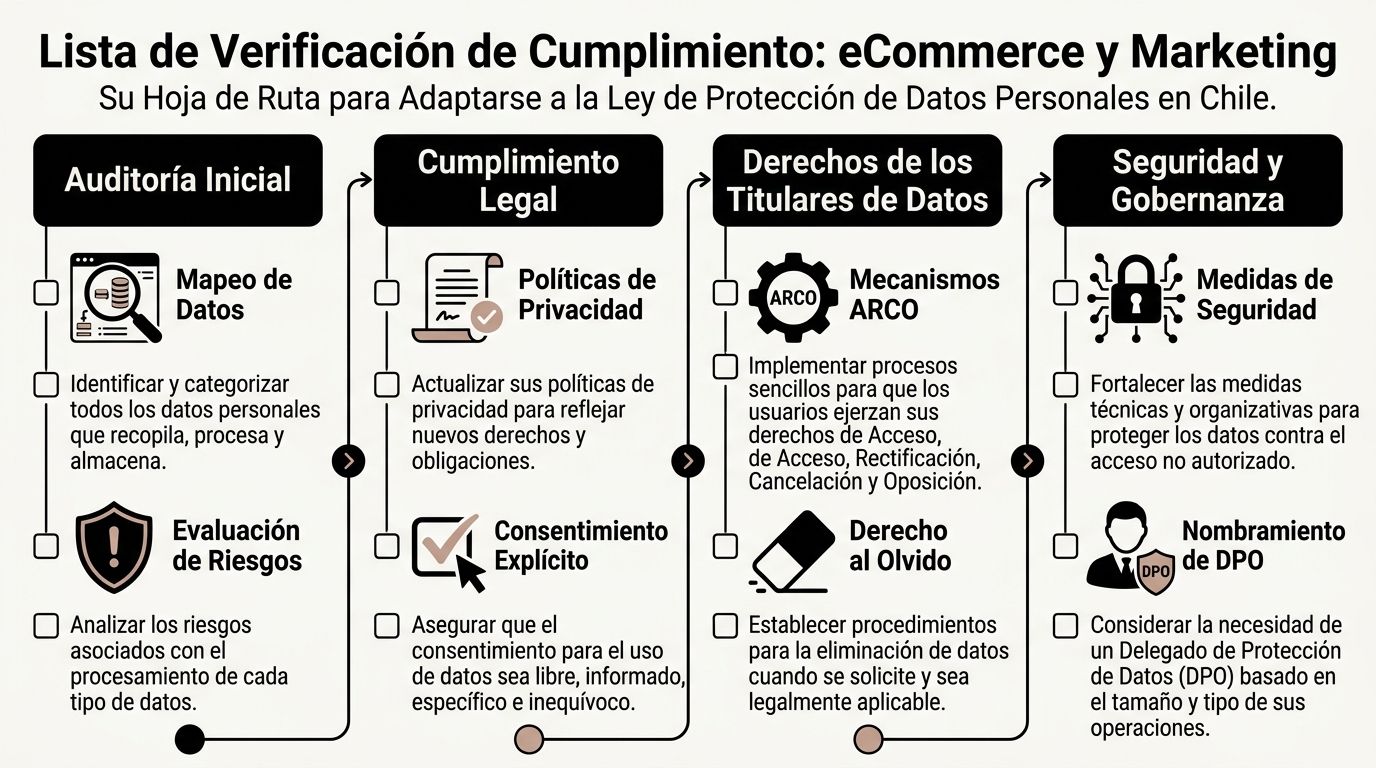
The site can no longer be seen only as a storefront. It is a data collection system.
SignalWhat it revealsGeneric policy downloaded from the internetLack of control over the real processingForms with no explanation of subsequent useRisk of insufficient consentMultiple scripts added by different agenciesLack of technical governanceCookies without clear managementMisalignment between acquisition and transparency
In e-commerce, the problem is not just capturing data. It is that the business depends on it to sell, ship, serve, and build loyalty.
You have to review checkout, user accounts, cart recovery, points programs, logistics integrations, payment gateways, antifraud systems, and after-sales service tools. Each layer adds complexity.
A healthy eCommerce is not the one that accumulates the most data. It is the one that best distinguishes between useful data, sensitive data, and unnecessary data.
This is the most delicate part because almost all modern digital growth depends on some level of tracking, segmentation, or personalization.
Marketing teams should audit, at minimum:
You do not need to turn the adaptation into unmanageable bureaucracy. But you do need to establish a serious base.
Companies that start now will reach 2026 with control. Those that wait will have to adapt sites, campaigns, contracts, and processes all at the same time. That scenario always ends up more expensive.
Most guides on Chile's personal data law stop at consents, policies, and breaches. That is insufficient. The most complex points are elsewhere: international transfers and AI applied to marketing.
If your company uses Google Analytics, cloud platforms, foreign CRMs, support tools, automation SaaS, or AI models to classify leads and analyze behavior, you are already touching these two fronts.
It is not. Every time personal data leaves the local perimeter or becomes accessible to an international provider, the company needs to understand under what conditions that transfer operates and what guarantees support it.
The usual problem is not bad faith. It is executive ignorance. Many companies buy technology for functionality, price, or speed of implementation, but never review implications of privacy, contract, jurisdiction, or subprocessors.
That creates an unnecessary fragility, especially in companies with binational or regional operations.
AI adoption in eCommerce in Chile rose 37% in the last year, but most companies do not carry out Data Protection Impact Assessments for large-scale processing such as user profiling or systematic monitoring, according to this analysis on Chile's privacy law and its impact on AI.
That data matters because many "marketing" decisions are, in reality, automated decisions about people. Which lead gets prioritized. Which offer a user sees. Which segment receives a sequence. Which traffic is considered most valuable. Which pattern triggers a commercial action.
For teams that make decisions from dashboards, attribution, and consolidated reporting, it is also worth reviewing how data is centralized and who controls access. This perspective on Looker Studio Pro and its use in more demanding reporting environments helps think about that layer with more judgment.
AI does not eliminate responsibility. It concentrates it. If an algorithm influences a commercial decision, the responsibility still belongs to the company.
The company that wants to keep innovating with AI and global tools will have to professionalize two things. First, contractual and provider review. Second, the ability to justify why certain automated processing activities are proportionate, necessary, and governable.
The future will not be less data-intensive. It will be more demanding about the quality of its management.
Companies that read this law only as a threat will react late and badly. They will do the minimum, under pressure, focused on putting out fires. That rarely produces a good digital operation.
The right reading is another. The law forces you to organize something that was already disorganized. And that order generates value.
A company that maps its data well understands its operation better. A company that asks for less unnecessary information improves friction. A company that documents criteria cleans up its stack. A company that reviews providers reduces blind dependency. A company that manages consent with clarity builds trust.
That is the most underrated point. Well-managed privacy does not slow growth. It makes it more sustainable.
In the coming months, the smartest teams will not be the ones discussing how to "dodge" Chile's personal data law. They will be the ones using it to improve governance, data quality, customer relationships, and the ability to scale with fewer vulnerabilities.
The right agenda for the C-suite is concrete:
Complying will be mandatory. Turning that effort into a competitive advantage will be a management decision.
If your company needs to turn this regulatory requirement into a clear roadmap for its digital operation, Bigbuda can help you organize sites, eCommerce, analytics, automation, and growth processes with a strategic perspective oriented toward performance, governance, and scalability.
Related reading: E-commerce: Master Data Protection Law in 2026
Law 21.719 was published on December 13, 2024 and is in force from December 1, 2026. It is not a minor update to Law 19.628: it redesigns how companies must capture, use, share and safeguard personal information, adding a specialized authority with real control powers.
Fines can reach up to 5,000 UTM for minor infractions, 10,000 UTM for serious ones and 20,000 UTM for very serious ones. The percentage of revenue (2% for serious and 4% for very serious infractions) applies only to companies that are not smaller-sized enterprises under Law No. 20.416 and that also reoffend, and it is calculated on the last calendar year's annual revenue from the business line, not on a group's global sales.
The law does not set a deadline in days. Article 14 sexies requires the controller to report to the Agency, by the quickest means possible and without undue delay, any breach that causes the destruction, leakage, loss, or alteration of personal data, or unauthorized access to it, when there is a reasonable risk to the rights and freedoms of data subjects. When the breach affects sensitive data, data of children under fourteen, or economic, financial, banking, or commercial data, each affected data subject must also be notified. Breach notification is the obligation most underestimated by eCommerce and high-traffic sites.
Yes, but with one condition: the company must be able to sustain that logic when a user objects or asks to limit the processing. If the growth team uses automatic rules to change CTAs, prioritize leads or segment traffic by behavior, consent and legitimate basis can no longer be a formality.
Treat it as a cross-cutting audit, not a legal task. Review forms and capture points, the consent banner and the privacy policy on the acquisition side. Then checkout, user accounts, cart recovery, points programs, logistics integrations, payment gateways, antifraud systems and after-sales tools, plus lead databases, automations and advertising audiences.
Yes. Every time personal data leaves the local perimeter or becomes accessible to an international provider, you need to understand under what conditions that transfer operates and what guarantees support it. AI adoption in eCommerce in Chile rose 37% in the last year, yet most companies skip Data Protection Impact Assessments.