










Solutions
Explore how to grow

Data protection has stopped being a legal obligation and has become a fundamental strategic asset. For business leaders and marketing teams, the way a company manages its customers' information not only defines its reputation, but directly impacts its capacity for growth and its sustainability in today's competitive digital environment.
Need help with this? Discover our digital marketing services.
If you still consider privacy management a simple legal requirement, you are overlooking one of the most powerful growth levers. Every digital interaction, from a visit to your website to a purchase, is a pact of trust. The customer hands over their data expecting value in return and, fundamentally, that you treat that information with maximum respect and security. When that trust is broken, the commercial relationship fractures.
When a company demonstrates a real commitment to privacy, the effects are felt directly in the numbers that matter most:
Investing in a solid privacy strategy is not an expense; it is a direct investment in your business's profitability and sustainability. Every decision about how you collect, use, and protect data echoes in the perception of your brand and, ultimately, in your bottom line.
Poor management can destroy in seconds the trust that took years to build. Conversely, an approach that puts the customer and their privacy at the center creates a competitive advantage that is hard to replicate.
Regulations, like Law 21,096 in Chile, are not an obstacle, but a guide that drives the adoption of best practices that consumers already demand.
Adopting a privacy-first approach means integrating privacy from the start: in the design of a new product, the choice of a CRM, or the planning of a marketing campaign. It is not about complying with the law out of fear of a fine, but about leading by example. The companies that will thrive in this new era are those that understand that customer trust is their most valuable asset and act accordingly.
Navigating the data protection environment may seem complex, but understanding its rules of the game is a strategic advantage. In Chile, the legal framework has evolved significantly, moving from the old Law 19,628 to the more robust requirements of Law 21,096, which aligns the country with international standards. This is not a simple technical adjustment, but a fundamental change in how companies must relate to their customers and their data.
The new law is comparable to a comprehensive security system, which goes beyond fulfilling a basic function to actively protect assets. This modernization is a logical response to a globalized market where data flows across borders, aligning Chile with regulations like the European GDPR.
The most radical change is the end of tacit consent. Before, silence was interpreted as a "yes" by omission. Today, it is quite the opposite: silence no longer grants permission.
Companies now have the obligation to demonstrate that they obtained explicit, informed, and unambiguous consent for each use of the data. This requires a complete review of forms, cookie notices, and sign-up flows, transforming what was a legal formality into a key touchpoint for building trust.
Beyond consent, the regulation introduces principles that must become part of your business's DNA:
This diagram sums it up well: a solid data strategy is the path to turning distrust into trust and, finally, into loyalty.
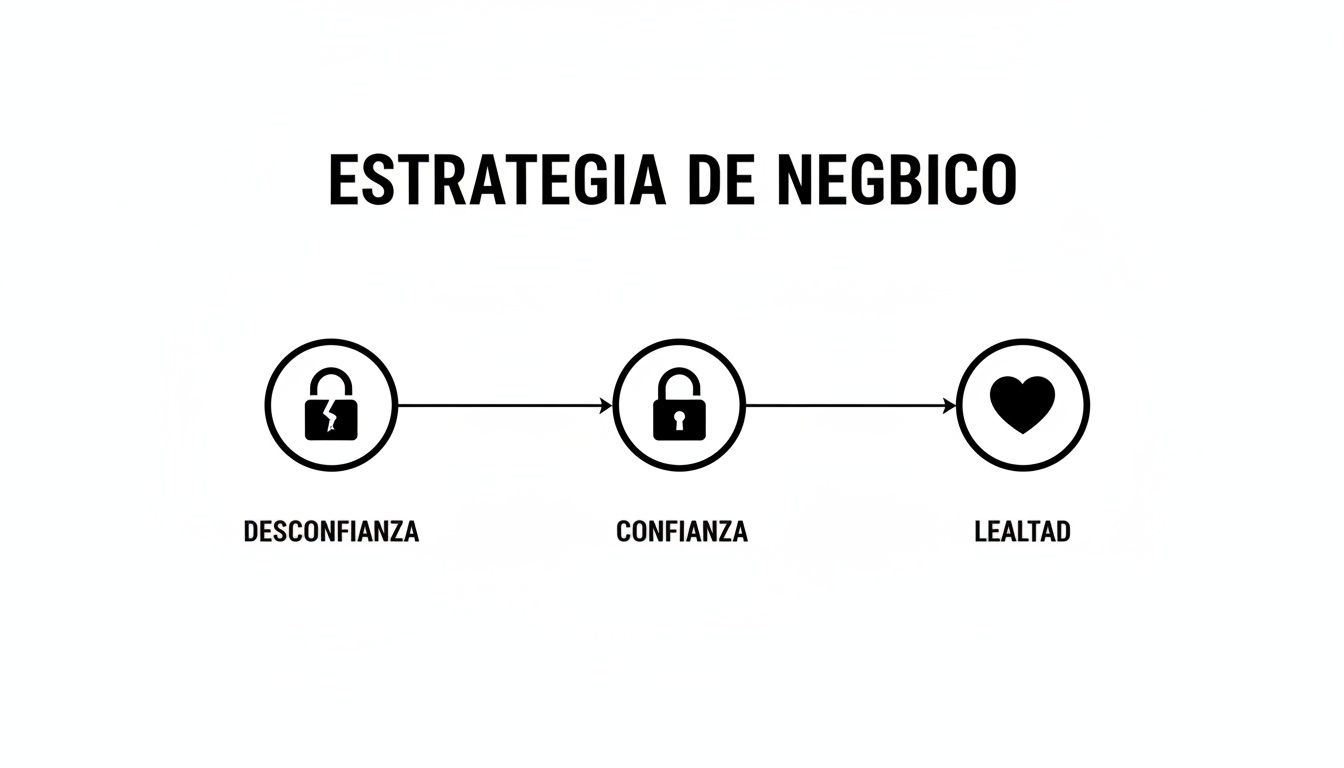
As you can see, trust is not the final goal. It is the bridge that allows you to build a solid, profitable, long-term relationship with your customers.
Another critical point is the obligation to report vulnerabilities. Law 21,096 is clear: if you suffer a security breach, you have a maximum of 5 business days to report it. During 2025, the Data Protection Agency (APD) received a record volume of notifications, a clear indicator of growing scrutiny.
These incidents, which you can review in the APD's annual report, show that a significant portion of breaches directly affect customers' personal data, underscoring the importance of proactive management.
Do not see the legal framework as a list of restrictions. Look at it as an instruction manual for operating successfully in the digital economy. The companies that take it on as a strategic guide, and not as an obstacle, are the ones that will lead the market.
Ultimately, the modernization of the data protection law in Chile is an opportunity for companies to reinforce trust, optimize their operations, and position themselves as responsible leaders.
Digital marketing and conversion optimization (CRO) have been built on the use of data to understand and persuade users. However, the "collect everything and figure out what to do later" approach is no longer just risky, it is bad business. The growing concern about privacy and the new data protection regulations have transformed the rules of the game.

Seeing privacy as an obstacle to marketing is a mistake. In reality, it is a recalibration that forces us to be smarter. A privacy-first approach is not a brake on growth; it is the foundation for building stronger, more profitable relationships. Today, trust is the most important KPI.
The mindset shift is clear: we move from quantity to quality. The real value is no longer in the terabytes accumulated, but in the precision of the data a user provides consciously and voluntarily.
A cookie banner, for example, is your first opportunity to demonstrate transparency and give the user control. When a visitor actively chooses what data to share, the information you obtain, although smaller in volume, is infinitely more valuable. You are dealing with an audience that really wants to hear from you.
Privacy does not eliminate data, it refines it. It forces us as marketers to be more strategic, to focus on the information that really matters to improve the experience, instead of drowning in an ocean of irrelevant data.
Conversion optimization (CRO) depends on experimentation and personalization. Both are affected by the new consent rules. Without a clear strategy, you run the risk of running tests with biased or incomplete data.
This is where strategy becomes fundamental:
Far from being an obstacle, data protection is becoming a powerful selling point. Companies that are transparent about how they use data and make control easy for the user are gaining an enormous competitive advantage.
A customer who understands that you use their information to improve their own experience is much more likely to trust and, therefore, to buy. Transparency thus becomes a tool of persuasion, demonstrating that you sell respect and security, in addition to your product. This approach not only improves short-term conversions, but fosters loyalty and creates a virtuous cycle of trust and growth.
Taking the legal theory into practice is the moment when a data protection strategy is truly put to the test. This goes far beyond ticking boxes on a checklist. It is about integrating each requirement into the DNA of your business to strengthen customer trust and optimize the experience on your site.

The goal is to transform an apparent obligation into a competitive advantage. From a well-designed cookie banner to an understandable privacy policy, each piece must work as a growth engine, not as a brake.
The cookie banner is the first digital handshake between your brand and a visitor. A clumsy or confusing design not only frustrates the user, but pushes them to reject tracking, leaving you without key data for your marketing and CRO analysis.
A smart approach focuses on:
Your privacy policy must be a manifesto of transparency that explains, in simple language, what data you collect, what you use it for, and how you protect it.
Likewise, every form must be based on the principle of data minimization.
Request only the information strictly necessary to fulfill your promise. Each extra field is an obstacle that can reduce your conversions and increase your legal liability.
Include links to your privacy policy and checkboxes (never pre-checked) to obtain explicit permission for marketing communications.
Your responsibility extends to all the providers that handle your customers' data: CRM, email marketing, or payment gateways.
It is crucial that your contracts include specific clauses on security and confidentiality. You must ensure that your providers also comply with the law and have robust security measures. Choosing a provider based on price alone without auditing their data handling is an enormous risk.
Below, a table that summarizes how each privacy element translates into business value.
ElementStrategic PurposeBusiness ImpactClear Cookie Notice (CMP)Build trust from the first contact, offering transparency and control to the user.Improves the acceptance rate of marketing and analytics cookies, which translates into richer data to optimize campaigns.Readable Privacy PolicyCommunicate the brand's commitment to data protection in a simple, direct way.Strengthens the brand image and reduces distrust, acting as an indirect marketing tool.Optimized FormsReduce friction in lead capture, requesting only the indispensable information.Increases the conversion rate on forms by simplifying the process and respecting the user's privacy.Explicit ConsentBuild a qualified, engaged marketing database, complying with the regulation.Reduces bounce and unsubscribe rates, since the communication is desired by the recipient.Contracts with Providers (DPA)Extend responsibility and good security practices to the entire technology supply chain.Minimizes the risk of fines and reputational crises caused by third-party security breaches.
Each of these components, well implemented, becomes a direct investment in the trust and performance of your business.
Ignoring these practices has a real cost. In Chile, Law 21,096 establishes fines that can reach 4,000 UTM. In 2025 alone, the APD imposed 156 fines for a total of 12.4 billion pesos, and 78% of those sanctions were concentrated in the private sector, especially in eCommerce. In addition, data from Sernac reveals that 1 in 4 consumers in the Metropolitan Region has abandoned online shopping carts after learning about security breaches, which demonstrates a direct, measurable impact on sales.

Data protection is not a plugin you install, but a work culture. Technical security is like the foundations of a building: no one sees them, but they are the only thing preventing a collapse.
Waiting for a breach to happen before taking action is a terrible business strategy. Prevention is about reducing the "attack surface," closing unnecessary doors and windows in your digital infrastructure.
The goal is to build a system that is secure by default. It is not about buying the most expensive technology, but about intelligently configuring the tools you already use.
The essential practices we apply in serious projects are:
In our experience, the biggest risks usually lie in overlooked details, like exposed configurations or forgotten user permissions. If you use WordPress, it is crucial to review certain critical points. You can dig deeper in our article on the importance of WordPress security.
One of the most solid pillars of data protection is the principle of least privilege. The logic is simple: each user, whether an employee, a collaborator, or an application, must have access only to what they need for their function. Not one permission more.
We manage access under the principle of least privilege. In addition, active credentials are reviewed periodically and those that are no longer necessary are removed. This reduces the risk of exposure and maintains control over sensitive information.
This approach drastically reduces the potential damage if an account is compromised. It limits the blast radius. Credential management, which includes not using weak passwords and revoking them immediately when someone leaves the company, is the other side of the coin. Technical security is not a product you buy, but a constant process of vigilance and adjustment.
A well-executed data protection strategy is a continuous discipline. This checklist is not a list of technical tasks, but a set of strategic questions for leaders and marketing teams. Use it to audit your current situation, detect blind spots, and use privacy as a competitive advantage.
Before protecting something, you must know what it is and where it is. Without a clear map of the information you manage, any protection effort is useless.
The way you ask for permission says a lot about the respect you have for your users. Consent obtained through tricks destroys trust.
Thinking strategically about data protection is not a project with a start and end date. It is a discipline that must be integrated into the company's culture, from how a product is designed to the way a marketing campaign is planned.
Your responsibility does not end at your own infrastructure. Each provider with access to customer data is an extension of your brand and your responsibility.
The demand from users for more control is a reality. In the Chilean context, 91% of people demand greater control over their data. The implementation of consent banners under Law 21,096 is already showing results: 24.8% of eCommerce report improvements in customer trust. However, the figures also warn: in 2025, the private sector reported 950 security breaches, and 55% of them came from sites with high traffic but poor privacy optimization. You can dig deeper into these statistics and their impact in data privacy management.
To conclude, let's address the questions that arise in board meetings and marketing teams, with clear, applicable answers.
Forget about the fines for a moment. The biggest risk, the one that can really sink a digital business, is the loss of your customers' trust.
When a customer feels that their data is not secure or is used in an unclear way, that relationship breaks. Distrust is reflected directly in your metrics: conversion rates fall, LTV plummets, and your brand reputation is damaged. It is a blow that is very hard to recover from.
No, the law does not require a specific certificate. What matters is being able to demonstrate that you are implementing good security and data management practices. This means adopting industry standards, starting from a secure-by-default configuration.
Think about applying the principle of "least privilege," reviewing access permissions periodically, and acting with diligence. It is about having a culture of prevention, not collecting diplomas.
Data protection is not a technical solution you buy and install. It is an ecosystem of best practices that must be integrated into the company's DNA. Preventing with secure configurations and access control will always be infinitely cheaper than managing a crisis.
This is where the law becomes practical. It forces you to be completely transparent. You must inform your users, in a simple way, what data you collect, what you use it for, and which third-party tools are involved.
This translates into having a clear privacy policy and cookie notice. You need the user's explicit consent before activating any tracking. In addition, you are responsible for your providers. Review your contracts with the CRM, the email marketing platform, and other services to make sure they also comply with data protection standards. Under the law, the responsibility for the entire processing chain is yours.
At Bigbuda, we see data strategy as the foundation of sustainable digital growth. It is not just about complying with a regulation, but about building the trust that turns a visitor into a loyal customer. If you want your web platform to be secure, scalable, and ready to convert, let's talk about your project.
Related reading: E-commerce: Master Data Protection Law in 2026