










Solutions
Explore how to grow

The worst advice still circulating about shipping companies is this: choose the cheapest one and negotiate a few pesos less per dispatch. That logic serves to protect a spreadsheet. It doesn't serve to grow an eCommerce.
This is amplified with a good digital marketing service.
Shipping isn't the last operational step. It's a direct part of the sale. It affects what happens before payment, during the wait and after delivery. If your logistics promise generates doubt, the customer doesn't convert. If the tracking is poor, complaints rise. If delivery fails, repurchase cools. And if that repeats, your brand starts to lose value even if your product is good.
In Chile, that's no longer a minor detail. An analysis cited by Tealca on abandonment and logistics in eCommerce indicates that 62% of buyers abandon the cart due to unexpected additional costs and 41% due to long delivery times. In the same context, the Santiago Chamber of Commerce reported 2024 online sales of US$ 11.5 billion, which confirms that logistics already touches a critical mass of digital commerce.

Many teams still treat shipping as a necessary nuisance. They pressure the provider to lower the rate, close the matter and go back to paid media, catalog or promotions. That approach leaves money on the table.
The right shipping company doesn't just move packages. It reduces friction at checkout, protects the post-purchase experience and sustains repurchase. The wrong one does the opposite. It introduces noise at the most sensitive moment of the funnel and turns a won sale into a fragile relationship.
Most eCommerces invest heavily in acquisition and creative, but hand the final moment of the experience to an operator that doesn't control the first and last leg well. That's where a contradiction arises: a brand promises convenience and ends up delivering uncertainty.
That shows up immediately in three points:
The customer doesn't separate your brand from your logistics operator. If the dispatch fails, to them you failed.
A shipping company doesn't compete only on price. It competes on commercial impact. If it helps you promise better, fulfill better and communicate better, it has stopped being a pure cost. It became a lever for conversion and retention.
That's why the useful question isn't "which courier charges less." The useful question is "which logistics partner best protects my future margin." That difference changes how you evaluate coverage, technology, returns, integration and support.
Poorly managed logistics absorbs budget. Well-designed logistics amplifies the value proposition. That's the difference between buying transport and building a competitive advantage.
The problem is that many online stores look at a shipping company's catalog as if it were a simple list of rates. It isn't. It's a menu of strategic decisions.
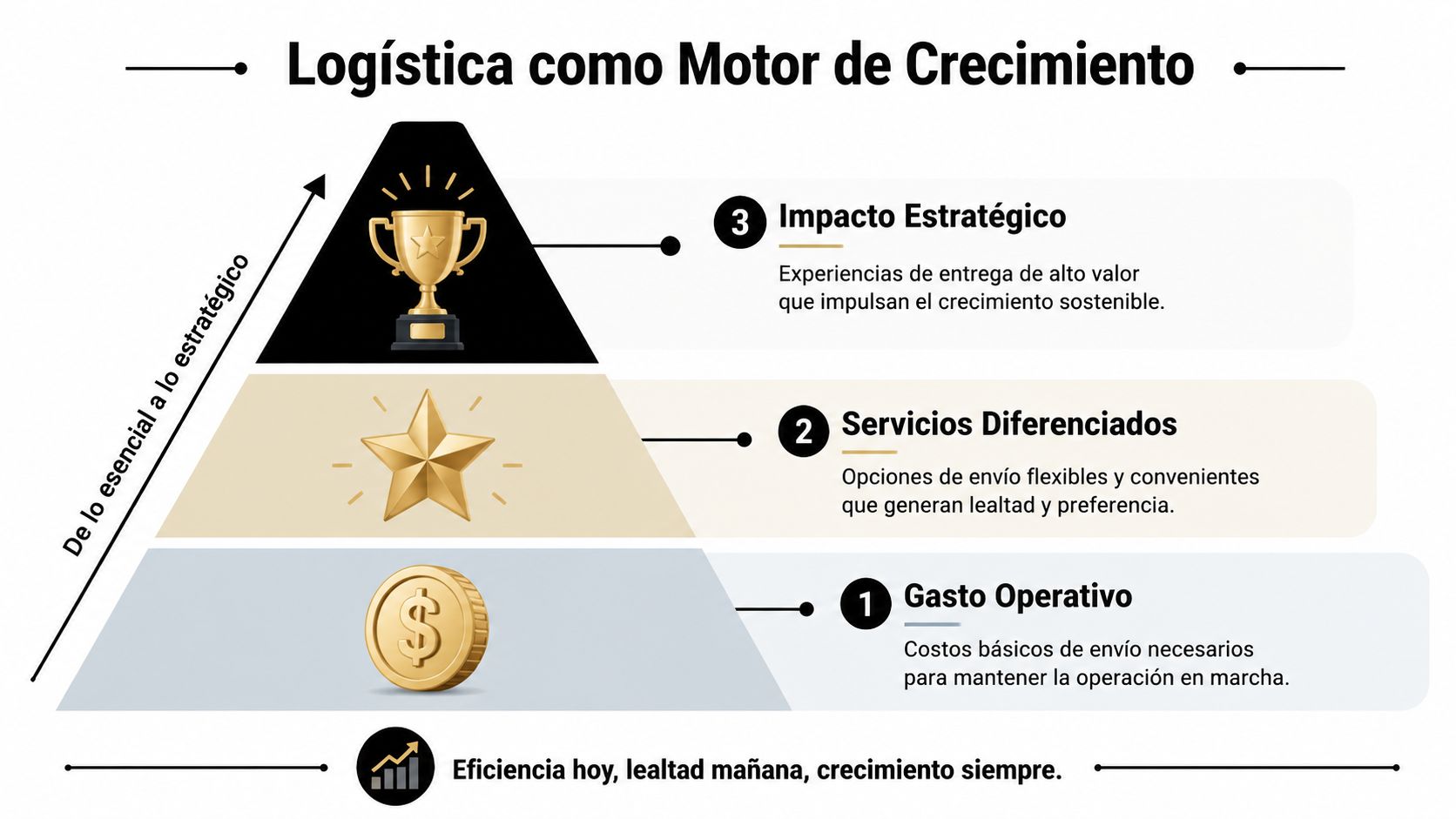
An express service doesn't serve only to "deliver fast." It can defend urgent sales, time-sensitive categories and replenishment purchases where delay destroys intent.
Scheduled shipping isn't a secondary convenience either. In categories where the customer needs to coordinate reception, a clear window reduces friction and lowers the perception of risk. That improves the experience even before the package leaves the warehouse.
Cross-border deserves an even more serious reading. It's not just internationalizing dispatches. It's opening markets without destroying the experience through customs, documentation or poorly resolved returns.
Not all operations need the same model. That's where many businesses go wrong. They copy the structure of a larger company or improvise with a smaller one.
For brands in expansion, a model with a specialized third party is usually more reasonable when the main focus is on selling more and not on operating a fleet. The advantage isn't only in outsourcing effort. It's in accessing coverage, processes and technology that would take time to build internally.
It's usually useful when:
There are businesses where it's worth combining internal control and an external operator. For example, managing a critical part of urban dispatch and outsourcing extended coverage or complex routes.
That approach works well when the brand needs to control certain sensitive moments, like premium deliveries, delicate products or a very careful unboxing experience, but doesn't want to carry all the logistics complexity.
Rule of thumb: if your commercial model depends on a specific delivery promise, don't delegate that promise without reviewing which part of the process you control and which you don't.
Some companies sell price. Others sell convenience. Others sell trust. Logistics changes the real weight of each positioning.
If you compete with marketplaces or large retailers, speed can help you close a perceived gap. If you sell higher-ticket products, traceability and support weigh more than a few pesos less on the rate. If you grow in the region, the ability to document well and resolve incidents is worth more than an aggressive commercial promise.
Not all shipping companies serve the same strategy. Choosing well requires starting from the business's value proposition, not from the courier's rate.
If in the meeting with an operator you only ask about price, coverage and "estimated" times, you're buying blind. The serious thing is to audit how it sustains your store's commercial promise when the operation comes under strain.
In Chile, the critical variable is operational reliability, measured in traceability and transit times. In addition, optimization must be based on real corridors and precise dispatch windows, because delays in the first or last leg explain much of the friction with the customer. When that fails, support tickets rise and repurchase drops, as detailed in the statistics and analysis of foreign trade and logistics flows published by the Ministry of Commerce.
The operator's technology matters as much as its vehicles. If tracking arrives late, if the order status doesn't update coherently or if the integration goes down at moments of high demand, the problem isn't technical. It's commercial.
Ask uncomfortable questions:
A technologically weak operator forces your service team to compensate with manual work. That doesn't scale.
The real operation never looks like the brochure. There are campaigns, partial stockouts, address changes, complex districts, atypical packages and returns. That's where you see whether you're working with a partner or with an outsourced problem.
Evaluate their flexibility in concrete situations:
Many operators work well at moderate volume and degrade when the store grows. The point isn't whether they can take on more packages. The point is whether they can maintain consistency when your business rises in complexity.
A good sign is that they can explain how they segment the operation by zone, service type and dispatch windows. A bad sign is that they answer everything with "it depends."
Don't hire only for the current volume. Hire for the volume you want to sustain without damaging your brand.
When a shipment fails, the only thing that matters is the speed and clarity with which it's resolved. Slow support equals frustrated customers and a saturated internal team.
Do this mental test: if several key orders go missing tomorrow, who do you call, which channel responds and how much control do you have over the case? If the answer is vague, that provider has already shown you its limit.
Criterion / What's worth seeing / Warning sign. Tracking / Clear and consistent milestones / Ambiguous or late statuses. Operation / Specific answers by zone and flow / Generic promises. Scalability / Capacity explained with processes / Commercial reassurance without detail. Support / Case owner and clear response times / Impersonal help desks.
The choice of operator must also fit your commercial stack. If you're still reviewing that foundation, it's best to organize the sales infrastructure first. This guide on the best eCommerce platforms for Chile helps evaluate that fit from a more strategic view.
Most brands analyze shipping after payment. That's the mistake. The impact starts much earlier, at the exact moment when the customer decides whether to buy or abandon.
If timeframes aren't clear, if the cost appears late or if the promise seems unbelievable, the checkout loses strength. There it's not just a sale that falls. The perception of professionalism also weakens.

Many eCommerces believe that showing several dispatch alternatives is enough to improve conversion. Not always. If the options are confusing, generic or unreliable, the excess of choice doesn't help.
What does move the needle is offering an understandable promise. A reasonable estimated date. A visible charge. Clear differences between express, scheduled and standard. If the information reduces doubt, the customer advances. If it forces them to interpret, they stall.
Once paid, the anxiety changes form. The customer no longer asks whether it's worth buying. They ask whether they can trust. And that answer depends on how the shipping is communicated.
A generic carrier link resolves little. A clear, legible tracking experience consistent with the brand resolves much more. It reduces unnecessary contacts, lowers uncertainty and sustains the sense of control.
Good tracking isn't a courtesy. It's a retention tool.
Many teams look at delivery as a fulfillment metric. They should see it as an LTV variable. The reason is simple: the customer remembers a kept or broken promise more strongly than the operator's internal efficiency.
When they receive timely updates, believable windows and consistent delivery, they interpret that the store is reliable. When they receive silence, disorganized retries or unhelpful statuses, the next purchase competes with that memory.
There's a direct connection between logistics friction and abandonment. To go deeper into that layer of the funnel, it's worth reviewing this analysis on how to reduce cart abandonment, where the clarity of the offer and trust play a central role.
Speed matters, yes. But certainty usually matters more. Many customers tolerate waiting if they know what's going to happen. What they penalize is the sense of being out of control.
That's why it's best to think of shipping as part of the experience, not as backstage. A well-presented logistics promise reduces anxiety, protects margin and improves the chance that the customer returns.
You can hire a good shipping company and still operate badly. It happens when the technical integration is weak, partial or manual. In that scenario, the operator doesn't compensate for the disorder. It amplifies it.
Modern logistics depends on connected systems. If your store, inventory, orders and dispatch don't talk well, the problem doesn't appear only in the warehouse. It appears at checkout, in customer service and in operational profitability.

Many businesses choose an operator by geographic reach and leave the integration for later. That's a priority mistake. If the technical layer fails, the promised coverage doesn't translate into a reliable experience.
A solid integration lets you automate labeling, sync statuses, calculate rates with commercial logic and trigger post-purchase communications without manual intervention. That's not a luxury. It's the foundation for scaling without multiplying errors.
In Chile, the operator's value isn't only in moving packages. Its ability to handle documentation, assistance in customs inspection and complementary processes also weighs. Delays usually originate in documentary failures, and when those processes are well integrated, failure costs are reduced and the delivery promise improves, according to Triple M's analysis on logistics services, documentation and customs inspection.
That point is usually underestimated in eCommerce. Especially in operations with imports, exports or cross-border sales, documentary quality stops being an administrative matter and becomes a commercial factor.
If your operation depends on manual steps to review documents, correct data and push statuses, you don't have scalable logistics. You have fragile logistics.
Manual operation holds up while volume is manageable. After that it starts to break things. Tasks are duplicated, dispatch-related picking errors rise, inconsistencies appear between what was sold and what was dispatched, and the team loses time resolving exceptions instead of improving the business.
The point isn't to automate as a trend. It's to automate to protect margin and growth capacity. A store that sells more but coordinates shipments with weak processes isn't scaling well. It's just running faster toward friction.
Shopify, WooCommerce and more customized configurations offer different integration possibilities. You don't need to get into a tutorial to understand the essentials: the platform you use conditions how fluid the dispatch will be, how precise the shipping calculation will be and how much visibility you'll have over the order.
If your operation combines catalog, inventory, invoicing and dispatch, the connection between systems stops being a secondary project. This analysis on the integration of Bsale and WooCommerce shows why that technical layer directly impacts operational consistency.
Negotiating with shipping companies as if you were only buying a rate is a bad practice. It leaves you exposed in everything that later destroys margin: breaches, retries, slow returns, weak support and commercial promises impossible to sustain.
The right conversation doesn't start with "how much do they charge." It starts with "which conditions will protect my business when the operation gets complicated."
Price matters. But in isolation it says little. Two operators can charge similar amounts and produce very different results for your conversion, your operational load and your repurchase.
In Chile, a rarely addressed angle is the ability to manage returns and cross-border sales efficiently. The useful question isn't who delivers fastest, but which operator reduces uncertainty in customs duties and reverse logistics, as raised in this analysis on traceability, returns and the regulatory context of cross-border commerce.
Negotiation Area / Key Metric to Negotiate / Strategic Impact on the Business. Service level / Delivery promise fulfillment / Protects conversion and satisfaction. Incidents / Resolution time and quality / Reduces pressure on internal support. Returns / Smoothness of reverse logistics / Protects margin and post-purchase experience. Cross-border / Operational clarity in customs and taxes / Reduces uncertainty for regional expansion. Technology / Integration quality and traceability / Sustains scalability and visibility. Peak season / Operational priority in high demand / Avoids degradation during commercial events.
If your agreement doesn't define what happens in case of breaches, incidents or saturation, in practice you don't have a management framework. You have a soft commercial promise.
It's best to put elements like these in writing:
Many brands still evaluate the carrier with a single figure: average cost per shipment. That metric is useful, but it isn't enough. A cheap operator can turn out expensive if it forces you to subsidize errors, absorb complaints or lose repurchase.
A useful dashboard should include at least these layers:
What you don't measure in logistics ends up showing up in support, reputation or repurchase.
Before renewing a contract or switching partners, review this:
Negotiating well isn't about squeezing the provider until the rate drops. It's about designing a relationship where the operator has clear incentives to take care of your customer experience.
The choice of a shipping company no longer belongs to the operational area. It belongs to the core of digital growth. If it affects checkout, trust, repurchase and support, then it affects sales.
That won't lose relevance. In Spain, a mature market, the parcel segment grew 15.4% in 2023 and went from 879.17 million shipments in 2022 to 1,014.33 million in 2023, driven by eCommerce, according to the report cited by El Mercantil on the sector's historical record in CEP. The last mile is already a structural piece of digital commerce. Treating it as a commodity is an expensive decision.
If your eCommerce already has traffic but isn't converting or retaining as it should, Bigbuda can help you review the complete experience, from checkout and logistics promise to CRO, UX and operational integration, to turn the same traffic into more sales and better repurchase.
No. A shipping company doesn't compete only on price; it competes on commercial impact. If it helps you promise better, fulfil better and communicate better, it stops being a pure cost. The useful question isn't which courier charges less, but which logistics partner best protects your future margin.
It affects checkout directly. The article cites analysis where 62% of buyers abandon the cart because of unexpected additional costs and 41% because of long delivery times. What moves the needle is an understandable promise: a reasonable estimated date, a charge visible early, and options that respond to a real need.
Technological reliability: which tracking milestones exist, how they respond when integrations fail, and whether the customer-facing information reduces uncertainty. Operational flexibility during commercial peaks, reverse logistics and exceptions such as incomplete addresses. Real scalability explained through processes by zone and service. And support with a case owner and clear response times.
A solid integration should generate labels automatically to avoid rework, synchronize statuses so customer and internal team see the same reality, calculate shipping rates with commercial logic so you don't over-promise or badly subsidize dispatch, and trigger post-purchase communications from the order's real milestones without manual intervention.
Service level measured by delivery promise fulfilment, incident resolution time and quality, the smoothness of reverse logistics, operational clarity in customs and taxes for cross-border, integration quality and traceability, and operational priority during peak season. The contract should also define escalation, incident protocols and high-demand capacity in writing.
Average cost per shipment is useful but insufficient. Track on-time delivery segmented by zone, service and commercial period; customer inquiries per shipment, which rise when promise, tracking or resolution fail; retries and exceptions, which show where the experience breaks; and delivery promise accuracy. What you don't measure surfaces in support and repurchase.