










Solutions
Explore how to grow

Your store sells more than a year ago, but you understand your business less. That is the real problem.
At Bigbuda we help you with digital marketing services.
Sales come in through Shopify or WooCommerce, payments move across several channels, the accountant works in another system, and your marketing team optimizes campaigns with metrics that do not always match validated invoicing. At the end of the month, there is activity. There is no clarity.
When someone searches for “nubox que es”, many answers stay at the basics: accounting software, invoicing, payroll. That is correct, but insufficient. For an SME that is growing online, Nubox matters for another reason. It can become the financial control point of the entire digital operation.
Financial disorder does not usually appear because the company is poorly managed. It appears because the business grew faster than its operational infrastructure. What used to be solved with spreadsheets and manual review stops scaling. Late closes begin, discrepancies between sales and accounting, purchasing decisions without cash visibility, and marketing investment based on intuition.
Practical rule: if your sales, cash, and tax compliance data live in separate systems, you do not have control. You have fragments.
A well-connected financial platform changes that. It does not replace strategy. It makes it possible. It lets you move from “we think this channel works” to “we know which channel leaves margin, which line consumes cash, and what growth pace you can sustain without straining the operation.”
That is the right frame for understanding Nubox. Not as an administrative expense. As management infrastructure to keep growing without losing control.
Digital growth has a trap. Orders increase, tax documents multiply, and the operation accelerates, but the financial reading of the business becomes slower. The sales team celebrates. Finance runs behind.
In many Chilean SMEs, the first symptom is not an accounting problem. It is a coordination problem. Shopify shows one figure, the bank another, the spreadsheet another, and the real close arrives when the important decision has already been made. That affects purchasing, promotions, hiring, and the marketing budget.
If your company sells through digital channels, the problem is not issuing more documents. The problem is that each sale generates consequences across several layers at the same time:
When that data does not connect, the company does not scale with intelligence. It scales with friction.
A platform like Nubox enters at exactly that point. Not just to “make accounting easier,” but to turn transactions into management information. That difference matters a great deal for an eCommerce manager.
With unified data, the conversation changes. It is no longer just about complying with taxes or closing balances. It is about answering business questions: which channel is worth pushing, which campaign generates real invoicing, which category turns over well but destroys margin, and what pace of investment the cash can support.
You do not need more reports. You need a single reliable base to decide from.
The best way to answer “nubox que es” is not to call it accounting software. That label shrinks it. Nubox works better if you think of it as a financial operating system.
An operating system does not do a single task. It coordinates processes, centralizes information, and lets different functions work from a common base. That is exactly what a modern SME needs. Not another spreadsheet. Not another isolated tool. A central layer that organizes accounting, invoicing, payroll, and analysis.
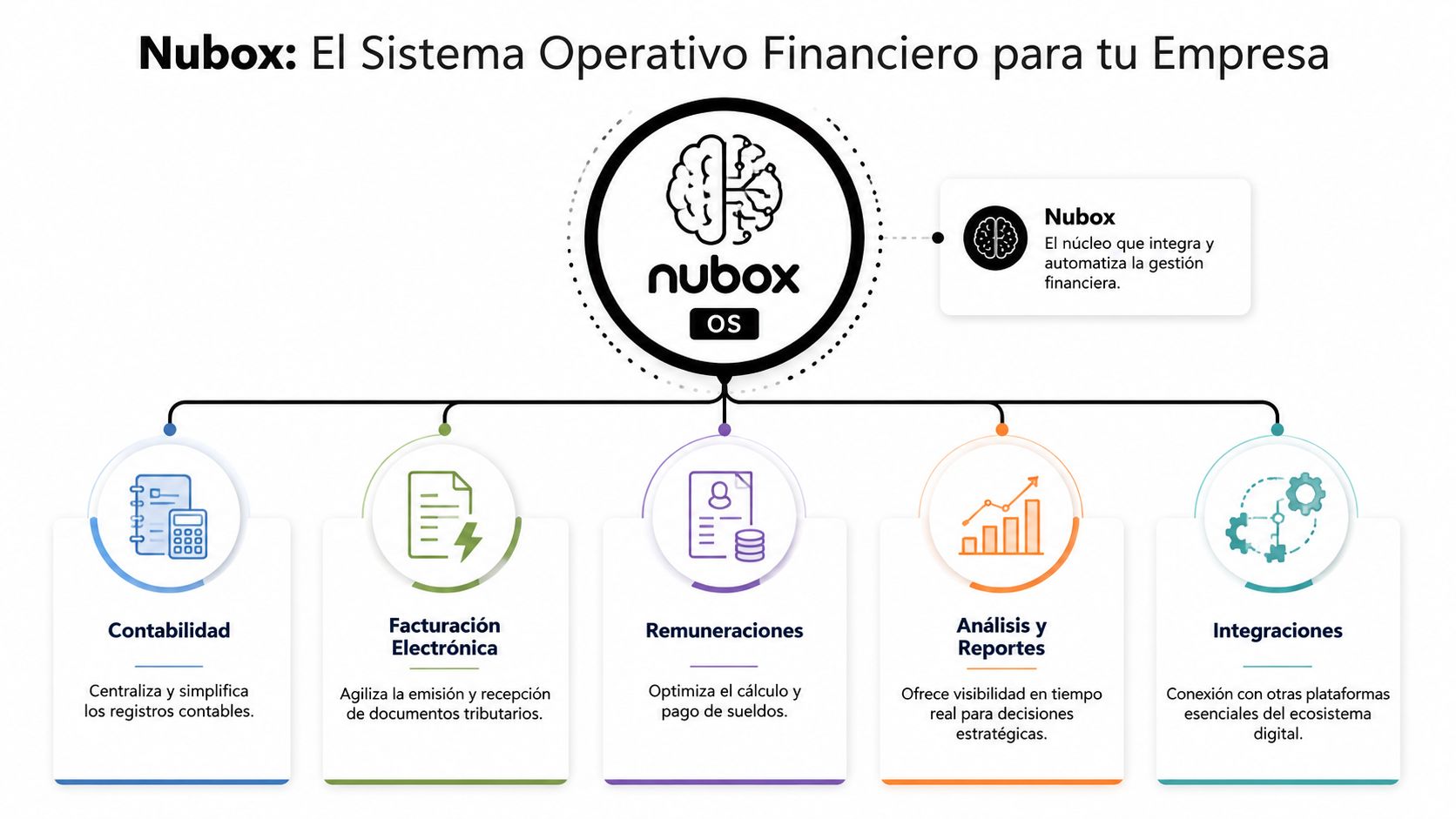
Nubox was founded in Chile in 2001 as Servipyme. It was a pioneer in offering cloud-based administrative software for SMEs. By the end of 2021 it had 13,852 active customers in Chile and was the first to launch the Electronic Payroll Book, according to the Nubox profile on Descubre.vc. That origin is not a decorative detail. It is an operational advantage.
Chile does not reward generic solutions in financial matters. Compliance with the SII, regulatory changes, and the need to operate without local friction make a platform adapted to the market more valuable than an international tool with a good interface but poor regulatory depth.
The company that keeps growing with disconnected systems ends up duplicating work. Someone issues, another corrects, another reconciles, another explains why the numbers do not add up. That is not a talent problem. It is an architecture problem.
Nubox proposes a single source of financial truth. That concept is decisive for CEOs and growth leadership. If marketing, operations, and finance work with different versions of reality, decisions are contaminated from the start.
A digital business does not need more speed in manual tasks. It needs fewer manual tasks.
When a company moves from fragmented processes to an integrated cloud platform, it gains three things:
That change looks a lot like what happens when a company organizes its customer relationships through a CRM. If you are interested in that logic of operational centralization, it is worth reviewing how a CRM works and what it is for. The difference is that here the focus is not on sales, but on the financial backbone that supports everything else.
Most software is sold by features. That is confusing. A manager does not buy “modules.” They buy management capacity. In Nubox, the relevant modules are accounting, electronic invoicing, and payroll. The useful question is not what they do. The useful question is what they unblock.

Accounting should not be a historical archive. It should be a system for reading the business while it moves.
According to the Nubox Accounting listing on ComparaSoftware, its direct integration with the SII can reduce manual reconciliation time by 80%, decrease human errors by 15-20%, and customers report an average reduction of 40% in hours spent on accounting. That figure matters for a simple reason: it frees up the team's time to analyze, not to type.
If your closes arrive late, you steer by the rearview mirror. If they arrive on time, you can adjust investment, purchasing, or pricing before the next month repeats the error.
Many treat electronic invoicing as a regulatory obligation. That is a short-sighted view. Invoicing well and on time accelerates the cycle between sale and collection, reduces administrative friction, and improves traceability.
For an eCommerce, that has a concrete impact on three fronts:
It is not glamour. It is cash. And cash matters more than sales volume.
Paying well and complying well is not just an HR task. It is an operational continuity decision. When payroll fails, the damage goes beyond the administrative error. It affects internal trust, team time, and regulatory exposure.
Nubox also gained local relevance for having been the first to launch the Electronic Payroll Book in Chile, as mentioned earlier. That reinforces something many underestimate: in a growing SME, an organized back office protects the business's ability to execute.
| Module | Problem it solves | Strategic impact |
|---|---|---|
| Accounting | Slow closes and manual reconciliation | Improves the speed and quality of decisions |
| Electronic Invoicing | Fragmented issuance and low traceability | Organizes cash and compliance |
| Payroll | Risk of errors and operational load | Sustains internal stability and compliance |
Evaluation criterion: if a module only “saves time,” it adds efficiency. If it also improves decision quality, it adds competitive advantage.
This is the point that is almost always explained poorly. Nubox's most powerful value is not only in its modules. It is in how it connects with the rest of your digital operation.
If you sell through Shopify or WooCommerce and then move the information into accounting manually, you are operating with a delay. Each delay contaminates analysis, budget, and cash flow. Integration is not a convenience. It is infrastructure.
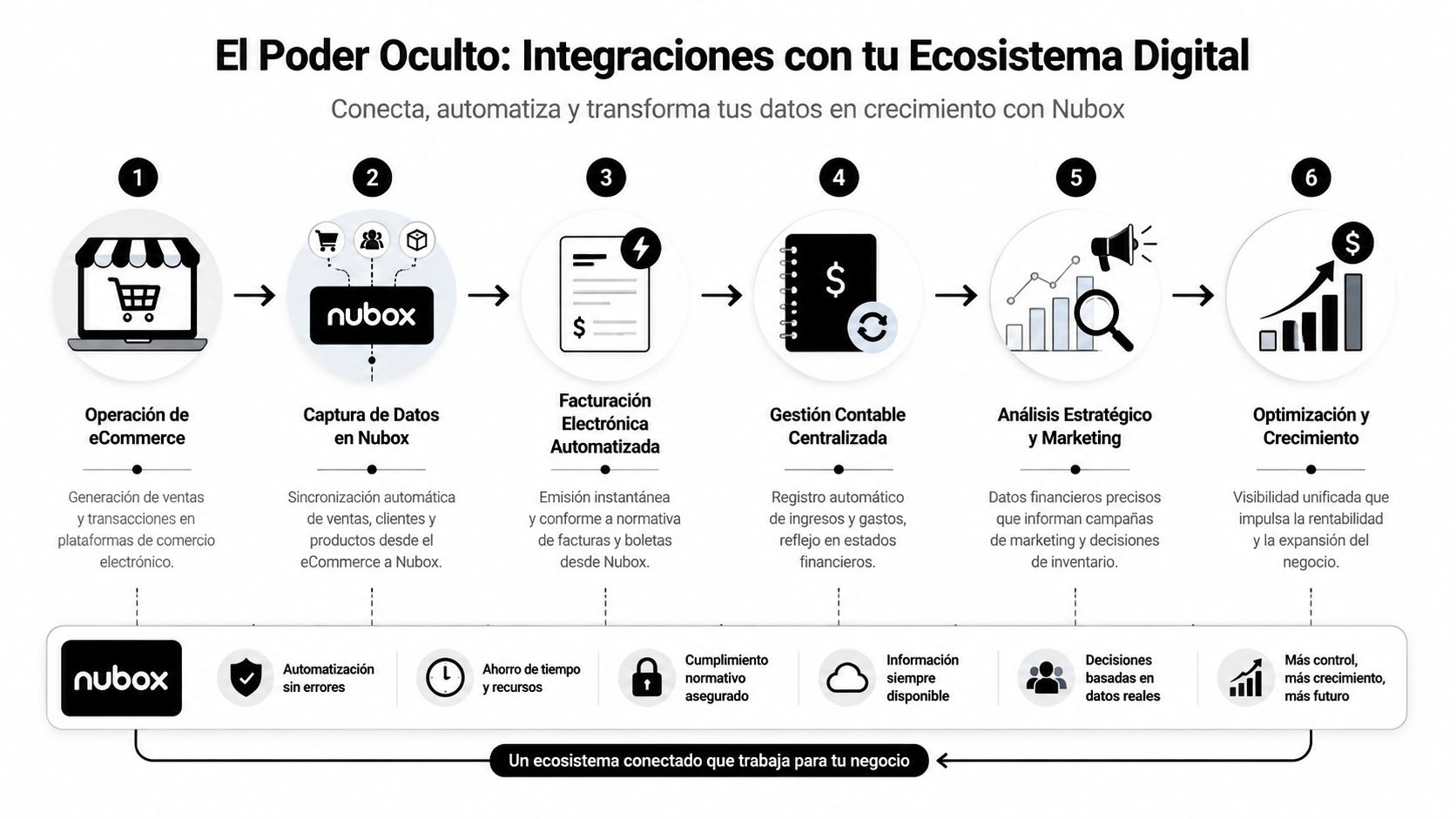
Nubox has 13 certified integrations in its Marketplace and a RESTful API that allows mass data synchronization. In addition, integration with eCommerce tools makes it possible to synchronize inventory and sales, generate cash forecasting with 95% accuracy, and reduce wrong decisions due to outdated data by 30%, according to the Forbes Chile article on Nubox.
That changes the game because it lets you connect what is normally separate:
A mature digital operation should work more or less like this:
When that flow does not exist, marketing optimizes campaigns looking at advertising ROAS and finance closes the month with another story. No one is lying. They are simply looking at different systems.
An eCommerce manager needs to know something more important than the return inside the advertising platform. They need to understand operational profitability by channel, with formalized sales and recognized costs. That reading does not come complete from Meta Ads or Google Ads. It comes when commercial and financial data connect.
If your operation is on WooCommerce, reviewing this integration between Bsale and WooCommerce helps you understand the general logic: the point is not just to automate issuance or recording, but to build data continuity between sale, operation, and finance.
If the marketing team celebrates a campaign that finance considers unprofitable, the problem is not usually the campaign. It is data fragmentation.
In day-to-day operations, Nubox's value appears less in the interface and more in the decisions it enables. The manager does not buy reports to admire them. They buy them to act sooner.

A retail eCommerce sees a good week of sales and assumes it should restock aggressively. That decision seems logical, until you review the real cash position, payment terms, and margin by category. If the financial reading arrives late, the purchase is made with optimism, not with control.
With a more integrated operation, the team can look at sales, issued documents, and financial behavior with greater synchrony. The decision changes. Instead of restocking everything, it prioritizes lines that turn over well and protect liquidity. That kind of precision is not achieved with intuition. It is achieved with a system.
The marketing team usually works with partial data. It sees investment, traffic, conversions, and platform-attributed sales. But that is not enough to answer the question that matters: what part of that invoicing sustains profitable growth.
In that context, a connected financial platform helps cross-reference commercial spend with real invoicing and a cash reading. For teams pushing digital growth, that integration pairs well with a broader view of digital marketing for eCommerce, where the goal is not just to sell more, but to do so with structure.
Growth also demands coordination across areas. The company itself implemented HubSpot and achieved a sustained 30% increase in revenue, according to the analysis published by Bemmbo on Nubox. That figure does not by itself prove what will happen in your company, but it does show a relevant idea: when an organization connects systems and organizes processes, growth stops depending solely on human effort.
Below, a useful visual resource to see the platform in context:
The strategic signal is clear. It is not enough to sell more if each additional point of growth adds opacity, manual work, and operational risk. Digital maturity is not measured only by the store's front end. It is also measured by the quality of the system that turns sales into control.
Comparing Nubox with other alternatives only by price or feature list is a mistake. The right comparison is another one: how well it solves the regulatory and operational reality of a Chilean SME.
Its main strength is in local depth. The integration with the SII, the focus on Chilean tax processes, and the combination of accounting, invoicing, and payroll within a single ecosystem give it a clear position. For a company in Chile, that reduces the friction between daily operation and compliance.
An international tool may look modern and have broad features, but if it demands constant adaptations to fit local logic, the real cost rises. Not always in money. Often in time, dependence on third parties, and risk of error.
Excel is still alive because it gives a sense of control. But it does not scale well when the business starts moving quickly. Spreadsheets work for handling exceptions. Not for sustaining a digital operation with frequent sales, tax documents, payroll, and commercial decisions that depend on consistent data.
Point solutions also have a limit. One for invoicing, another for payroll, another for reports. The problem is not that they work badly on their own. The problem is that they force the company to join later what should have been born connected.
The real alternative to Nubox is not “another software.” Many times it is continuing to operate with fragmentation.
The right question is not whether your company “needs digital accounting.” It probably already needs it. The useful question is whether you are at a point where continuing to grow without an integrated financial base starts to become expensive.
Answer this honestly:
If you checked several, you are not facing a minor administrative problem. You are facing a structural limitation.
A poorly solved challenge in the market is the integration of Nubox with Shopify or WooCommerce for Chilean SMEs. A 2025 CCS study shows that 45% of these SMEs have problems synchronizing financial data, and a correct integration could reduce manual errors by 60%, according to the video that captures this point about the eCommerce integration gap.
That figure should move any CEO or eCommerce Manager. If your sales are born digital, your financial system cannot live disconnected from the channel that generates revenue.
Do not start by buying modules on impulse. Start with diagnosis.
The mature decision is not “buy Nubox.” It is deciding whether your company will keep managing growth with patches or whether it will build a base to scale with control.
If your eCommerce has already grown faster than its internal operation, Bigbuda can help you connect store, data, automation, and business decisions within a more coherent digital ecosystem. The point is not to add tools. It is to make them work together so that growth is profitable, measurable, and sustainable.
Calling it accounting software shrinks it. Nubox works better understood as a financial operating system: it coordinates processes, centralizes information and lets different functions work on the same base. It was founded in Chile in 2001 as Servipyme, pioneering cloud administrative software for SMEs.
The relevant modules are accounting, electronic invoicing and payroll. Accounting solves slow closes and manual reconciliation, improving decision speed. Electronic invoicing organizes cash and compliance instead of being treated as a mere obligation. Payroll reduces error risk and operational load, sustaining internal stability and continuity.
Nubox has 13 certified integrations in its Marketplace and a RESTful API that allows mass data synchronization. According to the Forbes Chile article on Nubox, integration with eCommerce tools makes it possible to synchronize inventory and sales, generate cash forecasting with 95% accuracy and reduce wrong decisions from outdated data by 30%.
Its main strength is local depth: integration with the SII, focus on Chilean tax processes, and accounting, invoicing and payroll inside one ecosystem. For a company in Chile that reduces friction between daily operation and compliance. An international tool may look modern but demand constant adaptation.
When your online sales grew but you still lack a clear reading of profitability by channel; when the team spends too much time reviewing, exporting, consolidating and correcting data; when invoicing and accounting do not talk well with your eCommerce; or when purchasing decisions are made without cash visibility.
Do not buy modules on impulse. Start with a diagnosis: map your current operation, identify where data is born, where it is duplicated and where it is delayed. Define what to centralize first, which for some companies is invoicing and for others accounting or payroll, and evaluate integrations before isolated features.