










Solutions
Explore how to grow
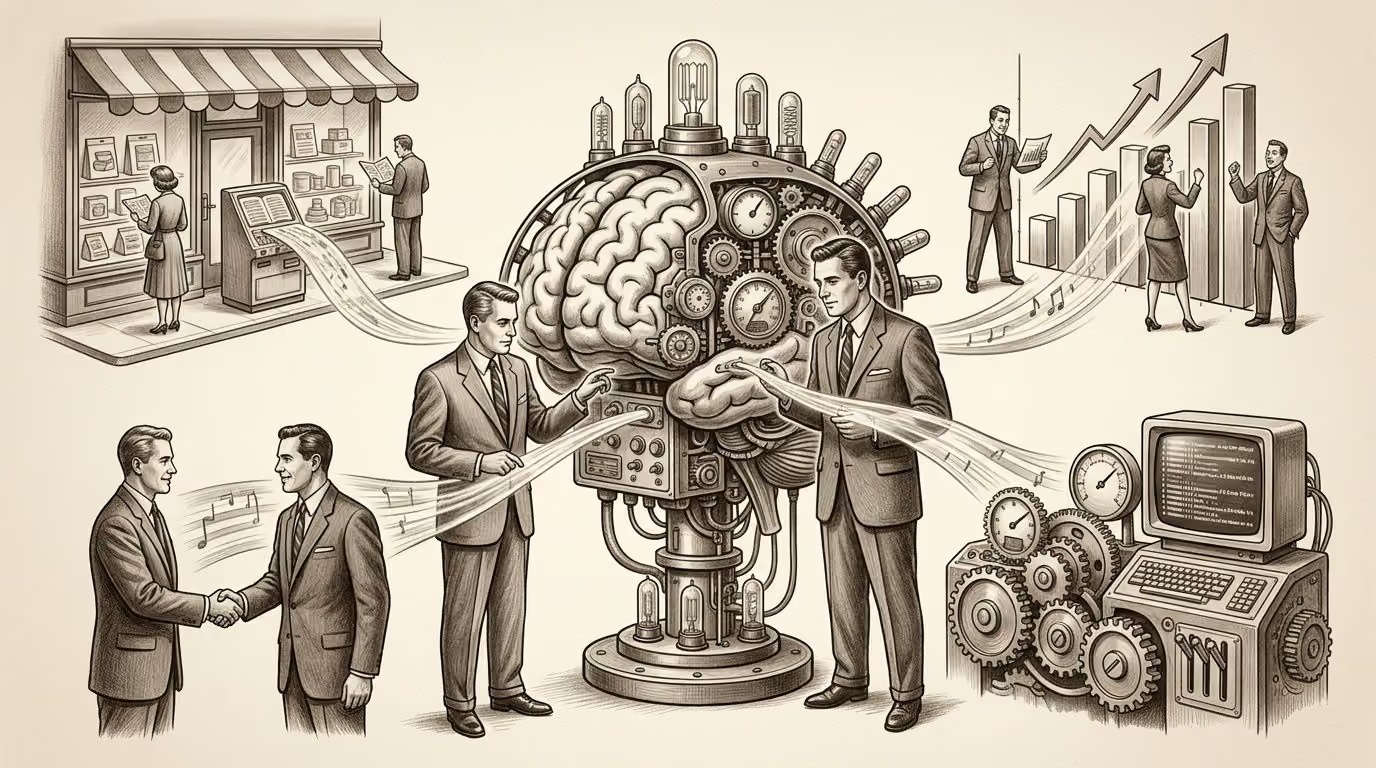
Your business has probably already moved past the stage where the challenge was attracting visitors. Today the symptom is different. Forms come in and no one follows up on time, conversations live scattered across emails, quotes depend on the sales team's memory, and campaigns generate traffic without clearly showing which contacts end up buying.
Need help with this? Discover our digital marketing service.
That disorder rarely looks like a growth problem. It gets read as operational friction, something the team will "solve" with more discipline. But when marketing, sales, and customer service work with different versions of the customer, the company loses something more important than time. It loses the ability to convert the same commercial effort more effectively.
That is why searching for what a CRM is and what it is for should no longer be answered with a basic definition. The right question is another. What role does a CRM play in a growth strategy where every interaction should help you sell more, retain better, and decide with greater precision.
In many expanding companies, the bottleneck does not appear because of a lack of demand. It appears when the volume of data exceeds the business's ability to interpret it. The sales team has useful information. So does marketing. Support knows objections, complaints, and early churn signals. But none of it talks to each other.
That is where the most common mistake lies. The CRM is thought of as a contact repository, when in reality its value lies in connecting scattered data to turn it into decisions. Without that system, the organization accumulates activity without building intelligence.
In Chile, that transition has stopped being marginal. The CRM market reached an approximate value of 150 million dollars in 2025, with an 18% CAGR, and 72% of Chilean companies with more than 50 employees adopted CRM to centralize customer data, with an average improvement of 29% in retention, according to the analysis cited by Cursos Femxa. More than a technology fad, this reflects a competitive shift.
Most digital businesses already have enough signals to grow better. They have web traffic, active campaigns, WhatsApp interactions, historical sales, and repurchase behavior. The problem is that those signals usually live in separate tools.
When that happens, leadership sees aggregate results but not causal relationships. It knows how much it invests in advertising, but not which lead ended up with the highest value. It knows which rep closed the most, but not which prior sequence raised the probability of purchase. It knows there is drop-off, but not at which exact point of the journey the commercial momentum is lost.
A well-used CRM does not store customers. It organizes the logic of growth.
A CRM fulfills a critical function when the company needs to move from reactive management to designed growth. That implies three shifts:
In that sense, the CRM does not compete with the website, paid media, or email marketing. It coordinates them. Its strategic value appears when it lets you answer questions that previously stayed hidden. Which leads deserve immediate follow-up. Which segment repurchases the most. Which point of the funnel needs intervention. Which customer looks active but is actually already cooling off.
That change in perspective matters because it turns the CRM into a growth infrastructure. Not administrative software.
Thinking of the CRM as "sales software" falls short. A more useful analogy is to see it as the nervous system of the digital business. It receives signals, organizes them, distributes them, and lets you react with judgment. Without that coordination center, each area acts on its own, even when it believes it is collaborating.
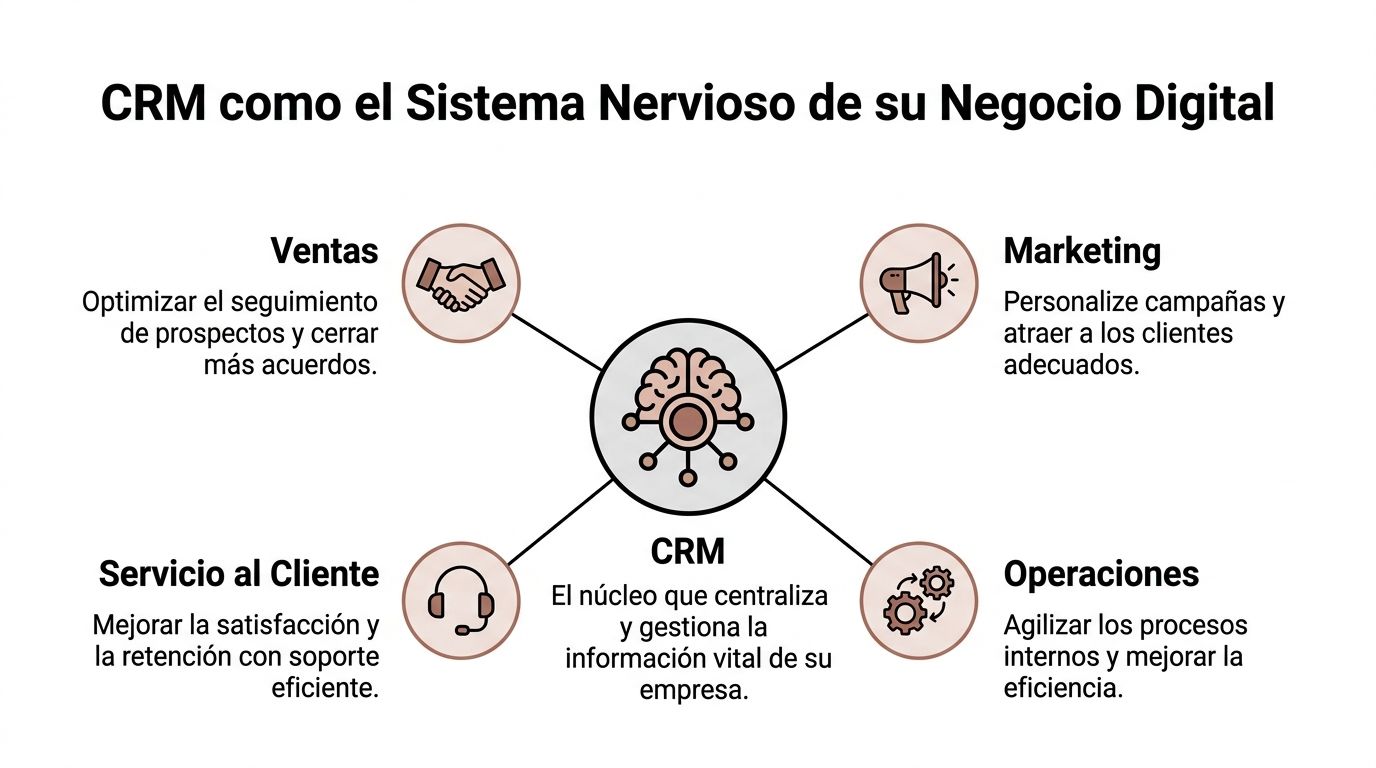
If someone asks what a CRM is and what it is for, the strategic answer would be this: it is the platform that centralizes interactions, commercial history, and behavioral signals so that marketing, sales, operations, and service act with a shared logic.
That changes the quality of decisions. A commercial director can see which opportunities are stalled. A marketing team can detect which audiences convert best. Customer service can respond with context, not from scratch. Operations can anticipate internal needs based on the type of demand coming in.
Not all CRMs add value the same way. It is worth distinguishing three functional layers.
This is the dimension that automates repetitive tasks and prevents the business from losing commercial rhythm. It serves to assign leads, schedule follow-ups, trigger emails, log calls, or leave pending tasks according to the pipeline stage.
Its value is not in "saving time" in the abstract. It is in ensuring continuity. If a customer abandons a cart, requests a demo, or asks for a quote, the operational CRM prevents that signal from being forgotten in an inbox.
Typical examples:
Here the CRM stops executing and starts explaining. It groups data to reveal patterns. Which channel brings better customers. Which stage concentrates the most drop-off. Which segment responds best to certain campaigns. Which accounts cool down before closing.
This dimension is decisive for growth because it transforms activity into strategic reading. A dashboard is not valuable for showing figures. It is valuable for letting you choose better where to invest time, budget, and commercial focus.
Practical rule: if your CRM only records activity but does not help prioritize decisions, you are still using a fraction of its value.
Its function is to break down internal silos. It makes the customer's history visible to different areas, so the experience does not depend on disconnected conversations.
A simple example shows it well. A sales executive calls to push a renewal. If, before that call, they can see that support received a recent complaint, the tone of the conversation changes completely. The collaborative CRM prevents that kind of misalignment, which usually costs more than it seems.
Not every company should prioritize the same thing.
| Business stage | Dominant need | Critical functionality |
|---|---|---|
| Early growth | Organize follow-up and avoid losing leads | Operational CRM |
| Commercial scale | Understand which channel and sequence generate value | Analytical CRM |
| Complex operation | Align areas and protect the full experience | Collaborative CRM |
In practice, the best results appear when these three layers are integrated. If the operational CRM executes, the analytical one guides, and the collaborative one aligns, the company stops working from fragmented intuition.
The difference between having a CRM and using it strategically is not in the tool. It is in the question leadership asks of the system. If it only seeks to "organize contacts," it will get order. If it seeks a foundation to decide better how to convert, retain, and scale, the CRM becomes a central piece of the growth model.
The functions of a CRM matter less for their name than for the type of growth they enable. A visual pipeline, an automation, or a report are not advantages in themselves. They become relevant when they improve the business's ability to detect commercial friction and act before revenue is lost.

According to DataCRM's analysis, businesses with a CRM such as Salesforce or Oracle CX achieve 37% more customer retention thanks to predictive modeling. The same analysis notes that, with automated follow-up workflows, closings can rise 28%, in a context where it is estimated that 60% of leads are lost due to lack of follow-up. The implication is clear. The CRM does not just organize. It recovers value the operation was already letting slip away.
A commercial funnel without visibility forces you to manage by feel. You know there are open opportunities, but not which ones are stuck, poorly qualified, or overestimated. The pipeline in a CRM corrects that because it turns the commercial process into an observable sequence.
For a B2B eCommerce on Shopify or a lead-generation site on Webflow, this function helps answer critical questions:
When leadership sees the pipeline this way, it can connect CRM and CRO more intelligently. If an early stage filters too much, the problem may be in the quality of the initial promise. If the drop appears after the meeting, the obstacle may be in pricing, arguments, or timing.
Automation is usually sold as convenience. Its real effect is more strategic. It prevents growth from depending exclusively on the team's memory.
In digital businesses, silence is often misread. A prospect who does not respond has not necessarily lost interest. They may have postponed the decision, changed priorities, or needed more context. If no one resumes contact with the right message, the opportunity cools off quietly.
A CRM lets you design journeys like these:
Mature automation does not replace the commercial relationship. It protects the relationship from improvisation.
Many teams look at campaigns, sales, and web performance on separate platforms. The CRM adds a layer that rarely appears in those isolated reports. It shows which interaction ended in real revenue and which signals best anticipate a better result.
That lets you evaluate the business with a different logic. Not just which campaign generated the most leads, but which campaign brought contacts with the highest probability of closing, better retention, or greater commercial value afterward. That is where a more useful reading emerges for leadership and growth.
| Function | Business question it solves | Strategic impact |
|---|---|---|
| Pipeline | Where the sale gets stuck | Prioritize improvements in the funnel |
| Automation | Which follow-up must happen without fail | Reduce lost opportunities |
| Reporting | Which source generates higher-quality customers | Redistribute investment |
| Unified history | What each account really needs | Personalize with context |
When a CRM connects with the site, paid media, email, and the commercial process, it stops being an administrative tool. It becomes a platform to intervene in business performance with evidence.
The arguments in favor of a CRM usually stay at vague promises. Better organization. More order. Better follow-up. All of that may be true, but it is not enough to justify investment to a board or a finance leadership team. The business case appears when the CRM connects with metrics that affect revenue, profitability, and commercial efficiency.

In Chile, 85% of B2B and eCommerce companies that implemented a CRM between 2022 and 2025 reported a 40% increase in qualified-lead conversion rates. CRM adoption also reduced churn by 32% and lowered advertising costs by 27%, according to the report cited by ForceManager. The strategic reading is powerful. The CRM does not just improve the commercial operation. It also improves how the growth budget is allocated.
In B2B, the value of the CRM appears more strongly when the buying cycle is long, several people are involved, and each account requires contextual follow-up. The system helps sustain continuity across meetings, proposals, and objections. It also makes the real status of each opportunity visible, something key when leadership needs more reliable forecasts.
In B2C and eCommerce, the focus is usually on personalization, repurchase, and advertising efficiency. A well-integrated CRM helps distinguish between occasional buyers, recurring customers, and segments with greater sensitivity to certain offers or messages. That reading layer improves the quality of activation, not just its volume.
The point is not "having more data." It is linking data with actions that change results. A well-implemented CRM lets you observe more clearly:
For many brands, that logic also connects with customer loyalty as a lever for sustained profitability. A CRM lets you institutionalize that loyalty. Not leave it in the hands of a few executives' individual talent.
A good CRM does not produce ROI just by existing. It produces it when it reduces commercial blindness.
The most frequent mistake when presenting a CRM project is treating it as support software. The conversation changes when it is framed as an infrastructure for three business outcomes:
That approach is more convincing because it shifts the discussion from licenses and features to economic impact. A CRM costs money. But operating without an integrated view of the customer also costs money, only that cost hides in opportunities that never close or customers who are lost without sufficient explanation.
Choosing a CRM by popularity is usually a bad decision. Choosing it by price alone is too. In businesses that operate with Shopify, WordPress, WooCommerce, or Webflow, the central criterion should be different. How well the CRM fits the growth model and the digital ecosystem that already exists.
An isolated CRM can record contacts. A well-integrated one can transform how information flows between acquisition, sale, after-sales, and analysis. That difference defines whether the tool will be one more administrative layer or a platform that is genuinely useful for leadership.
Not every team needs the same functional depth. But it is worth evaluating some strategic factors with discipline.
| Strategic Criterion | Why It Matters for eCommerce/B2B | Key Questions to Ask the Provider |
|---|---|---|
| Scalability | The CRM must support more volume, more users, and more complex processes without forcing an early migration | How does the operation change when contacts, automations, and teams increase? |
| Native integration | If it does not talk well with Shopify, WordPress, WooCommerce, or marketing tools, new silos are created | Which integrations exist natively and which require extra development? |
| Usability | If the team does not adopt it, the CRM becomes an incomplete, unreliable database | How simple is it to log activity, review the pipeline, and generate reports? |
| Analytical power | Without good data reading, the CRM is limited to storage and follow-up | What dashboards, filters, and performance views does it offer for decision-making? |
| Data governance | Access, safeguarding, and information consistency impact operation and compliance | How does it manage permissions, traceability, and safeguarding policies? |
On Shopify, a CRM gains relevance when it can sync order information, recurrence, behavior, and acquisition source. On WordPress or Webflow, its value depends more on how it connects with forms, content, campaigns, and lead qualification.
If that integration fails, familiar symptoms appear. Teams duplicating records. Incomplete histories. Reports with discrepancies between platforms. Automations that fire late or never. The business believes it has data, but in reality it has different versions of reality.
That is why it is also worth reviewing the criteria for data protection and digital governance from the start. A CRM concentrates sensitive information. Choosing without evaluating permissions, traceability, and safeguarding is not just a technical problem. It is a strategic risk.
Before signing with any provider, an internal committee should be able to answer these questions clearly:
The best choice is not the CRM with the most features. It is the one that makes your business more readable and your operation more coherent.
A company that sells through eCommerce needs an architecture that connects purchase, retention, and customer value. A B2B company needs continuity, context, and visibility of the commercial cycle. In both cases, the right criterion is not "which CRM is most famous," but which one best adapts to the way the business wants to grow.
For years it was assumed that the commercial problem was generating leads. Today many companies have already discovered that this is not enough. The real problem is that a significant share of those leads come in, show initial interest, and then disappear without an explicit no. That phenomenon resembles workplace quiet quitting, but applied to the commercial process. The prospect does not reject. They simply switch off.

In Santiago, the Digital Trends Chile 2026 study indicates that 42% of B2B companies lose between 25% and 30% of qualified leads due to a lack of personalized follow-up. The same analysis notes that AI-powered CRMs such as Salesforce Einstein, adopted by 15% of Chilean firms, can raise retention by 28% by analyzing interaction patterns for predictive scoring, according to the report cited by Arsys. This is not a cosmetic improvement. It is a direct response to a silent leak of value.
Many companies react to commercial cooling by increasing contact volume. More emails, more calls, more reminders. That can make the problem worse, because it treats every opportunity as if they were all the same.
AI in CRM changes that approach. Instead of intensifying indiscriminate follow-up, it prioritizes based on signals. Opens, response times, repeat visits, prior interactions, commercial history, and behavior changes can be combined to estimate which account deserves immediate action, which needs a different narrative, and which already shows low probability.
That makes the CRM stop being just a recording tool. It starts to function as an early-warning system.
There are three capabilities that change the strategic conversation:
That approach connects naturally with AI marketing automation applied to real sales. Classic automation ensures continuity. AI adds judgment about where to intervene first and how to do it with greater precision.
When a lead stops responding, the problem is not always a lack of interest. Sometimes it is a lack of relevance in the next contact.
There is a short explanation that helps visualize this technological evolution:
Adopting AI in CRM forces a review of an old belief. Having a good process is not enough. You need a system that detects variations before the human team notices them too late.
In Chilean B2B, where many sales depend on trust, timing, and timely follow-up, that capability can become a competitive advantage. Not because it replaces the salesperson, but because it gives them a smarter hierarchy of action. Instead of chasing everything, they can focus where there is the most value at risk or the greatest chance of progress.
AI-powered CRM does not replace commercial strategy. It makes it more anticipatory.
The poorest way to understand a CRM is to see it as an advanced address book. The most useful is to treat it as a decision infrastructure. When a company centralizes interactions, history, and behavioral signals, it gains something more valuable than order. It gains the ability to intervene in its growth with less intuition and more judgment.
That difference shows up across the whole operation. Marketing stops optimizing only for volume. Sales stops depending on memory and individual heroics. Service stops responding without context. Leadership stops looking at scattered metrics and starts reading customer journeys.
The question of what a CRM is and what it is for falls short if answered only with functions. It serves to align the company around the real customer, not the customer imagined by each area. It serves to detect friction before it turns into churn. It serves to sustain a growth strategy where conversion, retention, and efficiency are not managed separately.
The value of the CRM appears when it connects data, teams, and decisions within the same business logic.
From that perspective, the CRM does not replace a good digital strategy. It makes it operable. And when combined with continuous analysis, behavior reading, and a focus on conversion, it becomes a much more solid foundation for growing profitably and at scale.
No. A small company also suffers when customer information is fragmented. In fact, implementing a CRM before the disorder scales is usually simpler than fixing processes when there are already too many sources, salespeople, and campaigns operating at the same time.
What matters is not size. It is commercial complexity. If there are several points of contact, deferred follow-up, or a need to coordinate marketing and sales, the CRM can already add value.
It depends on scope. The initial setup can be relatively contained if the business starts with clear processes, well-defined fields, and few integrations. The longest part usually comes afterward. Adjusting automations, improving data quality, organizing qualification criteria, and achieving disciplined adoption by the team.
It is worth separating two stages:
Not always. In many cases they complement each other. The CRM concentrates the customer's context and commercial logic. The email marketing tool can still fulfill a specific role in campaigns, newsletters, or automations more oriented toward broad audiences.
The right decision depends on the business's maturity. Some companies reduce redundancies by consolidating functions. Others prefer to keep separate but connected tools. The criterion should be strategic, not a technology fad.
The most damaging mistake is treating the CRM as a software project and not as an operational change. If the team does not share criteria about funnel stages, the definition of a qualified lead, follow-up rules, and data ownership, the platform fills with inconsistent information very quickly.
It also fails when no one decides which business questions the system should solve. Without that clarity, the CRM accumulates records but produces no direction.
There are fairly obvious signs:
If several of those signs are already present, the discussion is not whether to implement a CRM someday. It is how much growth keeps being lost by postponing it.
If your company already generates demand but is not turning that flow into sustained growth, Bigbuda can help you organize the entire system. From digital strategy and CRO to platforms on Shopify, WordPress, and Webflow, its approach combines data, UX, automation, and artificial intelligence to turn traffic and contacts into better business results.