










Solutions
Explore how to grow

Your team reports more sessions, more clicks, and more spend. Yet the committee keeps asking the same question: where are the sales, the qualified leads, and the profitable growth?
This is reinforced by good best digital marketing agencies in Chile.
That scene repeats in companies of all sizes. An eCommerce increases investment in Meta and Google, traffic goes up, the dashboard looks healthy, but the business does not change at the expected pace. A B2B company publishes content, improves its digital presence, and receives visits, but commercial opportunities remain few or weak. The problem is usually not the absence of activity. The problem is confusing activity with real growth capacity.
When that happens, marketing services are bought as loose pieces. A campaign here. A redesign there. One agency for social media, another for paid media, another for SEO. The result is predictable. Plenty of movement, little accumulation of value. The company pays for execution, but does not build a system.
That is the key difference. Well-evaluated marketing services are not an expense to “make noise.” They are an investment to create an engine that turns attention into demand, demand into revenue, and revenue into competitive advantage. If that engine does not exist, every additional peso in traffic becomes less efficient.
In Chile, the pressure to get this decision right is no longer minor. The market moved fast and will keep moving. Spending on digital marketing in Latin America reached 15.2 billion dollars in 2024, an increase of 22% over 2023, and eCommerce surpassed 12 billion dollars. In that same context, companies that invested in CRO and SEO achieved an average increase of 18% in conversion, according to regional statistics on agencies and digital marketing.
That figure matters for a concrete reason. It shows that growth does not depend only on buying more visibility. It depends on converting the visibility that already exists better.
Many boards still approve marketing budgets with an operational logic. They want more campaigns, more pieces, and more presence. That seems reasonable, but it is incomplete. If the site does not convert, if the message does not differentiate, if the experience does not support purchase intent, and if acquisition is not aligned with the right type of customer, the additional spend only accelerates the inefficiency.
Practical rule: if your digital investment grows faster than your ability to convert and retain, you are not scaling. You are amplifying friction.
The right debate is not how much to invest. The right debate is what type of marketing services are worth investing in to increase the value of the company's digital asset.
A serious marketing service has to answer business questions, not just channel questions:
If an agency cannot connect its work to those four variables, it is selling production, not strategy.
Seeing marketing as a cost center is a poor financial reading. A cost maintains the operation. An investment creates future capacity. Marketing services should be evaluated by the capacity they generate, not by the number of deliverables they produce.
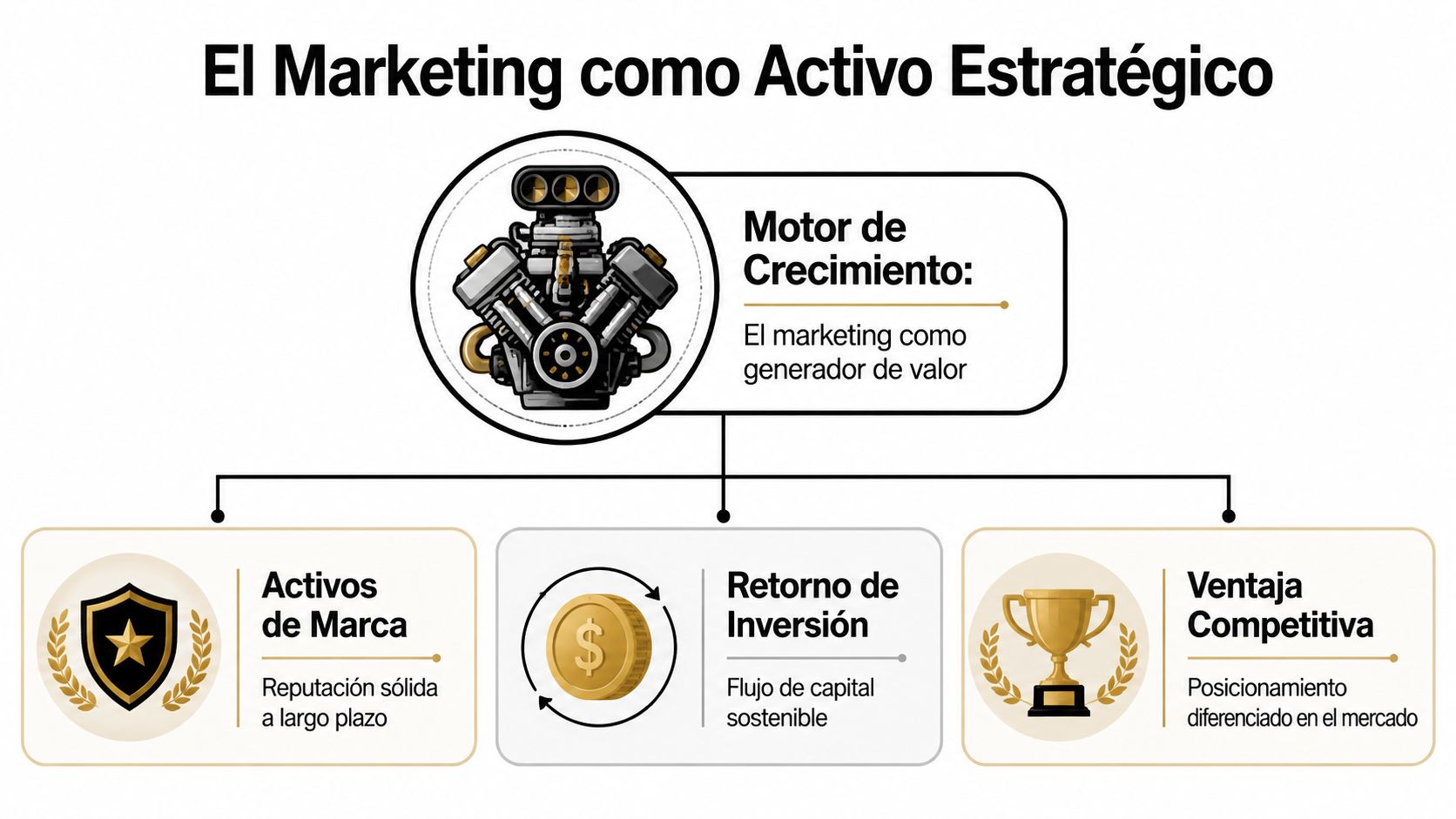
Consider two scenarios.
In the first, the company buys bricks: paid media, posts, emails, web tweaks, content. All of that can be useful, but without a common design it ends up as scattered inventory.
In the second, the company hires someone who designs a factory. Each component exists to produce a repeatable economic result. The brand improves preference. The site converts better. Positioning captures higher-intent demand. Automation sustains the commercial relationship. Paid media accelerates what already works.
That is the mature way of looking at marketing services. Not as tasks, but as commercial infrastructure.
When a company matures its criteria, it stops asking weak questions like “how many posts are included?” or “how much is the monthly package?”. It starts asking questions that matter:
A good marketing partner should accept that framework without discomfort. In fact, they should drive it. If you need an additional reference on how to think about marketing from a business standpoint and not from tasks, it is worth reviewing these growth-oriented digital marketing strategies.
Poorly bought marketing generates outputs. Well-directed marketing creates a system that produces demand with less friction and better return.
Not all marketing services create lasting value. The ones that do usually strengthen three assets.
| Asset | What it contributes to the business | Signal of real value |
|---|---|---|
| Brand | Reduces commercial friction and improves preference | The company competes less on price |
| Conversion capacity | Extracts more value from current traffic | Improves acquisition efficiency |
| Owned visibility | Reduces dependence on paid media | Increases control over demand |
If an investment does not strengthen at least one of those assets, it is probably funding operational noise.
Marketing performance is defined by how its services interact with each other. A company can invest in SEO, paid media, development, automation, and brand at the same time, but if each front operates in isolation, the result is usually scattered spend. The right criterion is another one. Evaluate which service strengthens the company's ability to capture demand, convert it better, and sustain growth with less external dependence.
Organic positioning serves a concrete business function. It gains presence at the moment the customer already has intent and is comparing options. That is where a relevant part of digital market share is defined.
In businesses with local or regional coverage, that opportunity is even more visible. Google explains in its documentation on local results that relevance, distance, and prominence directly influence which companies appear when a person searches for a nearby solution. That makes local SEO, AEO, and GEO an investment oriented toward capturing existing demand with greater control over the owned channel.
The right discussion is not “whether it is worth appearing on Google.” The question is how much value the company loses when high intent ends up with the competition.
If the site attracts visits and does not convert, the bottleneck is not in acquisition. It is in commercial performance. That is where CRO comes in.
The financial logic is simple. Improving conversion increases the return of the traffic that already exists and reduces the pressure to keep buying visits to sustain the same sales volume. In eCommerce, B2B, and services, that effect changes the quality of the investment because it turns a passive site into an asset that produces more revenue per session.
Before increasing the acquisition budget, fix the ability to convert the demand that is already arriving.
It does not depend on whether the company uses Shopify, WordPress, Webflow, or WooCommerce. It depends on whether its digital property is designed to produce business results.
A redesign approved out of aesthetic fatigue rarely pays for itself. A well-planned web development does, when it improves speed, commercial clarity, content management, operational stability, and measurement capacity.
That impact is direct. A slow site holds back conversions. A backend that is hard to manage delays campaigns. A poorly resolved architecture limits SEO, complicates integrations, and raises internal costs. Development stops being a visual project and becomes growth infrastructure.
Paid media has a clear function. To accelerate. Not to fix a weak message, a poorly presented offer, or a confusing purchase experience.
That is why it is worth demanding a more rigorous reading of this service. If the company already has a clear proposition, a page that converts, and serious commercial follow-up, the investment in paid media can gain speed with good return. If those fundamentals do not exist, paid media amplifies inefficiency and makes growth more expensive.
Many companies underuse email because they treat it as a secondary channel. That is a management error. Email marketing serves to recover intent, increase frequency, push repurchase, and sustain a relationship with audiences the company already paid to attract.
Its value is not in “sending campaigns.” It is in extracting more revenue from an owned base and reducing dependence on channels where each touch has to be paid for again. From that perspective, email is not tactical support. It is a profitability lever.
The brand affects commercial results long before the creative team notices. A clear brand reduces resistance, improves understanding of the proposition, and helps sales, site, and campaigns work with more coherence.
That has an economic effect. When perceived value rises, the pressure to compete via discount drops. When the company communicates without clarity, each channel needs more investment to compensate for the confusion. Branding, well evaluated, strengthens margin and competitive position.
The sequence depends on the main bottleneck of the business, but the evaluation must always be strategic.
To organize that decision with a business-oriented logic, it is worth reviewing these effective web positioning services.
A frequent mistake at the board level is asking for the same mix of services for different business models. That dilutes budget and creates false expectations. Priorities change depending on how revenue comes in, how the customer decides, and what friction dominates the commercial process.
In eCommerce, the biggest waste is usually in the combination of paid traffic with mediocre conversion assets. The company buys attention, but does not capitalize on enough intent. There it is worth prioritizing services that increase the commercial efficiency of the digital channel and reduce dependence on continuing to raise paid media to sustain growth.
The central question is not “how to bring in more people.” It is “how to make each visit, each product viewed, and each cart started more profitable.”
In B2B, the logic changes. The site must build credibility, better filter demand, and facilitate conversations with the right prospects. Marketing does not replace sales, but it can dramatically improve the quality of the sales team's starting point.
In non-transactional B2C businesses, in addition, the challenge is usually in local visibility, brand consistency, and the ability to capture high-intent demand at the right moment.
A B2B company should not measure its marketing services the same way an online store does. One needs to accelerate the purchase. The other needs to reduce friction before the commercial conversation.
| Strategic Objective | eCommerce (B2C) | Company (B2B) |
|---|---|---|
| Maximize revenue from current traffic | CRO, conversion architecture, email automation | Form optimization, proposition clarity, lead qualification |
| Capture high-intent demand | SEO for categories, product pages, product search, local visibility if applicable | Authority SEO, decision-oriented content, positioning by problem and solution |
| Accelerate growth with paid media | Shopping, search, remarketing, catalog campaigns | Intent search, LinkedIn or related media, demand generation campaigns |
| Build trust | Branding applied to experience, social proof, offer consistency | Corporate brand, case studies, expert narrative, visible credentials |
| Scale the digital operation | Shopify, WooCommerce, automation, sales integrations | WordPress or Webflow oriented to leads, CRM, commercial automation |
If your company is in an expansion phase, do not try to cover everything at once. First define the main bottleneck.
That clarity saves budget and accelerates decisions.
Your company can sign with an agency this quarter and spend the next twelve months buying activity instead of building growth capacity. That mistake is costly. It consumes budget, slows commercial learning, wears down the internal team, and reduces the speed at which the company gains share, improves margin, or increases its value.

The right question is not which agency produces the most pieces or buys the most media. The right question is which partner can turn marketing into a business asset. One that improves the quality of demand, reduces acquisition inefficiencies, and helps make better investment decisions.
Business criterion. A useful agency understands how your company makes money, where margin erodes, which segment is worth prioritizing, and which objectives deserve investment. If the conversation revolves only around clicks, formats, or publishing frequency, you are facing an operational supplier, not a growth partner.
Decision method. Ask for logic, not enthusiasm. A competent team can explain how it defines priorities, what signals it uses to decide, and under what conditions it changes course. If everything depends on “trying things” without a clear thesis, the risk is not assumed by the agency. It is assumed by your company.
Verifiable evidence. Do not look for pretty promises. Look for consistency. Credible cases, customer continuity, clear reasoning, and the ability to defend decisions under commercial pressure. If you want to dig deeper into that criterion, review this approach to strategic advisory in digital marketing.
A commercial proposal rarely reveals the partner's real quality. The right questions do.
These questions expose maturity. They also show whether the agency thinks like a campaign operator or like a leadership ally.
If an agency only wants to talk about deliverables, it probably does not want to take on a conversation about impact.
There are patterns worth cutting early.
| Signal | What it usually hides |
|---|---|
| Generic promises | Lack of criterion or overselling |
| Obsession with volume | Little control over demand quality |
| Reports full of cosmetic metrics | Disconnection from business results |
| Little curiosity about sales, margin, or operations | Strategic misalignment from the start |
The best partner does not compete to seem more creative in a meeting. It competes to demonstrate that it can strengthen the company's growth engine. That is the difference between hiring marketing and making a serious investment in commercial capacity.
Even a good agency fails if the relationship is managed as a black box. Consistent results appear when client and partner operate with shared objectives, access to data, and decision discipline.
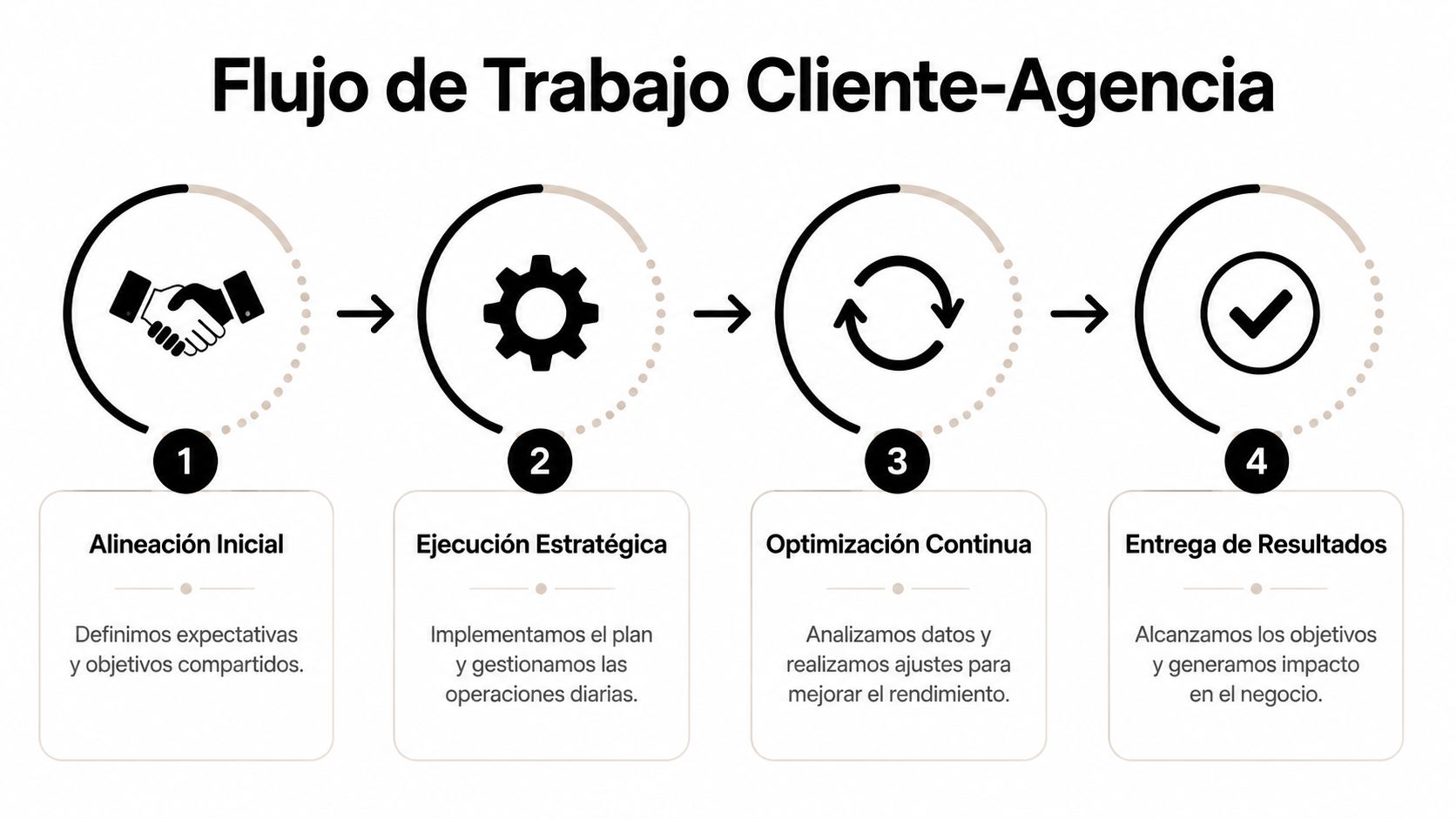
The first phase should not begin with pieces or campaigns. It should begin with context. Commercial priorities, constraints, margins, offer, sales channels, historical performance, and the quality of current traffic.
If that is not clarified at the start, the subsequent work fills up with wrong assumptions. Then come the sterile discussions about why “marketing did not work,” when in reality no one defined precisely what working meant.
Once the objectives are aligned, execution needs focus. Not an infinite list of pending tasks. A clear roadmap, with visible commercial priorities and explicit decision criteria.
Here it is worth distinguishing between productive work and decorative work. Productive work moves conversion capacity, useful visibility, demand quality, or acquisition efficiency. Decorative work fills calendars, but does not alter the business.
Most teams get this point wrong. They treat optimization as a marginal adjustment. In reality, it is the place where learning is captured and the return on investment is protected.
A mature agency does not defend its initial plan. It corrects course quickly when the evidence shows another route.
Reporting is not showing dashboards. Reporting is translating what happened into business impact. What improved, what did not, what was learned, what is being stopped, and where it is worth insisting.
When this process is well established, the relationship stops looking like outsourcing. It looks more like an external growth cell with concrete responsibilities. That is exactly what a company should demand from its marketing services.
If you take seriously the idea that marketing services should build an asset and not just produce tasks, then you need a partner that operates with that logic. Bigbuda fits that framework for a specific reason: it combines web development, CRO, SEO + AEO + GEO, branding, email marketing, and digital advertising with a methodology centered on conversion, data, UX, continuous experimentation, and artificial intelligence. It does not sell isolated disciplines. It articulates a performance system.
That matters especially for companies with high traffic and low return, online stores on Shopify or WooCommerce that want to sell more without continuing to inflate the acquisition budget, and B2B companies that need their site to function as a real commercial asset. In those cases, the value is not in adding more channels for their own sake. It is in connecting visibility, experience, and commercial decision.
The guiding principle is correct. First optimize the existing asset. Then scale the investment. That sequence reduces waste and improves the return of any subsequent channel.
In practice, that means working on elements many companies underestimate: speed, message clarity, navigation structure, search intent, demand recovery, automation, and decisions based on real behavior. When those pieces align, the business stops depending exclusively on buying more traffic to sustain results.
Do not look for an agency that “does everything.” Look for one that knows how to prioritize. Do not look for more reports. Look for better decisions. Do not look only for fast execution. Look for a business reading that lets you allocate capital with more confidence.
Three signals make this kind of partner especially relevant:
The best marketing service is not the most visible one. It is the one that makes the company's growth more efficient and more defensible.
If your organization already invests in digital but still does not feel that it built a real growth engine, the problem is usually not a lack of effort. It is usually a lack of strategic integration. And that can be corrected.
If you want to review your digital operation with a business mindset, Bigbuda can be a starting point to evaluate where value is being lost, which assets to strengthen first, and how to turn your marketing services into a real growth investment.
By business questions, not channel questions. How it contributes to sales, margin or commercial efficiency. How it improves position against direct competitors. What asset remains built after the campaign. And whether it attracts the right buyers or just cheap volume. Otherwise you are buying production, not strategy.
Those that strengthen three assets. Brand reduces commercial friction and improves preference, so the company competes less on price. Conversion capacity extracts more value from current traffic. Owned visibility reduces dependence on paid media. If an investment strengthens none of them, it is probably funding operational noise.
It depends on the main bottleneck. If you are losing high-intent searches, prioritize organic positioning. If traffic exists but the return does not appear, prioritize conversion. If the platform limits growth or measurement, prioritize web development. If there is a contact base without systematic work, prioritize automation and email.
Accelerate, not fix a weak message, a poorly presented offer or a confusing purchase experience. If the company already has a clear proposition, a page that converts and serious commercial follow-up, the investment can gain speed with good return. Without those fundamentals, paid media amplifies inefficiency and makes growth more expensive.
Use three filters. Business criterion: they understand how your company makes money and where margin erodes. Decision method: they can explain how they define priorities and under what conditions they change course. Verifiable evidence: credible cases, customer continuity and the ability to defend decisions under commercial pressure.
Generic promises usually hide a lack of criterion or overselling. An obsession with volume shows little control over demand quality. Reports full of cosmetic metrics reveal disconnection from business results. And little curiosity about sales, margin or operations points to strategic misalignment from the very start.