










Solutions
Explore how to grow

Studying marketing in Chile no longer means going into "advertising." It means entering a critical part of business growth.
At Bigbuda we help you with the best digital marketing agencies in Chile.
The clearest signal is this: in 2024, CLP 967,847 million was invested in advertising media in Chile, and digital took 52.8% of that total, according to the annual report from the Chilean Media Agencies Association (AAM). While total advertising investment fell 0.8%, digital grew 2.6% and lifted its share from 51.1%. If you are weighing a marketing career in Chile, that figure changes the conversation. It is no longer just about choosing an attractive career. It is about entering a market where companies are moving budget, pressure, and expectations toward measurable channels.
And if you hire talent, your criteria change too. You do not need more profiles that "do social media" with no connection to sales. You need marketers who understand business, margin, acquisition, conversion, and profitability. That is the right filter.
Digital is no longer a complement in Chile. It is the center of the budget and, in many companies, the focus of commercial pressure.
That change stopped being an academic discussion. Today it defines hiring, quarterly goals, and investment decisions. The figure already cited matters for one concrete reason: it confirms that marketing now competes under business standards, not under criteria of visibility or activity.

When spending migrates toward measurable channels, the whole bar changes.
First, the financial demand rises. Management expects traceability, a reasonable cost of acquisition, and a clear relationship between investment and result.
Second, the profile of talent worth more changes. It is no longer those who just run campaigns or publish content that stand out. Those who understand the funnel, detect friction, and improve conversion stand out.
Third, mediocrity gets expensive. Buying traffic without fixing pages, offers, forms, or checkout burns budget. That is where the gap appears that many marketing curricula in Chile still do not solve well: they teach distribution but do not go deep into CRO or experimentation. And that omission carries weight. Without those capabilities, the team attracts visits that do not convert and then blames the channel, the algorithm, or the market.
That point separates a useful professional from a replaceable one.
For anyone weighing whether to study marketing, the opportunity is not in entering an industry with more budget. It is in entering with skills that impact real revenue. If you graduate knowing how to plan campaigns but not how to formulate hypotheses, run tests, and drive conversion improvements, you will compete for the most saturated tier of the market.
For anyone hiring, the signal is also clear. A team does not improve by adding more operational hands. It improves when it incorporates commercial judgment, analytical discipline, and the ability to experiment with method. It is even worth distinguishing operational roles from strategic ones. This guide on what a community manager does in a company helps avoid a frequent mistake in Chile: asking for profitable growth from a role designed for content and community execution.
The opportunity exists. But it does not reward decorative marketing. It rewards those who turn attention into sales, learning, and margin.
The marketer who generates the most value in Chile is not necessarily the most creative. It is the one who understands how a marketing decision affects revenue, costs, and conversion.
There are still companies that confuse marketing with visibility. That mistake is expensive. Visibility without demand capture, without behavior analysis, and without the ability to fix friction is just activity. It is not always growth.
The old profile was easy to recognize. Lots of intuition, focus on campaigns, reach reports, and a weak relationship with finance or sales.
That profile still exists, but it has lost weight. Not because creativity has stopped mattering, but because today it competes with a different expectation: demonstrating business impact.
A good way to understand that difference is to separate functions. Advertising is one part of the system. Marketing is a broader discipline that connects research, value proposition, acquisition, experience, and retention. If your team still mixes everything under the logic of "doing outreach," it is worth reviewing how roles are distributed. A useful reference for that debate is this analysis on what a community manager does, because it helps avoid loading strategic objectives onto an operational role.
A strategic marketer in Chile should be able to do at least four things competently.
CapabilityWhat it demonstrates in practiceUnderstand the businessKnows how money is made, where margin is lost, and which channel adds valueRead dataDoesn't stop at vanity metrics. Looks for actionable signalsPrioritize frictionIdentifies bottlenecks between traffic, intent, and saleSpeak with managementTranslates marketing into decisions, not just tasks
That profile does not always come from an elite university or a large agency. Sometimes it comes from someone who learned to connect analytics, content, paid media, and digital experience in a disciplined way. What matters is not the origin. It is the ability to think of marketing as a system.
A strong marketer does not ask for budget first. First they show judgment.
If you are hiring, stop rewarding only channel experience. A channel is not a strategy.
Ask tougher questions:
The best answers do not sound grandiose. They sound connected to commercial reality.
The marketing career in Chile is dividing into two groups. Those who operate tools. And those who understand how tools affect growth. The second group leads. The first rotates.
The discussion should not be "which institution has the bigger name." It should be "what kind of trajectory you want to build."
In Chile, marketing education paths respond to different logics. University tends to provide more conceptual framework, more strategic thinking, and a better foundation for leadership roles. The technical institute tends to push toward application, concrete tools, and early employability sooner.
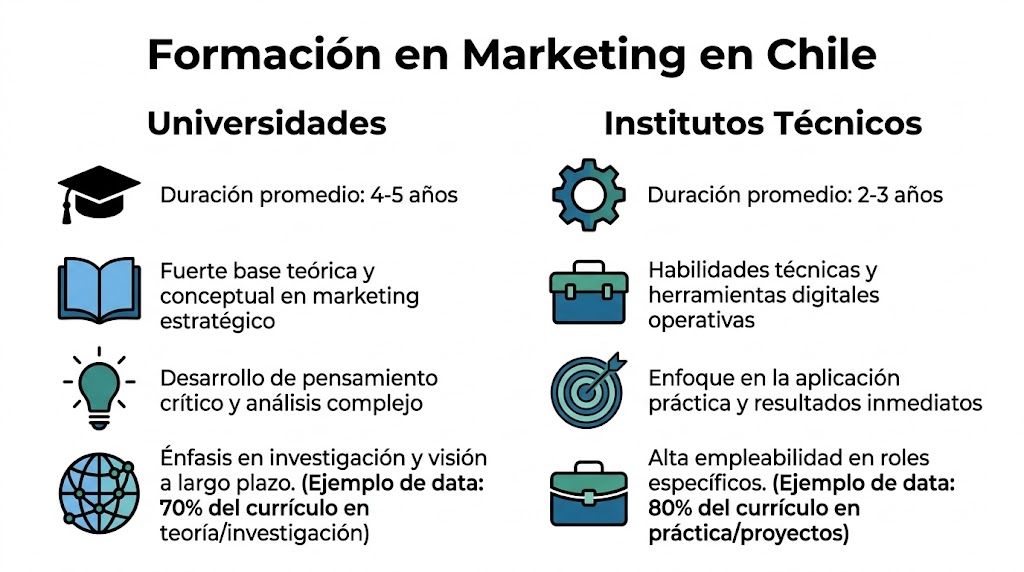
Enrollment in technical marketing and related programs grew 157.5% over the 2000s decade, with an average annual rate of 11.1%, above the growth of professional degree programs, which was 76.7%, according to the SIES Historical Compendium of Mineduc. That data is not anecdotal. It reflects a market decision.
Chilean companies began to need people who could quickly step in to execute, measure, and adapt to digital environments. That is where technical institutes gained ground.
University makes sense if you want to build a career with a trajectory toward management, leadership, or executive roles.
It tends to provide a better foundation in:
I am not saying university guarantees that. I am saying it usually offers a more favorable environment to develop it.
A technical institute is usually a better option if you want to enter the market quickly, specialize earlier, and learn with a practical focus.
That fits well with profiles who want to:
In marketing, the speed of applied learning matters a lot. A person who works with real metrics earlier can gain a competitive advantage, even over someone with better theoretical training.
Useful rule for deciding: if your goal is to lead corporate strategy, university is usually a good base. If your goal is to become indispensable through technical capability and operational judgment, the technical path can be more efficient.
Many applicants choose by institutional brand. Many employers too.
That criterion is weak. The name helps open a door, but it does not solve the central problem. Does the training develop commercial judgment and the ability to generate impact?
Look at this simple comparison:
PathMost likely strengthsMost common risksUniversityStrategy, analysis, business visionGraduating with little applied experienceTechnical instituteTools, execution, early insertionGetting too operational if you don't go deeper
The best decision is not binary. In fact, many good profiles mix both paths. They start with technical training, enter the market, and then complete studies or certifications to move up to more strategic roles.
If you lead hiring, stop asking only about the degree.
Ask for evidence of these three things:
The Chilean marketing market no longer rewards credentials on their own. It rewards professional traction. A technical graduate with judgment and hunger can outperform a university graduate who never had to answer for a relevant metric.
Most marketing programs in Chile still teach what is most visible, not what is most valuable. They talk a lot about SEO, SEM, social media, and content. They talk less about the part that defines whether a company converts or wastes demand.
That is the gap.

According to Marketing4eCommerce Chile, most academic programs in Chile emphasize SEO and SEM but lack deep modules in CRO and experimentation. That would be a minor omission if stores were converting well. They are not. The same analysis indicates that 65% of online stores in Chile have conversion rates below 2%, despite 28% annual growth in digital traffic.
That data should make any commercial director uncomfortable. And it should set off an alert for anyone weighing a marketing career in Chile.
Chile trained too many marketers to bring in visits and too few to turn visits into business.
That bias is understandable. Traffic is visible, clicks report easily, and paid media generates a sense of progress. But a company does not grow by adding sessions. It grows when it converts better, retains better, and monetizes better.
That is why the professional with a future is not just the one who knows how to launch campaigns. It is the one who knows how to ask uncomfortable questions:
That kind of thinking is worth more than a list of mastered platforms.
Not all specializations add the same business value. In the Chilean market, I would put these areas at the top of the list:
Not because of fashion. Because of business logic.
When a company already has traffic, improving conversion is usually a smarter lever than continuing to scale acquisition without fixing friction. The professional who masters hypotheses, prioritization, and result reading becomes strategically scarce.
It is not enough to open GA4, Search Console, or an advertising platform. You have to turn data into decisions.
Those who know how to distinguish signal from noise help the company stop reacting by intuition.
To expand on that difference between acquisition and real performance, it is worth reviewing this perspective on SEO and SEM in marketing. It helps explain why generating traffic does not by itself solve the growth problem.
The valuable specialist is not the one who "runs paid media." It is the one who understands cost, margin, return, and investment elasticity. That perspective changes the conversation with management.
The most profitable marketer does not always buy better traffic. Often they prevent the company from continuing to lose money after the click.
A useful resource for observing how this discussion is moving in practice is the following video.
If you are starting out, do not obsess over being a "digital jack-of-all-trades." That produces interchangeable profiles.
Specialize in a capability that affects results. CRO, analytics, eCommerce, or experimentation give you a much stronger base to grow professionally and to negotiate your value better. The Chilean market needs fewer channel operators and more people who understand why a business converts poorly.
The demand for digital marketing talent in Chile exists. The serious question is not whether there is a job market. The right question is what kind of profile gets the best opportunities and the best conditions.
The short answer is clear. Profiles that can demonstrate impact on conversion, revenue, or commercial efficiency have an advantage.
Programs such as Digital Marketing Engineering prepare graduates for a market where 80% find employment in agencies or high-tech sectors such as agro-tech, and starting salaries are around CLP 900,000, according to information from Escuela de Comercio. That same context highlights that skills tied to conversion improvements on WordPress or Shopify sites have a growing valuation.
That does not mean every graduate reaches that level. It means something else. The market is willing to pay when the profile comes aligned with real business needs.
Not every sector hires with the same maturity. In Chile, the environments that best leverage marketers with a growth mindset tend to be:
In those spaces, a marketer with a good business read advances faster than someone focused only on content or visual execution.
Many job postings are still poorly written. They ask for "social media skills," "creativity," "proactivity," and an endless list of tools.
But when hiring is serious, the criteria are different:
What the posting saysWhat really mattersCampaign managementThe ability to justify decisions with dataDigital experienceUnderstanding of funnels and behaviorAnalytical profileJudgment to prioritize business problemsResults orientationConcrete evidence of prior impact
If you want to raise your employability, stop presenting yourself as someone who "does marketing." Present yourself as someone who helps sell better, acquire better, or decide better.
If you are building a team, do not copy old structures.
A small but good team usually needs a healthier mix:
The common mistake is to fill the team with channel executors without a head who connects actions with business. That is where pretty reports and mediocre results appear.
The practical conclusion is harsh but useful. The Chilean marketing job market rewards specialization with impact. Base salaries exist. The real differentiator appears when the professional stops being an operator and becomes a critical piece of growth.
Entering the market does not require a perfect path. It requires a smart sequence.
Many people get stuck comparing institutions, curricula, or job titles. Meanwhile, the most competitive profiles move ahead because they build evidence. In a marketing career in Chile, credibility is earned faster by showing judgment than by accumulating labels.
Do not try to sell yourself as an expert in everything. The market does not need another generic profile.
Start with a reasonable combination:
That focus can be performance, analytics, eCommerce, strategic content, or automation. What matters is that it relates to a concrete business need.
A portfolio does not just mean pretty designs or uploaded campaigns. It means showing how you think.
Include work, exercises, or your own projects where you can explain:
If you do not have strong work experience, create your own cases. Analyze an online store, a B2B company, or a local brand. Your reasoning can say more than a junior title.
Career tip: in interviews, talk less about tasks and more about decisions. Tasks make you replaceable. Decisions make you valuable.
An underused route to scaling is mastery of GEO-SEO and AEO. In Chile, 55% of searches have local intent and voice searches grew 35%, according to Nexbu. For local businesses, regional retail, professional services, and B2B companies, that capability makes a clear difference.
This matters because many marketers compete in saturated terrain. Few develop a solid proposition around local visibility, presence in AI environments, and capturing high-intent demand.
If you are organizing your professional development, this guide on a digital marketing plan can help, because it helps you think about how a specialization fits within a broader strategy and not as an isolated skill.
This is where many people stall.
They know tools but cannot defend why their work matters. To scale, you need to be able to converse with commercial management, finance, or founders without hiding behind vanity metrics.
Ask yourself these questions regularly:
If you can answer that clearly, you are already above much of the junior and mid-level market.
Degree, diploma, certification, agency experience, your own project. Everything adds up, but nothing on its own guarantees progress.
The career accelerates when you combine three assets:
AssetWhat it is forFormal trainingGives you a base and conceptual orderApplied experienceGives you real judgmentVisible specializationDifferentiates you and raises your perceived value
The mistake is not starting from the bottom. The mistake is staying too long in a role where no one demands that you think.
The best way to look at a marketing career in Chile is this: you are not entering a decorative profession. You are entering a function that today impacts commercial decisions, investment, and growth.
For professionals, the recommendation is direct. Do not base your career on tools everyone learns. Base your career on capabilities few master and that companies actually need. Commercial judgment, analytics, conversion, experimentation, and useful specialization.
For those who hire, the recommendation is also simple. Stop looking for marketers who only publish, coordinate, or report. Look for people capable of thinking, prioritizing, and improving performance.
Chile already has a digital market mature enough to separate the marketing that sounds good from the marketing that generates value. In that context, the professional difference is not made by the pitch. It is made by the ability to influence real results.
That is the central point. The future of this career in Chile does not belong to those who know the most about channels. It belongs to those who understand how to grow a business.
Yes, but it is worth studying it with the right expectation. Do not go in thinking only about advertising, social media, or creativity. Go in understanding that companies need marketing connected with sales, data, and growth.
If you are looking for a career with room for specialization and evolution, it makes sense. If you are looking for an easy or purely creative path, you will probably get frustrated.
It depends on your professional goal.
If you aim for leadership, corporate strategy, or a long-term career with a stronger conceptual foundation, university usually gives you more structure. If you want to enter the market quickly, work earlier, and develop applied skills, a technical institute can be more efficient.
Do not make the decision based on prestige. Make it based on strategic fit.
My opinion is clear. Today the specialties that improve business performance, and not just visibility, add the most value.
Among the most powerful are:
The most saturated areas are usually the ones many people can execute with superficial training.
Yes. But it is not enough to say you learn fast.
You need to show evidence of how you think. A portfolio, your own case, a site analysis, an argued proposal, or independent projects can help a lot. In marketing, the quality of reasoning carries more weight than many believe.
Three things. Real curiosity, analytical ability, and commercial judgment.
Tools can be learned. Judgment does not appear just from using platforms. A valuable junior is not the one who knows a little of everything. It is the one who understands why an action matters to the business and knows how to ask good questions.
At the start, a generalist base with a visible specialization is best.
That means understanding the full system of digital marketing while having a clear angle that differentiates you. If you start only as a generalist, you compete with too many similar people. If you start as an extreme specialist without context, you can end up boxed in.
The good combination is enough breadth and depth in a capability that is in demand.
Confusing activity with value.
They learn tools, make pieces, publish content, and set up campaigns, but they do not always understand which business problem they are solving. That mistake makes them fragile in interviews, evaluations, and salary negotiations.
Hiring by a task list and not by the ability to make an impact.
They look for a "marketing manager" who does content, paid media, design, reports, CRM, and events, all at the same time. That usually ends badly. Not for lack of attitude, but because the role is poorly designed.
Yes, especially if you come from areas that contribute structured thinking or business understanding.
Profiles who migrate from sales, business engineering, design, communications, or analytics can adapt well. The key is to close the gap between prior experience and current digital skills.
You are doing well if you can increasingly answer these questions:
If you cannot answer that, you are still accumulating knowledge. If you can already answer it, you are building a career.
If your company already invests in digital but feels that traffic is not translating into the growth it should, Bigbuda can help you look at the problem with strategic judgment. Its approach combines data, conversion, digital experience, and artificial intelligence to transform performance, not just activity.