










Solutions
Explore how to grow

Your team has already done the hard part. It generated traffic, launched campaigns, pushed content, opened new channels, and brought in visitors. But sales aren't taking off at the same pace. The problem is almost never volume. The problem is relevance.
If you want to go deeper, take a look at our digital marketing service.
When a company speaks to everyone the same way, it buys clicks that aren't worth the same, attracts sessions with uneven intent, and ends up measuring performance with an average that hides where the real margin lies. That's where budget is lost. Not in a lack of demand, but in the inability to tell high-value audiences apart from low-conversion-probability ones.
Market segmentation has gone from being a commercial research discipline to becoming a financial decision. If you keep allocating investment with mass-market logic, you're paying for inefficiency. If you segment well, you concentrate resources where the probability of conversion and repurchase justifies the cost. This isn't a soft opinion. Companies that implement effective segmentation can reduce their acquisition costs by up to 30% by focusing resources on audiences with a higher probability of conversion, according to this analysis on market segmentation.
That figure matters for a simple reason. In a digital environment that's more expensive, more competitive, and more restricted by privacy, growth no longer depends solely on attracting more people. It depends on recognizing which groups deserve different messages, offers, journeys, and budgets.
If your dashboard shows growth in sessions, impressions, or reach, but the business doesn't feel the same progress in revenue or qualified leads, you don't need more traffic. You need a better allocation of attention, budget, and value proposition.
Most companies operate on a comfortable fiction. They believe their market is a single one. So they write a single campaign, build a standard offer, and buy media as if every visitor responded to the same logic. It doesn't work. It has never worked in a sustained way. It only seemed sufficient when the cost of getting it wrong was lower.
Today inefficiency shows up fast. The same product can attract price-sensitive buyers, customers who prioritize speed, B2B accounts that value support, mobile users who bounce due to friction, and segments that only convert when the promise matches their real context. Treating everyone the same inflates CAC, dilutes conversion, and degrades returns.
Rule of thumb: if a campaign needs to speak to the entire market, it's probably not speaking well to anyone.
The way out isn't to add complexity for its own sake. It's to organize the market with actionable criteria. Market segmentation lets you decide who to prioritize, which frictions to remove, which messages to adapt, and where to stop spending on visits without value. In executive terms, it's a tool to improve the efficiency of commercial capital.
That requires a shift in approach. Don't start from the channel, the creative, or the ad platform. Start from the real difference between customers. Those who buy more, those who repurchase, those who abandon, those who request a quote but don't close, those who value speed, those who seek trust, those who arrive on mobile, and those who need a consultative conversation before moving forward.
Segmentation based solely on age, gender, or income level is good for tidying up a spreadsheet. It isn't enough to drive digital growth. That approach describes groups but rarely explains intent, urgency, or real willingness to buy.
In Chile, ignoring the socioeconomic dimension is also a serious mistake. The income gap between groups isn't marginal. Data from the 2021–2022 EPF shows that the average monthly monetary income of the top quintile was $4,992,000 CLP and that of the bottom quintile was $724,000 CLP, a gap of nearly 7 times, according to this analysis based on the EPF and market segmentation in Chile. If your pricing, message, and channel mix don't acknowledge that reality, your strategy is miscalibrated from the start.
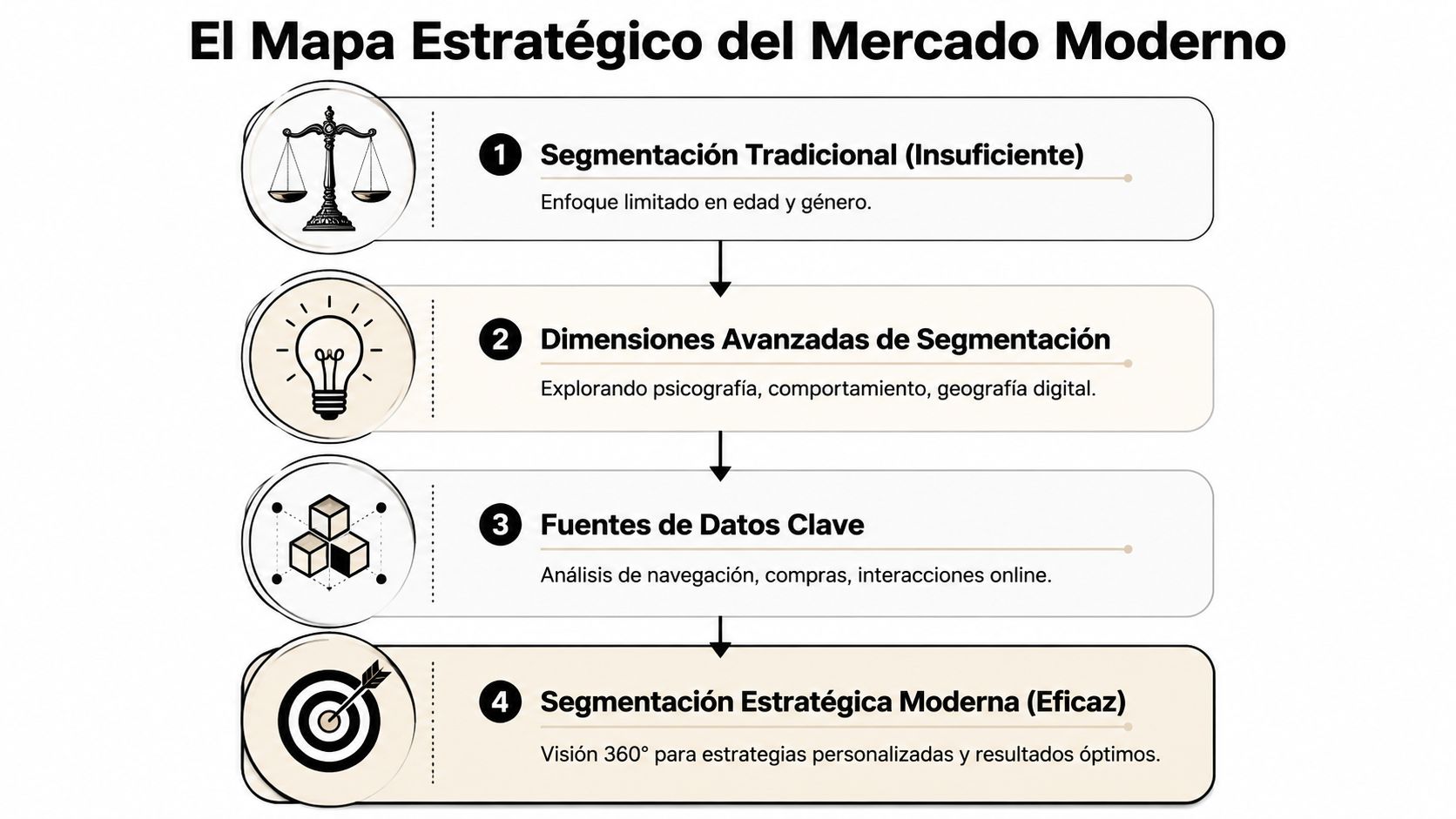
A useful strategic map combines several layers at once. Demographics still matter, but they work as a foundation, not as a final answer. On top of them are dimensions that explain far better why an audience converts or not.
That intersection changes business decisions. Two people of the same age and city can belong to opposite segments if one buys from mobile with low tolerance for friction and the other researches on desktop, compares vendors, and needs more validation before converting.
The value of this map isn't in labelling people. It's in uncovering pockets of profitability. When leaders understand which combination of variables best anticipates conversion, they stop spreading budget across audiences that are too broad and start operating on more precise hypotheses.
That affects several decisions at once:
A market isn't won when a brand achieves reach. It's won when it identifies subsets with enough value, differentiation, and accessibility to justify a specific strategy.
Companies that keep segmenting with old logic confuse breadth with scale. Profitable scale comes from understanding which part of the market deserves differentiated resources and which only consumes budget without proportional returns.
The four classic criteria are still valid. The problem isn't the framework. The problem is using them superficially. A leadership team doesn't need a schoolbook list of segmentation types. It needs to know which business question each criterion answers and when it stops being useful on its own.
Demographics are the most visible layer and the most poorly interpreted. Used well, they help define value range, type of need, and commercial tone. Used poorly, they become a lazy shortcut that produces generic campaigns.
In eCommerce, demographics guide assortment, expected ticket, and perceived barriers to entry. In B2B, they can be complemented with variables such as company size, decision-maker role, and the complexity of the sales cycle. The key is to treat them as an initial signal, not as a conclusion.
If your business still doesn't distinguish between a prospect, an occasional buyer, and a profitable buyer, it's worth reviewing how you define your profiles. One way to ground this is to connect segmentation with a clearer view of the ideal customer, as in this guide on what a buyer persona is.
Geography matters far more than many executives admit, but not for a decorative reason. It matters because it shapes experience.
In Chile, its value increases when crossed with other variables. Using it alone is a mistake. Its real contribution appears when you adapt value propositions, logistics, and messages according to operational availability and each area's sensitivity to friction, as this analysis on geographic segmentation and market strategy explains.
This becomes critical when a company promises the same thing in different contexts. Santiago and the regions don't necessarily respond to the same standard of delivery, trust in payment methods, or tolerance for delays. The same happens in B2B, where certain areas concentrate industries, supply urgencies, or different commercial service expectations.
Here is what's usually missing in performance meetings. Motivation.
Two customers with the same income and location can respond in opposite ways because one buys for convenience and the other for status, one needs certainty and the other speed, one avoids risk and the other prioritizes innovation. That layer explains why campaigns with the same offer work for one group and fail with another.
Psychographics are especially useful when a market becomes commoditized. If several competitors offer something similar, differentiation comes down to how the buyer interprets value. In B2B, that can translate into segments that prioritize control, scalability, or support. In eCommerce, it can separate price-driven buyers from those who respond better to curation, exclusivity, or ease.
Behaviour is the criterion closest to revenue because it reflects facts, not assumptions. Someone who visited a category several times, who repeated a purchase, who left a cart, who requested a quote and didn't respond, all provide far more useful signals than an isolated demographic category.
This is where much of the efficiency is defined. Behavioural segmentation lets you distinguish intent, expected value, and risk of abandonment. It also forces you to step away from vanity metrics. It doesn't matter so much who saw the ad. What matters is who showed behaviour compatible with conversion or repurchase.
| Criterion | Business Question It Answers | eCommerce Example | B2B Example |
|---|---|---|---|
| Demographic | Who can buy, and with what level of capacity or initial affinity? | Separate offers for entry-level tickets and premium tickets based on expected ability to pay | Differentiate messages for management, operations, or procurement |
| Geographic | Where does the experience change due to local context, logistics, or coverage? | Adjust delivery promise and assortment by city or area | Prioritize industries or territories with better commercial coverage |
| Psychographic | Why does this segment buy, and what value do they read as decisive? | Distinguish between price-sensitive buyers and convenience-oriented buyers | Adapt the narrative based on a focus on efficiency, control, or growth |
| Behavioural | What did the user do, and what does that indicate about intent or future value? | Identify first purchase, repurchase, high ticket, or cart abandonment | Separate cold, active, and evaluating leads from high-intent accounts |
The best segmentation isn't the most creative. It's the one that changes investment, message, and commercial priority decisions clearly enough to defend in committee.
The most common mistake isn't in understanding the theory. It's in leaving segmentation trapped between dashboards, presentations, and loose labels inside a CRM. To produce ROI, it needs to become a decision system.
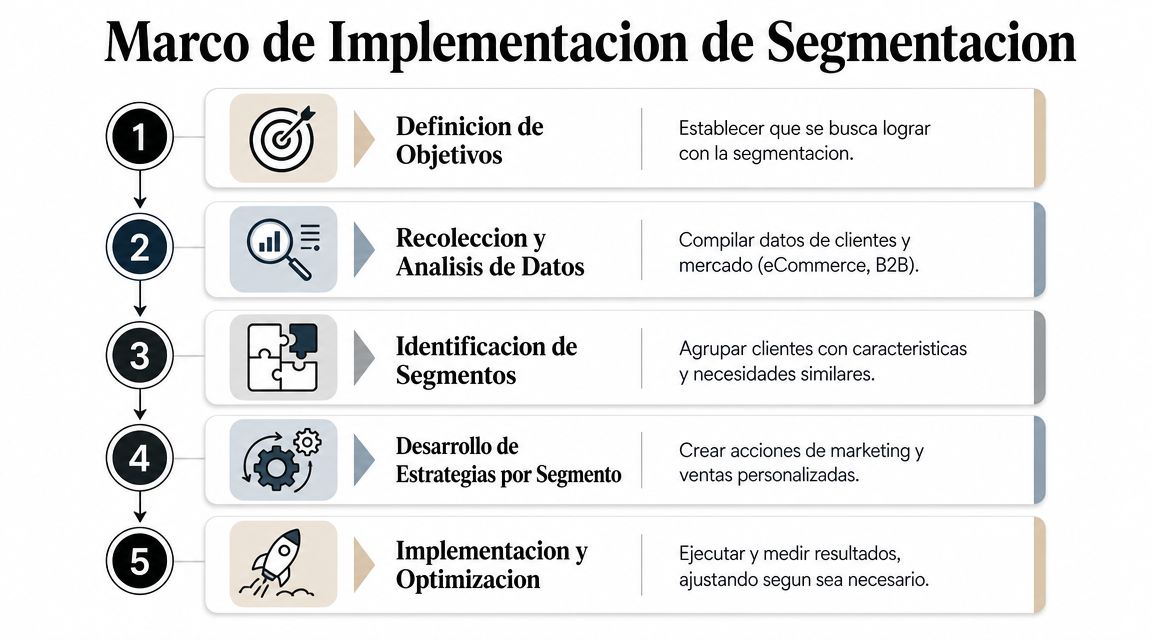
If your data lives separately across Google Analytics, Shopify, HubSpot, Salesforce, Meta Ads, forms, and internal reports, you don't have segmentation. You have fragments.
The first right decision is to build a unified view of the customer or lead. There's no need to chase technical perfection. You need to bring together the signals that actually change decisions: source, on-site behaviour, purchase history, recurrence, transactional value, account type, pipeline stage, content interaction, and commercial response.
In eCommerce, the guiding criterion should be behavioural. For the Chilean market, the most effective combination crosses behaviour with RFM (Recency, Frequency, Monetary), because it lets you isolate high-value customers, reallocate budget to segments with a higher probability of repurchase, and optimize messages by cohort, as this analysis on RFM segmentation for e-commerce details.
In B2B, the equivalent isn't to copy RFM mechanically. It's to organize firmographic and intent information. Industry, company size, urgency, type of need, decision-maker role, lead source, and level of commercial interaction usually provide a sufficient basis to separate real opportunities from noise.
An elegant but useless segment is worthless. If sales, marketing, and leadership can't recognize it, prioritize it, and act differently toward it, it isn't a segment. It's an aesthetic category.
It works better when each group responds to a clear logic. For example:
At this stage, some companies work with internal teams, others with implementation partners, and others with agencies that connect data, digital experience, and automation. Bigbuda, for example, approaches this layer through CRO, UX, data, and experimentation to translate segments into decisions about site, message, and performance, not just classification.
This is where segmentation stops being an analytical project and becomes a management discipline. Each segment must have concrete implications for budget, promise, and journey.
In eCommerce, that means deciding which cohorts receive greater media pressure, which enter repurchase sequences, which require a different value proposition, and which simply don't justify more investment. In B2B, it means defining which accounts move to human follow-up, which are nurtured with content, which require different materials, and which shouldn't distort the commercial forecast.
Define a financial priority
It could be lowering CAC, increasing repurchase, raising lead quality, or protecting margin. Without that priority, segmentation becomes decorative.
Select signals with business impact
Don't gather data out of anxiety. Gather data that helps decide investment, message, pricing, or channel.
Design actionable segments
Each group must be recognizable, measurable, and distinct enough to warrant differentiated treatment.
Assign a value hypothesis
What you expect from the segment. More conversion, more repurchase, less friction, better commercial close.
Review and correct
A segment that's useful today may lose value tomorrow. Segmentation doesn't freeze in place.
If your team can't answer which segment generates the most future value and which only inflates volume, you're managing marketing with partial visibility.
Segments don't produce results just by existing. They produce results when they change what the company shows, says, and prioritizes.

In Chile there's an underused opportunity. Since internet access is widespread, segmenting by digital maturity, preferred purchase method, and sensitivity to friction between mobile and desktop can reveal high-value groups that many competitors still overlook, according to this analysis on segmentation and digital behaviour.
That matters because conversion rarely drops for a single reason. A low-patience mobile visitor bounces over unnecessary steps. A repeat buyer doesn't want to read basic arguments again. A corporate B2B lead distrusts a site that looks too mass-market. The mistake is showing them all the same experience.
When segmentation is done well, tests stop being cosmetic exercises. You no longer test colours or phrases at random. You validate business hypotheses.
Think of an online store with four simple cohorts: new visitor, first-purchase buyer, repeat customer, and high-ticket buyer. Each one deserves a different level of friction, a different promise, and a different reason to move forward.
On a B2B site the logic changes, but the principle doesn't. An SMB looking to solve a problem quickly doesn't evaluate the same way as a corporation with multiple stakeholders. The former needs clarity, evidence, and speed. The latter needs structure, trust, operational compatibility, and less internal political friction.
For those who want to ground this logic in structured experimentation, it's worth reviewing examples of A/B experiments in eCommerce, not to copy tests, but to understand how to translate a segment hypothesis into measurable decisions.
| Element | Segment A | Segment B | Strategic Hypothesis |
|---|---|---|---|
| Main hero | New visitors | Returning | The introduction should sell trust to the first and speed to the second |
| CTA | SMB B2B lead | Corporate B2B lead | One account seeks speed, the other needs a more consultative conversation |
| Visible offer | Sensitive to logistical friction | High-value buyers | For some, operational certainty matters; for others, the premium proposition matters |
| Supporting content | Mobile user | Desktop user | Mobile demands brevity and clarity. Desktop tolerates more depth |
Many teams get obsessed with advanced personalization and end up over-engineering the problem. The best personalization is usually the most restrained. Showing different benefits by type of visitor. Adjusting social proof by industry. Changing email sequences based on behaviour. Prioritizing different content based on the journey stage.
Once a segment demonstrates enough difference, only then is it worth going deeper. Before that, operational coherence between audience, message, and experience is enough.
A simple way to think about it is this. If the ad promises speed, the landing page can't demand too much exploration. If the segment values support, the site can't hide signals of guidance. If the visitor arrives from mobile and shows high intent, every extra field works against you.
Below you'll find an audiovisual resource that helps visualize this logic applied to digital business:
A well-identified but poorly activated segment doesn't improve results. It only improves the team's internal vocabulary.
Segmentation is entering a less comfortable and more serious stage. Less comfortable, because relying on third-party audiences no longer offers the same stability. More serious, because companies need to build their own capability to understand intent without invading privacy.
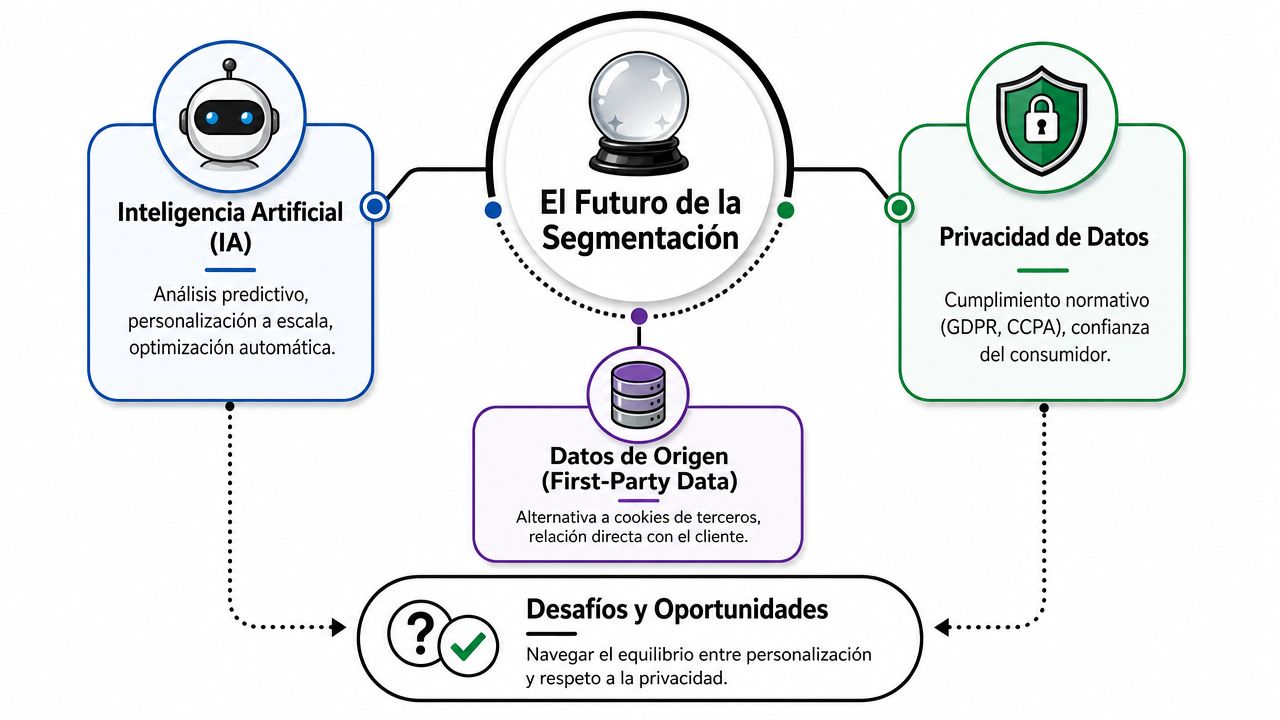
Most guides still stop at classic categories and don't explain how to operate segmentation with your own data in a cookieless context. The key for eCommerce and demand generation in Chile is to integrate web analytics, CRM, and on-site behaviour to build actionable segments based on your own intent signals, as this analysis on segmentation with first-party data proposes.
That redefines competitive advantage. A company that knows its own real behaviour well doesn't depend as much on external platforms to understand who to prioritize. It can recognize early signals of interest, friction, abandonment, or potential value with more precision than a competitor that only buys broad audiences.
The most valuable sources are usually inside the operation:
The conversation about AI in marketing usually moves too fast and thinks too little. AI doesn't fix a bad data architecture. Nor does it replace strategic judgment. Its real value appears when it helps detect patterns a team can't observe in time or at scale.
That can mean identifying users at risk of churn, leads with a higher probability of closing, customers likely to repurchase, or cohorts that respond better to certain messages. But the central point isn't automation itself. It's the ability to prioritize better.
AI that's useful for segmentation doesn't start by generating text. It starts by organizing signals, scoring intent, detecting similarities, and anticipating value.
Many companies still treat privacy as a legal matter and not as a strategic one. That's a mistake. Proper data management forces you to organize sources, improve capture quality, and reduce reliance on unreliable information. That strengthens decision-making.
Trust also matters. A business that builds relevant experiences from direct interactions with the customer works on a more sustainable foundation than one chasing opaque volume. If you want to dig deeper into that framework, it's worth reviewing these considerations on data protection.
The next competitive advantage in segmentation won't come from knowing more about other people's audiences. It will come from better understanding the signals your own customers are already giving you.
Market segmentation is no longer a marketing tactic. It's a capital-allocation discipline. It defines where to invest, which message to prioritize, which friction to remove, and what kind of customer deserves more of the business's attention.
Companies that keep operating with mass audiences pay a silent tax. They waste budget on low-value clicks, dilute their proposition, and force their teams to optimize campaigns that are misfocused from the start. The problem isn't a lack of tools. It's a lack of resolve to stop treating the market as a homogeneous block.
The important change isn't accumulating more segments. It's building actionable segments, connecting them with your own data, activating them in differentiated experiences, and measuring them with a profitability logic, not just a volume one. That's where the growth that matters appears. Not the kind that inflates dashboards, but the kind that improves commercial efficiency.
If your company still speaks the same way to customers with different behaviours, contexts, and values, you're letting one of the few levers that still allow growth without relying solely on more acquisition spend slip away.
If your business needs to better convert the traffic it already has, Bigbuda can help you organize segments, detect frictions, and turn data into growth decisions that are more profitable for eCommerce and B2B.
Related reading: Age generations: a marketing and conversion guide · Market Segment: Key to Growing in eCommerce 2026
No. When sessions, impressions or reach grow without the business feeling the same progress in revenue or qualified leads, the problem is allocation, not volume. Treating every visitor with the same campaign, offer and media logic inflates CAC, dilutes conversion and degrades returns.
Demographics describe groups but rarely explain intent, urgency or real willingness to buy. They work as a foundation, not a final answer. A useful map layers socioeconomic capacity, geography, psychographics, behaviour and technographics on top, because two people of the same age and city can behave in opposite ways.
Behaviour, because it reflects facts rather than assumptions. Repeat visits to a category, a second purchase, an abandoned cart or an unanswered quote request signal intent, expected value and risk of abandonment far better than an isolated demographic category. It also pulls the team away from vanity metrics.
Turn it into a decision system. First unify the commercial truth across analytics, CRM and ad platforms. Then build segments that sales, marketing and leadership can recognize, prioritize and act on. Finally attach each segment to concrete choices about budget, promise and journey.
The experience itself. New visitors respond to trust signals and clarity on delivery. Repeat customers need speed, relevance and simple access. High-ticket buyers need more context and less promotional noise. A corporate B2B lead needs structure and a consultative conversation, not a mass-market pitch.
AI does not fix a bad data architecture or replace strategic judgment. Its value is detecting patterns at scale, such as churn risk, probability of closing or likelihood to repurchase. Combined with first-party signals from CRM, web analytics, transactions and sales interactions, it helps prioritize better.