










Solutions
Explore how to grow

The most repeated recommendation about Google Ads is also the most incomplete: invest more, raise bids, gain visibility. That logic serves to open the wallet, not to build a competitive advantage. If a company understands Google Ads only as a system for buying clicks, it ends up managing spend. Not growth.
This is strengthened by a solid digital marketing service.
The useful question is not only how Google Ads works, but why two companies with similar budgets can obtain very different results. The answer lies in the relationship between the auction, ad relevance, search intent and the experience the user receives after the click. Google decides who gets to compete and in what position. Your site decides whether that traffic turns into revenue or into waste.
Many executives still think Google Ads is a “pay to play” channel. Pay more, show up more. Pay less, disappear. That reading is comfortable, but bad for making decisions. Google does not operate as a showcase bought by the highest bidder. It operates as a system that filters visibility based on eligibility, context and perceived quality.

The mistake appears when the company separates media and conversion as if they were different worlds. The media team buys traffic. The site “receives visits.” And if the sales do not come, the blame almost always falls on the campaigns. That conclusion is usually premature.
Google makes it clear that ad rank determines whether the ad is eligible to show, but the landing page experience is decisive for converting. That is why two accounts with the same budget can obtain radically different results, as Google's documentation on ad rank explains.
Practical rule: if the internal conversation revolves only around CPC, bids and budget, the company is looking at half the system.
An investment in Google Ads does not buy sales. It buys opportunities for attention with intent. What is profitable happens when that intent finds a coherent message, a clear offer and a post-click experience that does not add friction to the decision.
This completely changes how to manage the channel. The focus stops being “how to spend more efficiently” and becomes “how to better capture commercial intent.” In an eCommerce, that means reviewing product, message, speed, trust and continuity between ad and landing, not just keywords.
To go deeper into that advertising-profitability logic, it is worth reviewing this perspective on advertising on Google oriented toward ROAS and CRO.
The Google Ads auction is less like an auction house sale and more like a selection process. The one who offers the most money does not automatically win. The one who best combines economic signal with expected quality wins. That difference matters because it redefines where a company should work to improve margin.
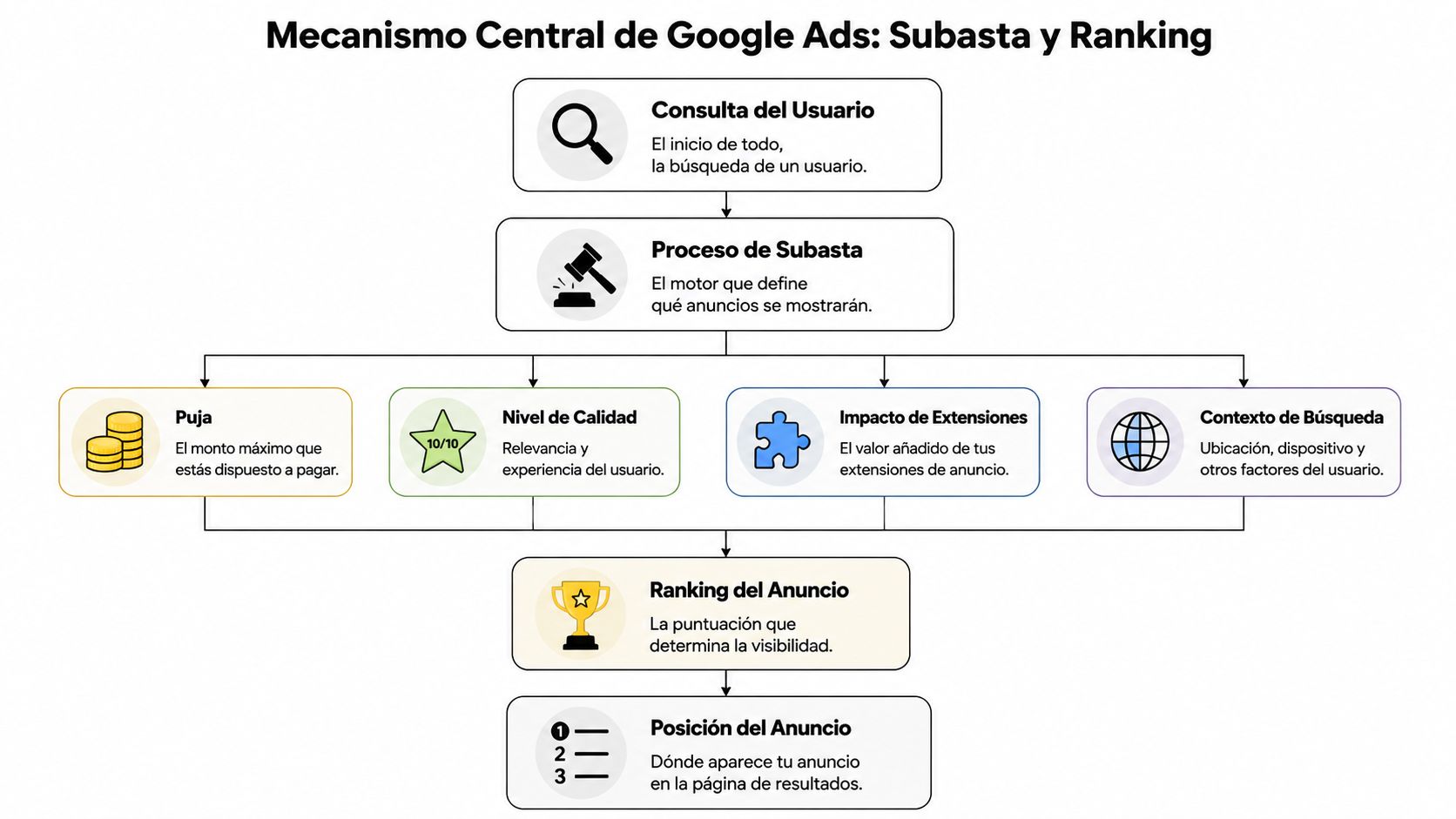
Every time a user performs a search, Google runs a real-time auction. In that evaluation it does not consider only the bid. It also calculates an ad rank with signals such as relevance, landing page quality and expected CTR, according to the Google Ads help on ad rank.
The business consequence is direct. A company can pay less per click than a competitor if its ad and its landing experience are better. That is not a technical detail. It is an operational advantage.
Think of it like a job interview. Two candidates ask for different salaries, but the decision does not depend only on salary expectations. Experience, fit for the role and the likelihood of performing well also matter. In Google Ads, something similar happens. The bid opens the door. Quality defines whether you get in and in what position.
When a director asks “how much more should we invest?”, they are often asking the wrong question. The useful question is “why does Google consider that our experience deserves less visibility?”.
A leader does not need to memorize every setting on the platform. They do need to understand which levers change the economics of the channel.
There are four fronts that do deserve executive attention:
The correct reading of how Google Ads works is not tactical. It is financial. If you improve quality, you not only raise visibility options. You can also better defend margin because the platform does not force you to compensate for weaknesses with money.
That point is uncomfortable for many companies. It forces them to accept that the problem is not always in the account manager or in the bid. Sometimes it is in the commercial proposition, in a poorly presented offer or in a page that does not sustain the ad's promise.
Choosing campaigns in Google Ads is not a platform decision. It is a business-model decision. Each type of campaign responds to a different stage of demand, and mixing objectives within the same logic usually degrades results.
If you sell products with demand already formed, Search and Shopping usually concentrate the most direct value. The first captures intent declared in text. The second puts product, image and price in front of a user who is already comparing options.
Performance Max expands coverage and automates inventory across Google surfaces. It can be useful when the company already has reasonable conversion signals and an orderly creative operation. If that base does not exist, automation can hide errors instead of solving them.
Display and Video serve another role. They are vehicles for reach, recall and accompaniment. They work better when the brand already understands its funnel and does not demand the same kind of immediate return as Search or Shopping.
For search campaigns in Chile, the most important technical lever is segmentation by intent. The correct structure, campaign → ad groups → ads → keywords, improves traffic estimation and auction precision against audiences with local intent, as Adsmurai explains in its analysis on how to get started with Google Ads.
That has a simple strategic reading. A disorganized account is not only harder to operate. It also sends confusing signals to the system. And when the system receives poor signals, it buys less precise traffic.
Three structural decisions usually make the difference:
A well-structured account is not “more orderly.” It is more profitable because it reduces ambiguity in the auction.
Campaign TypeMain ObjectiveIdeal ForSearchCapture demand with explicit intentCategories with high purchase intent, brand searches, transactional termsShoppingShow the product offer directly in resultsRetail, broad catalogs, price and product comparisonPerformance MaxExpand automated coverage based on conversion signalsCompanies with solid tracking, an orderly catalog and enough data volumeDisplayMaintain presence and build recallRemarketing, awareness, accompaniment to longer decisionsVideoGenerate interest and reinforce the brand messageLaunches, market education, support to existing demand campaigns
The right decision is not to “use everything.” It is to assign each format to the work it can perform with economic logic. A mature company does not distribute budget by trend or by generic platform recommendation. It distributes it based on intent, margin and the real capacity to turn that attention into revenue.
Artificial intelligence in Google Ads is not magic. It is delegation. You give the system a goal, conversion signals and business constraints, and the algorithm adjusts bids in real time to pursue that objective. If the underlying strategy is wrong, automation accelerates errors.

Smart Bidding can be useful because it processes contextual signals that a human operator cannot adjust manually in each auction. But the machine does not define your positioning, your value proposition or the quality of your measurement. It only optimizes within the framework you give it.
That is why a serious marketing leadership should not ask “do we turn on automation, yes or no?”. It should ask something else:
When those answers are weak, automated bids end up optimizing low-quality signals.
Google Ads requires minimum thresholds for certain audience statistics to activate. Lists must have at least 1,000 active users in the last 30 days, and customer lists require 1,000 Gmail users, according to this explanation on auction statistics and audiences in Google Ads.
That data matters much more than it seems. It means the AI does not work on intuitions. It needs critical mass. In markets like Chile, that forces you to be realistic. Not all accounts have enough volume to demand the same level of algorithmic sophistication.
Some organizations resolve this by first organizing their measurement and site infrastructure. Others bring in external support to connect media, UX and CRO. There come options like Bigbuda, which works on the relationship between data, experience and conversion from the web toward performance, not only from media buying.
The click is not the goal. It is the handoff point between the advertising promise and the commercial experience. If that transition fails, the account may look active, but the business does not grow.
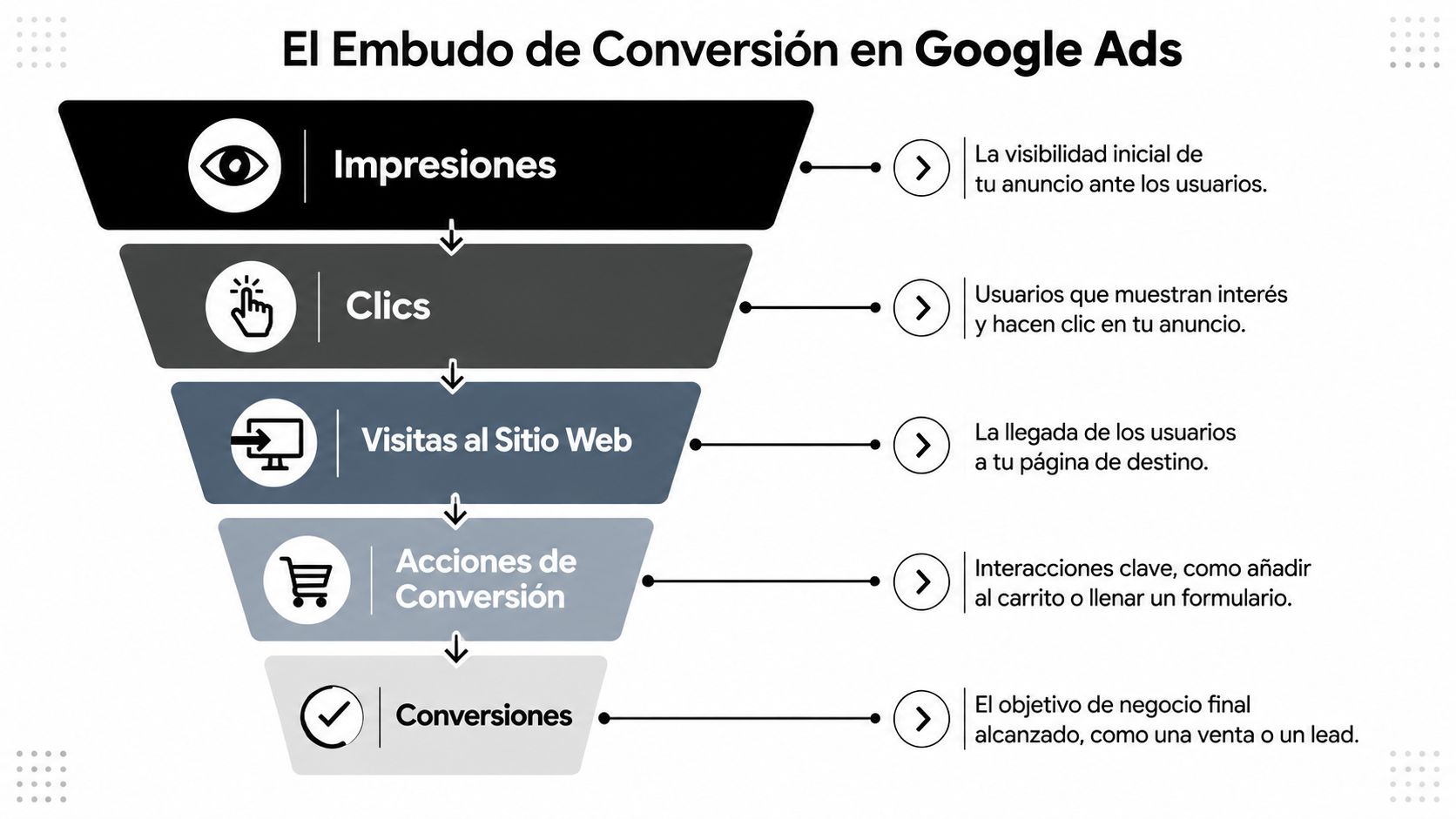
Here appears the gap that many companies do not see. They evaluate ads, keywords and campaigns with enormous detail, but accept slow pages, vague messages or uncomfortable purchase processes as if they were a secondary problem. They are not. They are part of the channel's performance.
Measuring that second half of the journey well is mandatory. If conversion tracking is poorly implemented, the system learns poorly and so does the team. To organize that technical layer, tools like Google Tag Manager in a measurement strategy help connect relevant events with business decisions.
The executive reading is simple:
The real performance of Google Ads is defined when the user lands. Before that, you are only buying an opportunity.
Google Ads offers an Insights page that shows market and search-interest trends selected based on account performance and searches about the advertised products or services. In addition, it allows you to observe windows of the last 7 or 28 days, according to the Google help on the Insights page.
For an eCommerce in Chile, that matters because it forces you out of a purely internal view. It is not enough to review what historically performed in the account. You also have to read whether market demand is shifting, concentrating or cooling in certain categories.
That approach changes the optimization conversation:
What many companies look atWhat they should really interpretCampaign with more clicksCategory with the highest current commercial intentKeyword with more trafficDemand that sustains margin and conversion probabilityIsolated historical performanceRecent market signal in short windowsProblem attributed to mediaPossible post-click friction or change in intent
CRO comes in here as a business discipline, not as a cosmetic adjustment. If demand exists and the traffic arrives, the company needs to improve its ability to transform that intent into action. That means reviewing value proposition, content hierarchy, trust, offer clarity and continuity between ad and destination.
Understanding how Google Ads works is not about mastering an interface. It is about understanding a system that allocates visibility based on expected relevance and that only becomes profitable when the complete experience accompanies that promise.
A mature company stops seeing Google Ads as an isolated cost center. It treats it as a growth engine connected to pricing, offer, data, UX and conversion. There lies the difference between an account that “spends reasonably” and an account that improves its efficiency over time.
A CEO or marketing director should demand answers to harder questions than usual.
It is also worth evaluating whether the current operation needs a more integrated view across media, site and conversion. For that, reviewing how a Google Ads agency with a focus on business performance works can help organize criteria, even before changing provider or internal structure.
The real advantage is not in winning more clicks. It is in better converting the right intent. When a company understands that, it stops chasing platform metrics and starts building a more efficient commercial machine.
If your company already invests in traffic but keeps seeing leaks between clicks, visits and sales, Bigbuda can help you align advertising, measurement, web experience and CRO so that Google Ads works as a growth lever and not just as an operational expense.
Every time a user performs a search, Google runs a real-time auction. It does not consider only the bid: it also calculates an ad rank with signals such as relevance, landing page quality and expected CTR. A company can pay less per click if its ad and landing experience are better.
Because ad rank determines whether the ad is eligible to show, but the landing page experience is decisive for converting. An investment in Google Ads does not buy sales, it buys opportunities for attention with intent. Profit appears when that intent finds a coherent message and a frictionless post-click experience.
Search captures demand declared in text and Shopping puts product, image and price in front of a user already comparing. Performance Max expands automated coverage when you already have reasonable conversion signals. Display and Video serve reach, recall and accompaniment, and work better once the brand understands its funnel.
The correct structure is campaign, then ad groups, then ads, then keywords. That improves traffic estimation and auction precision against audiences with local intent. Three decisions make the difference: separate by commercial intent, group by offer logic such as categories or margins, and align each ad with a concrete destination.
Automation does not correct a bad strategy; it optimizes within the framework you give it. Google Ads requires minimum thresholds for certain audience statistics: lists must have at least 1,000 active users in the last 30 days, and customer lists require 1,000 Gmail users. The AI needs critical mass.
When the user lands. Before that you are only buying an opportunity. Without reliable measurement you do not know which demand generates value; without coherence between ad and landing you pay for attention that cools down on arrival; and without conversion work media optimization hits an artificial ceiling.