










Solutions
Explore how to grow

The most repeated recommendation about advertising on Google is still the most incomplete: lower the CPC, improve the CTR and expand coverage. That approach serves to operate campaigns. It is not enough to lead growth.
At Bigbuda we help you with our digital marketing service.
A CEO does not need more clicks. They need a system that turns investment into revenue with visibility over margin, customer quality and the capacity to scale without destroying profitability. That is where many Google Ads accounts fail. They are managed as a traffic channel, when in reality they work as a system of acquisition, learning and capital allocation.
The mistake is not only in the platform. It is in the mental model. If the company separates paid media, website, analytics, CRM and commercial experience, Google Ads ends up optimizing what it can measure within its own interface, not what matters most to the business. That explains why campaigns with “healthy” metrics can keep producing mediocre results.
Advertising on Google no longer behaves like an isolated search tool. Since Google renamed Google AdWords to Google Ads in 2018, the platform consolidated its expansion toward YouTube, Display, Google Shopping and Google Maps, which turned it into a broader and more measurable multichannel environment for performance, branding and remarketing, as this analysis on the evolution of Google Ads summarizes. For a Chilean company, that changes the right question. It is not “how do we advertise on Google,” but “how do we use Google as growth infrastructure.”
The real advantage is not in buying cheaper traffic. It is in turning every click into a better-interpreted business signal.
That change forces you to look at advertising with a different logic. Not as a marketing expense, but as an investment in commercial intelligence, attribution and operational efficiency.
The most expensive reading of Google Ads is treating it as a channel for “buying clicks” at the end of the funnel. That view serves to operate campaigns. It does not serve to decide investment, prioritize growth or defend profitability.
Google Ads today fulfills a broader function within the company. It makes it possible to observe real market intent, test value propositions, detect frictions between marketing and sales, and allocate budget based on the probability of generating sustainable revenue. Under that logic, the platform stops being only an acquisition tool and becomes part of the commercial decision system.
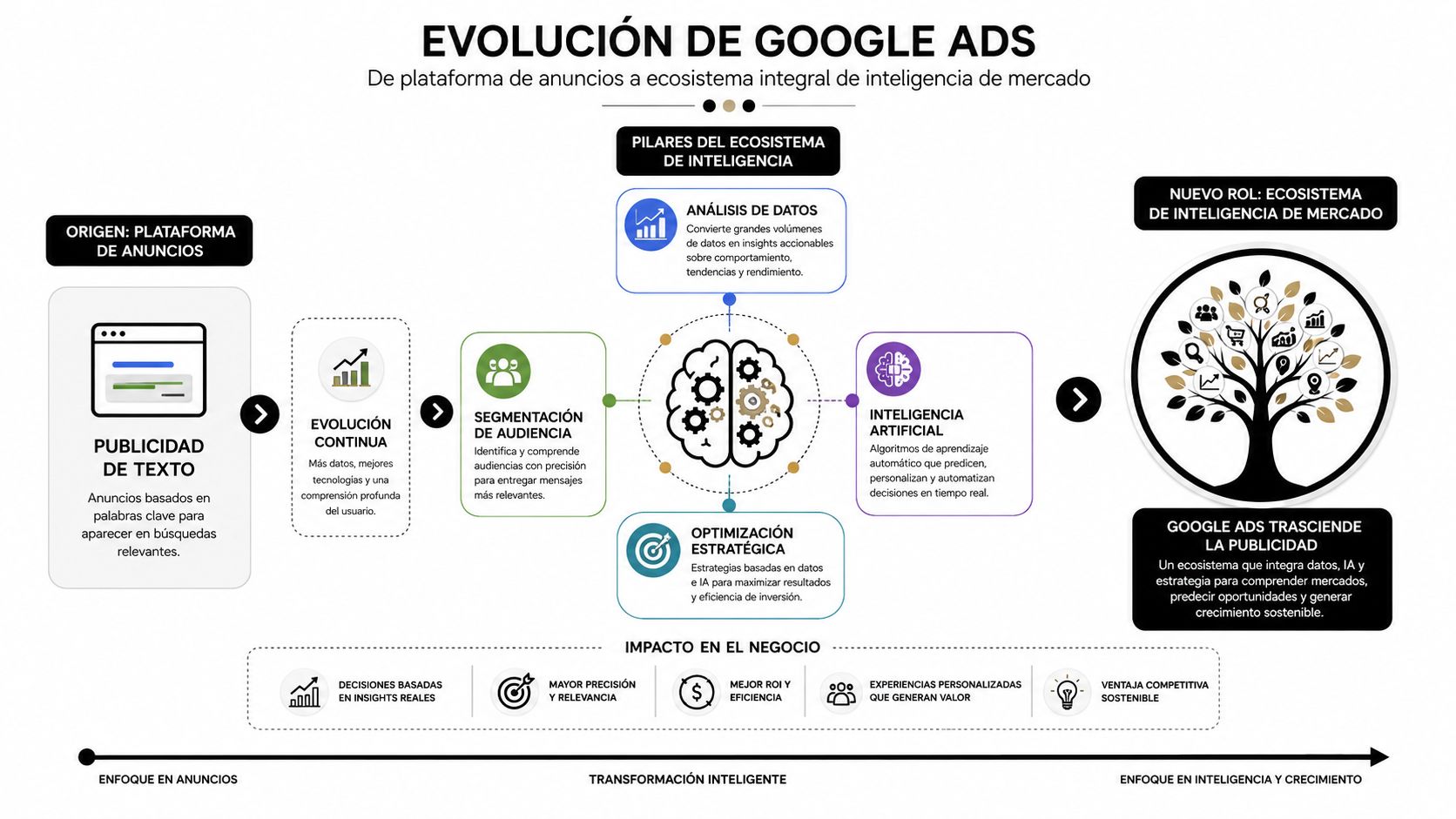
The shift from Google AdWords to Google Ads reflected a fundamental change. The platform stopped centering on text ads in search and moved to integrate environments with different functions, such as YouTube, Display, Shopping and Maps. For a company, that modifies the strategic question. It is no longer only about capturing whoever searches for a solution. It is about deciding at which moment of the commercial process it is worth appearing, with what message and for what economic objective.
That difference matters at the general-management level because it connects advertising with operations. If Search shows high demand but the final conversion does not follow, the problem may be in pricing, offer, commercial timelines or post-click experience. If YouTube improves brand searches but sales do not rise, perhaps awareness is growing in an unprofitable segment. Google Ads, well read, does not only buy traffic. It also exposes mismatches between what the company promises and what it can actually monetize.
In B2B, this breadth allows something few organizations structure well. Using Search to capture declared intent, YouTube to accelerate recognition in complex categories and audiences to keep alive opportunities that sales has not yet closed. In eCommerce, the value appears when connecting discovery, evaluation and user return under a single data logic, instead of measuring each campaign as if it operated in isolation.
Executive reading: the real contribution of Google Ads is not to increase advertising activity. It is to help distinguish between useful demand and expensive demand, before scaling investment.
Anyone who needs to contrast this more strategic perspective can review how a Google Ads agency in Chile with a focus on growth and profitability works.
The usual mistake is not choosing the wrong format. It is starting from the advertising inventory instead of starting from the business bottleneck.
Search responds best when the company needs to capture explicit intent and validate whether its proposition competes well in a category with existing demand. YouTube makes more sense when the market still requires education, differentiation or recall to shorten future decisions. Display tends to perform better as continuity support, especially in long purchase cycles or with multiple visits before the close. Shopping turns catalog, price and availability into a commercial piece visible from the search. Maps gains weight when proximity, local trust or the physical visit influence the decision.
The implication for a CEO is concrete. The Google Ads mix should not be defined by operational habit or by an agency's standard configuration. It should respond to the main constraint of the business at that moment.
If qualified demand is missing, the investment must concentrate on capturing and creating intent with discipline. If traffic exists but the financial result does not appear, increasing coverage only accelerates a prior inefficiency. In that scenario, CRO, landing pages and attribution weigh as much as the campaign. That is where Google Ads fits into a predictable growth strategy. Not as an isolated media system, but as a piece integrated with sales, analytics and profitability.
Most accounts are organized by products, service lines or operational habit. That seems logical. It is also usually inefficient. A more solid architecture starts from a different question: what type of demand deserves more investment based on its economic impact?
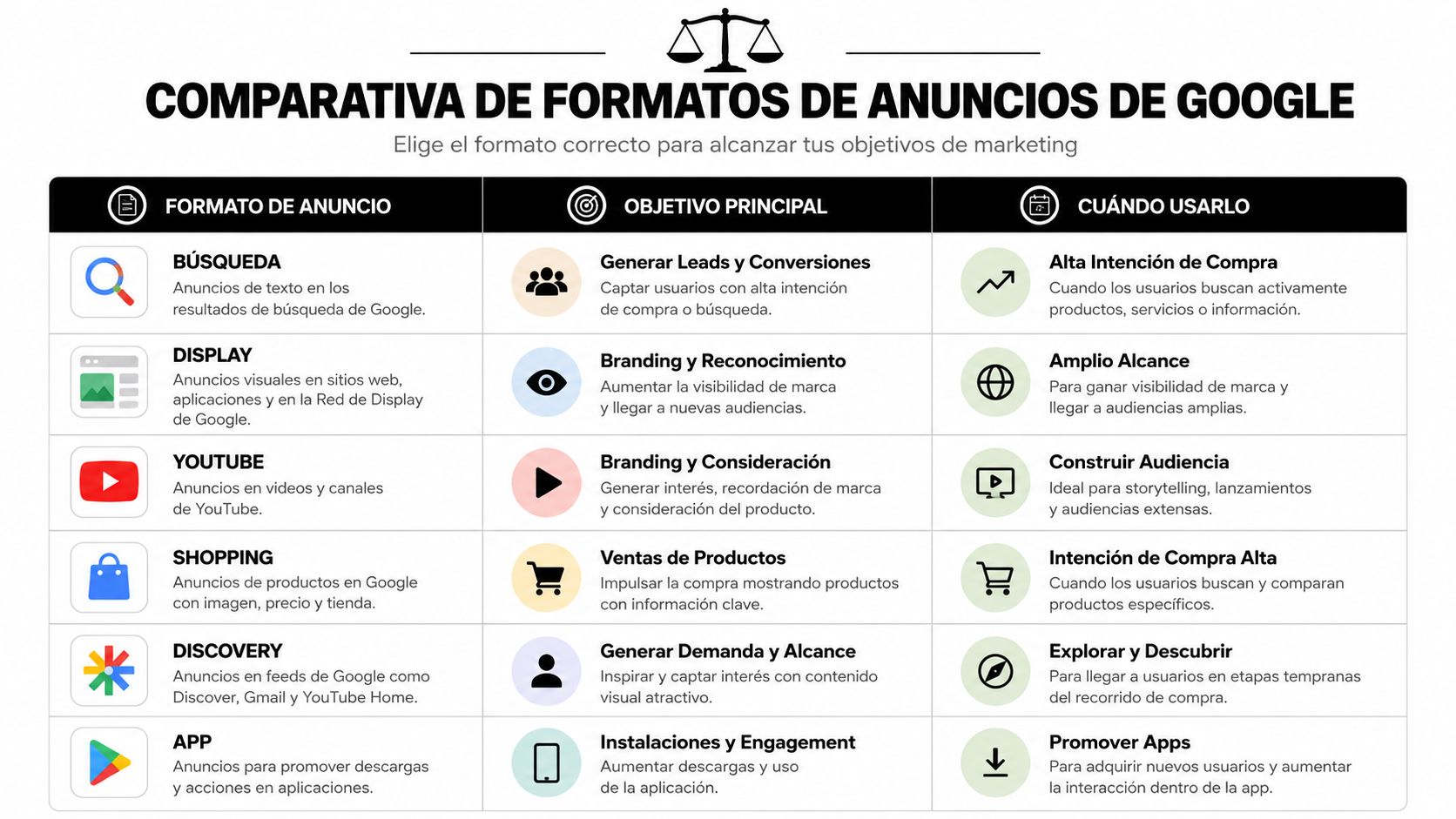
In eCommerce, not all products deserve the same level of advertising pressure. Some can bear more investment because of margin. Others because of repurchase. Others because of ticket potential or the ability to activate cross-sells. In B2B, something similar happens. Not all leads have the same commercial value, nor do all services justify the same acquisition cost.
That is why the smartest design separates campaigns by their financial logic. For example:
A frequent mistake is to group everything under the same performance goal. That averages different realities and makes the analysis opaque. The result is an account that optimizes aggregate volume, not profit.
Ad FormatMain ObjectiveIdeal For eCommerceIdeal For B2BSearchCapture active intentProducts with demand already formed, competitive categories, high-decision queriesLeads with explicit need, high-intent servicesDisplayMaintain presence and remarketingUser recovery, support to promotions, recallNurture longer cycles, reinforce brand and considerationYouTubeBuild demand and educateLaunches, visual categories, brand differentiationMarket education, expert positioning, awarenessShoppingFacilitate the transactional decisionCatalog, product comparison, traffic with purchase intentLower priority except for cases with a packaged or tangible offerPerformance MaxIntegrate inventory and automationScaling with margin and quality supervisionBroad coverage, as long as there is control over lead quality
In Chile, Google Ads works as an auction system by Ad Rank. The position depends on the bid, the ad quality and the expected impact of the assets. Google also indicates that greater relevance and a better landing experience can reduce the effective cost per click by improving the quality component, as the documentation on Ad Rank and ad relevance explains.
That point changes the conversation with finance. Not every efficiency improvement comes from paying less per click. An important part comes from making Google perceive a greater correspondence between search, ad and landing page. In other words, the company can buy better if it builds better.
A higher budget does not correct a poorly aligned proposition. It only buys more exposure of the same problem.
That is why the right discussion about advertising on Google is not only how much to invest. It is under what conditions the account can absorb more investment without degrading results.
Scalable accounts do not look like a collection of campaigns. They look like an operating model. Each campaign fulfills a function, each group organizes an intent and each landing page sustains a concrete commercial promise.
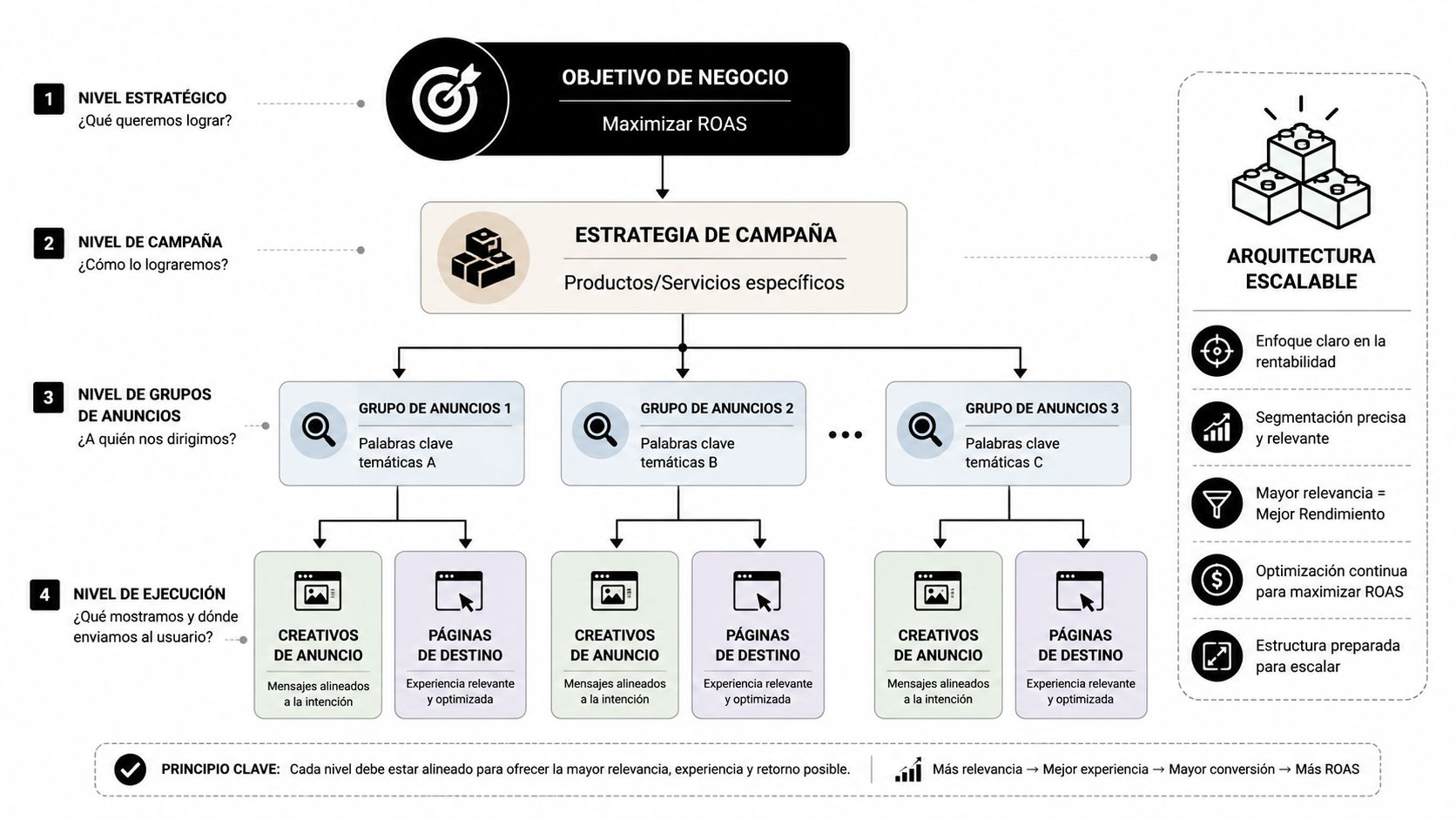
If the company sells a lot, but with very different margins between lines, a structure based only on commercial categories mixes incompatible priorities. The same happens when a B2B business has services with very different closing cycles. The account needs to reflect those differences from the start.
A useful architecture usually distinguishes between:
That structure is not a management detail. It defines where you learn, where you protect profitability and where you take on exploration.
Many companies still believe that the profitability of Google Ads is played mainly in keywords, bids and targeting. That view is already too narrow. The greatest multiplier is usually in the post-click experience.
If the ad promises something the landing page does not deliver clearly, the business pays to generate a visit that does not advance. If the page loads slowly, friction destroys value before the user even evaluates the offer. If the message does not maintain semantic continuity between search, ad and destination, the campaign loses efficiency even if the traffic arrives.
That has direct implications for ROAS and for internal marketing governance. The investment in advertising should not be approved in isolation from the site, the analytics and the mobile experience. When those teams work separately, the company ends up treating symptoms on the platform and causes silently within the site.
A board should look at this problem as capital allocation. There are moments when putting more budget into media produces less return than first investing in the conversion base. Not because the advertising is bad, but because the receiving system is not yet ready to scale.
DecisionTactical readingStrategic readingRaise budgetMore trafficMore pressure on an experience that may not convertChange bidsCost adjustmentReallocation of risk between volume and profitabilityOpen new campaignsAdditional coverageDemand expansion that requires better measurementImprove landingPost-click changeIncreased productivity of existing spend
The click is not the result. It is the handoff of control from Google to your business. From that moment, the platform stops deciding and your digital experience starts deciding.
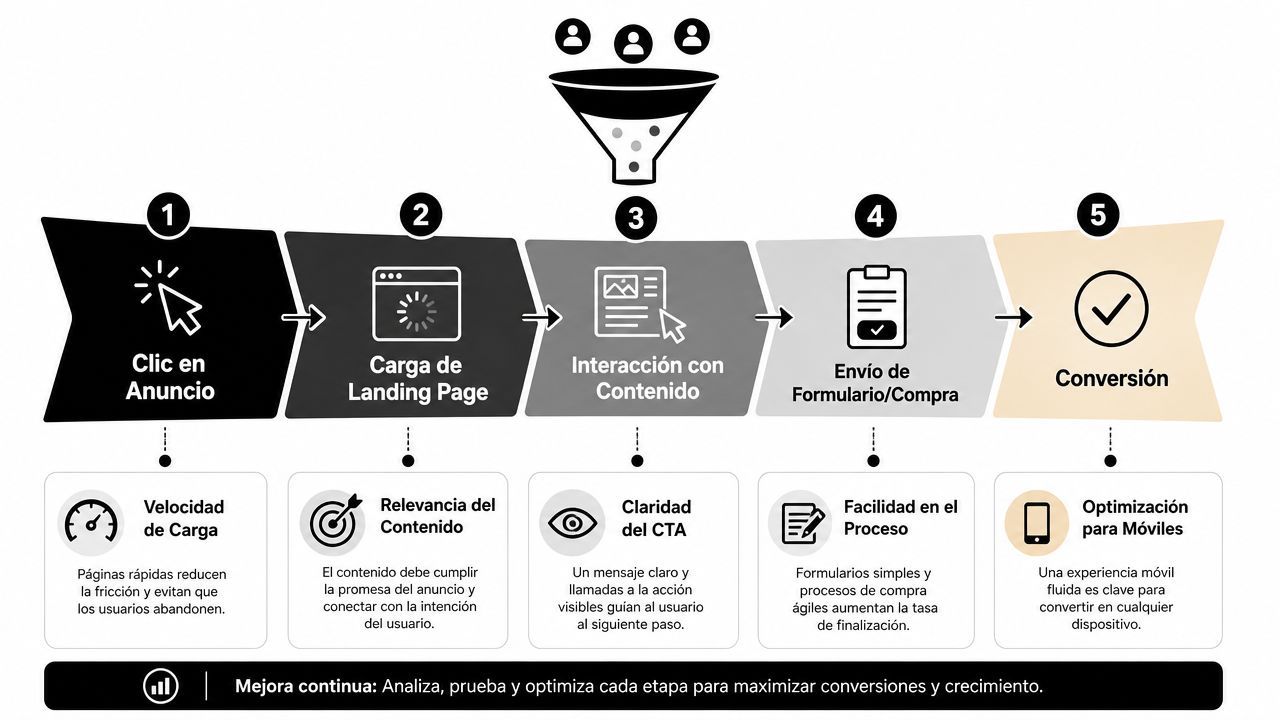
For campaigns oriented toward eCommerce and leads in Chile, the most actionable technical data is not only the CPC, but the post-click conversion rate. Continuous optimization should include keyword research, bid adjustment and landing page improvement, because the same traffic can perform better when frictions of usability, load speed and content relevance are corrected, as this analysis on campaign and landing page optimization argues.
That point is deeper than it seems. It means that two companies can buy similar traffic and obtain radically different results not because of the auction, but because of what happens afterward. The advertising reveals the quality of the digital commercial system. It does not replace it.
To go deeper into that layer, it is worth understanding how advertising connects with conversion rate optimization, or CRO, especially when the business wants to scale without depending on permanent budget increases.
You do not need to go into an endless tactical list to detect the problem. It is enough to review whether there is continuity between intent, message and action.
Practical rule: if a campaign needs more and more advertising pressure to sustain results, the problem may be less in the media buying and more in the site's ability to convert visits into business.
This material helps to visualize that transition between click and conversion:
When the team looks only at conversions reported by the platform, it tends to overvalue what generates a click and undervalue what improves the close rate. That biases decisions. The campaign that “brings conversions” is protected and the work that would make those conversions more frequent, more profitable or of better quality is postponed.
In a lead-based business, the question does not end at form submitted. It begins there. Did that lead qualify? Did sales respond? Did it close? Was there a real fit? Without that layer, Google Ads optimizes toward partial signals. And a partial signal always ends up buying a partial version of the market.
The Google Ads interface shows advertising performance. It does not show, on its own, business performance. That difference seems obvious, but many budget decisions are still made as if both concepts were equivalent.
A mature account should cross-reference Google Ads with CRM, web analytics and commercial data. In eCommerce, that means understanding which campaigns attract orders with a better margin composition, lower returns or higher recurrence. In B2B, it means separating a generated lead from an accepted lead and from a real opportunity.
Attribution also changes depending on the sales cycle. A simpler model can work for quick decisions or low tickets. In longer processes, that simplification penalizes discovery campaigns, supporting remarketing or informational searches that participate before the close.
If the company only invests in what captures the last interaction, it will end up underinvesting in what creates the decision.
Automation tools, including campaigns with a high level of machine learning, can expand coverage and accelerate learning. But they can also hide quality degradation if the company only looks at platform conversions. There a leadership tension appears: gaining operational efficiency can mean losing visibility over what type of demand is being bought.
That supervision requires a clean technical foundation. Consistent implementations of events, tags and conversion definitions are the starting point. For that, it is worth reviewing the role of Google Tag Manager in digital measurement, because without that layer attribution ends up depending on incomplete or inconsistent configurations.
In Chile there is an operational change that forces the conversation to be elevated. Since June 1, Google Ads removes from the interface, the API and BigQuery the granular data more than 37 months old, as this analysis on the new historical retention limit explains. The consequence is not only technical.
If the company does not export and preserve that historical data, it loses the ability to compare seasonality, read cohorts and sustain long-term analysis. In a context where investment must be justified with more precision, giving up historical memory weakens decisions about budget, expansion and forecasting.
That changes the maturity standard. It is no longer enough to “have access” to the data within the platform. You have to own it, organize it and connect it with the financial reading of the business.
Automation does not eliminate strategy. It increases the cost of not having one. That is the most useful way to understand the future of advertising on Google.
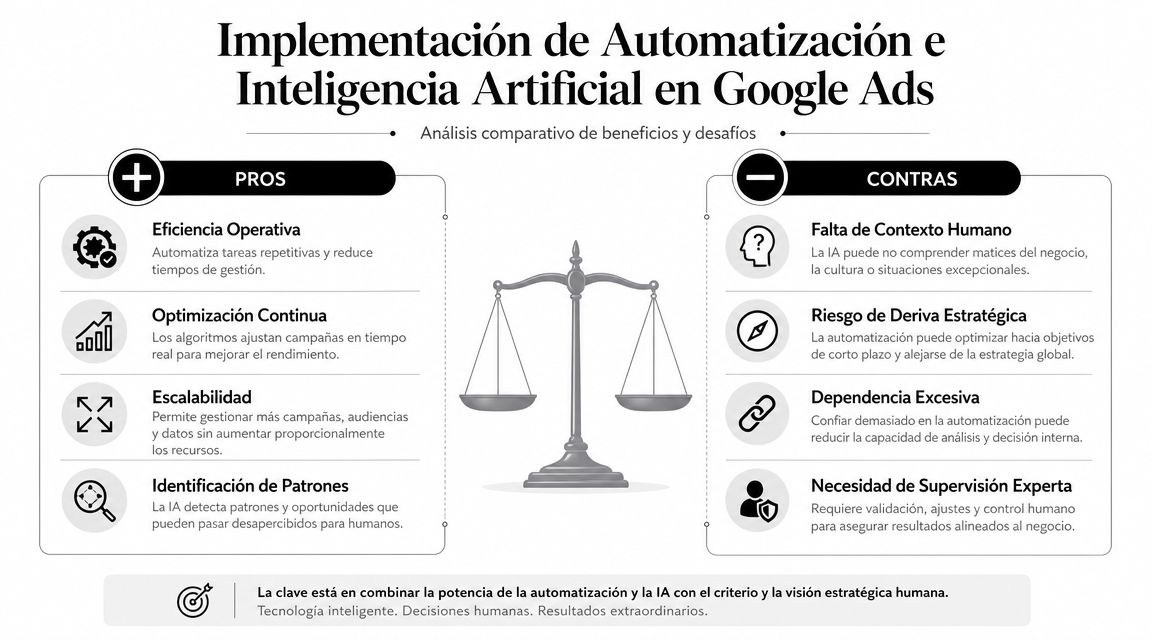
Systems like Performance Max, broad match and automated bidding strategies can process signals at a scale impossible for a human team. Used well, they help explore inventory, adjust decisions in real time and reduce operational load.
That frees up time for higher-impact tasks: offer strategy, measurement architecture, creativity, pricing, site experience and coordination between marketing and sales. There lies the most interesting value. Not in “managing less,” but in thinking better.
In Chile, a rarely discussed risk is the loss of control over traffic quality due to automation. Many guides remain focused on CPC, CTR and basic targeting, but rarely ask whether Performance Max, broad match and other automations are bringing genuinely profitable queries for eCommerce and lead gen. In addition, when the site has UX or speed problems, the cost of conversion in Search rises, as this analysis on traffic quality and automation in Google Ads observes.
The executive risk is clear. Automation can improve internal platform indicators while degrading the commercial quality of what comes in. More forms do not always mean better opportunities. More attributed sales do not always mean incremental sales.
It is not advisable to answer that question from ideology. It is best to do so with business criteria.
A mature organization does not delegate strategic judgment to the platform. It uses the platform to execute faster on a thesis it has already defined. That nuance separates the teams that buy traffic from those that build growth.
If your company needs advertising on Google to work as part of a growth system, and not as a series of disconnected campaigns, Bigbuda can contribute through the integration of media, CRO, analytics and digital experience to improve profitability with the same traffic and measurement that is more useful for making decisions.
Related reading: How to Advertise on Instagram: Strategic Guide 2026 · Search Engine Marketing and SEO: A Unified Strategy · Social Media Advertising: Maximize Your ROI in 2026
No. Treating Google Ads as a channel for buying clicks at the end of the funnel is useful to operate campaigns, but not to decide investment, prioritize growth or defend profitability. The platform now works as a market system spanning Search, YouTube, Display, Shopping and Maps, each solving a different problem.
Start from the business bottleneck, not from the advertising inventory. Search works best to capture explicit intent and test whether your proposition competes in a category with existing demand. YouTube makes more sense when the market still needs education and differentiation. Display supports presence, remarketing and recall.
Not necessarily. In Chile, Google Ads works as an auction by Ad Rank, where position depends on the bid, the ad quality and the expected impact of the assets. Google indicates that greater relevance and a better landing experience can reduce the effective cost per click by improving the quality component.
Usually because there is no continuity between intent, message and action. Check that the promise is clear enough for the user to recognize they arrived at the right place, that the page quickly shows what is offered and to whom, and that friction such as long forms is minimal.
No. The interface shows advertising performance, not business performance. A mature account cross-references Google Ads with CRM, web analytics and commercial data, so eCommerce can see which campaigns bring better margin or recurrence, and B2B can separate a generated lead from an accepted lead and a real opportunity.
Automate more when measurement is reliable, conversion signals represent real value and the post-click experience already has a solid base. Automate with limits if the business has fragile margins, high sensitivity to lead quality or little clarity about incrementality. Automation does not eliminate strategy; it raises the cost of not having one.