










Solutions
Explore how to grow

Many teams are in the same situation. They invest in acquisition, improve campaigns, refine targeting, but the site keeps leaving money on the table because the user arrives and doesn't find a next step that's clear, convincing or timely enough.
Need help with this? Check out our digital marketing service.
That's where the call to act stops being a visual detail and becomes a business decision. It's not about "placing a pretty button." It's about designing a system that turns intent into a measurable action, and that action into revenue, qualified leads or less commercial friction.
When a company already has traffic, recognition or latent demand, the main bottleneck is rarely reach. It's usually the transition between interest and decision. A well-designed call to act organizes that transition. A badly designed one breaks it.
The formal definition is still useful because it clarifies the basis of the problem. The U.S. SBA defines a CTA as an instruction for the visitor to take a specific action, with examples like "call us now," "find out more" or "subscribe to our Newsletter," according to its guide on what a call to action is and why you need one on your website. In a company, that means something broader: the exact point where traffic transforms into an attributable action.
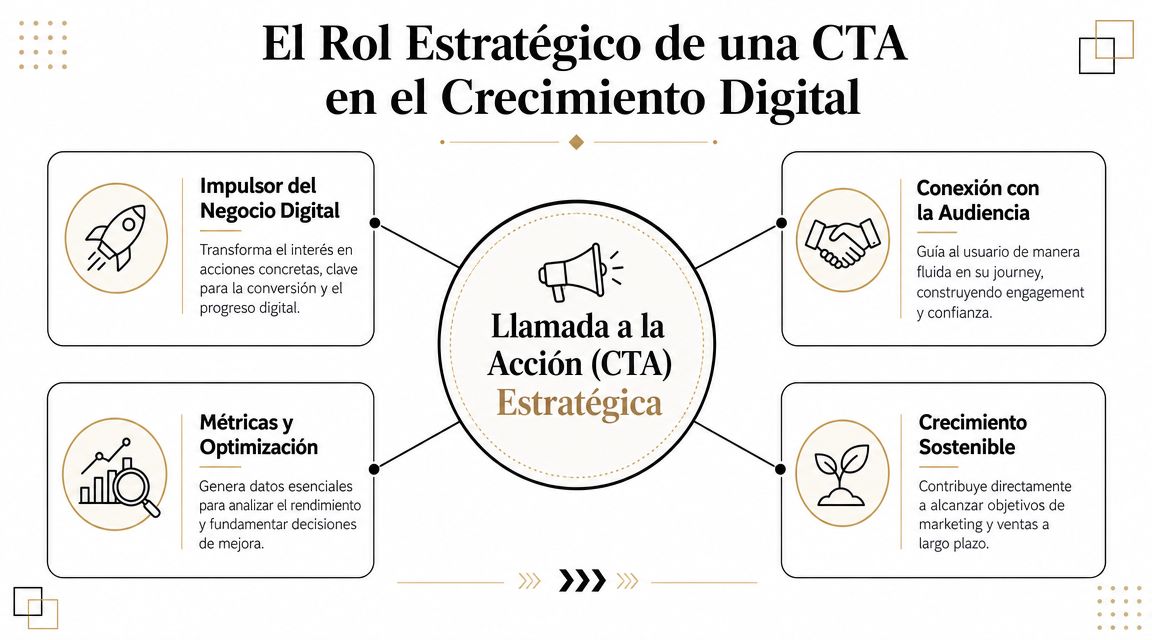
A site with passive CTAs forces the user to figure out on their own what to do. A site with an active call-to-act system removes that burden and guides the decision. That difference seems minor, but it changes the entire efficiency of the funnel.
The clearest signal appears when you compare it with more expensive prospecting channels. In 2025, the average cold-calling success rate was 2.3%, a 53% drop from the 4.82% of 2024, which equals about 1 sale for every 43 calls. On top of that, it usually takes 8 attempts to reach a prospect, according to the benchmarks summarized in the same source cited in the SBA guide. For marketing and sales, the reading is obvious: when human attention becomes more expensive and less efficient, the website has to capture existing intent better.
Rule of thumb: if the site receives visits with intent and doesn't guide them toward a clear action, the company ends up paying twice. Once to attract traffic. Once to compensate for the friction with sales effort.
That changes the internal conversation. The CTA stops belonging only to design or content. It moves to the revenue table, because it determines how much value each session, each campaign and each brand visit produces.
Thinking in systems means setting priorities. Not all users should receive the same invitation, nor should every space on the site compete with one another.
A useful framework for leadership is this:
| Decision | Weak approach | Strategic approach |
|---|---|---|
| Objective | Multiply buttons | Prioritize one action per context |
| Measurement | Count isolated clicks | Connect action with sales or leads |
| Copy | Generic messages | Specific, value-driven instructions |
| Channel | Rely on the sales force | Capture demand from the site |
In practice, a mature company uses the call to act to do three things at once:
A weak CTA doesn't just reduce conversions. It also distorts the read on the business, because it hides real intent that never gets recorded as a useful event.
The implication for leadership is direct. If the site is a growth asset, the call to act is one of its most sensitive governance pieces. Not because it "raises clicks" on its own, but because it decides whether demand becomes actionable data or dissolves into navigation with no result.
High-performing CTAs don't come from a single discipline. They work when psychology, message and visual experience operate as a single unit. If one of those parts fails, the action loses strength even if the other two are well resolved.
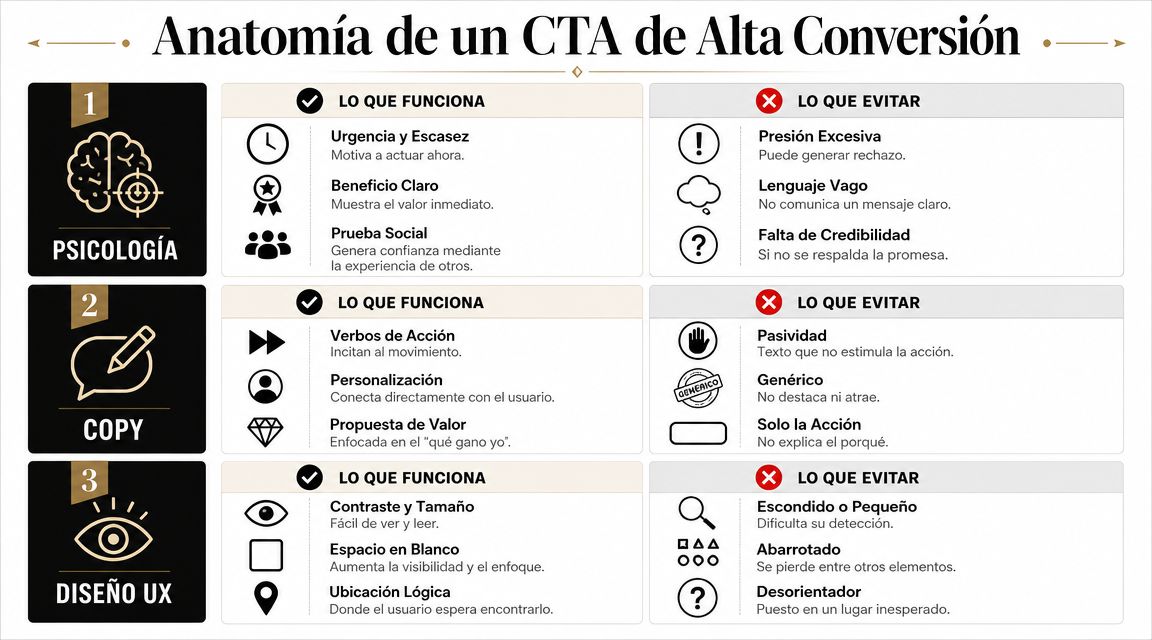
The user doesn't evaluate a CTA in the abstract. They evaluate risk, clarity and perceived value in seconds. That's why the right wording is rarely the most aggressive. It's usually the one that reduces uncertainty without diluting intent.
In growth teams, this point matters more than it seems. Psychological friction usually comes from simple questions: "What do I get?", "how much commitment does it involve?" and "can I trust this?". A button can answer them or make them worse.
Three principles tend to make the difference:
The benchmarks gathered by LogRocket point in the same direction. For teams in Chile, CTAs must be specific and actionable, with direct verbs and an explicit value proposition. The same analysis cites increases of up to 80% in conversion for SaaS landing pages with a well-implemented CTA and 34% improvements in sign-ups, while identifying generic copy like "click here" and a lack of testing as frequent mistakes, according to its article on the power of a call to action.
A good CTA doesn't just say what to do. It says why it's worth doing now and what friction is removed in the process. That combination is what turns the text into a business lever.
The difference between "Submit" and "Request an assessment" isn't stylistic. The second option clarifies the next step and improves the perception of value. The same happens between "More information" and "See how to reduce checkout friction." The problem with generic copy isn't that it looks amateur. It's that it doesn't help you decide.
A useful way to audit copy is to check whether it includes these three layers:
Concrete action
The verb should indicate real movement: book, compare, calculate, download, explore, request a quote.
Visible value
The CTA should hint at what the user gets. Asking for a click isn't enough.
Compatibility with the moment
A cold user doesn't respond the same as one who has already seen pricing, read specs or compared alternatives.
A strong CTA doesn't push the user. It clarifies the right decision for the moment they're in.
When a team needs to align brand, experience and conversion, it's worth reviewing how microcopy, visual hierarchy and user behaviour interact. A good reference point is this look at UX and UI, because it reminds us that the action isn't designed in isolation. It's built within a complete experience.
Design doesn't "beautify" the CTA. It gives it cognitive priority. If the user doesn't see it, doesn't understand it or perceives it as a secondary element, the message falls apart even if the copy is right.
The decisions that weigh most tend to be quite concrete:
There's a recurring mistake on corporate and eCommerce sites. They try to "cover all possibilities" by adding several buttons with the same visual weight. The result isn't more freedom for the user. It's more decision load.
| Pillar | What works | What tends to fail |
|---|---|---|
| Psychology | Reduce risk and clarify benefit | Pressuring without building trust |
| Copy | Direct verb and explicit value | Generic or ambiguous text |
| UX Design | Clear hierarchy and visibility | Visual competition between actions |
A high-conversion CTA doesn't come from optimizing a word or a colour separately. It comes when the company treats the call to act as an interface between user intent and business objective.
Placement defines context. The same message can perform well or badly depending on the moment it appears. That's why deciding where a CTA lives isn't a layout discussion. It's a decision about intent.
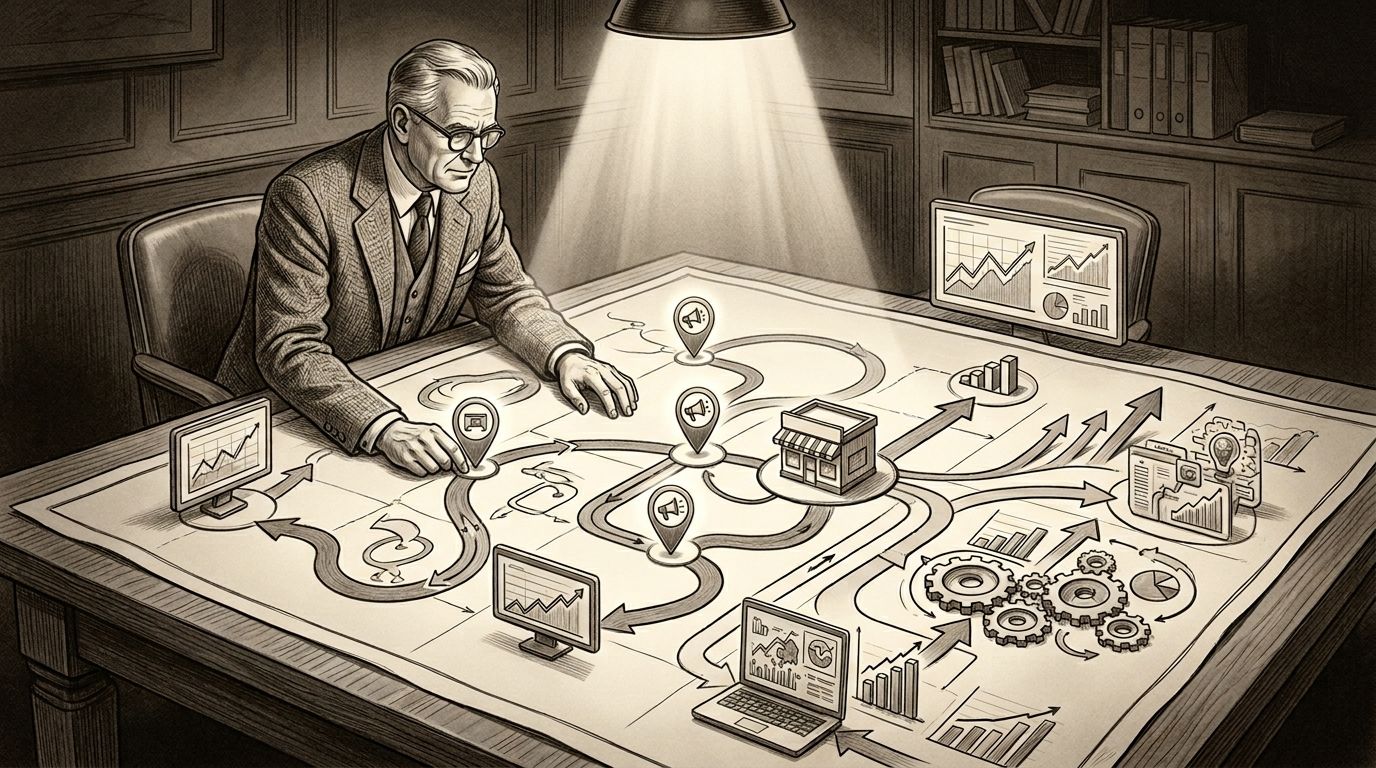
Above the fold, the user is still deciding whether it's worth continuing. There, a CTA that quickly translates the value proposition works best. On service pages it can be "Book a demo." In eCommerce, "Buy now" or "Check availability" can make sense when intent is already high.
At the end of the content, the logic changes. The user has already processed arguments, compared or understood the offer better. That space serves CTAs for deeper engagement or decision, because it capitalizes on conviction that's been built and not just initial attention.
Fixed bars deserve a separate analysis. In documented tests, a sticky CTA beat the control with no button by at least 8% across all variants, and the best version, "Start Your Risk-Free Trial," raised sales 25% and conversions 22%, according to the analysis of the science behind high-performing calls to action. The underlying reason isn't magic. Visual persistence reduces the cost of searching for the next step again.
The right placement doesn't add value on its own. It makes value visible when the user is ready to act.
The soundest criterion remains prioritizing a single primary action per screen. That doesn't prevent offering secondary routes, but it forces you to define which action has the most economic impact in that context.
A simple way to organize placements is to map them by intent and objective:
To validate these decisions, heatmaps help you see whether real attention matches the priority the business defined. This guide on heatmaps for websites is useful because it shows how to turn visible behaviour into a placement criterion, not an aesthetic opinion.
The most expensive mistake is usually this: repeating the same CTA, with the same copy, in every place. That simplifies implementation, but it weakens relevance. The company gains more when it adapts the invitation to the decision point. A visitor on pricing doesn't need the same nudge as one who just landed from a campaign.
The companies that convert best don't "guess" better CTAs. They learn. And they learn because they turn every hypothesis into a measurable experiment.
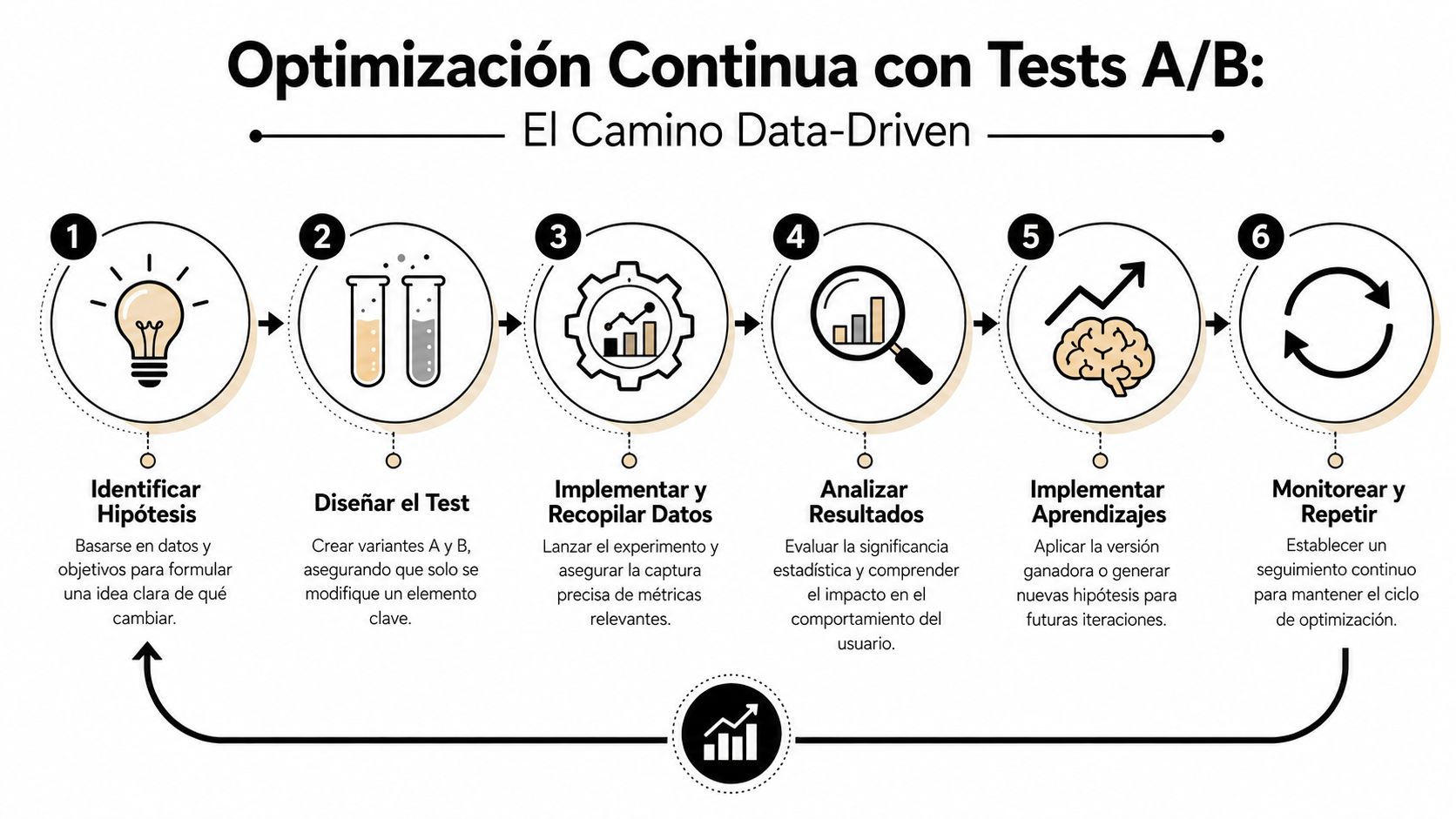
A poorly designed A/B test only produces variation. A well-designed one produces transferable knowledge. That distinction matters for leadership because it defines whether the organization accumulates learnings or just isolated changes.
The best hypothesis doesn't start with the visual element. It starts with a business friction. For example: if the user fears commitment, a wording that reduces anxiety can perform better than a more imperative version. If the offer isn't understood, a CTA with explicit benefit can outperform one focused only on action.
Language matters more than many teams accept. A report from C-Level Partners indicates that saying "we" instead of "I" can increase success by 35%, and that asking "how are you" can multiply the probability of booking an appointment by 3.4 times, according to its compilation of cold-calling statistics and takeaways. Although that data comes from sales interaction, the implication for the call to act is clear: small changes in wording change the perception of closeness, trust and willingness to move forward.
Not all elements have the same impact or the same implementation cost. The right priority depends on where the main friction is.
A sensible order is usually this:
The CTA proposition
Before touching colour or shape, it's worth checking whether the offer is right for that moment. "Book a demo" and "See how it works" don't just compete for clicks. They compete for level of commitment.
Primary and supporting copy
The CTA rarely works alone. The title, subtitle, nearby proof and surrounding microcopy can change the entire interpretation.
Placement and persistence
If the primary action isn't available when intent grows, the opportunity is lost.
Visual design
Design matters. But testing it before resolving proposition and context tends to produce superficial learnings.
Useful criterion: prioritize experiments that can change a user's decision, not just their momentary attention.
For teams operating under high commercial pressure, the value of testing lies in reducing subjective debates. A well-defined experiment replaces internal preferences with operational evidence. In e-commerce, services and lead generation, that shift improves focus.
A CTA can win more clicks and still hurt the business if it attracts less-qualified users or increases abandonment after the click. That's why the right reading never ends at the initial interaction rate.
The strategic evaluation should include questions like these:
When the experimentation process becomes a discipline, the company starts to build an internal library of behaviour. There, testing stops being a minor optimization mechanism and becomes a leadership tool. To deepen that logic, this guide on A/B experiments in eCommerce offers a useful look at how to connect hypotheses with commercial performance.
The call-to-act strategy breaks fast when the technical operation forces you to resolve each CTA as a manual piece. The problem isn't only speed. It's also consistency, control and the ability to scale changes without introducing errors.
The opportunity today isn't in "adding more buttons," but in building an architecture that lets you adjust messages by intent, device and commercial context. That matters especially in Chile, where data from NIC Chile and SUBTEL/INE shows a broad, mobile-centric digital economy, which makes it more relevant to optimize CTAs by intent and device, not just by colour or text, as this analysis on the emerging opportunity to optimize by digital context argues.
In WordPress, the critical point usually isn't capability, but governance. When each page uses different blocks, different templates or different plugins for the same function, the team loses control over consistency.
The mature decision is to create reusable components. With Gutenberg, patterns and reusable blocks let you update messages, styles or structures without touching each page separately. That reduces operational debt and speeds up commercial adaptation when an offer, a promotion or an acquisition priority changes.
In Shopify, the greatest value appears when the CTA converses with the catalogue and doesn't operate as a static element. Collections, product types, availability and purchase context can change the best suggested action.
In a store with a diverse assortment, it's not always best to push "buy now." Sometimes it makes more sense to highlight comparison, stock, pickup, subscription or line discovery. The use of metafields and logic in the theme makes it possible to sustain that personalization without turning the site into a pile of hard-to-maintain exceptions.
Webflow offers a clear advantage for teams that need speed with brand control. Components let you standardize CTAs at the level of the visual and content system, which simplifies creating new pages without degrading consistency.
The key isn't using one platform that's "better" than another. It's using the chosen platform as a system. That means centralizing variants, defining usage rules and connecting business changes with interface changes. At that layer, internal tools, product teams, specialized partners or services like Bigbuda's can support the operational implementation when the company needs to scale with a focus on conversion.
The most common mistake in evaluating CTAs is confusing activity with result. A click can be useful, but it doesn't demonstrate business value on its own.
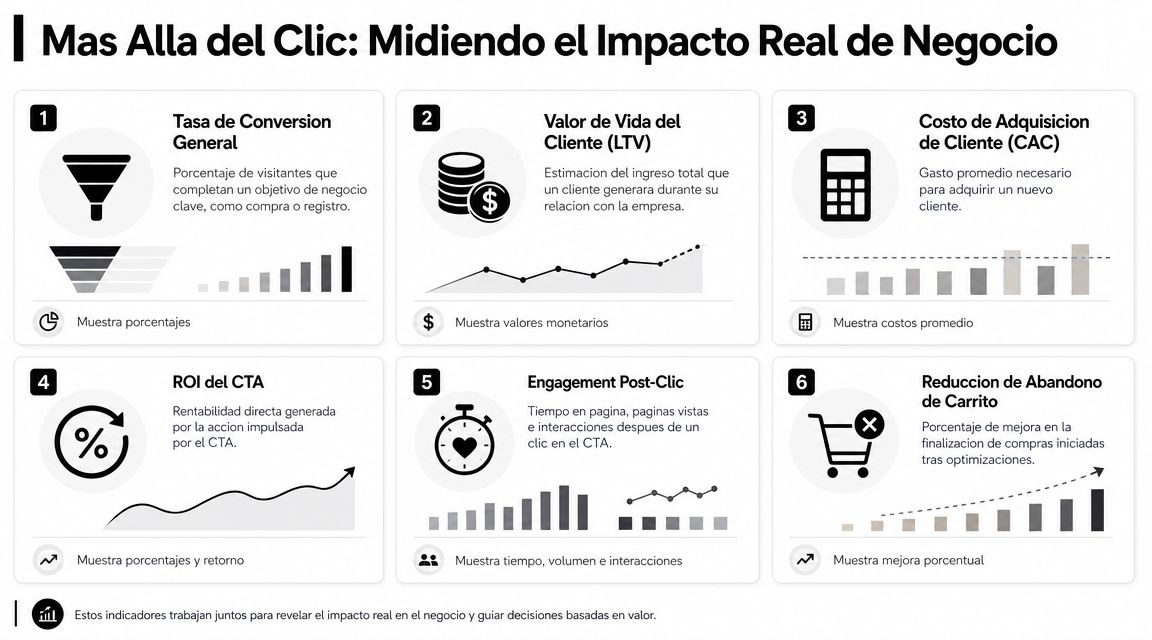
In Chile, the gap isn't only in attracting more users. It's in converting an already-digitalized audience better. The CCS reported online sales of US$11.5 billion in 2024, an annual rise of 8.4%, and internet use reached 92.6% of the population in 2024 according to SUBTEL/INE, as summarized in this analysis on how to turn intent into measurable action. If the market is already connected, the strategic problem comes down to conversion efficiency.
That's why measuring only CTR is staying on the surface. A CTA can attract curious clicks and at the same time deteriorate the quality of the opportunities or increase abandonment in later stages.
If the report celebrates clicks but can't show an effect on sales, lead quality or commercial efficiency, the CTA is still a hypothesis, not a validated asset.
Correct measurement connects the action with later results. Instead of asking only "did they click?", it's worth asking "what value did that click produce?".
A useful dashboard for leadership should include, at a minimum, these dimensions:
GA4, custom events and a disciplined UTM structure make it possible to build that traceability. You don't need to complicate the stack to start. You need to define a consistent taxonomy and agree, between marketing, product and sales, on which event represents real value.
A good call to act isn't validated because it "looks better" or because it increases initial interaction. It's validated when it improves the efficiency with which the company transforms digital intent into attributable commercial results.
If your company already has traffic and the problem is converting that demand into revenue better, Bigbuda can help you assess the real role of your CTAs within the complete conversion system, from strategy and UX to experimentation and business-impact measurement.
It is the exact point where traffic transforms into an attributable action. A site with passive CTAs forces the user to work out what to do; an active system guides the decision. That determines how much value each session, campaign, and brand visit produces for the company.
Good CTA copy has three layers: a concrete action verb such as book, compare, calculate or request a quote; visible value that hints at what the user gets; and compatibility with the moment. The difference between "Submit" and "Request an assessment" is not stylistic; the second clarifies the next step.
Placement is a decision about intent. Above the fold works for a CTA that quickly translates the value proposition; the end of content suits deeper engagement because conviction has been built; a sticky CTA keeps the primary action available during long navigation. Prioritize a single primary action per screen.
Start with the CTA proposition, whether the offer suits that moment, then primary and supporting copy, then placement and persistence, and only afterwards visual design. Testing design before resolving proposition and context tends to produce superficial learnings. Prioritize experiments that can change a decision, not just attention.
A CTA can win more clicks and still hurt the business if it attracts less-qualified users or increases abandonment after the click. Measurement should connect the action to later results: conversion to the final objective, result quality, associated cost, post-click behaviour, and attribution by source and CTA variant.
In WordPress the critical point is governance: Gutenberg patterns and reusable blocks let you update messages and styles without touching every page. In Shopify, metafields and theme logic let the CTA respond to catalogue and purchase context. In Webflow, components standardize CTAs so new pages do not degrade consistency.