










Solutions
Explore how to grow

Your team invests in campaigns, performance and digital experience. An incident at checkout, tampering with forms or a credential leak can stall sales within hours, trigger complaints and erode trust at the exact point where the business needs continuity.
This is strengthened by a solid WordPress Care service.
That is why evaluating cybersecurity companies in Chile is not a purchase of technical support. It is a decision that affects revenue, operational risk and growth capacity. In eCommerce, a poor protection architecture can translate into cart abandonment, failed payments and brand damage. In B2B operations, the impact usually appears as halted integrations, exposure of commercial data and friction in sales or after-sales processes.
The central issue is not who offers the most tools, but which provider best resolves the real risk of your operation. Some firms stand out in audits and compliance. Others have more experience in continuous monitoring, incident response or protection of critical infrastructure. That difference matters because a company that sells online needs more than controls on paper. It needs the capacity to sustain availability, detect anomalies quickly and fix failures without affecting conversion or customer experience.
It also helps to look at the problem from the technical foundation. Perimeter protection, segmentation, access control and traffic visibility remain decisive in preventing outages and lateral movement within the network. If you want to review that front before comparing providers, this guide on network security for businesses provides useful context.
This selection analyzes seven cybersecurity companies in Chile through a business lens: where they fit best, what type of organization gets the most out of their services and how their proposition impacts operational continuity, compliance and digital growth. The goal is to help you choose a partner that reduces risk without slowing down the commercial operation.
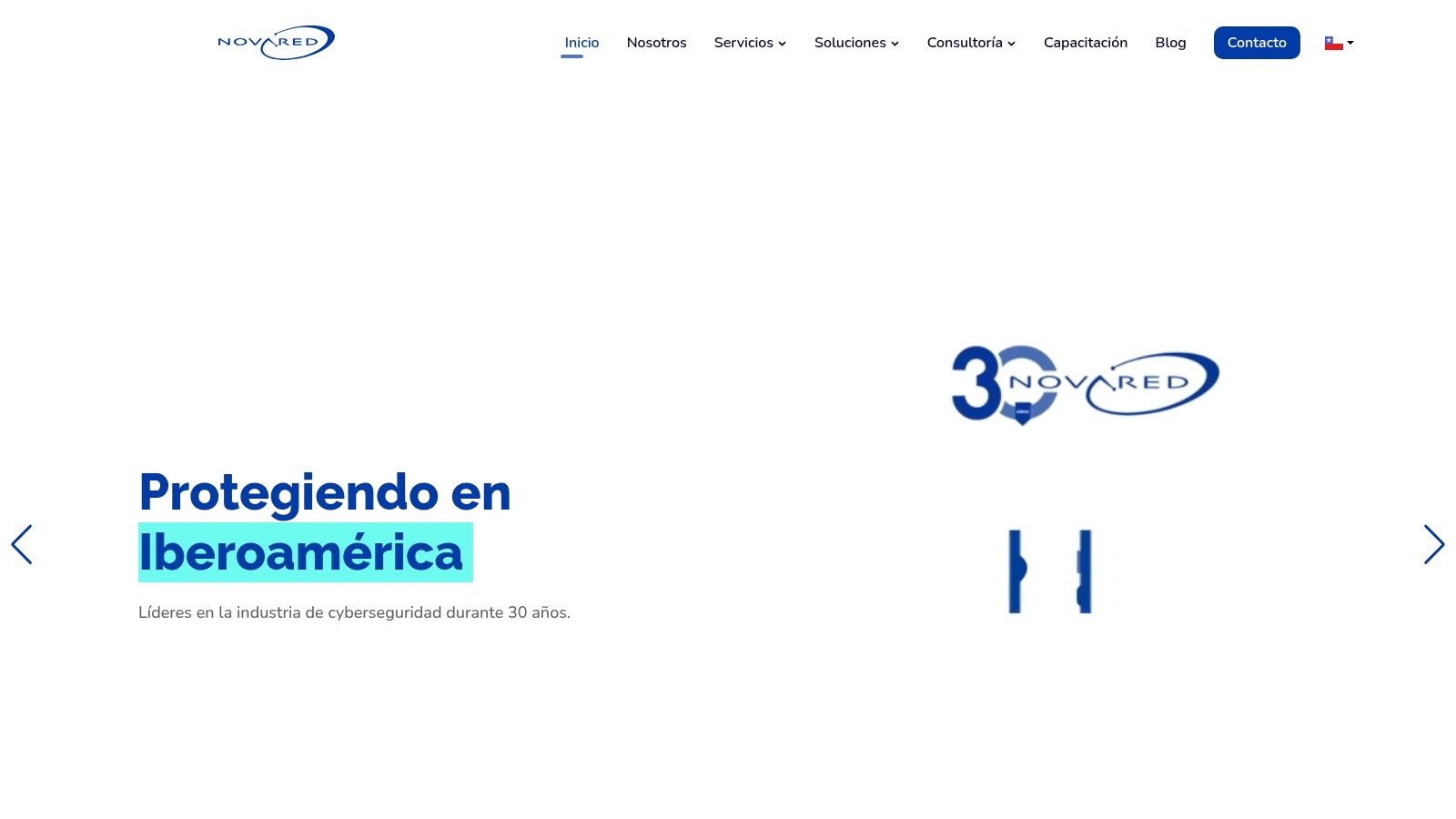
A Chilean retailer detects intermittent outages at its checkout on a Friday afternoon. The problem does not always look like an attack. Sometimes it starts as an unpatched web vulnerability, an exposed access point or monitoring that arrives too late. In that kind of operation, the cybersecurity provider stops being a technical expense and starts influencing revenue, conversion and customer trust.
NovaRed fits well in that scenario because it combines consulting, offensive testing, vulnerability management and continuous operations. That combination makes sense for companies that cannot separate diagnosis from response time. If the digital channel sustains sales, leads or after-sales service, narrowing that gap matters as much as the technical finding.
Its proposition is especially useful for organizations that need to protect exposed assets and, at the same time, put governance and internal processes in order. In eCommerce and digital B2B, that translates into less risk of visible interruptions, less friction for the user and a lower probability of incidents that end up affecting brand reputation or organic performance.
NovaRed usually fits better with mid-sized and large companies, retailers with broad public-facing surfaces, and regulated sectors where audit, traceability and response are already part of the business conversation. Its local footprint also weighs in. For many buyers in Chile, having a close point of contact speeds up decisions, escalation and coordination with legal, IT and compliance teams.
Practical rule: if the risk is in your digital channel, it is better to contract detection, response and remediation, not just a one-off audit.
There is also an operational cost in that model. Onboarding and coordination tend to be more formal than with smaller providers. For an SMB, that can feel heavy. For a company with a risk committee, several critical systems and reporting requirements, it is usually an advantage because it clarifies who is responsible, timelines and evidence.
If the focus is the online store, perimeter hardening and site continuity, it is worth reviewing how that layer connects with a strategy of WordPress security for companies with an active digital presence. There, NovaRed shows more value as a continuous-operations partner than as a provider of an isolated deliverable.

Arkavia Networks represents another category among the cybersecurity companies in Chile. It does not compete from telco scale or from the muscle of a regional integrator. Its proposition looks closer to a specialized MSSP, focused on raising maturity in infrastructure, cloud and networks.
That nuance matters. Many companies do not need a massive structure. They need a partner that quickly pins down which controls are missing, which technology to integrate and how to prioritize risk based on their real operation. In Chile, the conversation is no longer only about contracting pentesting or a firewall. The National Cybersecurity Agency is pushing toward an environment where complying, responding and demonstrating control carry increasing weight.
Arkavia can be a good choice for companies that are organizing their stack and do not want to split consulting, integration and support across too many providers. That approach is especially useful for businesses that mix offices, cloud, remote access and sales or digital service platforms.
Its advantage usually lies in operational proximity.
In a digital business, the right provider is not the one that offers the most acronyms. It is the one that can connect diagnosis, implementation and operations without leaving gaps in accountability.
Its main limitation is predictable. Against larger players, it has a smaller regional footprint and fewer economies of scale. If the company needs highly formalized multinational coverage, it may fall short. If what you are looking for is agility and local knowledge, it becomes more appealing.
For brands that run content, catalogs or stores on widely attacked content managers, it is also worth connecting that discussion to platform risks, for example in WordPress security for enterprise sites. There, a partner like Arkavia can contribute more when the conversation stops being “install tools” and becomes “reduce the attack surface.”
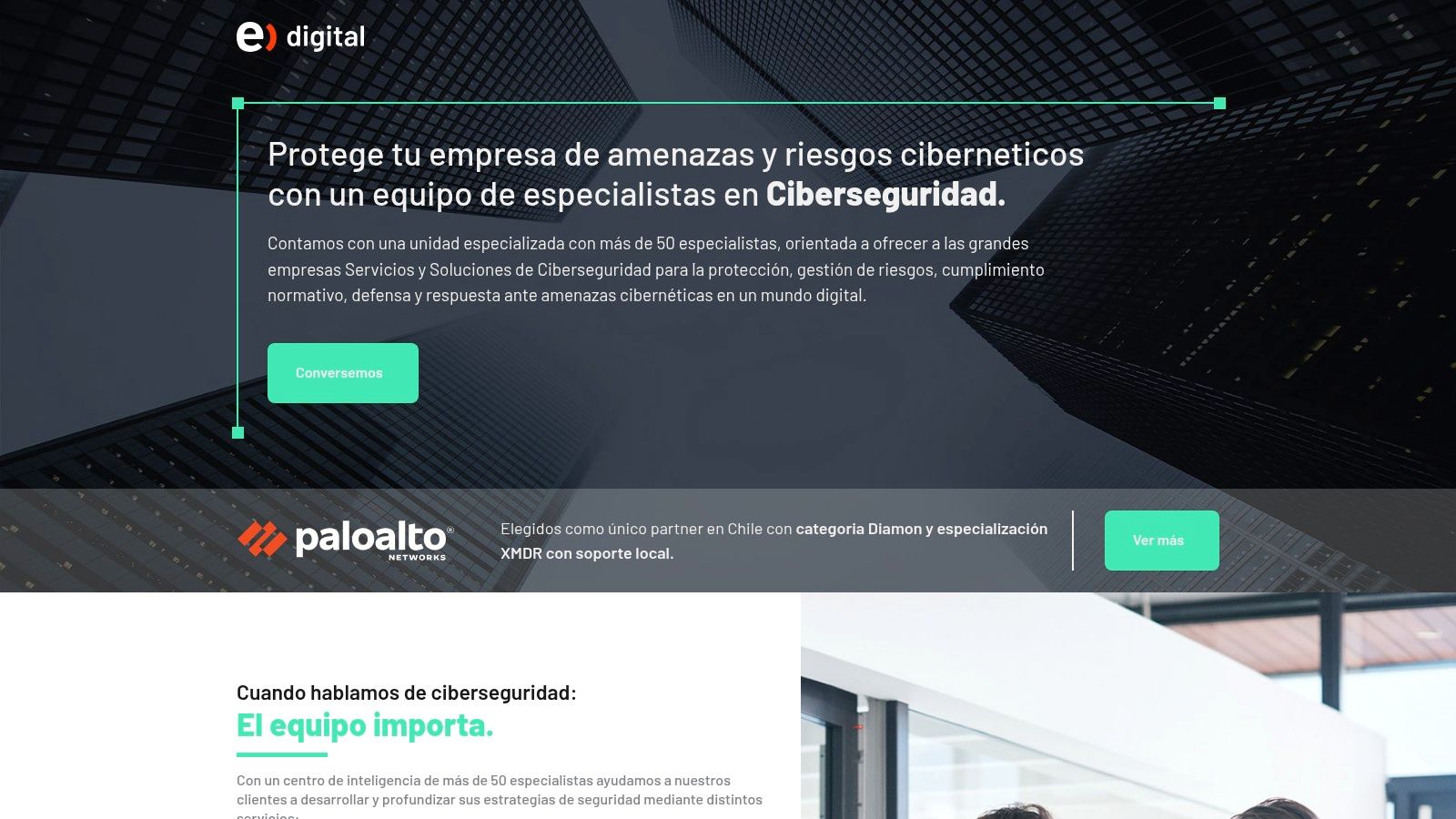
An eCommerce site goes down during a campaign, remote access starts failing and alerts appear about anomalous activity on the network. In that scenario, the problem is not only technical. Every minute affects sales, customer service and trust in the brand. That is where Entel Digital Ciberseguridad makes sense for companies that already operate with Entel for connectivity, cloud or managed infrastructure.
Entel Digital Ciberseguridad competes better as a provider of operational coordination at scale. Its proposition is more attractive when the company wants to consolidate network, monitoring, vulnerability management and response under a single service relationship. For a CIO or a general manager, that can translate into less friction when containing incidents that cut across several layers at once.
The advantage is not only in having a broad portfolio. It is in the fact that security connects with the day-to-day operation of the business. If a company depends on branches, a mobile sales force, VPN, cloud environments and digital channels, splitting each layer across different providers usually lengthens escalation, diagnosis and remediation. In digital B2B and eCommerce, that delay has concrete effects. More downtime means more abandoned purchases, more support tickets and more reputational risk if the incident affects accounts, payments or availability.
Entel fits better with organizations that prioritize operational continuity over narrow hyper-specialization. That category includes retail, financial services, companies with distributed operations and mid-sized or large companies that already consume managed services. In those cases, MDR, XDR, CASB or pentesting matter, but they matter more when they are embedded in an operating model with clear owners and real execution capacity.
There is also a strategic reading. Choosing a telco with a cybersecurity arm can reduce vendor complexity, but it increases the need for internal governance. If the client does not define critical assets, business priorities and risk thresholds, it ends up buying coverage without a clear connection to commercial impact.
Its limitation appears elsewhere. A large provider can resolve breadth, but it does not always replace the depth of a firm highly focused on specific niches or on highly customized consulting. For a company with a complex digital operation, the right question is not whether Entel has many capabilities. It is whether those capabilities are aligned with the risks that most affect revenue, continuity and compliance.
Consolidating security, network and cloud with a single provider can reduce coordination times. It also concentrates operational dependence. The decision is best evaluated as part of the business continuity model, not just as an IT purchase.
If the company processes personal data, manages user accounts or depends on digital transactions, it is worth reviewing that decision alongside a broader strategy of data protection for digital operations. That intersection matters especially in businesses where a breach not only exposes information but also damages conversion, retention and commercial trust.
SONDA fits better with companies where an incident affects not just a single asset, but several layers of the business at once. ERP, sales channels, identities, third-party integrations, branches and cloud workloads tend to fall within the same operational perimeter. In that kind of environment, the priority is no longer an isolated tool but the ability to coordinate response, governance and continuity without losing traceability.
That point matters especially in B2B and eCommerce operations of a certain scale. If a breach interrupts inventory, payments, internal access or logistics integrations, the problem does not end in IT. Halted orders appear, friction at checkout, overwhelmed customer service and a loss of commercial trust. In brands with high digital dependence, those effects can also translate into lower conversion and reputational damage.
Its proposition is more logical for organizations that already operate with real complexity. Regulated sectors, corporations with several sites, companies with critical third parties and businesses that need evidence of control for audits tend to value a provider that combines SOC, CSIRT, managed services and GRC frameworks within a single service structure.
For a general manager or a digital transformation leader, the useful reading is strategic. SONDA can help define who responds, how an incident is escalated, which controls are documented and which gaps require formal remediation. That reduces internal friction at moments where decision speed matters as much as technical capacity.
Its main limitation appears in mid-sized or digital companies in an expansion stage, where the priority is usually speed of implementation, tactical focus and lower operational overhead. In those cases, part of the value of an enterprise provider can go underused.
The decision, then, is not only about evaluating technical capabilities. It is about measuring how much an interruption in sales, service or compliance costs, and whether the business needs a partner capable of sustaining that complexity on a continuous basis.
SONDA makes more sense when the company needs governance and execution at the same time. If the operation is still simple, that structure can add cost and process before generating a clear return.
Movistar Empresas and Telefónica Tech occupy an interesting middle ground. They have global scale, local presence and a catalog that can serve both mid-sized companies just structuring their security operation and more mature organizations that want to evolve toward MDR, XDR and cyber intelligence.
That middle ground is valuable because many Chilean companies are not at zero, but they also do not need a full enterprise architecture from day one. They need to grow in stages without rebuilding the model at each phase.
Its proposition is attractive for companies that want to start with managed services and then expand coverage. Also for organizations that already work with Movistar in telecommunications and prefer to extend an existing relationship into managed security.
The market moment helps explain why that approach is gaining traction. Mordor Intelligence projects that the Chilean cybersecurity market will reach USD 319.26 million in 2026 and grow to USD 446.16 million, with a projected CAGR of 6.92%, while for 2024-2029 it estimates a CAGR of 9.80%. More than an industry figure, this suggests more structural budgets and fewer isolated purchases.
Its limitation appears when the buyer needs a highly tailored solution or extremely deep consulting from the start. In those scenarios, a specialized boutique may have more focus. But for a company that prioritizes coverage, continuity and a maturity path, Movistar Empresas becomes competitive.

NLT Secure looks best when the business needs to bring a broad security conversation down to concrete, remediable risks. Its boutique profile tends to be useful for teams that do not want a full corporate transformation but do need clarity about exposure, priorities and a closure plan.
That way of working fits well with digital commerce and marketing companies, where the cost of an incident is not only technical. It also shows up in compromised accounts, paused campaigns, eroded trust and more friction in the funnel.
NLT's most interesting contribution is not selling “360 cybersecurity.” It is in grounding posture, exposure monitoring and remediation roadmaps. That language is more useful for management teams that need to make decisions, allocate budget and know what to fix first.
That approach responds to a common gap in the local market. As BeCyber argues when analyzing the gap between perceived security and real operational readiness in Chile, many providers talk about CyberSOC or ethical hacking, but rarely connect security to management metrics that are comparable for an executive. There, a consultative boutique can gain relevance.
The security that helps the business most is usually the kind that translates technical findings into a clear sequence of decisions.
Its counterweight is scale. Compared to large telcos or integrators, its multi-country coverage and its ability to absorb massive operations may be smaller. For a digital company focused on speed and concrete risk reduction, that is not always a problem. For a corporation with many countries and service layers, it can be.
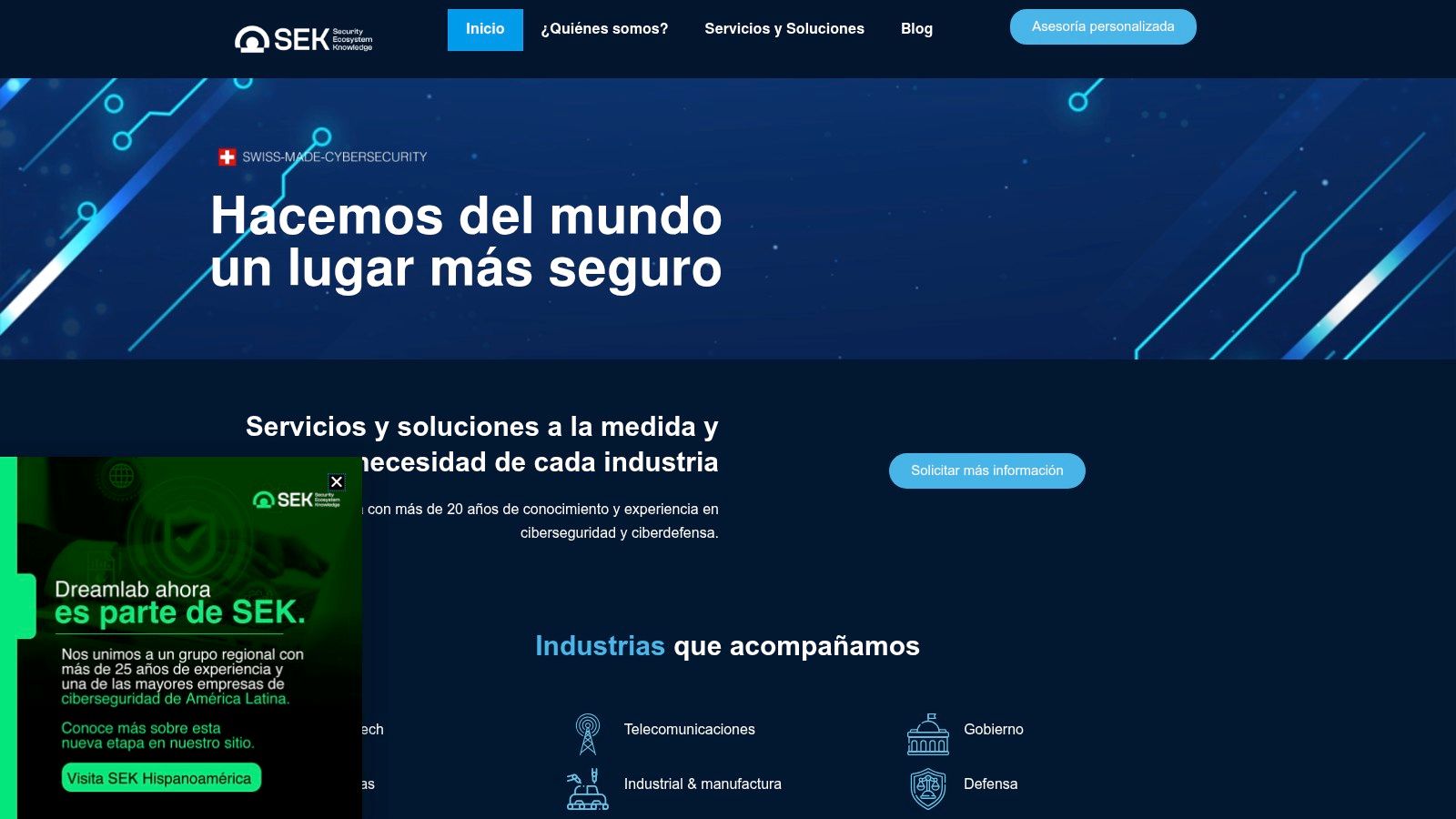
Dreamlab Technologies fits better in a specific situation. The company already operates relevant digital channels, has basic controls in place, but needs to confirm whether its architecture, its processes and its response capacity can withstand a real incident. At that point, a consultancy oriented toward strategy, technical audit and offensive testing can contribute more than another monitoring package.
That approach has direct implications for eCommerce and digital B2B operations. A flaw in authentication, poor privilege segmentation or an undetected exposure in critical applications does not only open a technical breach. It can also stall sales, affect customer trust, interrupt commercial integrations and turn a security incident into an operational continuity problem.
Dreamlab is more convincing as a validation and design partner than as a generalist provider of day-to-day operations. Its value appears when reviewing controls in depth, running a red team, testing hardening and discussing architecture or governance decisions with teams that already have a certain internal maturity.
Its best fit is in organizations with regulatory requirements, sensitive assets or high dependence on digital platforms. In those cases, preparing the response matters as much as preventing. As noted earlier in the article, the Chilean regulatory environment requires fast reporting in certain scenarios, and that increases the value of working with a partner that helps organize processes, responsibilities and verification capacity.
Dreamlab's practical advantage lies in the type of questions it helps answer.
Its limitation is clear. It is usually not the most suitable option for SMBs looking for a simple managed solution, with fast implementation and few internal dependencies. This type of work requires a defined scope, available owners and the capacity to execute changes after the diagnosis.
A well-designed offensive exercise does not replace day-to-day operations. It verifies whether that operation truly protects the business.
| Provider | Complexity 🔄 | Resources ⚡ | Expected results 📊 | Ideal use cases 💡 | Key advantage ⭐ |
|---|---|---|---|---|---|
| NovaRed | High, formal processes and extensive onboarding | High, SOC/MDR, consulting and enterprise licensing | Robust detection/response; hardening and pentesting | eCommerce and regulated sectors that require SOC and testing | Comprehensive portfolio and local track record >25 years |
| Arkavia Networks | Moderate, agile and specialized implementation | Medium, senior local team and technology integrations | Maturity uplift in infra, cloud and networks | Chilean organizations that need practical compliance | Exclusive focus on cybersecurity and local agility |
| Entel CyberSecure | High, broad catalog that demands governance | Very high, 24/7 SOC, cyber intelligence center and alliances | Continuous coverage and strong integration with connectivity/cloud | Companies already using Entel that require service integration | Telco scale and its own cyber intelligence center |
| SONDA | High, multi-country governance and processes | Very high, regional SOC, CSIRT and GRC services | Enterprise support and formalized incident response | Organizations with complex IT and operations in several countries | Enterprise capacity and regional presence |
| Movistar Empresas (Telefónica Tech) | Moderate-high, offerings segmented by segment | Very high, local SOC, cyber intelligence and scalable solutions | Scalable MDR/XDR; options also for SMBs | Clients with Movistar connectivity looking for integrated security | Global scale with local operations and a scalable catalog |
| NLT Secure | Low-moderate, agile and consultative projects | Medium, specialized consulting and MDR partners | Fast diagnosis and a prioritized remediation roadmap | SMBs or stores that need to close concrete risks | Boutique agility and advanced Fortinet certifications |
| Dreamlab Technologies | High, strategic and well-defined engagements | Medium-high, experts in governance and red team | Maturity uplift and advanced offensive testing | Organizations with a SOC looking for red team and hardening | Specialization in strategy, audit and advanced testing |
First thing on a Monday, an online store detects intermittent outages at checkout. The problem looks technical, but the decision that follows is commercial. Every minute of friction affects conversion, support, trust and, if the incident drags on, brand perception. In that scenario, choosing among the cybersecurity companies in Chile stops being an operational purchase. It becomes a decision about business continuity.
That is the most useful way to read this local market. It is not enough to review who offers SOC, pentesting or MDR. The point is to understand which provider best reduces risk based on the type of operation your company sustains. An eCommerce site with active campaigns, payment gateways and logistics integrations faces different problems than a B2B firm with sensitive data, remote access and long sales cycles. The same tool can deliver very different returns depending on the context.
That is why the right choice depends less on the size of the catalog and more on strategic fit. NovaRed and Entel Digital fit better with organizations that need continuous monitoring, broad coverage and sustained response capacity. SONDA weighs more when there is corporate complexity, multiple sites and formal governance processes. Movistar Empresas is reasonable for companies that want to scale in stages without fully separating security and connectivity. Arkavia Networks and NLT Secure make more sense when the priority is proximity, agile execution and a consultative focus. Dreamlab Technologies stands out in maturity, technical validation and in-depth control review.
There is a less obvious implication for business teams. A poorly aligned provider does not only leave technical gaps. It can also introduce unnecessary friction. Poorly implemented controls affect load times, authentication, the buying experience and the commercial operation. In eCommerce, that translates into cart abandonment and loss of trust. In B2B, it can affect the availability of forms, portals, integrations or assets that influence demand generation and digital reputation.
The evaluation, then, is best done with three concrete questions. Which business risk should be reduced first. How quickly the provider can respond when there is a real interruption. And how well that partner understands the commercial cost of adding controls that hinder the customer experience.
If the answer is clear across those three dimensions, cybersecurity stops working as an isolated expense. It becomes an investment that protects revenue, sustains digital growth and prevents rushed decisions made under pressure.
If your company needs to align cybersecurity, digital performance and commercial continuity, Bigbuda can help you translate that risk into clearer business decisions. For eCommerce, B2B and high-impact sites, the work does not end at protecting the infrastructure. It also means taking care of speed, experience, trust and conversion so that security does not become another source of friction.
It reviews seven providers through a business lens: NovaRed, Arkavia Networks, Entel Digital Ciberseguridad, SONDA Ciberseguridad, Movistar Empresas with Telefonica Tech, NLT Secure and Dreamlab Technologies. Each is assessed by where it fits best, what type of organization benefits most and how it affects operational continuity.
NLT Secure and Arkavia Networks fit better when the priority is proximity, agile execution and a consultative focus. NLT works well for teams that need actionable diagnosis and a prioritized remediation roadmap rather than a full corporate transformation, while Arkavia helps organize the stack without splitting consulting, integration and support.
Entel fits organizations that prioritize operational continuity and want to consolidate network, monitoring, vulnerability management and response under one relationship. SONDA weighs more with corporate complexity, multiple sites and formal governance, combining SOC, CSIRT, managed services and GRC frameworks. Both increase the need for internal governance.
Mordor Intelligence projects that the Chilean cybersecurity market will reach USD 319.26 million in 2026 and grow to USD 446.16 million, with a projected CAGR of 6.92%, while for 2024-2029 it estimates a CAGR of 9.80%. That suggests more structural budgets and fewer isolated purchases.
Use three concrete questions: which business risk should be reduced first, how quickly the provider can respond during a real interruption, and how well that partner understands the commercial cost of adding controls that hinder the customer experience. Answer those clearly and security stops being an isolated expense.
Yes. A poorly aligned provider does not only leave technical gaps, it can introduce unnecessary friction. Poorly implemented controls affect load times, authentication, the buying experience and the commercial operation. In eCommerce that translates into cart abandonment; in B2B it can affect forms, portals, integrations and assets that influence demand generation.