










Solutions
Explore how to grow

If someone on your executive committee still thinks Instagram is "just social media," they're misreading the market. In Chile, the platform had around 16.8 million user identities in January 2023, equivalent to about 85.1% of the population, according to the analysis cited by Cocina tu Marca. That changes the conversation. The question is no longer whether it's worth being on IG. The question is whether your company is using a massive commercial infrastructure with business logic, or running it as a decorative channel.
This is amplified by a good digital marketing service.
For serious leadership, the question "what is IG" isn't answered with a basic definition. It's answered with a decision: whether Instagram will be a source of demand, a layer of brand trust, a product showcase and a conversion accelerator, or whether it will stay trapped in pretty metrics that don't move revenue.
What IG is for a company is answered with a business figure, not a dictionary definition. In a market where Instagram already concentrates a critical mass of attention and digital habit, the right question for leadership is another one: how much value the brand captures from that attention and how much it's leaving on the table.
For leadership, Instagram doesn't deserve a popularity read. It demands a profitability analysis. If the team still runs it as a publishing calendar, the company is treating a commercial infrastructure as if it were a creative medium.

That mistake completely changes resource allocation. Many companies respond with more pieces, more ad spend and more pressure on the content team. The improvement rarely comes from there. It comes when the company fixes its proposition, mobile experience, offer, purchase journey and the connection between Instagram and the rest of the commercial system.
The underlying problem is one of management.
An active account with a weak narrative, poor links, slow load times and disconnection from ecommerce or CRM produces visible activity but limited value. There's reach. There are visits. There are messages. Without a clear commercial architecture, that attention doesn't turn into predictable revenue or a defensible competitive advantage.
Rule of thumb: if Instagram already generates attention, the executive priority is to convert that attention into intent and that intent into sales.
Leadership doesn't need to weigh in on every Reel. It needs to make decisions that organize the channel as part of the business:
The conclusion for any executive committee is simple. Instagram is no longer a secondary communication channel. It's an asset that influences demand, conversion and margin. Treat it as commercial infrastructure or accept the cost of operating with high visibility and low value capture.
Instagram works best when understood as a system of formats with distinct roles. It's not wise to expect the same result from every piece. A Reel doesn't serve the same function as a Story. A carousel doesn't compete with a Live. Each format pushes a different phase of the commercial journey.
Most corporate accounts fail because they publish out of habit, not purpose. The team creates "content for Instagram" as if the platform were homogeneous. It isn't.
Reels serve to widen discovery and capture attention beyond the immediate audience. Stories serve to keep proximity, update context, trigger quick responses and sustain intent. Feed posts, especially carousels and brand pieces, consolidate positioning and help the user understand who you are, what you sell and why they should trust you.
If your team needs to dig deeper into the role of this format, it's worth reviewing how a Reel on Instagram works from a more specific angle.
Lives play a different role. They're useful when the company needs to transfer trust, address objections, present expertise or turn lukewarm interest into serious consideration. And Shop or tagged-catalogue experiences close the loop, because they reduce friction between inspiration and product.
| Format | Primary Business Objective | Key Metrics | Lifecycle |
|---|---|---|---|
| Reels | Discovery and audience expansion | Qualitative reach, plays, profile clicks, follow-up actions | Short to medium |
| Stories | Relationship, nurturing and activation | Replies, taps, exits, clicks, signals of interest | Very short |
| Feed posts | Positioning, brand proof and offer clarity | Saves, shares, profile visits, qualitative engagement | Medium to long |
| Lives | Trust, demonstration and objections | Attendance, questions, messages, referral to follow-up actions | Event with residual effect |
| Shop and product tags | Conversion and commercial continuity | Product clicks, page visits, purchase actions | Continuous |
A mature company shouldn't ask "how many pieces should we post." It should ask "which mix of formats best moves the business." That difference separates a content operation from a commercial operation.
The best use of Instagram doesn't look like a full calendar. It looks like a chain of decisions where each format does a specific job.
A simple example:
When leadership understands this anatomy, it stops asking for "more content" and starts demanding a portfolio of assets with an economic function. That shift in language improves focus, budget and accountability.
Instagram wasn't born as a commerce engine, but it evolved toward that quickly. It launched on October 6, 2010 and by April 2012 had already surpassed 100 million active users. By December 2014 it had passed 300 million, and in January 2023 it reached around 2 billion monthly active users worldwide, according to the timeline published on Wikipedia about Instagram. That accelerated adoption explains why "IG" stopped being slang and became a universal reference for a platform with real commercial impact.
For ecommerce, the point isn't massiveness on its own. The point is that Instagram blends visual discovery, social validation and immediate access to the product in a single environment. That shortens the mental path between "I'm interested" and "I want to buy it."
When that transition is designed well, Instagram acts as an operational extension of the store. When it's designed badly, it becomes a pretty detour that generates attention but loses sales before checkout. That's why the right conversation isn't "we have Instagram." The right conversation is "how fluid is the path between content, product and purchase."
The commercial journey on IG isn't linear, but it does have a recognizable logic.
A user finds a brand through organic content, collaborations or ads. What's decisive here isn't just capturing the view. It's installing fast relevance. If the content doesn't communicate product, context or differentiation within seconds, interest evaporates.
Then comes the phase where the person evaluates. They look at more pieces, read comments, visit the profile, save posts or explore the catalogue. Here visual consistency matters less than commercial clarity. The user wants to understand whether the brand seems trustworthy, whether the product is relevant and whether the next step will be easy.
At this stage, the purchase surfaces come in. Product tags, a synced store, well-designed links and mobile landing pages make the difference. If your operation requires investment in paid media, it's also worth understanding how to advertise on Instagram from a business perspective and not just a setup one.
The purchase happens outside or within the environment closest to the content. That's where the accumulated value is won or lost. The user has already shown intent. If the page is slow, stock isn't clear, the checkout confuses or the promise changes, the sale cools off.
In ecommerce, Instagram doesn't fail for lack of attention. It fails when the company breaks the continuity between inspiration and transaction.
Three frictions frequently destroy performance:
Teams that understand this stop measuring Instagram as a display window. They manage it as a commercial entry point that must connect frictionlessly with Shopify, WooCommerce or whatever ecommerce stack the company uses.
Likes don't pay for acquisition. Followers don't guarantee margin. And a visually impeccable account can be destroying value if it doesn't convert interest into measurable actions.
That's the shift many marketing teams still haven't made. They report visibility as if it were performance. Leadership tolerates it because the activity looks healthy. But visible activity isn't the same as commercial impact.
Vanity metrics have a place. They serve as early signals. They can indicate creative resonance, audience affinity or distribution capacity. The problem appears when they replace business indicators.
A brand can celebrate that a piece of content was shared many times and still not understand whether it attracted useful traffic, pushed products with healthy margin or generated buyers who later repeat. That gap between attention and economics is where budget gets wasted.
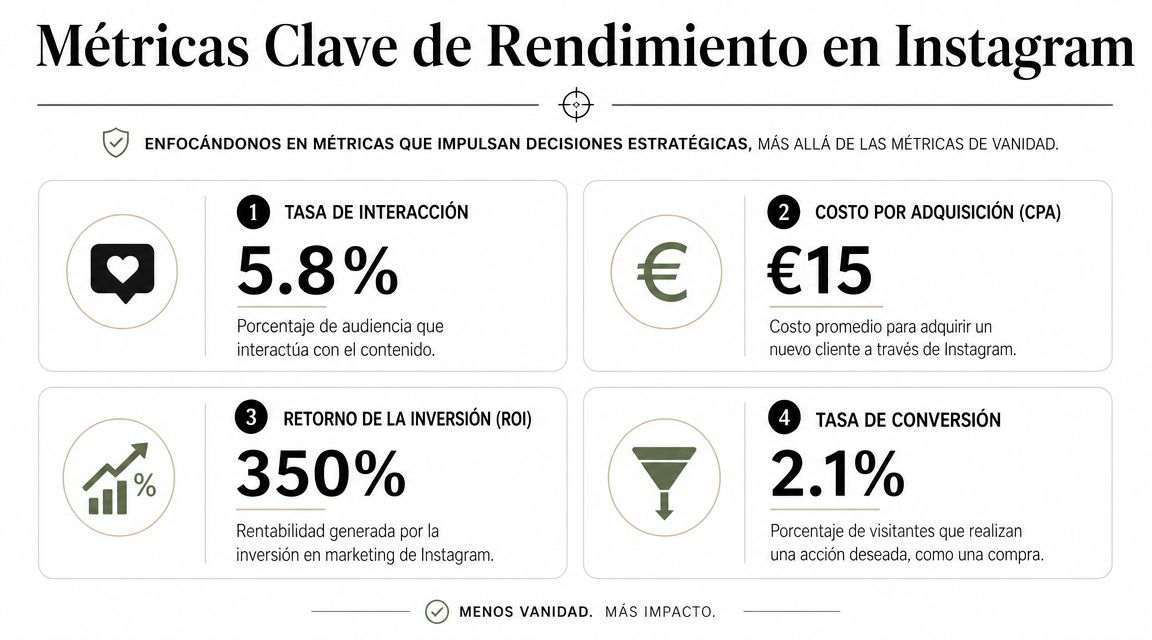
If the company uses Instagram with executive judgment, it should track a layer of metrics connected to the business:
Executive criterion: if a metric doesn't help decide budget, experience or message, it can't occupy the centre of the report.
This is where a continuous-optimization mindset comes in. I'm not talking about isolated tactics. I'm talking about a way of operating. The company formulates hypotheses, tests narratives, adjusts offers, improves landings, reviews sequences and corrects leakage points.
That demands a different conversation between marketing, ecommerce, content and technology. Instagram can't be measured separately from the site, the CRM or the paid channel. If the creative team chases engagement while the commercial team needs margin, the system breaks.
A more mature practice would look like this:
Companies that do this stop "managing Instagram." They start extracting value from a demand asset.
Instagram's advantage changes depending on the business model. There's no single recipe. There are clear leadership patterns, though. The brands that advance don't copy trends without filtering. They design a system aligned with how they sell.

A D2C fashion or beauty brand uses Instagram as its primary discovery surface. It doesn't publish to "look active." It publishes to create desire, accelerate product identification and drive traffic to its store.
Reels show usage context, texture, transformation or the lifestyle associated with the product. The feed organizes the proposition, collections and social proof. Stories sustain urgency and recall. When the product tag or the step toward Shopify is well resolved, the channel stops being pure branding and becomes part of the commercial engine.
A D2C brand wins on Instagram when the content doesn't entertain separately from the catalogue but makes it more shoppable.
Many B2B firms write Instagram off too quickly. A mistake. Not because it's a direct-close channel, but because it can reduce distance, raise authority and open conversations with decision-makers.
A consultancy, SaaS company or complex-services firm can use short clips to install points of view, carousels to organize ideas and Lives to transfer trust. In that context, the Live format on Instagram works better as an environment for conversation and credibility than as a spectacle.
After a first layer of content, the brand can move the audience toward meetings, forms or high-intent resources. The value isn't in having thousands of superficial reactions. It's in attracting fewer people, but the right ones.
Here it's worth seeing a practical example of the kind of environment where this format gains weight:
A local shop, a clinic, a restaurant or a specialized store uses Instagram differently. Its priority is usually to activate visits, bookings or purchases nearby in time and location.
In these cases, Stories, geotagged content, recent visual proof and direct messages can work as a quick-response layer. It's not about competing for global attention. It's about being present in the local decision. The brand that posts clear hours, availability, usage context and trust signals reduces mental friction.
Leaders in this category understand something simple:
Instagram rewards brands that understand their own economics. Format matters, but the business model matters more.
A company that treats Instagram separately ends up operating with fragmented visibility, incomplete attribution and slow decisions. The real cost shows up later. It invests in content, ads and community, but the organization can't connect that effort with revenue, retention or customer value.
That problem belongs to leadership, not just marketing.
If IG isn't connected with the rest of the stack, the company loses three advantages that do matter in an executive committee: traceability, commercial response and accumulated learning. The team sees engagement but doesn't really understand which profile bought, which lead qualified better or which audience returns most often. That way, budget is allocated with less judgment and campaigns are corrected too late.
The right integration links Instagram with ecommerce, CRM, automation and analytics. The goal isn't to add software. The goal is to turn scattered signals into useful operational decisions.
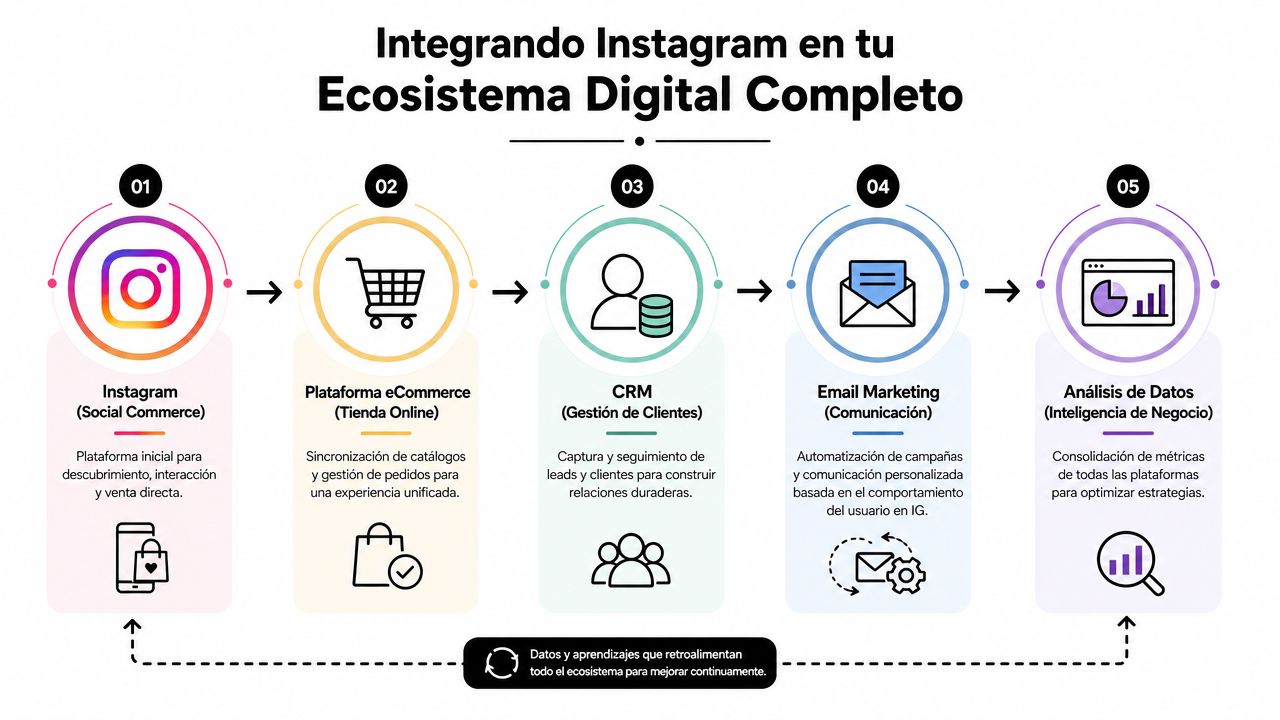
A well-executed integration improves four fronts at once:
This also changes how providers are chosen. An agency focused only on creative pieces doesn't fix data, checkout or commercial-tracking problems. An isolated technical partner doesn't organize the full strategy either. The company needs coordination between content, experience, platform and measurement. In Chile, brands running Shopify, WooCommerce, WordPress or Webflow usually require that integration capability. Bigbuda, for example, works in web development, CRO, ecommerce, automation and digital marketing, a combination aligned with operations that prioritize conversion and efficiency.
Instagram connected to the digital ecosystem works as a continuous source of commercial signals. Those signals can feed remarketing, lead scoring, email flows, product optimization and investment decisions made with better judgment.
The competitive advantage appears there. Not in publishing first, but in turning knowledge into action before the market does.
The useful answer to what IG is for a company is simple. It's a critical commercial layer. Not a marketing accessory. If you want to capitalize on it, make four clear decisions:
Whoever keeps treating Instagram as a social display window will compete worse. Whoever manages it as commercial infrastructure will convert better.
If your company needs to organize Instagram within a real growth strategy, Bigbuda can help you connect content, ecommerce, CRO, automation and measurement into a more profitable system.
Related reading: Social Media Advertising: Maximize Your ROI in 2026 · Types of Clients: Power Your Digital Growth in 2026
As commercial infrastructure, not a creative medium or a publishing calendar. The executive question is not popularity but how much value the brand captures from the attention it already has and how much it leaves on the table. Instagram influences demand, conversion and margin directly.
No. Reels widen discovery and capture attention beyond the immediate audience. Stories keep proximity, update context and trigger quick responses. Feed posts and carousels consolidate positioning and offer clarity. Lives transfer trust and address objections. Shop and product tags reduce friction between inspiration and product.
In three frictions. Misalignment between content and landing, when the user sees a promise on IG and arrives at a page that does not hold it up. A poor mobile experience with small buttons, long product pages or slow loading. And a disconnected or outdated catalogue.
Conversion of traffic coming from Instagram, average order value of customers originating there, return on ad spend, quality of the lead or customer acquired, and advancement rate between funnel stages. If a metric does not help decide budget, experience or message, it cannot occupy the centre of the report.
Yes, though not as a direct-close channel. It can reduce distance, raise authority and open conversations with decision-makers. Short clips install points of view, carousels organize ideas and Lives transfer trust. The value is attracting fewer people, but the right ones, and moving them toward meetings or forms.
Four fronts improve at once: more consistent digital commerce with an aligned catalogue, a CRM with real commercial value, useful automation for intent recovery and nurturing, and actionable analytics across the full journey. Isolated, Instagram costs the company traceability, commercial response and accumulated learning.