










Solutions
Explore how to grow

Your team invests in ads, traffic arrives, the reports show activity and yet the business doesn't take off. The explanation is rarely in a single campaign. It usually lies in a more uncomfortable truth: you operate without a clear performance reference and, for that very reason, you decide blindly.
At Bigbuda we help you with our digital marketing service.
That's where benchmarking comes in. Not as an academic definition or an obsession with watching the competitor, but as a leadership discipline. If you don't know how your business compares against the right standard, you can't decide well where to invest, what to fix first or what advantage to build.
In other words, the problem isn't only growing less than expected. The problem is not knowing why. And when that lack of clarity sets in, the company compensates with more budget, more meetings and more urgency. That destroys margin.
For those reviewing their digital strategy with a focus on real growth, it's worth starting from a simple question: is your performance below the market, below your category or below your own potential? That difference completely changes the action plan. If you need to organize that diagnosis within a broader vision, it's worth reviewing these digital marketing strategies from a business logic, not just an execution one.
When a company feels it "has already done everything" and growth is still slow, it's usually confusing activity with progress. There are active campaigns, there are visits, there are dashboards. But none of those things answer the board's central question: are we performing well or just being busy?
The concept of benchmarking that's useful for a business doesn't start with the definition. It starts with the gap. If your conversion isn't rising, if your mobile channel sells less than it should or if your acquisition cost is squeezing your margin, you need comparative context to interpret that performance. Without that context, every data point stays isolated.
Most people misunderstand the term. They believe benchmarking is watching the leaders, copying their pages and repeating their messages. That reading is superficial and dangerous. In an environment marked by AI, generative search and rapid changes in digital expectations, copying the visible leader only makes you interchangeable.
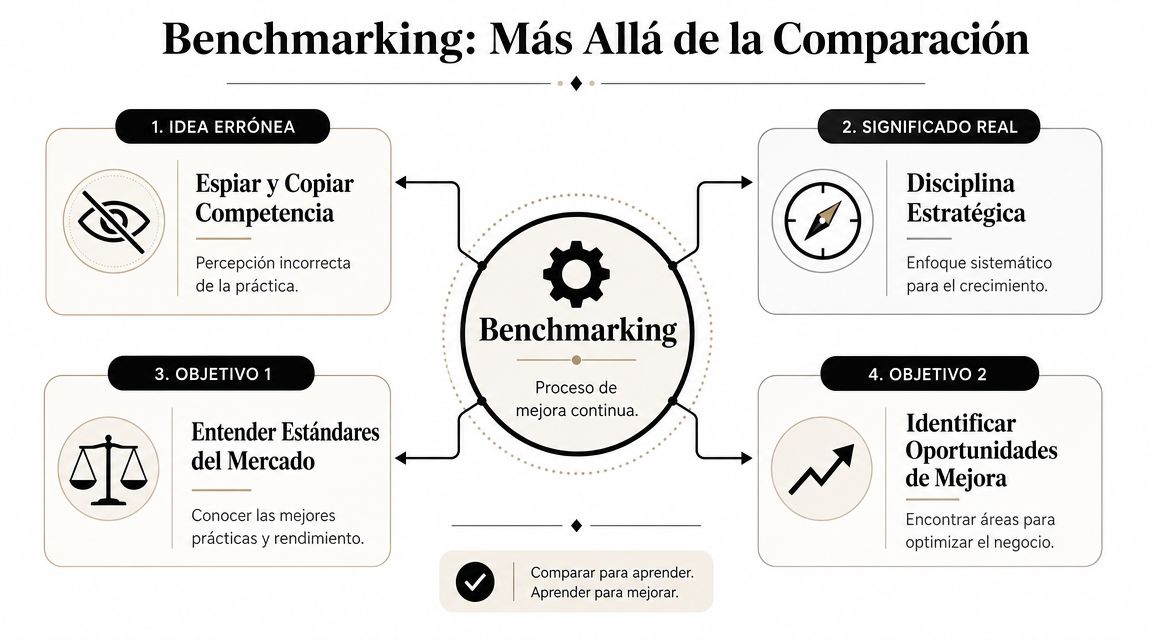
The right thing is something else. Benchmarking means building a comparable baseline, measuring the gap against relevant standards and deciding where to attack first. According to this explanation of continuous benchmarking and differentiation in changing markets, the most valuable approach for Chilean teams is benchmark plus experimentation: detecting patterns, validating them with your own data and prioritizing improvements that reduce acquisition cost and increase conversion, instead of mechanically copying the leader.
Board point: if everyone watches the same leaders and everyone replicates the same patterns, the advantage is no longer in imitating. It's in interpreting better and executing sooner.
Think of it like a serious athlete. They don't just look at the champion's time. They analyze the gap, the conditions, the competitive context and then adjust their own plan. The company that does good benchmarking acts the same way. It doesn't copy the visible result. It understands which standard it must reach and which internal levers it needs to move.
That changes the executive conversation on three fronts:
The benchmarking that really matters doesn't answer "what are others doing." It answers "what level of performance does the market demand to win and what must this company change to reach or surpass it."
Not all benchmarking serves the same function. A director who lumps everything together ends up with lengthy analyses and poor decisions. It's worth separating three levels, because each answers a different question.
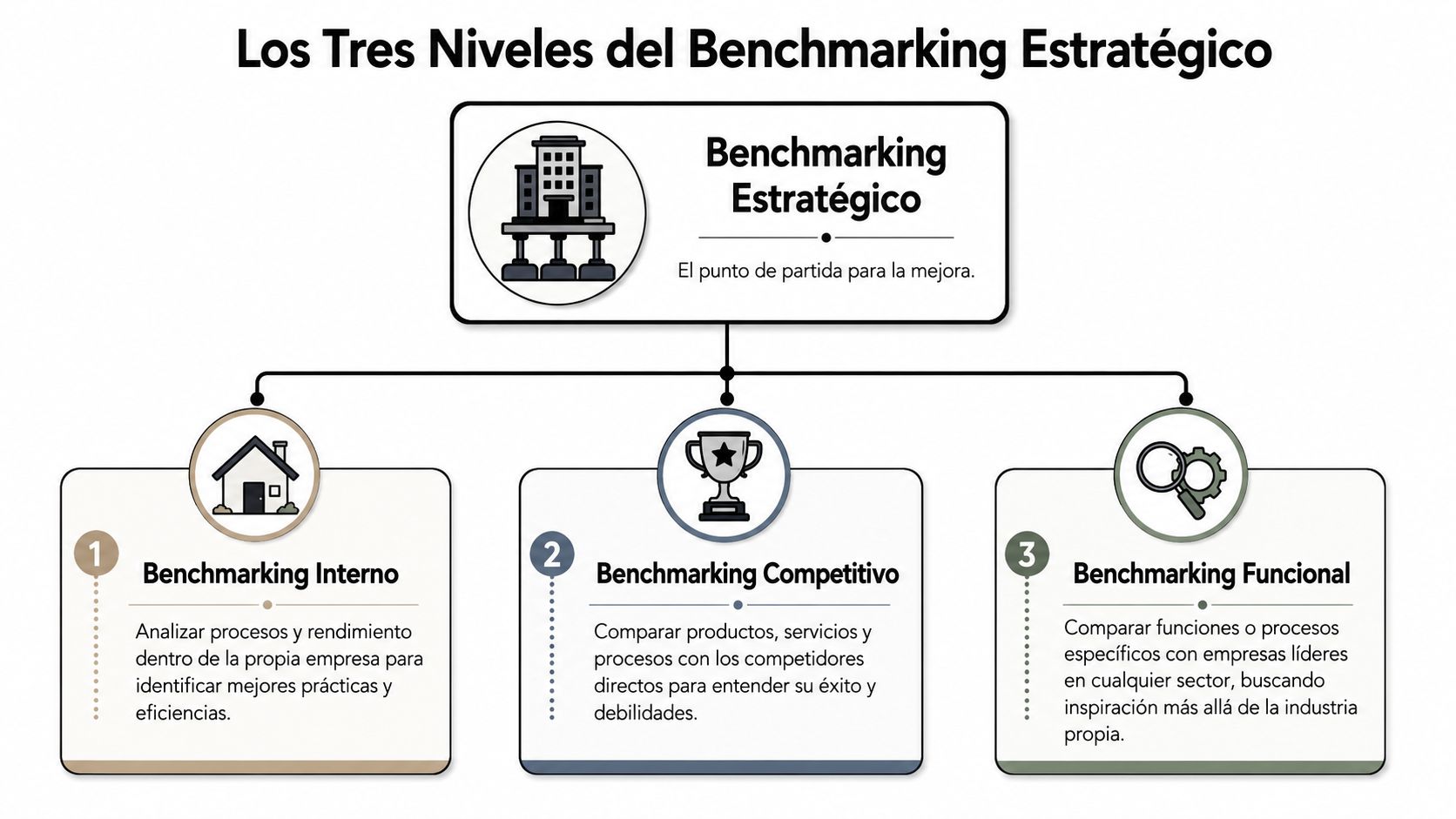
Internal benchmarking answers the basics: where do we perform best and worst within our own operation?
Many companies want to compare themselves with the market before understanding their own mess. A mistake. First you have to look at differences between channels, product lines, campaigns, devices, regions or periods. If one category converts better than another with similar traffic, there's a clue. If a mobile channel collapses against desktop, there's a signal. If one landing consistently outperforms the rest, you already have an internal reference.
This level serves two things:
Competitive benchmarking answers another question: how do we stand against direct rivals for attention, trust and conversion?
This isn't about spying on creative or counting banners. It's about understanding how others compete on value proposition, perceived speed, offer architecture, mobile experience, commercial friction and brand consistency. The right comparison doesn't seek to admire the competitor. It seeks to discover where your business loses needlessly.
A company doesn't fall to a competitor just because the other "does more marketing." It falls because it offers a clearer, more trustworthy or less friction-laden experience at the decisive moment.
This level helps answer whether the gap is one of execution, positioning or experience. That completely changes the budget.
Functional benchmarking is the most underrated and, in many cases, the most profitable. It answers this: what do the leaders of any industry do better in a critical function that we also need to master?
A fashion eCommerce can learn from an airline about process clarity. A B2B company can learn from a fintech about reducing form friction. A consumer brand can learn from a global retailer about visual hierarchy and trust.
You don't need to compete against the same industry to learn a superior practice. In fact, many advantages are born outside the category.
A useful way to read these three levels is as follows:
| Level | Main question | Executive use |
|---|---|---|
| Internal | Where do we perform best or worst within the business? | Identify our own bottlenecks |
| Competitive | Where do we lose against direct rivals? | Defend share and adjust the proposition |
| Functional | What superior practice exists outside our category? | Accelerate innovation and differentiation |
If the board wants a simple rule, it's this: internal to organize, competitive to defend, functional to lead.
In eCommerce, the usual mistake is filling the report with KPIs without distinguishing which ones have strategic value. The board doesn't need more metrics. It needs fewer, but better interpreted.
In benchmarking, the technical value isn't in copying leaders, but in defining a comparable baseline and measuring the gap against standardized metrics. For eCommerce and CRO, that means comparing conversion, load speed, cart abandonment and channel efficiency with companies of the same segment, size and digital maturity. If you don't control variables like traffic mix, product category and device, the analysis pushes you toward wrong conclusions, as this guide on benchmarking applied to eCommerce and CRO argues.
In Chile, this logic matters even more because digital behaviour is heavily concentrated on mobile. When a company converts poorly in that environment, the problem usually lies in the mobile experience, speed or checkout friction. Not in a lack of traffic.
This video helps bring down to earth how to think about benchmarking from performance improvement and not from passive observation.
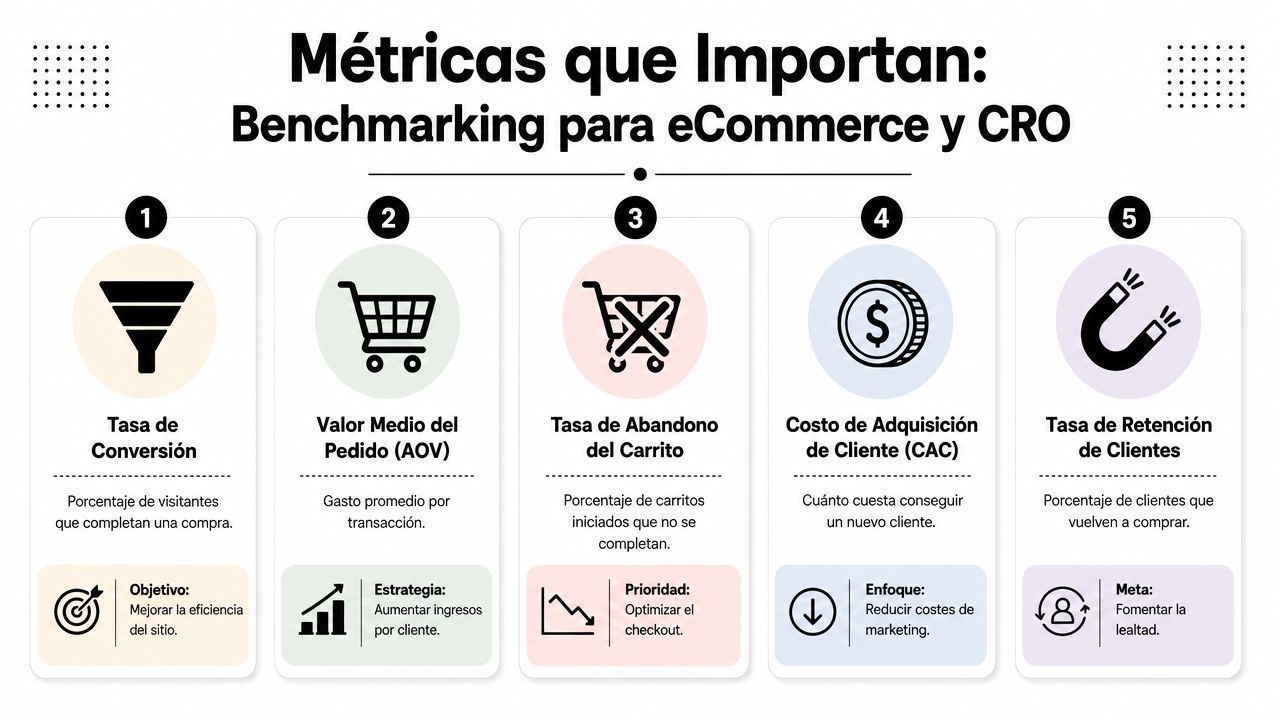
The metrics that actually move decisions are few:
If a metric doesn't change an investment decision, it doesn't deserve to be on the cover of the report.
When these signals point in different directions, the true value of benchmarking appears. For example, a low mobile conversion rate together with high cart abandonment and worse load performance suggests operational friction. A low conversion with correct speed but early exit can point to value proposition or trust.
Below, a simple table for reading KPIs as leadership instruments:
| Metric (KPI) | What it measures | Key strategic question |
|---|---|---|
| Conversion rate | The site's efficiency at turning visits into sales or leads | Are we monetizing well the demand we already generate? |
| Average order value | Average revenue per transaction | Is the business capturing enough value per customer? |
| Cart abandonment rate | Loss of intent in the final purchase stages | Are we introducing friction right before the close? |
| Customer acquisition cost | Investment needed to win a new customer | Is the growth we buy still profitable? |
| Customer retention rate | Capacity for repurchase and commercial continuity | Are we building a repeatable business or a constant-replacement machine? |
If you want to dig into the optimization layer that follows this analysis, it's worth understanding well what CRO is from a business perspective.
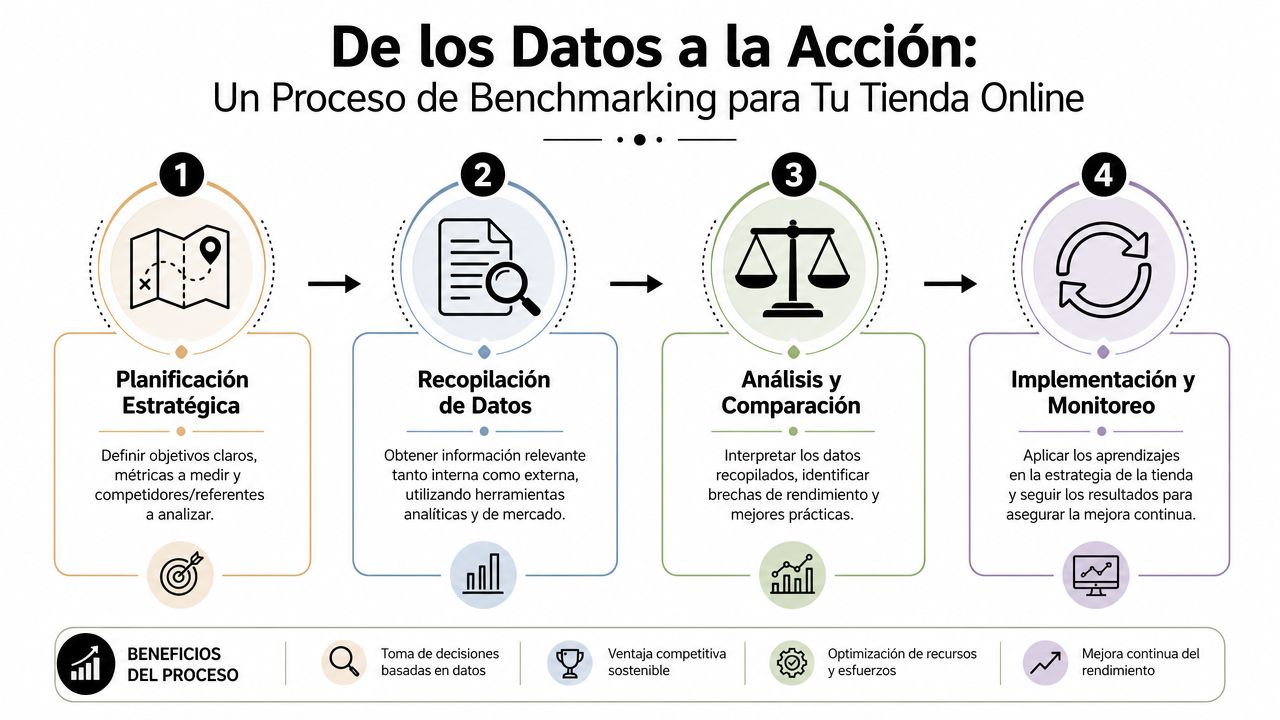
Benchmarking is useful when it lands in decisions. If it stays in a comparative report, it isn't worth much. For an online store, the useful process is short, repeatable and priority-oriented.
For digital businesses in Chile, useful benchmarking combines local market data with your own operational evidence. The recommendation is to contrast your KPIs with independent sources from the country, such as SUBTEL connectivity reports, CCS e-commerce studies or public sector metrics, to avoid comparing your store with generic standards from other markets. That logic turns the comparison into a diagnostic tool, according to this look at benchmarking and market research.
First, define the business objective. Not "improve the site." That doesn't work. The objective must have an impact logic, such as recovering mobile conversion, raising commercial efficiency by channel or reducing friction in a critical stage.
Then, gather two types of evidence:
At this stage, the risk isn't a lack of data. It's scatter. That's why it's best to select few KPIs and few references. Better a well-built comparison than a chaotic collection of screenshots.
With that data, identify the real gap. If the drop is concentrated on mobile, you've already narrowed the problem. If it also happens on certain channels, you've narrowed it further. If, when looking at performance, trust, value proposition and purchase journey, a pattern emerges, you already have a business hypothesis.
From there, the plan must translate into executive priorities, not loose tasks:
Mature benchmarking doesn't produce a list of observations. It produces a sequence of decisions.
To operationalize this measurement layer without relying on improvised implementations, a tool like Google Tag Manager, or GTM, is usually key to the orderly capture of events and business signals.
If you want to structure it as a program, this combination works well:
That cycle avoids the most expensive mistake of all: measure a lot, decide little.
A fictional store, ModaActiva Chile, sells well in acquisition campaigns. The problem appears afterward. Traffic comes in, initial navigation is acceptable, but the close on mobile is below expectations and commercial management insists on raising investment to compensate.

That diagnosis would be incomplete if read without local context. In Chile, benchmarking became especially relevant for measuring digital performance because the ecosystem already operates on a massive connectivity base. The Undersecretariat of Telecommunications recorded more than 27 million mobile internet accesses in 2023 in a country with a population near 19.5 million, and the 2022 CASEN Survey reported that 94.9% of households had internet access, according to this reference on benchmarking and digital performance in connected markets. The message for an online store is clear: the problem is no longer whether the user is connected. The problem is whether your operation meets the market's digital standard.
ModaActiva starts by comparing its internal performance by device and by channel. It detects a marked drop on mobile within the checkout stage. Then it looks at direct references in its category and observes something simple: the stores that resolve the purchase best reduce steps, make commercial trust more visible and lower the cognitive load of the close.
Management, until that moment, wanted to invest more in ads. Benchmarking changes the conversation. The bottleneck wasn't at the top of the funnel. It was at the bottom.
The team reorganizes its plan with a more executive logic:
This example matters because it illustrates a change in governance. The company stops reacting with spending and starts responding with diagnosis.
You don't need to invent grand stories to understand the value. In a highly digitalized Chilean market, a Shopify store that doesn't use benchmarking is competing on intuition against companies that already make decisions with context.
You don't need a giant stack. You need a useful stack. The right selection depends on the type of gap you want to understand.
For competitive intelligence, tools like Similarweb or Semrush help you observe visibility patterns, estimated traffic, categories and comparative signals. They don't replace your own data, but they help you formulate better hypotheses.
For technical performance, Google PageSpeed Insights and GTmetrix let you observe speed, stability and critical experience points. If the business depends on mobile, this layer isn't optional.
For user behaviour, Microsoft Clarity and Hotjar serve to detect friction, abandonment and interaction patterns that aggregate reports don't show.
At the management level, a serious template in Google Sheets, Looker Studio, Notion or Airtable is enough to organize KPIs, gaps, findings and decisions. What matters is that the document forces you to record three things: the comparative reference, the business hypothesis and the prioritized action.
If a company needs external support to translate those findings into an optimization program, one option is Bigbuda, which works on benchmarking, CRO, UX and performance analysis as part of continuous-improvement processes. But the rule stays the same with any partner: demand a clear comparative diagnosis before approving execution.
The right question isn't what benchmarking is. The right question is whether your company uses it as a leadership discipline or still operates on intuition.
In mature digital markets, complacency is expensive. Well-done benchmarking organizes priorities, protects margin and improves the quality of investment. It's not an isolated project. It's a continuous system of observation, comparison and decision. The companies that understand it don't just correct deviations faster. They also build an advantage before the rest.
If your company has traffic, investment and pressure to grow, but still doesn't translate that effort into better conversions, Bigbuda can help you turn benchmarking, data and digital performance into a growth plan with clear priorities.
No, and that reading is dangerous. In an environment marked by AI, generative search and rapid changes in digital expectations, copying the visible leader only makes you interchangeable. Benchmarking means building a comparable baseline, measuring the gap against relevant standards and deciding where to attack first.
Internal benchmarking identifies your own bottlenecks by comparing channels, product lines, campaigns, devices or periods. Competitive benchmarking shows where you lose against direct rivals and helps defend share. Functional benchmarking looks at superior practices outside your category. A simple rule: internal to organise, competitive to defend, functional to lead.
Few, but well interpreted. Conversion rate by channel, cart abandonment, load speed and mobile stability, average order value, customer acquisition cost, and retention or repurchase. If a metric does not change an investment decision, it does not deserve to be on the cover of the report.
Combine local market data with your own operational evidence. The recommendation is to contrast your KPIs with independent national sources, such as SUBTEL connectivity reports, CCS e-commerce studies or public sector metrics, instead of comparing your store with generic standards from other markets.
Four phases. Define a business objective with impact logic, such as recovering mobile conversion. Gather internal data and external references, selecting few KPIs to avoid scatter. Identify the real gap until a business hypothesis emerges. Then translate it into executive priorities: fix what blocks revenue first, postpone the cosmetic and install a routine.
As a program rather than a one-off project. A monthly executive review covering gaps, changes and alerts. A biweekly improvement sprint with one hypothesis prioritised by impact. And a quarterly review of references, to update against whom and against what standard it is worth comparing yourself.