










Solutions
Explore how to grow

Keywords are not just words for SEO. In Chile, when implemented strategically, they can increase eCommerce conversions by up to 25%, because they reveal real purchase intent and allow you to better align content, offer, and digital experience.
This is strengthened by solid web positioning (SEO).
The most repeated advice about what keywords are is poorly focused. Reducing them to “terms people search for on Google” is a useful simplification for beginners, but a dangerous one for a CEO, a marketing director, or an eCommerce leader. If your team still measures a keyword’s value by ranking and volume, you’re reading a business signal with a technical-checklist mindset.
A well-interpreted keyword doesn’t just describe a search. It describes a need, an urgency, a customer’s language, an objection, and, very often, an internal failure of the business. It tells you what people want to buy, how they phrase it, what they compare, what they don’t understand, and where they get stuck.
That change in perspective matters because digital growth no longer depends only on bringing in traffic. It depends on capturing demand with intent, detecting friction before the competition, and responding with an experience that closes the gap between search and conversion. That’s where a keyword strategy stops being SEO and becomes applied commercial intelligence.
Your marketing team is probably underestimating one of the most useful sources of commercial intelligence it already has in front of it. Treating keywords as simple inputs for content reduces a real demand signal to an operational SEO task. That decision costs money.
Every search exposes something the business needs to understand precisely. “Best WordPress hosting Chile” isn’t just a query. It’s a clue about priority, local context, evaluation criteria, and purchase readiness. “Compare accounting software for SMEs” reveals a different stage. There you already have a defined problem, active comparison, and a real risk of losing the customer if another player responds better.
Using keywords only to rank distorts decision-making. The team celebrates visibility, while sales, product, and customer experience keep operating without a clear reading of intent or commercial friction.
The result shows up on three fronts:
Practical rule: if a keyword doesn’t change a business decision, your company is still treating it as a technical task.
It’s also worth correcting a common illusion. Publishing more content doesn’t fix a bad strategy. The underlying problem appears when the company creates pages disconnected from intent, from the buyer’s real objections, and from the friction points that stall conversion. There you lose traffic, margin, and executive focus.
A board doesn’t need more ranking dashboards. It needs to see which searches anticipate a purchase, which express doubts that block the sale, and which expose gaps in the commercial proposition. For that analysis, it’s worth organizing the information in executive reports with tools like Looker Studio for tracking intent and commercial performance.
The right conversation doesn’t start with “can we rank for this?” It starts with questions that protect revenue and market share:
The question what keywords are is misunderstood when answered from basic SEO. A serious leader uses it to detect demand, friction, and conversion opportunities before the market does.
Keywords are the digital DNA of demand. Every searched term contains commercial context, the market’s real language, and signals that no traditional focus group delivers with that frequency.
That changes the place of keywords within the company. They don’t belong solely to the SEO team. They also speak to product, performance, sales, branding, and commercial leadership.
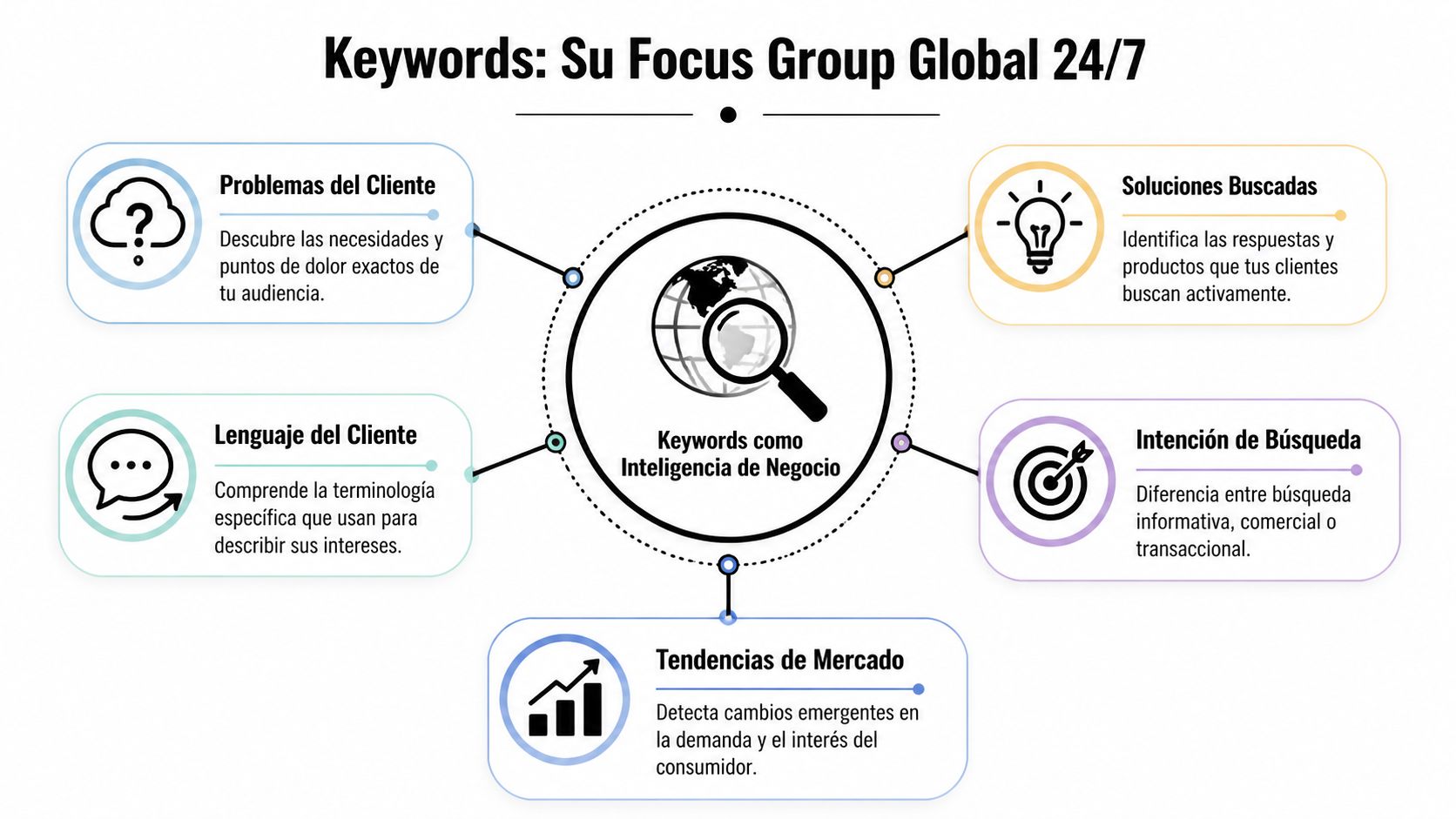
A keyword can answer questions that matter to the business:
In Chilean eCommerce, that point isn’t theoretical. Strategically implemented keywords can increase conversions by up to 25%, and geo-specific long-tail keywords generate a CTR 2.5x higher than generic ones. In addition, that greater semantic relevance reduces bounce rate by 15% and raises the conversion rate per session by 12%, according to the reference on semantic query expansion and search behavior.
Don’t read that data as a tactical promise. Read it as management evidence. When the business’s language matches the customer’s language, friction drops and performance rises.
Companies with the best reading of intent don’t depend on intuition. They build a layer of continuous observation.
That means looking at patterns, not just isolated terms. If more searches tied to comparison, local delivery, warranties, payment methods, or regional trust appear, we’re not facing an editorial task. We’re facing an instruction to redesign the value proposition and the experience.
A good executive dashboard can consolidate that signal and make it actionable. Visualization tools like Looker Studio for strategic reporting help turn scattered searches into clear decisions for leadership.
A keyword isn’t worth the click it brings. It’s worth the market truth it exposes.
Your team doesn’t need more SEO categories. It needs an investment criterion.
Each type of keyword serves a distinct function in growth, margin, and competitive defense. If they all enter the same backlog, the result is predictable. Inflated traffic, generic messages, and poorly allocated budget.
Understanding what keywords are from a business standpoint requires a simple reading. Each search answers a different question about the market. Some show category reach. Others expose purchase intent. Others reveal friction, doubts, and objections that are currently holding back conversion.
Short-tail keywords serve to contest visibility in broad categories. They tell you whether your brand exists or not in the market’s mind, but they rarely explain why a customer would choose your offer. They’re useful for presence and coverage. They’re weak for projecting revenue if the business doesn’t have a clear proposition.
Long-tail keywords matter more than an executive report usually admits. There the buyer’s precise language appears. Local need, concrete use, price range, urgency, compatibility, delivery, warranty. That specificity lets you capture demand with a better commercial fit and, at the same time, detect barriers that your site, your offer, or your message hasn’t yet resolved.
Informational keywords don’t only feed awareness. They also anticipate objections. If a company receives volume on searches like “how to choose,” “which is better,” “is it worth it,” or “what’s the difference,” it has a clear signal: the market still needs arguments to move forward. Commercial and transactional keywords appear later, when the user no longer seeks to understand the problem but to reduce risk before buying.
| Type of Keyword | Strategic role for the business | Dominant stage | Example |
|---|---|---|---|
| Short-tail | Measure category presence and competitive pressure | Discovery | “running shoes” |
| Long-tail | Capture specific demand with a better fit to offer and intent | Consideration or decision | “online store running shoes Santiago” |
| Informational | Identify doubts, objections, and the market’s education needs | Awareness | “how to choose WordPress hosting Chile” |
| Commercial | Influence the comparison between alternatives and defend the value proposition | Consideration | “best WordPress hosting Chile” |
| Transactional | Convert active intent into revenue | Decision | “buy WordPress hosting Chile” |
| Navigational | Protect the brand and direct traffic toward owned assets with clear intent | Decision or retention | “brand + login” or “brand + pricing” |
| Semantically related | Expand the real coverage of the customer’s language and connect variations of intent | Whole funnel | “virtual store,” “e-commerce,” “online purchase” |
Priority isn’t defined by volume. It’s defined by the economic value of the intent and the friction that the search exposes.
A specific keyword can reveal an opportunity that a mass term never shows:
That reading must translate into concrete decisions about architecture, messages, and experience. If a relevant part of your searches includes attributes, comparisons, or purchase conditions, your internal structure must respond with precision. An on-site SEO architecture oriented toward search intent helps turn that signal into pages, categories, and journeys that sell better.
Executive decision: short-tail keywords buy presence. Long-tail keywords buy precision. Don’t ask both for the same return.
The language around the main keyword also matters. In Chile’s marketing, customers don’t search the way they’re labeled in your content plan. They search with synonyms, typos, slang, urgencies, and shortcuts. If your company works only with literal matches, you’re seeing a cropped version of demand.
A healthy portfolio doesn’t look like a list exported from a tool. It looks like a growth thesis with three clear fronts:
That defines future market share. Not through ranking. Through a superior reading of intent and a more precise commercial response than the rest.
Poorly done keyword research produces lists. Well-done research produces decisions.
The point isn’t to open Ahrefs, SEMrush, or Google Trends and export ideas. The point is to understand where profitable demand is, how occupied that opportunity is, and what market language no one is answering well yet.

A business leader should demand four readings in any research:
Existing demand
What the market searches for today and with what intent.
Competitive capacity
Who dominates those searches and why. It’s not enough to know there’s competition. You have to understand whether they win by authority, brand, commercial structure, or experience.
Potential economic value
Which terms appear close to revenue, a qualified lead, or ticket expansion.
Undocumented demand
What questions exist outside the traditional tools.
The fourth point is where almost everyone fails.
Competitive keyword gap analysis rarely includes the study of unanswered questions in local forums and communities. That gap matters especially in Latin America and Chile, where Reddit, Quora, and eCommerce communities contain real demand that many methodologies don’t capture, as the content gap analysis approach applied to unresolved questions points out.
That means your company can find opportunities before they appear clearly in the typical SEO-tool dashboards.
Review conversations where users explain problems in their own words. There you’ll find doubts about payment methods, delivery to the regions, integration with Shopify, trust in local providers, or comparison between solutions the formal market still doesn’t answer well.
To deepen that competitive and intent reading, it’s worth complementing the view with an SEO in site analysis oriented toward structure and relevance.
The best keyword doesn’t always appear in a tool. Sometimes it appears in a complaint, a repeated question, or a poorly resolved comparison.
Don’t ask for an endless spreadsheet. Ask for an executive synthesis with three outputs:
Growth territories
Categories where demand exists and the company can compete clearly.
Intent gaps
Searches where the user expects an answer no one delivers well.
Market risks
Areas where the competition has already taken over the language and forces you to differentiate.
Well-directed keyword research doesn’t answer “what do we publish.” It answers “where to grow, where to defend, and where not to spend.”
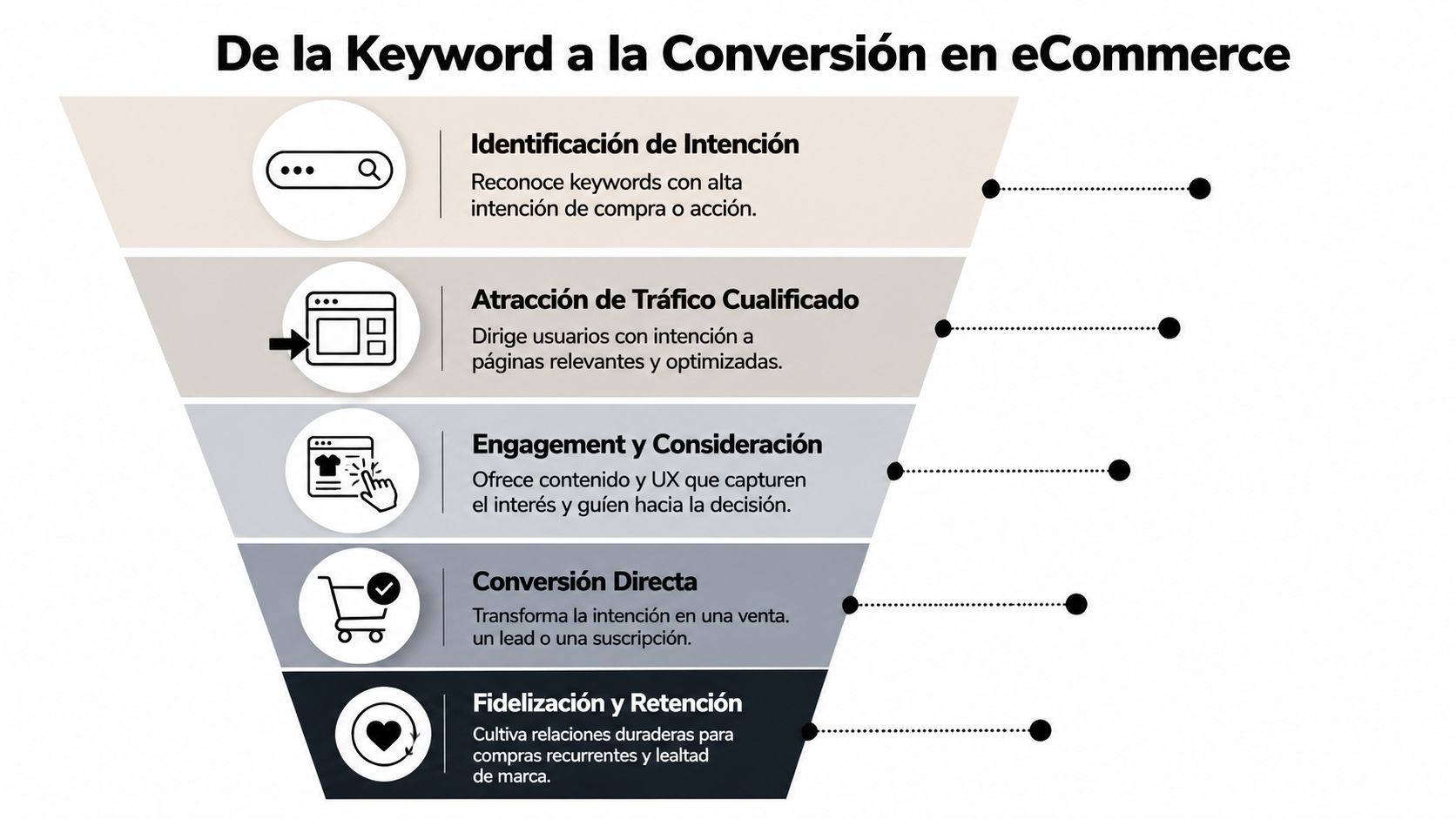
The user’s click doesn’t close the SEO work. It opens a real-time commercial evaluation.
Every keyword brings a concrete expectation about what the user wants to solve, compare, or buy. If the page receives that visit with a generic message, a confusing structure, or a poorly framed action, the company loses more than a session. It loses margin, trust, and market share to competitors who do understand the intent.
A search like “compare cushioned running shoes” demands an experience oriented toward deciding. The user expects clear comparisons, useful filters, social proof, differences between models, and signals about which option suits them based on use, weight, or distance.
A search like “buy ergonomic desk Santiago” demands something else. It needs visible stock, delivery times, coverage by district, final price, local trust, and a simple purchase.
Most teams separate SEO, UX, and conversion as if they were different fronts. That’s a management mistake. A well-read keyword works as a business brief: it defines what objection the user brings, what evidence they need to move forward, and what friction must be removed to capture the sale.
Use this executive filter to check whether a keyword is well activated:
Sending different intents to the same class of page dilutes conversion. It also distorts the internal diagnosis, because marketing celebrates visits while sales and eCommerce see abandonment. To align acquisition, experience, and result, it’s worth reviewing this approach to digital marketing for eCommerce with a performance focus.
A visual example helps organize this approach:
Stop discussing keywords only by volume or by page titles. For each priority term, demand clear answers to these four questions:
A disconnect between the keyword’s intent and the page’s experience reveals a strategic problem. In eCommerce, the most valuable keywords aren’t the ones that inflate traffic. They’re the ones that expose intent, show conversion barriers, and let you design an experience that captures demand more efficiently.
If your keyword report ends in rankings, your team is measuring activity, not growth.
The board doesn’t need to know whether a page rose from position 6 to 3. It needs to know whether the company is capturing demand more efficiently, whether that demand converts better, and whether marketing is reducing pressure on paid media. That’s the difference between an SEO report and a business reading.

A dashboard that’s useful for leadership connects search intent with economic result. If it doesn’t, it’s superfluous.
Include these five fronts:
This last point is often ignored, and that’s a mistake. If your brand gains visibility in secondary terms but loses presence in searches that define the category, you’re ceding market share even though total traffic rises.
A well-executed keyword strategy improves more than one channel. It organizes content, corrects mismatches between search and page, filters out low-value traffic, and helps paid media buy better. The result isn’t just more visibility. It’s a more profitable capture of demand.
That effect shows up on three levels. First, conversion rises in segments where the intent is well resolved. Second, budget waste drops in campaigns that previously attracted clicks with no commercial outcome. Third, the internal reading of the market improves, because searches start to clearly show which objections hold back the purchase and in which categories it’s worth competing more aggressively.
Don’t measure whether a keyword ranks. Measure whether it reduces the cost of capturing demand and increases the proportion of visits that generate business.
Take these metrics out of the center if they’re not connected to revenue, margin, or commercial efficiency:
| Overrated metric | Problem |
|---|---|
| Average position | Can improve with no impact on sales |
| Gross traffic | Mixes useful demand with irrelevant visits |
| Impressions | Show exposure, not result |
| Total number of ranked keywords | Inflates activity, not profitability |
A mature strategy doesn’t produce pretty reports. It produces better decisions about budget, content, priority categories, and conversion experience. That’s the real impact of keywords.
The question what keywords are deserves a more demanding answer than usual. They’re search terms, yes. But for a company that wants to grow, they’re something far more valuable. They’re direct signals of intent, friction, market language, and competitive opportunity.
Companies that keep seeing keywords as an isolated SEO task will capture partial visibility and limited understanding. Those that use them as a commercial intelligence system will detect sooner what the market wants, how it asks for it, and what prevents that demand from turning into revenue.
That approach changes content decisions, digital architecture, commercial prioritization, and budget allocation. It also changes the internal conversation. Marketing stops chasing traffic out of inertia and starts working with a more precise reading of the business.
In 2026, the advantage won’t be in whoever publishes more or chases more terms. It will be in whoever better interprets the intent behind those searches and acts with more speed and coherence.
Keywords are not an accessory of the digital channel. They’re a layer of intelligence to better understand and dominate your market.
If your company needs to turn that intelligence into real growth, Bigbuda helps translate search intent into business decisions, more effective digital experiences, and better commercial performance without wasting investment.
Because every search exposes something the business needs to understand. A keyword can reveal the latent problem the customer wants to solve, their level of sophistication, sensitivity to local context such as delivery, support or price, and demand maturity. Treating them only as content inputs reduces a real demand signal to an operational task.
In Chilean eCommerce, strategically implemented keywords can increase conversions by up to 25%, and geo-specific long-tail keywords generate a CTR 2.5 times higher than generic ones. That greater semantic relevance also reduces bounce rate by 15% and raises the conversion rate per session by 12%.
Short-tail keywords buy presence: they contest visibility in broad categories and tell you whether your brand exists in the market's mind, but rarely explain why a customer would choose you. Long-tail keywords buy precision: they carry the buyer's exact language about local need, use, price range, urgency, delivery or warranty. Do not ask both for the same return.
Demand four readings: existing demand and its intent, competitive capacity and why rivals win, potential economic value close to revenue or a qualified lead, and undocumented demand. That last point is where almost everyone fails, because unanswered questions in local forums and communities rarely enter competitive gap analysis.
Read the keyword as an experience brief. Informational intent needs a page that reduces uncertainty and leads to the next commercial step. Commercial intent needs comparison, credibility and choice criteria. Transactional intent needs a shorter path to purchase with clear conditions. Sending different intents to the same class of page dilutes conversion.
Take average position out, since it can improve with no impact on sales. Remove gross traffic, which mixes useful demand with irrelevant visits. Drop impressions, which show exposure rather than result. And cut the total number of ranked keywords, because it inflates activity, not profitability.