










Solutions
Explore how to grow

The question is not how much traffic your eCommerce needs. The question is how many of the people who already interact with your brand are misclassified within your systems, reports, and investment decisions.
If you want to dig deeper, check out our digital marketing service.
That is where a leak in profitability begins, one that many companies confuse with a demand problem. If a high-intent visitor, a lead captured by email, an active user, and a recurring buyer all end up under imprecise or interchangeable labels, the business optimizes the wrong funnel. Marketing buys more sessions. CRM works with audiences that are too broad. Operations receives poor signals about recurrence and future value. The result is not only conceptual disorder. It is an inflated CAC, weak segmentation, and budget allocated to stages that do not move margin.
In 2026, defining a customer as “someone who already paid” describes a transaction, but it does not help you run a digital company. In eCommerce, economic value appears before and after the purchase. It appears when a person compares several times, returns through direct traffic, subscribes, adds to cart, responds to an automation, or repurchases without an incentive. Treating those signals as if they were equivalent erases differences in intent and reduces the team's ability to prioritize.
That error also distorts the reading of growth.
A company that mixes customers, users, and leads in the same analysis block usually believes it needs more traffic to sell more. Often it needs something less costly and more profitable: an operational definition that separates acquisition, consideration, purchase, and recurrence with criteria useful for measuring value. That change organizes investment and improves conversion without increasing media spend. It also allows you to build more precise strategies based on different types of customers in eCommerce, instead of treating every interaction as if it carried the same commercial weight.
The most repeated recommendation in digital marketing says you have to bring in more traffic to sell more. It is a half-truth. When a company is not clear on what counts as a customer at each stage of the journey, more traffic only amplifies the waste.
In many online stores, the problem is not a lack of interest. It is the poor classification of that interest. A visitor who returns several times, compares products, and leaves clear signals of intent usually ends up labeled the same as someone who bounced on entry. Under that logic, the company buys more visits, but does not build more value.
That is the strategic error. A customer is no longer solely the buyer who appears at the end of checkout. It is a sequence of signals, decisions, and data that begins long before payment and continues after. If the company only recognizes the customer when it invoices, it arrives late to the most important part of the process.
This view matters because it defines where the budget goes. It also defines which teams have a voice. If “customer” equals only a transaction, marketing obsesses over acquisition, sales over closing, and operations over shipping. If “customer” includes intent, behavior, and recurrence, then CRM, first-party data, experience, and retention move to the center of the strategy.
If your definition of a customer starts at the purchase, your growth model starts too late.
To dig deeper into how business decisions change according to each profile, it is worth reviewing this analysis of types of customers in digital environments.
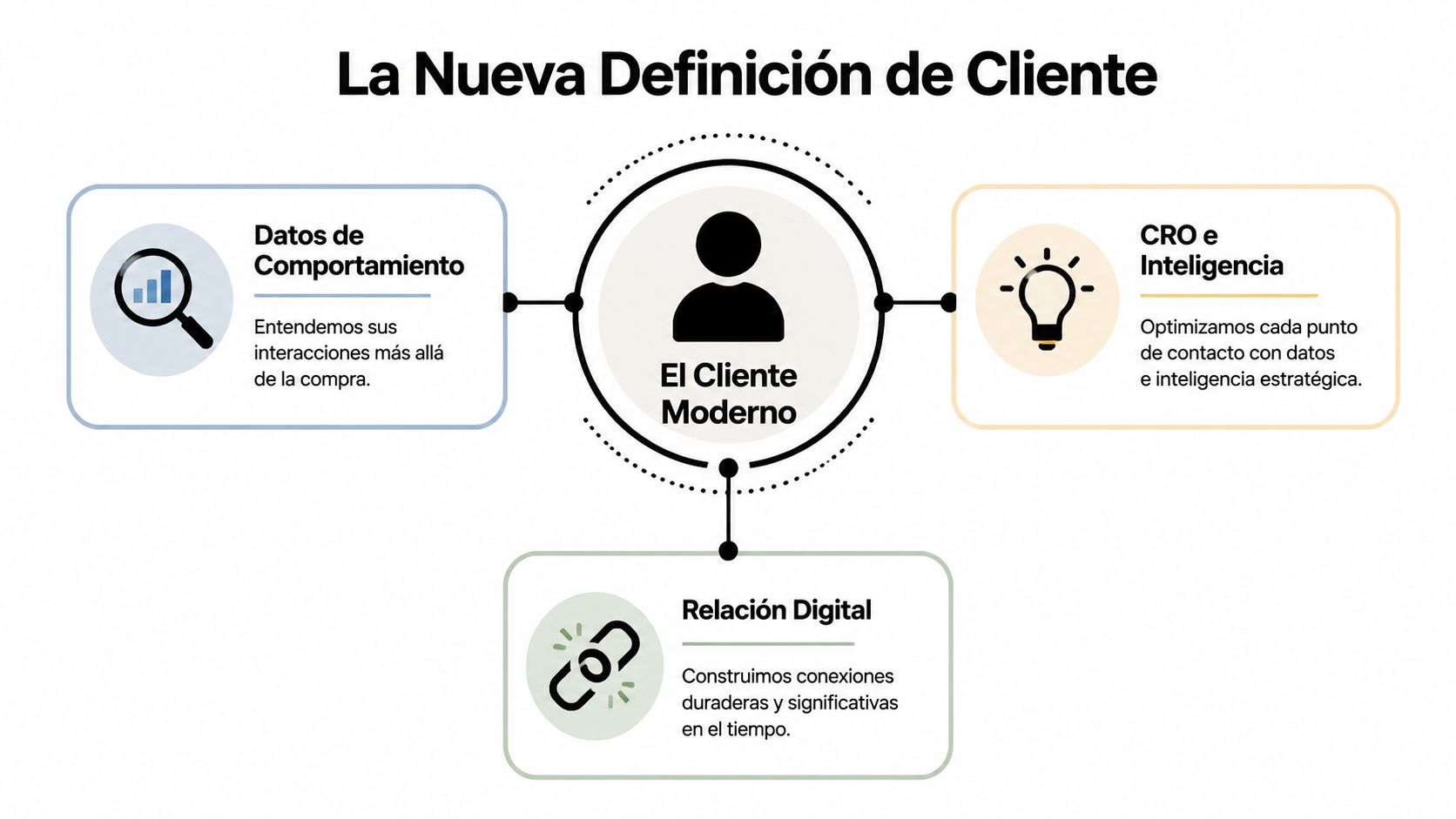
The definition of a customer that a company uses determines what revenue it can attribute, what audiences it can work, and what spend ends up wasted. In eCommerce, treating the customer as a figure born at checkout distorts three decisions at once: investment in acquisition, the reading of the funnel, and the priority that retention receives.
A limited definition turns a business problem into a reporting problem. Marketing reports growth in traffic. CRM reports more registrations. Performance reports a competitive cost per lead. Finance keeps seeing the same pressure on margin. The contradiction is only apparent. Each team is optimizing a different unit because the company never set a shared economic definition of a customer.
That error has an operational effect. If the “customer” only exists after paying, all the prior signals are degraded to tactical noise. So the value of early identification is underestimated, too much is attributed to the last session, and additional traffic is bought to compensate for a conversion that actually fails due to poor classification, not a lack of demand.
The strategic definition corrects that bias. A customer becomes a measurable relationship with present value and future value. The purchase matters, but it does not exhaust the category. Observable intent, identification, repetition, and the probability of repurchase also matter.
In practice, it is best to organize that relationship into states that affect budget and decisions, not just nomenclature:
| State | What it represents for the business | Risk of mishandling it |
|---|---|---|
| Prospect | Interest not yet identified | Buying reach without the ability to follow up |
| Lead | Identifiable and actionable relationship | Losing intent through irrelevant sequences |
| Buyer | Confirmed revenue | Overvaluing a low-margin first purchase |
| Recurring | Future revenue flow and better efficiency | Underinvesting in retention and repurchase |
The difference seems semantic. It is not.
If a store mixes these states within the same “customers” report, the CAC is inflated or disguised depending on the criterion used, automation activates late, and remarketing chases people who have already changed phase. The result is not only analytical disorder. It is poorly allocated spend.
That is why redefining the customer must leave the conceptual realm and enter management, finance, and operations. A company that organizes its states of value well can decide with more precision how much to pay to acquire, how much to invest in nurturing, and how much to reserve for retaining. It can also stop rewarding volume metrics that do not improve marginal contribution.
That point changes the conversation about loyalty. Retaining does not consist of “rewarding” the person who already bought, but of protecting the stretch of the funnel where the incremental cost drops and the accumulated value rises. To dig deeper into that impact, it is worth reviewing this analysis of the importance of customer loyalty.
CEO reading: redefining “customer” changes how capital is allocated, how growth is measured, and what part of the funnel stops absorbing budget without return.
Most eCommerce stores do not lose profitability for lack of traffic. They lose it because they poorly measure who they are attracting, who they are identifying, and who they have already converted into revenue.
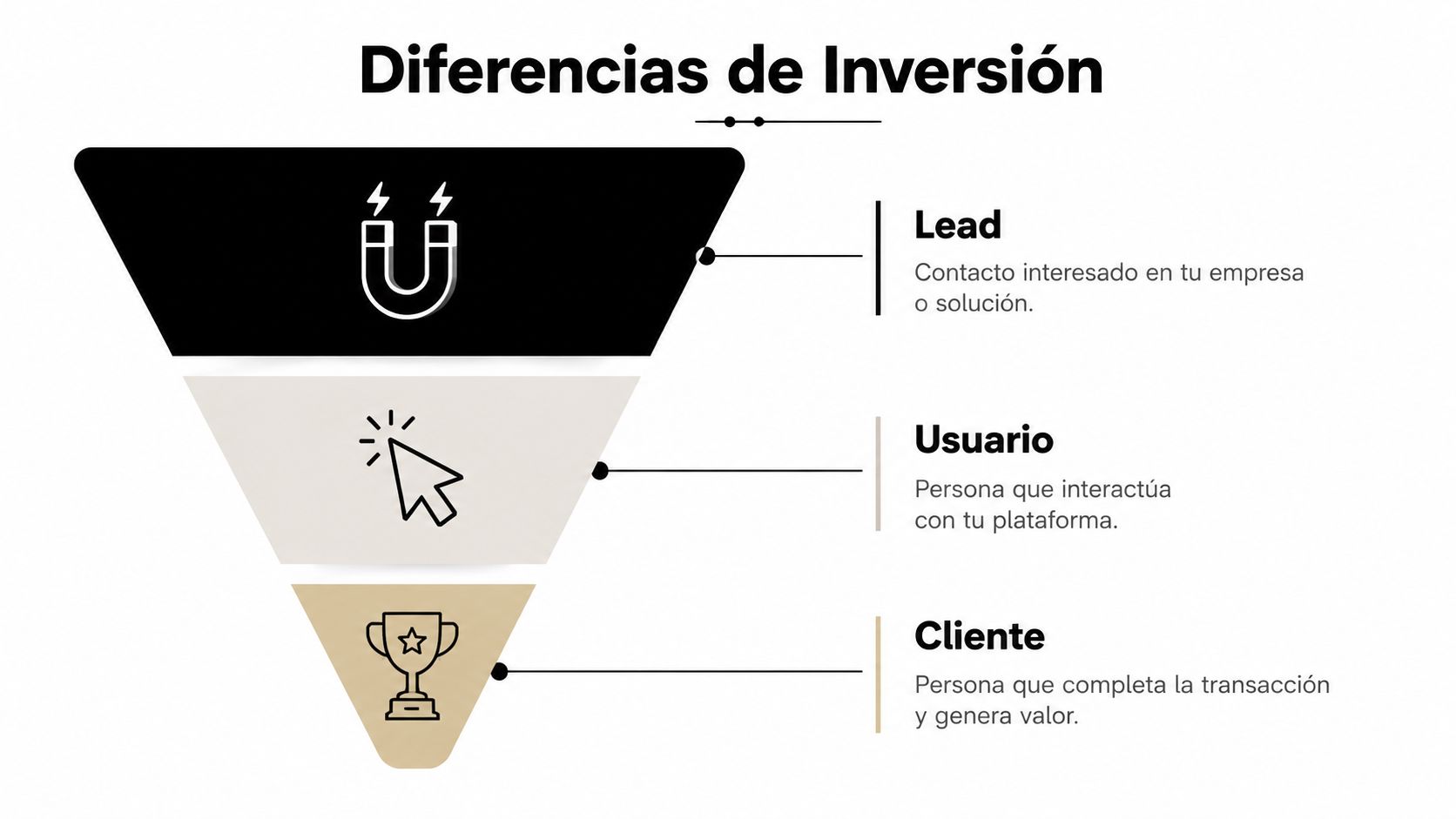
In operational terms, a user is a person who interacts with the site or the app. A lead is an identifiable person, with permission or a real possibility of contact. A customer is someone who has already produced a transaction. That sequence seems basic, but many stores alter it in their dashboards, in their CRM, and in the way they distribute budget.
The problem worsens when the person who buys is not the person who uses the product. The analysis of the customer on Economipedia recalls a distinction that many brands overlook: a customer is not always synonymous with the end consumer. In eCommerce, that difference affects creative, promotions, automations, and after-sales service. If a brand treats everyone as if they played the same role, it optimizes campaigns against a simplified reality and makes decisions on a conceptually flawed database.
Confusing user, lead, and customer does not only muddy analytics. It also alters financial decisions.
The real cost appears in capital allocation. An anonymous user should not receive the same target CPA as a lead with clear intent. A lead does not deserve the same treatment as a customer with proven margin or a high probability of a second purchase.
From a conversion perspective, the useful question is not how many “customers” the company has in a broad sense. The useful question is how many people are in each state of value and what friction prevents moving them to the next.
That change organizes the entire operation. The paid media team stops buying undifferentiated volume. CRM stops automating sequences for poorly labeled databases. Product and UX can detect whether the problem is in capturing intent, in turning intent into a purchase, or in converting a first purchase into a profitable relationship.
That is why a well-configured data system matters so much. A CRM oriented toward real stages of relationship and commercial value helps separate behavior, intent, and confirmed revenue. Without that structure, the company reports growth in contacts while deteriorating efficiency in acquisition and contribution margin.
CEO reading: if your eCommerce calls any person who enters the database a “customer,” you do not have a commercial definition. You have a leak in investment disguised as nomenclature.
Segmentation fails when it describes audiences but does not organize decisions. In eCommerce, that error has a direct cost. Traffic is bought for profiles without intent, users without likely value are retargeted, and an occasional buyer is treated the same as a customer with a high probability of a second purchase.

The useful question is not who your audience is. The useful question is which segments change the return on every dollar invested in acquisition, CRO, and retention.
The first model segments by current intent. It is not enough to know which channel a visit comes from or what device it uses. What matters is identifying signals that indicate proximity to purchase, such as internal searches, repeated visits to specific categories, interaction with product pages, or progress through checkout. In conversion terms, these signals usually predict the outcome better than many demographic data points, because they reflect active demand and not general affinity.
The second model segments by observed behavior. Here the logic is operational. A user who compares variants, reviews shipping policies, and returns to the cart should not enter the same flow as someone who bounces from a cold campaign. If both receive the same commercial pressure, the team wastes impressions, emails, and discounts. Behavioral segmentation corrects that problem because it adjusts message, sequence, and commercial effort to the real friction of each group.
The third model segments by expected value. RFM is still useful for a simple reason. It forces you to classify the base by recency, frequency, and spend, which are variables connected to revenue, not just to activity. That model lets you distinguish four different decisions: protect valuable customers, reactivate dormant buyers, develop accounts with potential, and stop overinvesting in profiles with a low probability of return.
Segmentation stops being a marketing task when it affects capital allocation. A CEO should ask for segments that explain which part of the base deserves acquisition, which needs nurturing, and which justifies retention investment.
For example:
That framework changes the meetings. The debate stops being how many sessions arrived this month and becomes which segments grew, which bought profitably, and where value is being lost due to poor classification between lead, user, and customer.
Practical rule: if your dashboard does not distinguish intent, recurrence, and expected economic value, your company is optimizing activity, not profitable growth.
Better segmentation improves conversion because it reduces errors in commercial pressure. It also lowers the cost of acquisition by concentrating budget on users with a higher probability of purchase or repurchase. In practice, that means fewer campaigns chasing undifferentiated volume and more investment directed at cohorts with a better expected response.
The most important effect appears in the operation. Paid media stops inflating remarketing audiences with low-value visits. CRM stops sending identical automations to different commercial states. The CRO team can prioritize tests according to real economic impact, not superficial volume. And finance gains a more precise reading of return by segment.
The executive conclusion is concrete. Segmentation is not for describing customers. It is for deciding how much to invest, in whom, with what message, and with what expectation of return. That is where the serious improvement in conversion begins.
Measuring only the conversion rate produces an incomplete reading of the business. In eCommerce, that limitation is costly because it mixes leads, active users, occasional buyers, and recurring customers in the same report. The result is a budget allocation that rewards visible volume, even though part of that volume destroys margin at 30, 60, or 90 days.

The central metric is not the initial purchase. It is CLV, because it forces you to evaluate whether the acquired customer generates enough value to justify CAC, support, discounts, returns, and retention effort. If a store improves conversion with aggressive promotions but attracts buyers who do not repeat and demand more operational cost, the commercial improvement is apparent, not economic.
That is why CLV corrects a frequent distortion in management. Many companies believe their problem is traffic when in reality they have a customer-quality problem. They are buying visits to capture low-value users and then interpret the drop in profitability as a signal to invest more in acquisition.
The implication is operational. Marketing should not answer only for new sales. It must also answer for the future quality of the cohorts it brings in.
| Metric | What it answers | What decision it improves |
|---|---|---|
| CLV | How much margin a customer leaves over time | How much the company can invest to acquire and retain them |
| CAC | How much it costs to convert a real customer, not just generate demand | Which channels deserve more budget |
| Churn | What percentage of customers is lost or stops buying | Where the experience, the offer, or the repurchase frequency fails |
| Cohorts | How groups acquired in different periods or channels behave | Which source brings valuable customers and which only brings volume |
These metrics matter together. Apart, they can lead to errors.
A low CAC may look like a victory and hide a churn problem. A drop in conversion may look alarming and, at the same time, reflect a healthy cleanup of traffic if it improves the CLV of new cohorts. A channel with an attractive CPA can worsen the income statement if it brings in one-time buyers who depend on discounts to convert.
In many eCommerce operations, the dashboard treats as equivalent a lead captured by pop-up, a registered user who browses categories, and a customer who has already bought twice. That confusion alters the reading of performance on three fronts. It inflates remarketing audiences with low-intent profiles. It distorts attribution because it assigns revenue credit to channels that only captured curiosity. It also reduces the precision of CRO, since tests are evaluated over a mix of incompatible commercial states.
Finance ends up seeing it later. Marketing creates it earlier.
If the company redefines a customer as an economic relationship with a probability of recurrence, the metrics stop being descriptive and become instruments of capital allocation. That is where the executive conversation changes. The question stops being how many bought and becomes which segments recover CAC faster, which sustain margin, and which consume budget without returning value.
Retention, purchase frequency, and cohort quality usually have a greater impact on profitability than small improvements in initial conversion. In practical terms, this means that part of the advertising ROI does not depend only on the ad, but on what happens after the click. If the post-purchase experience, the CRM, and personalization fail, the company forces paid media to compensate with more investment for what the operation does not retain.
That dynamic explains why businesses with growing sales can deteriorate margin at the same time.
The strategic consequence is clear. Customer metrics do not belong only to analytics or marketing. They must organize decisions in product, pricing, retention, automation, and budget. When each team uses a different definition of a customer, the company optimizes departments. When everyone shares an economic definition, it starts to optimize profitable growth.
The strategic discussion only matters if it changes real decisions. On platforms like Shopify, Webflow, and WordPress, the difference between seeing the customer as a transaction or as a data system shows in the quality of decisions, not in the number of tools installed.
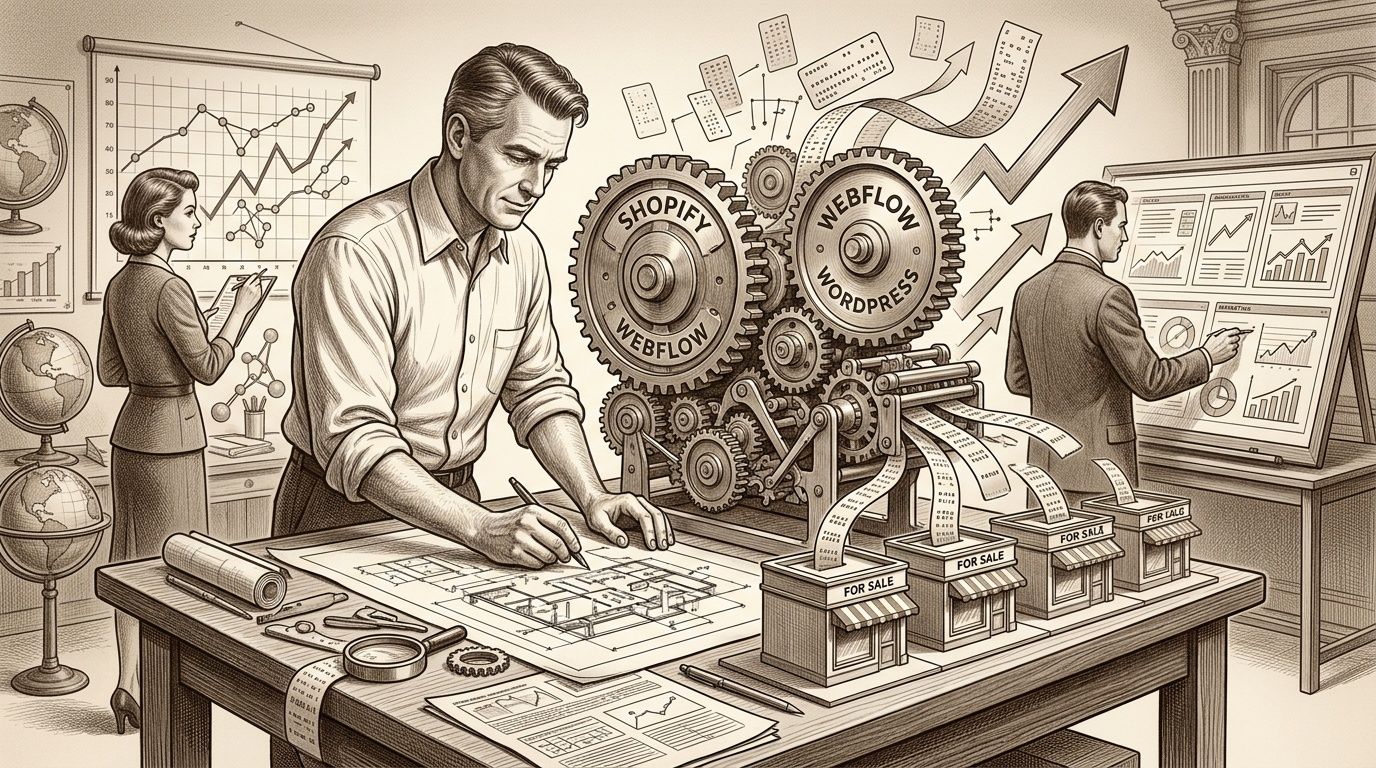
In Shopify, a mature reading of the customer lets you separate one-time buyers, repeat buyers, and segments with valuable behavior. The verified data from the Billin customer glossary shows that a recurring customer generates 2.6 times more value. That completely changes the business priority.
Instead of measuring the channel only by initial sales, the company can evaluate it by the quality of the customer it brings. A channel may look efficient by immediate CAC and, at the same time, bring in weak cohorts. Another may look more expensive at the start, but generate superior recurrence.
The opportunity in Webflow or WordPress is not only in design or publishing. It is in how the site interprets behavior. The same dataset indicates that, in Chile, the bounce rate in eCommerce ranges between 65% and 75%. That means a large part of the traffic leaves without developing a meaningful relationship.
When the company understands the customer as a set of data, that bounce stops being a simple interface problem. It becomes a signal of incomplete classification. Context is missing, relevance is missing, or continuity between expectation and experience is missing.
There are three capabilities that matter at the leadership level:
A platform does not create growth on its own. It is created by the quality of the customer intelligence the company brings into that platform.
Here is the final thesis. The companies that will win in the coming years will not necessarily be the ones that buy the most traffic. They will be the ones that better understand who they already have in front of them, who decides, who uses, who repeats, and who is about to leave.
The question of what a customer is seems basic. In reality, it defines a large part of the economics of a digital business. If the company keeps calling “customer” only the person who pays, it leaves out the intent that precedes the purchase, the experience that sustains the repurchase, and the data that allows for better budget allocation.
Companies that do not correct that definition end up playing an expensive game. They buy traffic to compensate for a limited understanding of their own demand. Those that do correct it operate differently. They classify better, prioritize better, and measure better.
The most profitable change does not always start in media, design, or technology. Sometimes it starts in the internal language with which the business decides which person matters, at what moment, and why.
If your company needs to translate this vision into measurable growth, Bigbuda helps turn data, experience, and strategy into better sales without wasting investment in traffic. Its approach combines CRO, analytics, automation, and development in Shopify, Webflow, WordPress, and WooCommerce so that the definition of a customer stops being theoretical and starts moving results.
Related reading: Leads in marketing: a guide to converting more without traffic · Market Segment: Key to Growing in eCommerce 2026 · Power up your business with the customer lifecycle
In operational terms, a user is a person who interacts with the site or app. A lead is an identifiable person, with permission or a real possibility of contact. A customer is someone who has already produced a transaction. Many stores alter that sequence in their dashboards, their CRM and the way they distribute budget.
It distorts financial decisions. CAC looks efficient at the top of the funnel while hiding low-quality demand, remarketing insists with acquisition messages to people who already bought, the conversion rate loses managerial usefulness, and retention stays underfunded because first buyers sit in the same group as qualified leads.
Three. Segmentation by current intent, using signals such as internal searches, repeated category visits and checkout progress. Segmentation by observed behaviour, which adjusts message and commercial pressure to each group's real friction. And segmentation by expected value through RFM, classifying the base by recency, frequency and spend.
Four, read together. CLV shows how much margin a customer leaves over time and how much you can invest to acquire them. CAC shows what it costs to convert a real customer. Churn shows where experience or offer fails. Cohorts show which source brings valuable customers and which only brings volume.
Metrics stop being descriptive and become instruments of capital allocation. The executive question stops being how many bought and becomes which segments recover CAC faster, which sustain margin and which consume budget without returning value. CRM, first-party data, experience and retention move to the centre of the strategy.
After the first conversion. Retention, purchase frequency and cohort quality usually have a greater impact on profitability than small improvements in initial conversion. If the post-purchase experience, the CRM and personalisation fail, the company forces paid media to compensate with more investment for what the operation does not retain.