










Solutions
Explore how to grow

When around 30% of mobile searches in Chile are already done by voice and 88% of those users take an action within 24 hours, the conversation stops being technological and becomes financial, commercial and competitive (BBVA on mobile voice search). For a board, that shifts a central question: it is no longer enough to know how much traffic arrives. You have to understand what part of demand is being resolved before the click and which brands are being chosen as the answer.
This is reinforced by a strong digital marketing service.
Most content about voice search stays on the surface. It explains the phenomenon, lists technical tips and treats it as an extension of SEO. That approach underestimates the real shift. Voice changes the way customers express intent, accelerates decisions, favors a single visible or audible answer and penalizes companies with scattered, slow or unclear information.
In Chile, this change matters for three reasons. First, because it directly affects the capture of high-intent demand. Second, because it changes the economics of the organic channel, especially in eCommerce and local businesses. Third, because it forces a redesign of digital strategy as a system of consistent answers, not as a sum of disconnected assets.
A market signal deserves a board's attention when it changes the way customers discover, evaluate and choose. That is already happening with voice search. Its adoption in mobile search and its link to short-term actions, cited earlier in this article, change the conversation. This is no longer an interesting innovation. It is direct pressure on acquisition, service and captured share of demand.

The central implication is economic. Voice compresses the journey between intent and answer. In that shorter stretch, the user reviews fewer options, tolerates less friction and rewards the brand that offers clear, up-to-date information that is easy for search engines and assistants to interpret. In business terms, that raises the value of every point of operational precision in digital channels.
For a Chilean company, the effect appears on three fronts:
The strategic reading is concrete. Voice shifts the competitive logic of search toward faster, more direct answers with less room for information errors.
Digital fads tend to inflate expectations before finding a stable use case. Here something different happened. Adoption advanced because resolving a need by speaking reduces effort in everyday contexts of high commercial value, such as local searches, simple comparisons or urgent decisions.
That forces a review of an assumption that still dominates many digital strategies in Chile. For years, the goal was to gain positions within a list of results. With voice, the goal shifts to other ground: being considered a trustworthy answer by systems that prioritize clarity, authority and context. That difference affects budget, technology priorities and content governance.
The risk of ignoring it does not always show up first in traffic.
It can show up in something more costly. Lower participation in high-intent queries, lost store visits, fewer qualified calls and an inconsistent customer experience right where the decision accelerates. For a board, that combination does not describe a consumption trend. It describes a change in the mechanics of growth.
Text search forced the user to adapt to the machine. Voice does the opposite. It lets the user phrase their need the way they think it. That changes the nature of the query and, with it, the strategic value of the information a brand publishes.
In a written search, someone might type "restaurant Santiago." With voice, the query looks more like a real conversation: a person asks the way they would ask a colleague, a salesperson or someone they trust. The difference is not only in length. It is in the quality of intent.
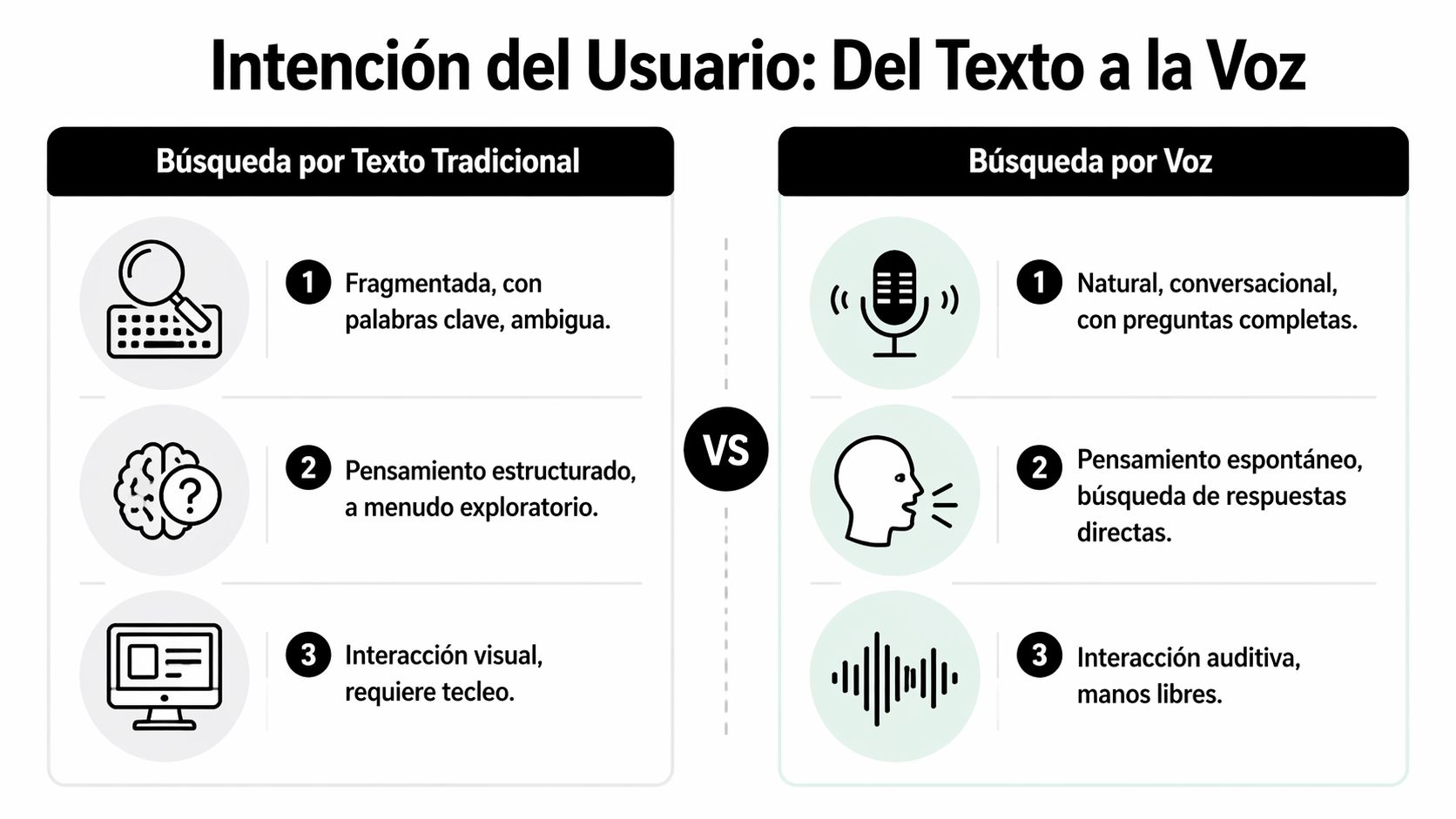
Think of the difference between using an old card catalog in a library and asking the librarian directly which book solves your problem. The first action requires translating the need into categories. The second reveals context, urgency and judgment.
With voice search, the consumer delivers more information in the same query. That includes nuances like location, timeframe, price, availability or preference. For marketing and growth, that richness changes the kind of signal received from the market.
Some business implications are clear:
For years, many brands built content to "cover keywords." That model is still useful in certain scenarios, but it falls short when the user speaks in natural language. The content that gains relevance in voice is not necessarily the longest or the most technical. It is usually the one that responds most clearly to a concrete need.
That shifts the editorial criterion from the volume of terms to the understanding of real questions. A company that knows its customers' doubts, objections and urgencies can better align its digital presence with the way those customers are already searching.
When the way of asking changes, the way demand is distributed changes too.
Here a conclusion appears that many teams do not see in time. Voice does not just improve the user experience. It also raises the cost of a poorly articulated value proposition. If the company cannot express what it offers, for whom, where and under what conditions in a clear and consistent way, it loses competitiveness against brands that are easier for search engines, assistants and users to interpret.
In other words, conversational search exposes strategic weaknesses that the visual channel still allowed to be masked. A site with ambiguous messages, confusing categories or undifferentiated promises can keep working on desktop or mobile. With voice, that ambiguity weighs more.
The opportunity already has economic scale. The impact of voice search in Chile generates more than 2 billion dollars in annual sales at the regional level, and 65% of people aged 25 to 49 use voice daily in comparable markets, a segment especially relevant for eCommerce. On sites optimized with AEO, that group raises conversion rates from 2% to 5%, according to statistics compiled by Synup.
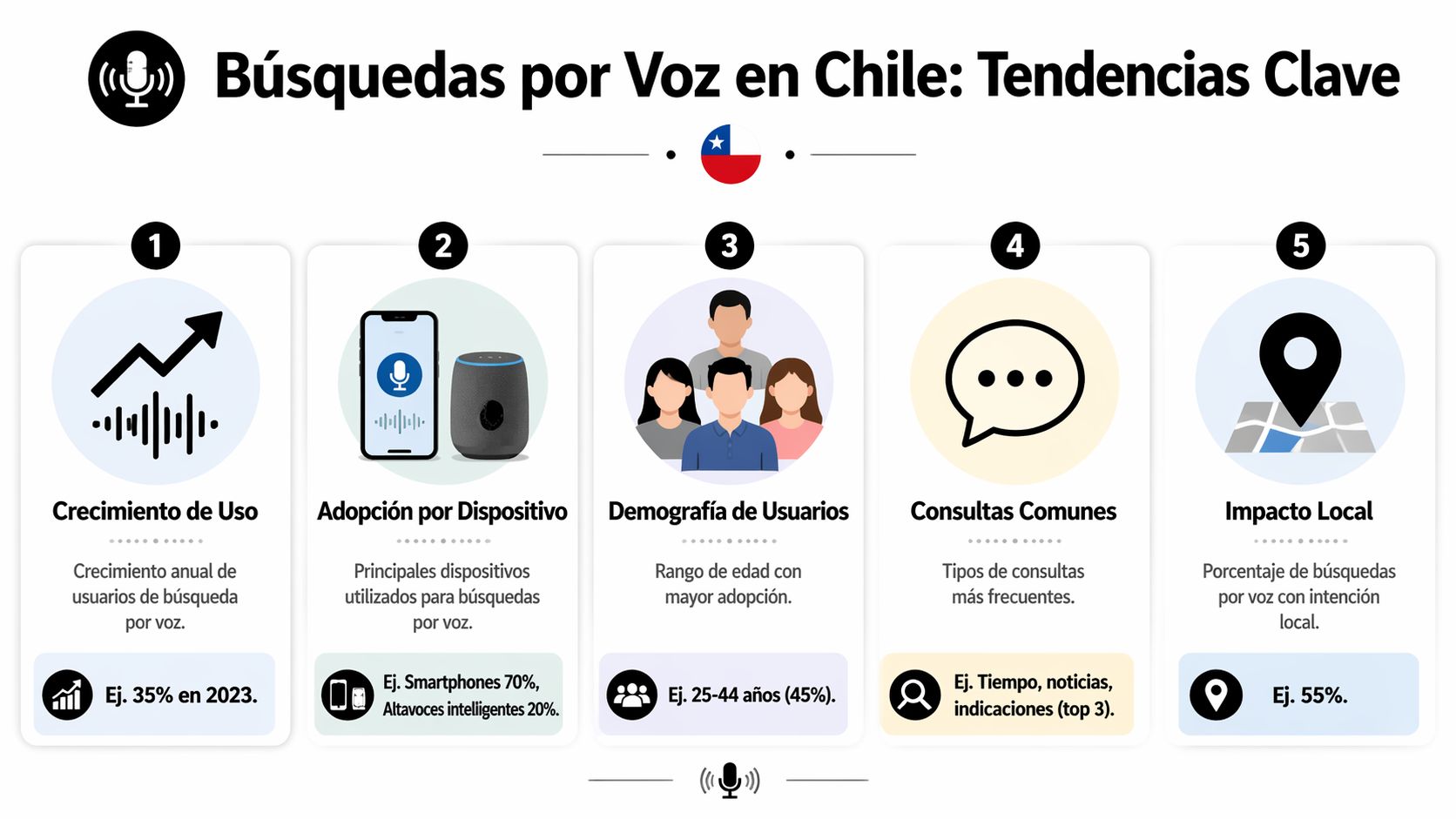
It is not just about adoption. It is about capturing profitable demand. If voice already takes part in annual sales of that magnitude, then its impact no longer belongs to the innovation budget. It belongs to the growth agenda.
The 25 to 49 age group is especially relevant because it concentrates many of the buyers with the greatest decision-making power and consumption frequency. For retail, services and eCommerce companies, that means voice is not entering through the periphery of the funnel. It is touching a central segment of the P&L.
The most important point is not that voice creates a separate channel. The point is that it is improving the efficiency of a channel that already exists. When an interaction reduces friction and clarifies intent, the company needs less effort to move the user toward a valuable action.
That is an important signal for those reviewing CAC, channel mix and the return of organic content. Instead of thinking of voice as an interface fad, it is better read as a layer of efficiency over search, local discovery and commercial consideration. Anyone who wants to evaluate this phenomenon within a broader strategy can connect it with a perspective on digital marketing for eCommerce in Chile.
| Indicator | Strategic relevance |
|---|---|
| Sales attributed to voice | Shows the channel already has measurable economic impact |
| Daily use among 25 to 49 year-olds | Confirms adoption in a commercially attractive segment |
| Conversion improvement on optimized sites | Suggests an opportunity to better monetize existing traffic |
The costliest mistake is not underestimating the technology. It is underestimating that it is already moving purchase decisions.
A board does not need to wait for voice to replace traditional search to act. It is enough to recognize that the competitive structure is already changing. In markets with pressure on margins, any mechanism that improves organic conversion, accelerates action and reduces dependence on paid media deserves priority attention.
The implication is simple. If two companies compete for the same demand and one of them organizes its digital presence to better answer spoken queries, it does not just gain visibility. It can gain a compound economic advantage: better capture, better conversion and less commercial waste.
Voice search changes how organic demand is distributed among brands. On screen, the user compares options. With voice, the assistant tends to synthesize, prioritize and reduce the number of candidates considered. For a board, that difference matters because it concentrates value in fewer positions and makes the relationship between digital visibility and effective intent capture more sensitive.

In this context, SEO, AEO and GEO stop operating as isolated disciplines. They form a single discovery architecture. SEO continues to sustain authority, crawlability and topical relevance. AEO increases the probability that this authority translates into clear, summarizable answers useful to assistants. GEO defines who captures demand when the query includes proximity, availability or local urgency.
The business implication is concrete. In traditional search, appearing among several results can still generate traffic. With voice, the system tends to favor one answer or a very narrow set of options. That is why the discussion no longer hinges only on ranking. It hinges on the probability of being selected.
That change favors companies that organize their information better. Ambiguous content, slow pages, inconsistent data and hard-to-interpret structures reduce the chance of being cited or summarized by the search engine. The economic effect is clear. A brand can invest in content and still lose presence in high-intent queries if it does not turn that content into a precise answer for the engine.
It also changes the criteria for evaluating editorial production. Volume without structure adds digital inventory, but does not necessarily improve distribution. What gains weight is the ability to answer specific questions with natural language, enough context and clear signals of authority.
Outside Santiago, the opportunity is not explained only by lower advertising pressure. It is explained by asymmetries in readiness. Many companies still treat local presence as an operational layer of listings, addresses and hours. With voice, that becomes a more sensitive commercial asset because the local query usually arrives with a need closer to action.
If a company has consistent geographic information, coverage of local categories and pages able to answer how, where and when to solve a need, it improves its chance of entering the assistant's shortlist. If it does not, it cedes advantage before even competing on assortment, price or delivery.
Three fronts concentrate the strategic risk:
To organize this work with a more operational view, it is worth reviewing this guide on SEO, AEO and GEO for companies competing on visibility, answers and proximity.
Reducing this topic to a technical task would be a management error. Voice changes how higher-intent organic demand is allocated. That affects acquisition costs, share of consideration and commercial efficiency by area.
A company that builds its SEO, AEO and GEO layer well does not just improve its digital presence. It increases its ability to capture moments when the customer has already framed the need clearly. In strategic terms, that brings marketing, experience and sales together at the same point of decision.
If a brand does not control its local information or organize its content for direct answers, it leaves a growing part of its commercial distribution in the hands of the search engine.
Many marketing and eCommerce teams still measure conversion from the site visit. That model leaves out a growing part of the decision process. In voice search, the user can decide which brand to contact, which store to visit or which product to consider before opening a page.
The implication for the board and commercial management is direct. If the company only assigns value to the click, it underestimates interactions that already serve a sales function: calls, location requests, hours validation, availability checks or quick comparisons between alternatives. Voice shifts part of conversion to those earlier moments, where speed of response weighs more than depth of navigation.

In Chile, the everyday use of voice assistants can no longer be treated as marginal behavior. What is relevant for the business is not only channel adoption. It is the expectation it sets. Someone who asks by voice expects a concrete, fast and actionable answer. If the brand responds with long paths, vague text or information scattered across several pages, it loses advantage at a moment of high intent.
That has an effect on revenue and on efficiency. A user who arrives with a well-framed need costs less to persuade than one who is still exploring. When the digital experience does not resolve that need clearly, the company wastes demand that was already well advanced in the decision process.
A technical review of the site helps detect those frictions before they affect commercial performance. In this on-site SEO audit focused on experience and findability, the focus is not only on ranking, but on how the digital asset responds when the customer wants to act fast.
Voice increases the weight of micro-conversions with transactional intent. Not all of them end in checkout. Many end in contact, a physical visit or a brand shortlist. From an executive view, that forces a redefinition of which events deserve tracking and which signals anticipate future revenue.
It is worth reviewing at least three management questions:
A critical observation is this. An experience can look correct on screen and still fail at conversational intent. The problem is not always in visual design or isolated performance. Often it lies in the difficulty of delivering a brief, reliable answer consistent with the next action.
Voice compresses the time between question and decision. That changes the experience standard. The user does not evaluate only aesthetics, content or architecture. They evaluate whether the brand saves them time.
In operational terms, that pressure concentrates on three demands:
| Dimension | What the user expects |
|---|---|
| Clarity | Direct, understandable answers |
| Speed | Fast access to relevant information |
| Continuity | Consistency between what is heard, seen and can be done |
For a Chilean company, the conclusion is not tactical. It is strategic. Voice is changing where conversion begins, which signals anticipate business and which frictions damage the experience. Brands that keep designing their digital ecosystem only for traditional navigation will cede revenue, intent data and customer preference to competitors that respond better in real time.
The strategic response is not to launch an isolated voice search project. It is to reorganize the digital presence so the company can be understood, chosen and acted on with less friction. That requires leadership criteria, not just execution tasks.
The first decision is conceptual. Voice should be treated as a cross-cutting layer of experience and discovery. It affects content, data, performance, analytics and brand governance. If each area optimizes separately, the company keeps active channels but a fragmented experience.
1. Conversational content
The brand needs to express its proposition in the language in which the customer frames their questions. It is not enough to have product pages, categories or campaign claims. A layer of content is needed that answers real intent, with phrasing close to how the market asks.
Here the executive criterion is simple. If the content only works once the user already knows what to type, the company is capturing late. If the content helps resolve complete questions, it can enter the decision earlier.
2. Structured data and interpretability
Engines and assistants need to interpret what the company offers, where it offers it and under what conditions. When that information is scattered, outdated or poorly modeled, the brand becomes harder to select as an answer.
This is not a purely technical matter. It is information governance. The organization needs a clear logic to keep consistency across site, local listings, catalogs, content and brand signals.
3. Speed and mobile experience
Voice lowers tolerance for friction. The user expects continuity between question and action. If the answer leads to a slow, confusing or poorly prioritized experience, the company breaks the promise that the conversational interaction itself had created.
4. Intent-oriented measurement
Classic metrics remain useful, but they are no longer enough. A board needs to measure how conversational search contributes to calls, visits, local discovery, brand queries and assisted conversion paths.
| Criterion | Traditional SEO (Keyboard) | Voice SEO (Conversational) |
|---|---|---|
| Query form | Fragmented, keyword-oriented | Natural, phrased as a question |
| Level of context | Lower, more ambiguous | Higher, with more explicit intent |
| User goal | Explore, compare, research | Resolve, decide, act |
| Type of expected answer | List of options | Direct, trustworthy answer |
| Competitive advantage | Broad semantic coverage | Clarity, relevance and interpretability |
Instead of opening an endless tactical list, it is better to do a maturity review on concrete questions:
A company that answers "no" or "not for sure" to several of these questions already has a strategic case to act.
The opportunity of voice is also in protecting efficiency. In a scenario where paid acquisition costs keep pressuring margins, improving organic responsiveness can become a profitability lever. Tools like Google Business Profile, Google Search Console, analytics platforms and content architecture solutions help organize that layer. There are also specialized approaches from partners like Bigbuda in its on-site SEO analysis, aimed at making the site function as a business asset that is more interpretable for search engines and users.
The brand with the most content does not necessarily win. The one that reduces the most friction between the customer's question and the next action does.
The main takeaway for a Chilean board is that voice should not be evaluated as peripheral innovation. It should be evaluated as an early signal of how demand capture is changing. The customer no longer just searches. They converse. And when they converse, they express their intent better, expect less friction and reward the brand that responds with more clarity.
The second change is competitive. The goal is no longer just to rank. It is to be the chosen answer. That makes topical authority, data quality and consistency between content, location and value proposition more important. Companies that keep competing only on visual presence run the risk of losing high-intent moments that are already being resolved in conversational interfaces.
The priority is not to chase every interface trend. The priority is to strengthen three capabilities:
Companies that act now will not only improve their visibility. They can also capture a more profitable share of existing traffic, depend less on incremental media spend and build an advantage that is hard to replicate: being easy to find, understand and choose at the exact moment of need.
If your company needs to assess how voice search is affecting its visibility, conversion and digital strategy in Chile, Bigbuda can help diagnose performance gaps and translate them into growth decisions focused on business, data and customer experience.
Text search forces the user to adapt to the machine; voice does the opposite. Queries become conversational and carry more context, including location, timeframe, price, availability or preference. Intent arrives more defined, concentrated on resolving something rather than exploring, so generic language leaves a company out of the game.
They stop being isolated disciplines and form a single discovery architecture. SEO sustains authority, crawlability and topical relevance. AEO increases the probability that this authority becomes clear, summarizable answers useful to assistants. GEO defines who captures demand when the query includes proximity, availability or local urgency.
Because part of the decision happens before the click. A user can choose which brand to contact or which store to visit without opening a page. Calls, requests for directions, hours validation and availability checks already serve a sales function, so companies that only value the click underestimate interactions that anticipate revenue.
Reorganize around four pillars. Conversational content that answers real intent in the language the market uses. Structured data and interpretability, keeping information consistent across site, listings and catalogues. Speed and mobile experience, because voice lowers tolerance for friction. And intent-oriented measurement covering calls, visits, local discovery and assisted conversion paths.
Because local queries usually arrive with a need closer to action. Three fronts concentrate the risk: modelling content around real local phrasing rather than keyboard syntax; keeping addresses, phone numbers, hours and coverage consistent across site, profiles and directories, since discrepancies reduce algorithmic trust; and building geographic authority for the areas served.
Not necessarily. Volume without structure adds digital inventory without improving distribution. What gains weight is the ability to answer specific questions with natural language, enough context and clear signals of authority. The brand with the most content doesn't win; the one that reduces friction between question and next action does.