










Solutions
Explore how to grow

The most repeated recommendation in digital marketing is still the least questioned: buy more traffic and you will grow. In practice, that logic usually hides a more expensive problem. If the site, the offer or the sales process converts poorly, increasing investment only accelerates the loss of efficiency.
At Bigbuda we help you with AI for companies in Chile.
In Chile, that discussion can no longer rest on intuition. eCommerce surpassed US$12.5 billion in annual sales in 2023 and more than 8 out of 10 Chileans bought online that same year, according to the framework cited by the University of Murcia on statistics applied to marketing. When the market operates at that scale, the focus stops being only about attracting visits. It becomes about converting the traffic that already exists better.
This is where marketing engineering comes in. Not as a sophisticated label for digital campaigns, but as a way to build a measurable growth system. A system that connects data, messaging, digital experience and real sales. Instead of asking how much more budget is needed, it asks where demand is being lost, what frictions slow down conversion and which decisions improve revenue without always depending on more investment.
Buying visits is easy. Monetizing them is not.
That is the mistake I keep seeing in companies in Chile and LATAM that already invest consistently in media. The marketing report shows sessions on the rise, the cost per click looks reasonable and the team feels it is doing its part. But sales do not take off, the pipeline cools down or eCommerce grows less than expected. In that scenario, adding budget rarely fixes the underlying problem. It only accelerates the entry of users into a system that still loses opportunities.
The hidden cost appears after the click. A product page that does not address objections, a form that asks for too much, a slow landing page on mobile, a checkout with unnecessary steps or a weak integration between marketing and sales. Each of those points reduces the performance of the traffic you already paid for.
In practice, many companies react to a commercial drop with the same recipe. They raise investment in Google Ads, Meta Ads or retail media and hope to offset the decline with more demand. Sometimes that sustains the result for a month. It does not correct the inefficiency.
The financial effect is direct. If conversion drops, CAC rises. If CAC rises and the ticket or close rate does not improve, margin gets compressed. In B2B, sales also receives more leads to filter and ends up spending commercial time on low-intent opportunities. In eCommerce, the symptom is different but equally costly. More carts started, fewer purchases completed.
That is why it is better to treat the site, the landing pages and the commercial flow as part of the revenue engine, not as a digital showcase.
Practical rule: before buying more traffic, review where the traffic you already have is being lost and how much revenue you could recover by fixing that leak.
I have seen this pattern in CRO and performance audits. A business believes it needs more reach, but the bottleneck is somewhere else. The value proposition is not understood in five seconds. The form does not qualify well. Remarketing pushes to pages that do not close. The sales team makes contact too late. None of those problems is solved with more impressions.
The profitable shift is to move from a spending logic to a performance logic. The question stops being how many more visits can be bought and becomes how much more the current traffic can produce if the system converts better.
That change of criteria modifies concrete decisions. Instead of expanding campaigns immediately, the priority is to improve high-intent pages, shorten checkout frictions, organize measurement events, connect the CRM with acquisition sources and detect which channel brings real sales, not just volume. That is where marketing engineering starts to have business impact.
If you want to see that approach applied to the local context, check out this analysis on how to sell more without adding more traffic in Chile.
Marketing engineering is not a tactic or a growth-team fad. It is a way of managing growth with system logic. Instead of thinking of marketing as a series of isolated campaigns, it understands it as an operation where things are measured, modeled, tested and corrected.
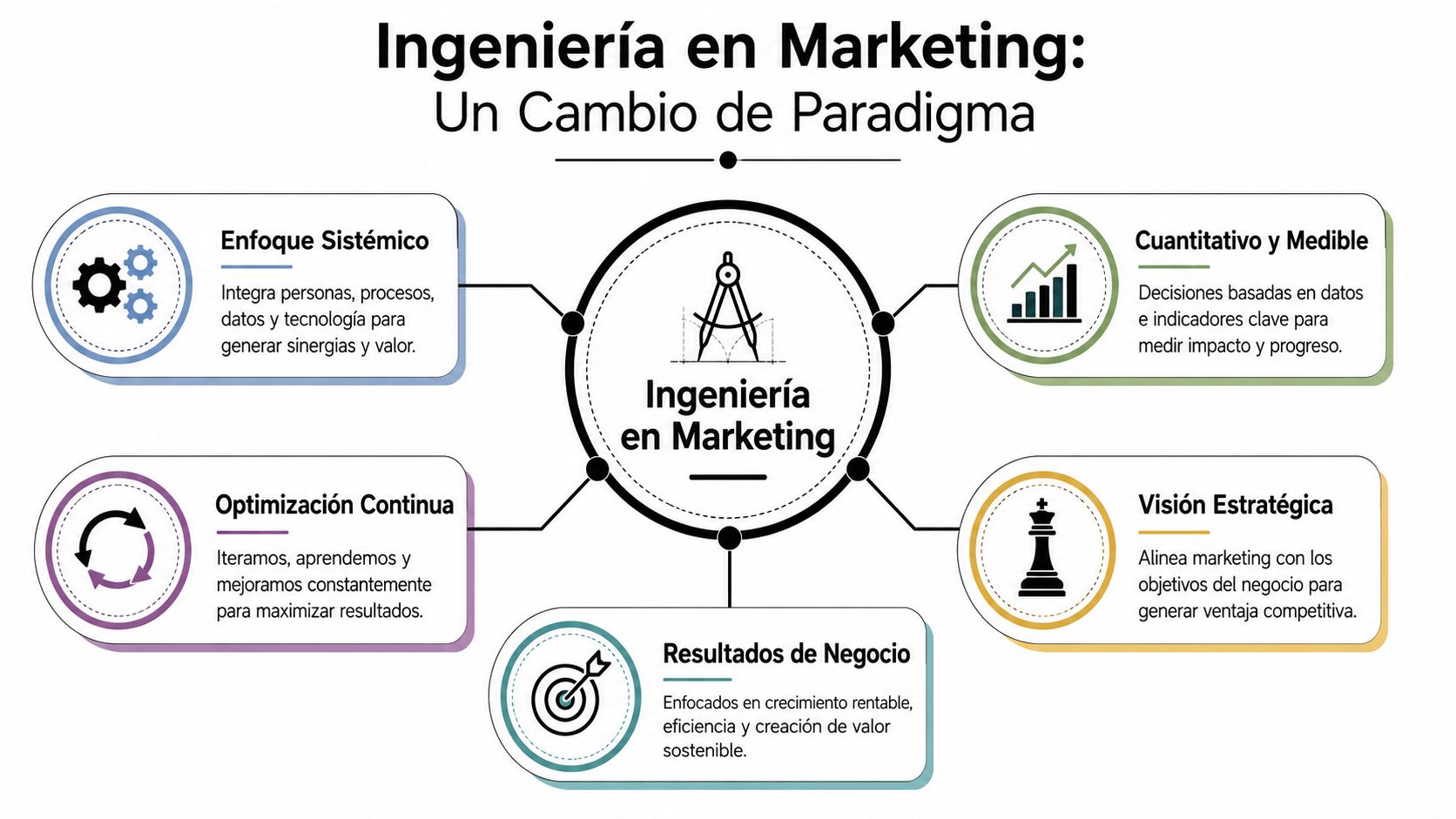
The most useful comparison is not between digital marketing and traditional marketing. It is between improvising events and designing infrastructure. An isolated campaign can generate one-off demand. Marketing engineering builds an environment where that demand is captured better in a repeatable way.
When a company works without this approach, marketing produces pieces, sales receives leads and technology resolves tickets. Each area optimizes its own part, but nobody corrects the complete system. The result is usually familiar: good traffic, unclear messages, weak follow-up and incomplete attribution.
With marketing engineering, the questions change:
The relevance of this approach is not only operational. It also has institutional backing. The University of Chile highlights the fusion of engineering, statistics and marketing as an evolution of the field, where quantitative tools serve to model reality, summarize data and make decisions oriented toward KPIs such as conversions and sales.
In markets where digital competition has matured, growing no longer depends solely on being present. It depends on operating better. That affects eCommerce, B2B businesses and complex-service companies.
The one who invests the most does not always win. Often, the winner is the one who best understands which part of the commercial process is holding back demand.
Marketing engineering forces you to unite three layers that many companies still manage separately:
| Layer | Critical question | Business impact |
|---|---|---|
| Data | What is really happening? | Avoids decisions by intuition |
| Experience | What prevents the user from moving forward? | Reduces friction and leakage |
| Message | What value does each audience understand? | Improves conversion quality |
That is why its value is not in sounding technical. Its value is in turning marketing into a more predictable business capability.
Marketing engineering works as a cycle. It does not start with creativity, or with media buying, or with rushed redesigns. It starts with rigorous observation. First you identify where commercial intent is being lost. Then you prioritize what is worth fixing.
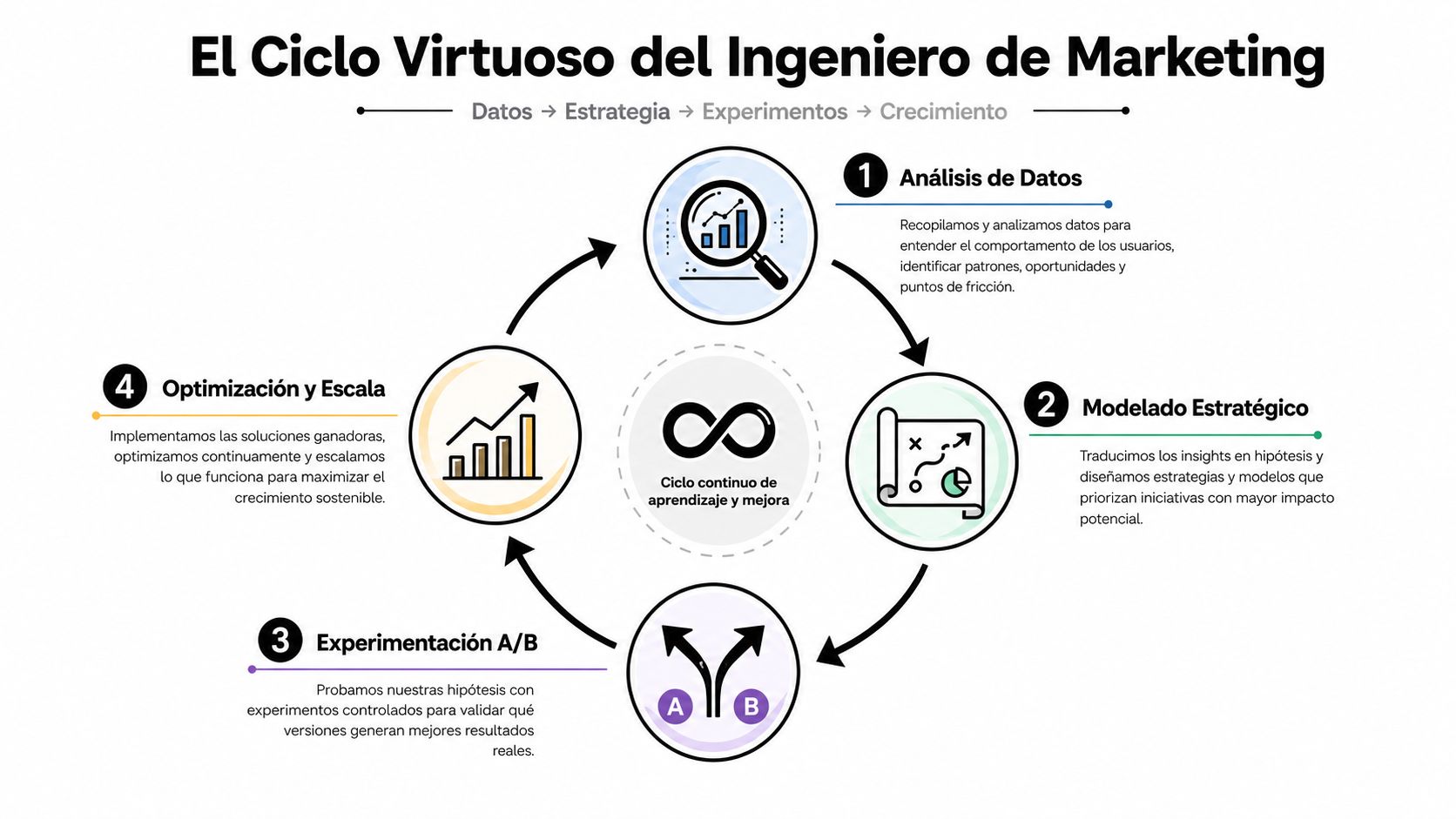
The capabilities that sustain this work are not decorative. They include data analysis, A/B testing, API integration, Google Analytics and SQL, according to the description of key skills published by Adaface on the marketing engineer role. The reason is simple: without real access to data and without the ability to test hypotheses, marketing reverts to intuition.
The first task is to read the funnel as a system of losses and not as a collection of metrics. A mature team does not look only at sessions, clicks or submitted forms. It looks at drop-offs between stages, differences between audiences, behaviors by device, friction in forms and abandonment patterns.
That requires cross-referencing several sources. Analytics shows general behavior. The CRM shows which leads advance. The heatmap or session recordings reveal friction. SQL and APIs make it possible to connect that data when it is fragmented across platforms.
Some diagnostic questions tend to be more valuable than any creative brainstorm:
Once frictions are detected, the next layer is not “making changes.” It is testing changes with clear hypotheses. There, A/B testing stops being a fad and becomes a learning discipline.
Not all tests have the same value. Changing a color can move superficial interaction. Rethinking a value proposition, an order of information or a decision sequence can move business conversion. The difference is in what is being questioned.
A good experiment does not seek to validate the team's opinions. It seeks to reduce commercial uncertainty.
At that stage, it is best to work with a backlog of hypotheses prioritized by potential impact, ease of implementation and proximity to revenue. That approach avoids a common mistake: filling the roadmap with attractive but irrelevant ideas.
For those exploring a more structured operation, this CRO methodology with artificial intelligence shows how to combine analysis, prioritization and experimentation within a continuous process.
Below, a visual resource helps to understand the shift from campaigns to system:
The fourth layer is where many companies rush. They want to automate before understanding what works. That only scales errors. Automation is useful when a hypothesis has already shown value and now it is worth making it sustainable.
Here come email flows, segmentation rules, behavior-based personalization, lead scoring and synchronization between site, CRM and campaigns. The point is not to have more technology. The point is that every automation responds to a previously validated business decision.
A marketing engineer does not build a stack to look sophisticated. They build a system that learns, corrects and scales without wasting investment.
A frequent mistake in boards and marketing management is to ask for reports full of activity and empty of business. Clicks, reach, sessions and submitted forms are reviewed, but it is not clear how much of that ended up as revenue, pipeline or real customers.
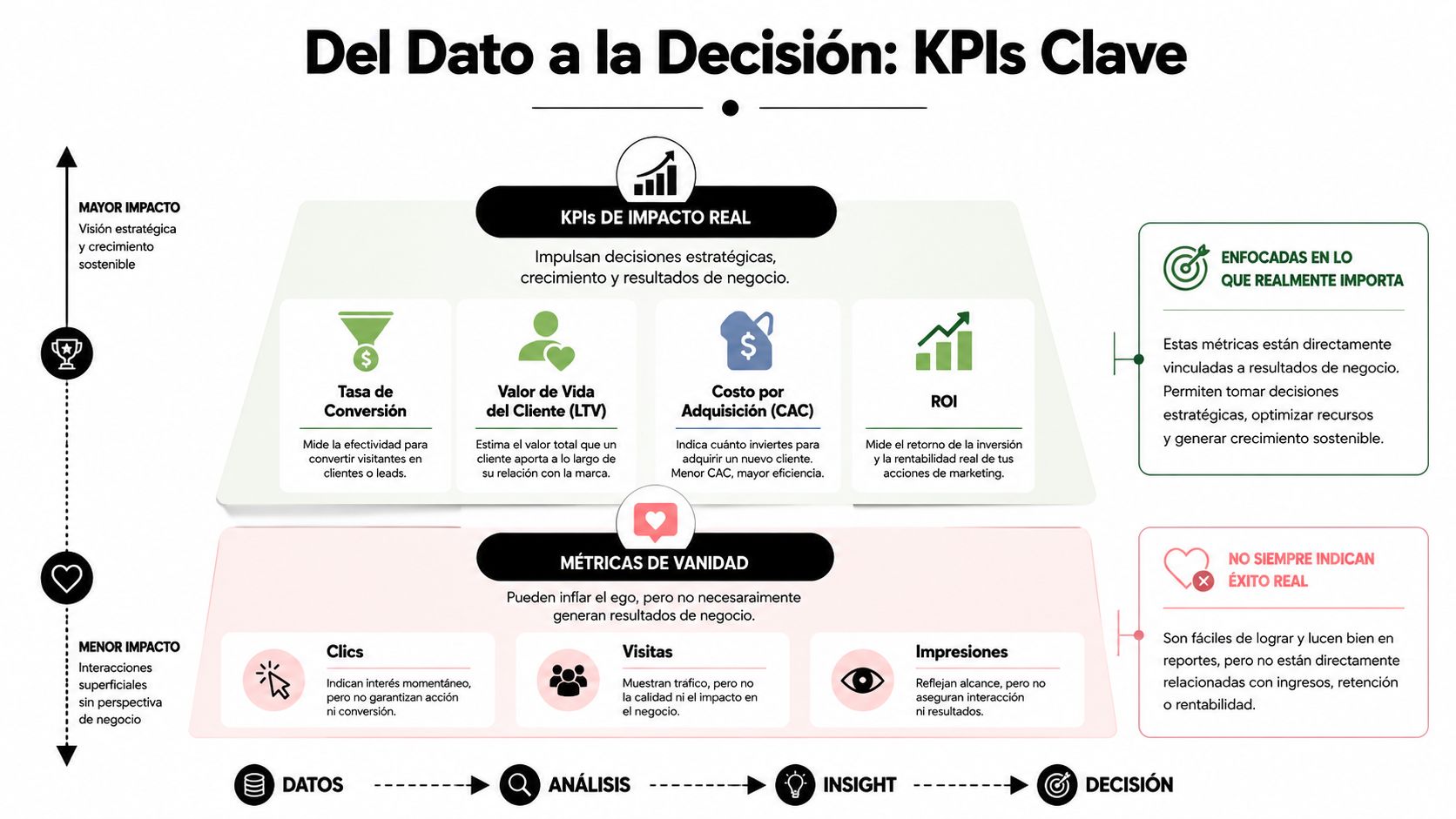
Marketing engineering corrects that distortion. It does not eliminate operational metrics, but it subordinates them to a financial logic. A visit is worth little if it does not translate into commercial progress. A lead is worth little if it does not enter the right pipeline. A campaign is worth little if it does not improve conversion, quality or efficiency.
In B2B environments or those with long sales cycles, the decisive metric is usually not CPL. According to Korzur, the key question becomes the cost per qualified commercial opportunity, because optimizing the site and the experience can improve that KPI without increasing traffic, as long as there is measurement connected to the real pipeline.
That forces you to organize KPIs into different levels:
| Level | Useful metrics | What decision they enable |
|---|---|---|
| Operations | clicks, visits, bounce rate, interaction | Detect symptoms |
| Conversion | conversion rate, checkout starts, valid forms | Identify friction |
| Business | qualified opportunity, closed sale, attributed revenue | Allocate budget |
If marketing reports volume and sales reports closes, but nobody unites both worlds, the company is not measuring growth. It is measuring separate activities.
You do not need to build a complex architecture from day one. You do need a coherent stack. In practice, that usually includes four groups of tools.
For companies that need a more solid measurement layer, a good implementation of Google Tag Manager in marketing and analytics environments is usually a key piece for organizing events, conversions and traceability.
The difference between measuring and really managing is there. Not in how many dashboards exist, but in whether those dashboards make it possible to decide better where to invest and what to fix.
Marketing engineering becomes tangible when it stops talking about “optimization” in the abstract and enters real business scenarios. Not as a tactical tutorial, but as a criterion for deciding where to intervene first.
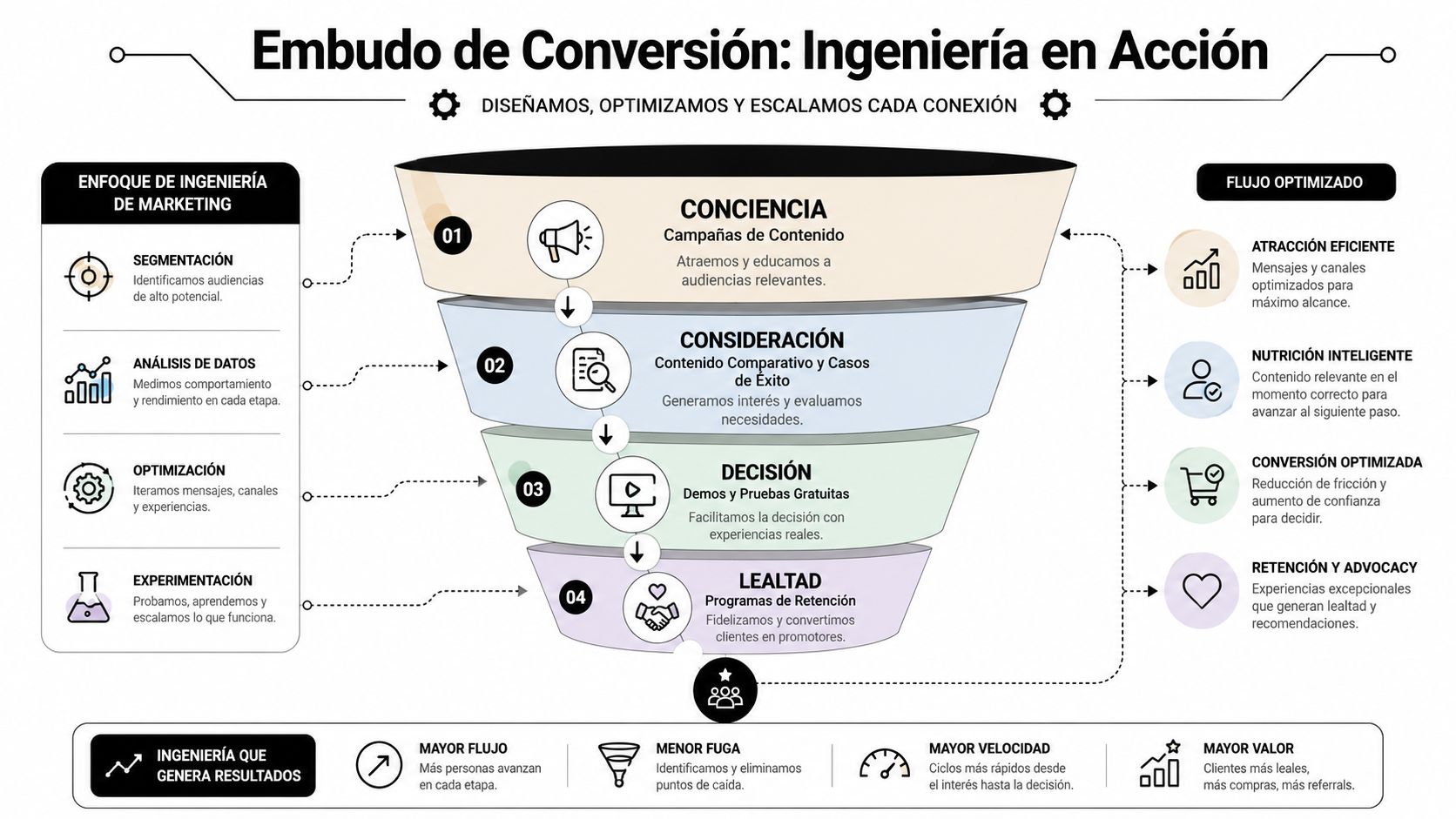
An online store can have well-segmented campaigns, the right catalog and active demand. Even so, it sells less than expected. When that happens, the problem usually lies between intent and purchase.
In a scenario like that, a marketing-engineering approach does not start by rebuilding the entire site. It starts by locating the most costly drop-offs in the journey. It reviews product pages, the checkout sequence, shipping clarity, visual trust, message consistency between ad and landing, and the structure of the offer.
The consequence of this approach is important. Instead of assuming visits are missing, the company treats each leak as an opportunity to better capture existing demand.
There are companies that invest well in content, SEO, media or brand. The problem is that all that effort reaches a site that does not know how to respond differently based on audience, source or decision moment.
There a second strategic application appears: segmenting experience and message, not just campaigns. The same traffic may require different journeys if it arrives via brand searches, via a high-intent campaign or via discovery content. Personalizing does not always mean showing complex content. Sometimes it means better organizing priorities, removing distractions and presenting the right next step.
At this point, a solution like Bigbuda can come in as design, development and CRO support when the company needs to unite digital experience, data and experimentation within a single system. It does not replace the business strategy. It operationalizes it.
The site that greets everyone in the same way usually converts below its potential.
In engineering companies, industrial software, complex services or B2B solutions, the biggest problem is usually not a lack of information. It is usually an excess of technical language poorly translated commercially.
The gap is well described in the analysis by MarketiNet on creative angles: one of the difficulties is turning technical discourse into messages that resonate when the buyer is technical, but the final decision-maker is not always so. Marketing engineering helps precisely to identify, through data and testing, which value proposition works with each actor.
That changes how the B2B sales funnel is built:
In long cycles, this perspective avoids a common mistake: optimizing forms or campaigns by lead volume when what the business needs is qualified conversations. The difference may seem semantic. In revenue, it is not.
Adopting marketing engineering does not require transforming the entire operation at once. It requires organizing priorities. The companies that advance best usually do so in phases, with logic similar to any serious operational change: first secure visibility, then install learning, then scale what already works.
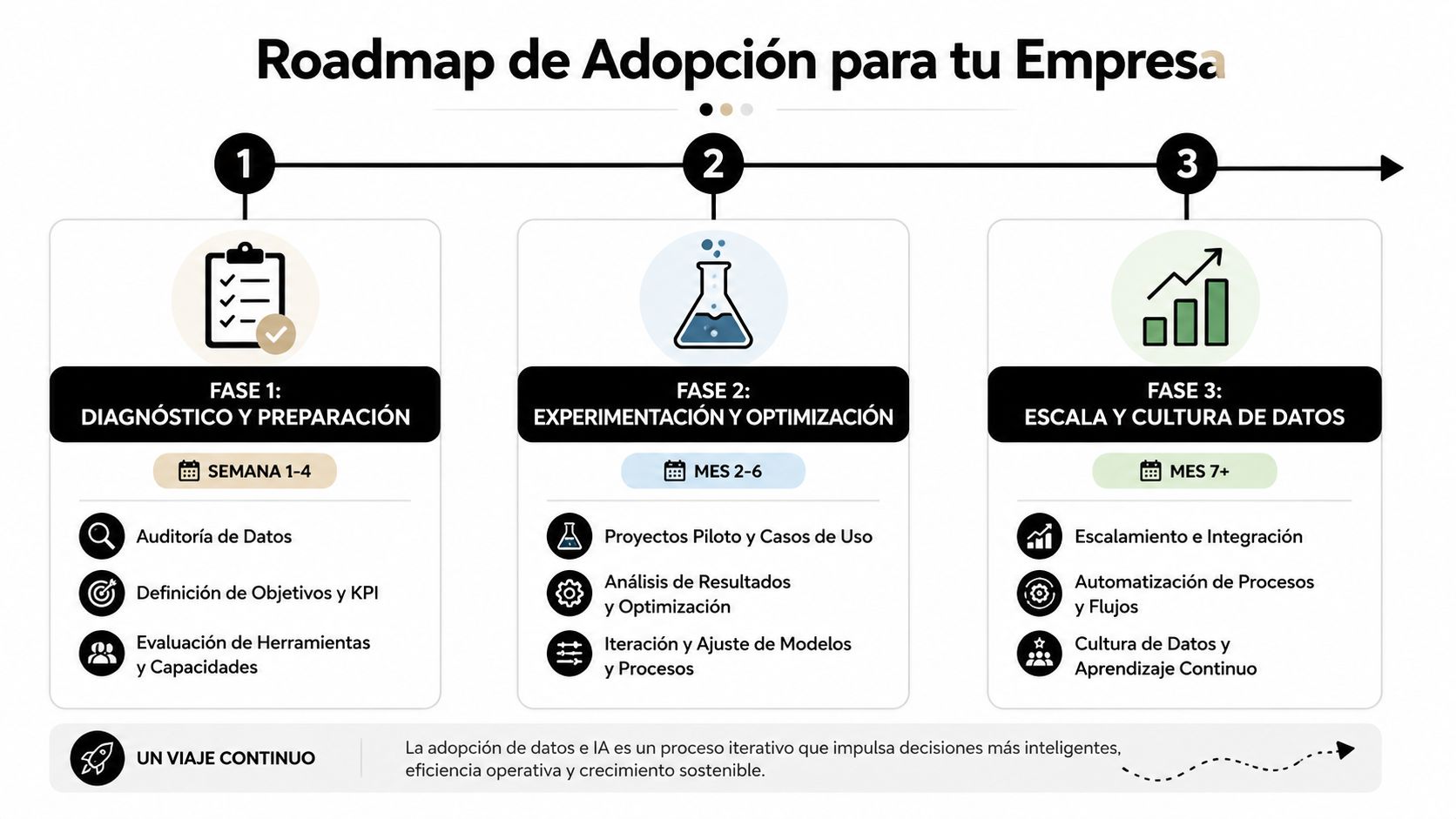
The first phase is about no longer operating blind. Many companies believe they already measure, but in reality they only accumulate partial data. There are misconfigured events, forms without traceability, campaigns disconnected from the CRM and reports that do not talk to each other.
At this stage, it is best to resolve three foundations:
Without that foundation, any later optimization runs the risk of improving the wrong metric.
The second phase installs discipline. Detecting frictions is not enough. You have to turn them into hypotheses and test them in an orderly way. That practice changes the team's culture because it replaces hierarchical opinions with cumulative learning.
A mature company in this phase does not test for the sake of testing. It prioritizes based on potential business impact. Some hypotheses will touch the message. Others will touch information hierarchy, the commercial journey, forms or the contact sequence.
Useful criterion: if a test cannot be linked to an expected improvement in lead quality, conversion or commercial progress, it probably does not deserve priority.
Once there is evidence about what works, only then is it worth scaling. There come automation, personalization and operational rules that make the improvement sustainable. The goal is not to have more software. It is to reduce dependence on manual interventions and maintain consistency.
A reasonable roadmap in this phase usually includes:
| Phase | Key decision | Expected result |
|---|---|---|
| Preparation | Organize measurement and definitions | Real visibility of the funnel |
| Optimization | Test the highest-impact hypotheses | Learning and accumulated improvements |
| Scale | Automate what has been validated | Operational and commercial efficiency |
The clearest sign of successful adoption is not technological. It is cultural. The company begins to argue less about opinions and more about evidence. Marketing stops defending activities. It starts demonstrating contribution.
The next growth leap in Chile and LATAM will not be captured by the companies with the most campaigns. It will be captured by those that reduce friction before their competitors do and turn that improvement into margin, pipeline and commercial speed.
That change has already begun. Acquisition costs keep applying pressure, commercial teams tolerate less irrelevant lead and boards ask for a more demanding answer than “let's raise investment.” In that context, the advantage does not come from buying more reach. It comes from operating a system that detects revenue loss at each stage and corrects it with discipline.
That is where a real difference is defined between companies that execute marketing and companies that build growth capacity.
In eCommerce, that capacity translates into improving the purchase rate, the average ticket and the recovery of demand that today leaks away due to operational details. In B2B, it shows up in forms that filter better, faster contact processes and a clearer relationship between demand source and won business. It is not a promise of abstract efficiency. It is a way to defend profitability in markets where every poorly allocated peso weighs more than before.
The underlying question is no longer whether your team can generate activity. It is whether your company can turn learning into a cumulative advantage before the market forces it to do so under pressure.
If your company wants to move from isolated campaigns to a growth system based on data, digital experience and conversion, you can learn about Bigbuda's approach to building web and marketing assets oriented toward real sales.
Related article: Search Engine Marketing and SEO: A Unified Strategy
Because adding budget only accelerates the entry of users into a system that still loses opportunities. The hidden cost appears after the click: a product page that does not address objections, a form that asks for too much, a slow mobile landing page, or a checkout with unnecessary steps.
It is a way of managing growth with system logic instead of a series of isolated campaigns. Marketing becomes an operation where things are measured, modeled, tested and corrected. The useful comparison is not digital versus traditional marketing, but improvising events versus designing infrastructure that captures demand repeatedly.
With rigorous observation, not creativity or media buying. Read the funnel as a system of losses: drop-offs between stages, differences between audiences, behaviors by device, friction in forms and abandonment patterns. Cross analytics, CRM, heatmaps and session recordings before deciding what is worth fixing first.
Organize them in three levels. Operational metrics such as clicks, visits and bounce rate detect symptoms. Conversion metrics such as conversion rate, checkout starts and valid forms identify friction. Business metrics such as qualified opportunity, closed sale and attributed revenue are what justify allocating budget.
Once a hypothesis has already shown value and it is worth making it sustainable. Automating before understanding what works only scales errors. Email flows, segmentation rules, behavior-based personalization, lead scoring and synchronization between site, CRM and campaigns should each respond to a previously validated business decision.
Four groups of tools. Analytics and tagging with an orderly implementation of events. Data connection through a well-configured CRM and API integrations. Experimentation and qualitative evidence via A/B tests, heatmaps and session recordings. And visualization tools such as Looker Studio, Tableau or Power BI when they ground actionable KPIs.