










Solutions
Explore how to grow

The most repeated advice about the market segment is still one of the least useful for directing digital growth: divide audiences by age, gender, and general location, and assume that’s enough to compete. In 2026, that approach no longer describes how people buy online. It only describes who they are on a profile sheet.
If you want to go deeper, check out our digital marketing service.
The problem isn’t academic. It’s financial. An eCommerce can attract traffic consistently and still destroy margin if it invests in audiences that are too broad, undifferentiated messages, and experiences that don’t respond to the real purchase context. In Chile, that distance between traffic and profitability is especially visible in businesses that operate with wide catalogs, always-on campaigns, and a strong dependence on mobile.
A board doesn’t need another basic definition of segmentation. It needs to answer three questions: which segments explain the economic result, which concentrate the greatest margin potential, and how to turn that reading into a competitive advantage. When segmentation is used well, it stops being a marketing tool and becomes a system for allocating commercial capital.
Most companies still work with a market segment designed for mass media, not for digital environments. That model was acceptable when the goal was buying reach. It no longer works when growth depends on relevance, speed of learning, and profitability by cohort.
In eCommerce, traditional segmentation fails for a simple reason. It groups people by static attributes, but purchase decisions happen in dynamic contexts. The same user changes their intent depending on device, time of day, technical friction, logistical urgency, price sensitivity, or trust in the brand. If the company doesn’t capture those variations, it ends up treating traffic as equivalent when it isn’t.
That explains why so many brands confuse volume with opportunity. They have sessions, impressions, clicks, and large databases, but they don’t turn that asset into quality cash flow. What looks like a performance problem is usually, in reality, a market-reading problem.
Segmentation is no longer about describing audiences. It’s about identifying which groups generate disproportionate economic value and which frictions prevent capturing it.
The critical point for a board is this: an obsolete segmentation not only reduces sales. It also raises acquisition costs, deteriorates ad return, and makes it harder to defend market share against competitors who do personalize. In other words, failing to segment with precision isn’t neutral. It’s a loss of efficiency.
The most widespread mistake is thinking that segmenting equals classifying customers. In practice, its strategic function is different. To diagnose where conversion breaks and why that break affects some groups more than others.

The local evidence shows that gap clearly. Most content about the market segment ignores how to apply it to Chilean eCommerce with high traffic and conversions below the regional average of 1.8% to 2.2%, and it also omits how to integrate local data for CRO without increasing ad spend. In addition, in Chile 65% of stores report cart abandonment above 70% on mobile due to slowness, but psychographic segmentation by “technical frustration” is almost never addressed, according to the data summarized in this review on market segmentation.
Knowing that an audience is a certain age or lives in a big city helps little if you don’t understand how it buys. Two users in the same age range can behave in opposite ways. One tolerates friction because they know the brand. The other abandons at the first logistical doubt or a slow load on mobile.
From the perspective of the income statement, that difference matters more than the demographic label. It defines how much it costs to acquire, how much each visit returns, and which segments justify additional investment.
Consider three questions that do have leadership value:
A company with a lot of traffic and low conversion doesn’t necessarily have a demand problem. It may have a mismatch between proposition and segment.
That changes the internal conversation. Marketing stops defending volume. Product stops debating abstract preferences. The executive team starts to see actionable patterns: what type of visitor arrives, what they expect to find, and at what point the site or the message fails.
Practical rule: if your segmentation can’t explain variations in CAC, conversion, or retention, it isn’t guiding decisions. It’s just organizing data.
The competitive implication is profound. A firm that understands segments by behavior and friction buys media with more judgment, personalizes better, and learns faster. A firm that only sees averages ends up managing blindness with pretty dashboards.
The classic question, “who do we sell to?”, is too broad to direct digital growth.
The useful question is different: “which set of needs, motivations, and frictions are we resolving for a group with high economic potential?” That formulation connects segmentation with the P&L. It forces you to distinguish between profitable traffic and decorative traffic.
A useful market segment doesn’t come from a single variable. It emerges from combining layers of information that explain intent, value, and context. In eCommerce, four types of segmentation concentrate the strategic value.
Demographics on their own tend to produce poor generalizations. But combined with territorial context, they recover value. Income, life stage, and urban density modify delivery expectations, perception of convenience, and message sensitivity.
In Chile, that reading matters because digital behavior isn’t homogeneous across territories. For commercial leadership, geography isn’t just a map. It’s a variable of access, competition, logistical capacity, and willingness to buy.
Behavioral segmentation is the closest to cash because it works on observable signals. Which pages a person visits, how many times they return, whether they abandon a cart, which categories they compare, or how long they take to decide.
Here the company stops talking about “ideal customers” and starts classifying users by probability of conversion and expected economic quality. That allows budget to be reallocated from generic campaigns toward audiences with clearer intent signals.
Psychographics is often treated as a soft topic. That’s a mistake. In categories with a lot of supply, values and aspirations explain as much about the purchase as the price.
The most useful case for the Chilean market is the “sustainability-conscious” subsegment in B2C eCommerce. According to this analysis on psychographic segmentation, this group aged 18 to 35 with incomes above CLP 1.5MM per month represents 22% of the online market and prefers brands with eco-friendly certifications. On landing pages with “eco-friendly” CTAs, that subsegment drives a 37% conversion uplift, and it also shows an LTV 3x higher than the average. The important point isn’t just the rise in conversion. It’s the combination of more initial efficiency and greater future value.
When a company aligns message and values, it doesn’t just improve the immediate response. It also improves the quality of the revenue it retains.
The transactional layer looks at purchase frequency, ticket size, and the type of product bought. It’s the most direct way to distinguish between customers who buy once and customers who sustain the business.
In sectors with wide catalogs, this dimension lets you identify whether profitability comes from volume, recurrence, or product mix. Not all buyers are worth the same. Some inflate short-term sales. Others justify investment because they sustain margin over time.
| Type of Segmentation | Key Question It Answers | Main Data Sources | Strategic Value in eCommerce |
|---|---|---|---|
| Demographic | What purchasing power and life stage does the customer have? | CRM, forms, customer data | Helps calibrate offer, pricing, and positioning |
| Geographic | In what competitive and logistical context do they buy? | Analytics, shipping data, location | Defines territorial relevance, service promise, and expansion |
| Behavioral | What signals anticipate intent or abandonment? | Browsing, recurrence, cart, onsite interaction | Allows prioritizing demand with higher probability of conversion |
| Psychographic | What motivations and values drive the decision? | Surveys, interviews, content behavior | Raises differentiation, loyalty, and the ability to capture a premium |
| Transactional | Which customers sustain the business in economic terms? | Purchase history, ticket, frequency, categories | Orders investment by real value and not by apparent volume |
For leadership teams that want to go deeper into how different typologies change the way demand is captured and retained, this read on types of customers in digital environments helps translate commercial categories into growth decisions.
Effective segmentation doesn’t start with advertising creativity. It starts with a decision discipline. Companies that extract value from their market segment don’t do it because they invent better names for their audiences. They achieve it because they turn scattered data into investment priorities.
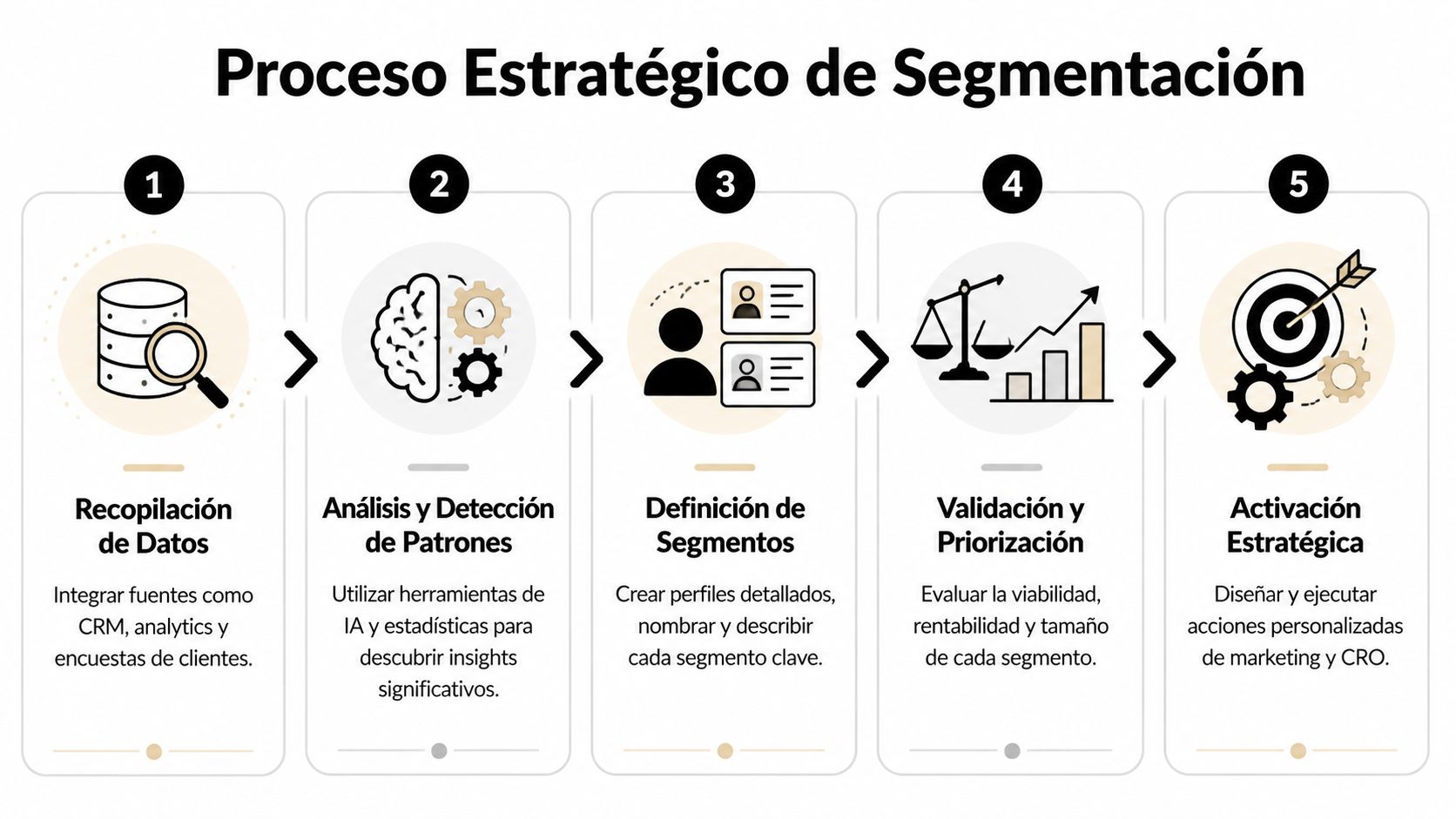
The first methodological mistake usually occurs before the analysis. The company defines segments from commercial intuition and then looks for data to confirm them. That produces bias and, worse still, immobilizes resources in audiences that don’t explain the result.
The correct sequence reverses that order. First you observe signals. Then you formulate segments. The board doesn’t need to participate in daily operations, but it should demand that the process start from combined quantitative and qualitative evidence.
The sources are usually spread across analytics, CRM, purchase history, commercial inquiries, reviews, customer service, and voice-of-customer studies. None alone is enough. Together they show something more relevant than classic segmentation: they reveal patterns of value and friction.
An interesting segment isn’t just a group that looks alike. It’s a group that behaves differently enough to justify a different decision.
That’s why it’s worth having the analysis answer questions like these:
Here an important difference appears between useful segmentation and decorative segmentation. The latter describes. The former forces prioritization.
Once the patterns are detected, the strategic step isn’t to launch campaigns immediately. It’s to build business hypotheses.
Some are commercial. Others are about experience. Others, about value proposition. The point isn’t to get it right the first time, but to formulate hypotheses that can be tested against economic impact.
An example of a solid formulation would be this:
Urban users who browse from mobile and show high intent may not abandon for lack of interest, but because of an experience that doesn’t meet their expectation of immediacy.
Notice that this sentence already contains a P&L implication. If the hypothesis is correct, the problem isn’t solved by buying more traffic. It’s solved by better capturing the traffic that already exists.
Not all segments deserve executive focus. Some are large but unprofitable. Others are small but concentrate better margin, higher recurrence, or lower acquisition cost.
A useful way to organize the internal discussion is to use a logic similar to RICE. You don’t need to turn it into a methodological ritual. You do need to preserve its criteria:
| Criterion | Leadership question |
|---|---|
| Reach | How many relevant customers or sessions does this segment affect? |
| Impact | How much could it move conversion, CAC, retention, or ticket? |
| Confidence | How solid is the evidence supporting the hypothesis? |
| Effort | How much organizational and technological complexity does acting on it require? |
This reading avoids two frequent biases. The first is prioritizing “interesting” segments that are hard to activate. The second is concentrating on high-volume segments with ambiguous economic value.
A mature company doesn’t work with a single large audience. It manages a portfolio. Some segments target immediate demand capture. Others sustain LTV. Others open space for geographic or category expansion.
That portfolio should include at least three classes of segments:
Board criterion: prioritize segments where the company can capture a repeatable advantage, not just a one-off improvement.
When the organization adopts this methodology, something more important than a campaign improvement happens. The decision language changes. Marketing stops asking for budget with generic arguments. Commercial stops measuring opportunity by gross volume. The company starts allocating resources according to evidence of potential profitability.
That’s what turns segmentation into a strategic capability. Not an annual exercise. A continuous discipline of focus.
Most companies stop too soon. They identify segments, present them in a deck, and consider the problem solved. But a market segment only creates value when it changes experience, message, commercial priority, and investment allocation.

In the Chilean market, the opportunity to move from theory to action is concrete. In eCommerce, geographic and behavioral segmentation shows that 65% of online sales come from the Metropolitan Region, and that millennial consumers aged 25 to 40 convert 2.5 times more in personalized mobile campaigns. The same dataset indicates that non-segmented ads raise CAC by 45% due to a lack of contextual relevance, and that A/B tests with technographic variables can reduce CAC by up to 30% by prioritizing segments with CLV above CLP 150,000 per year, according to the analysis gathered by HubSpot on market segmentation.
That data has a bigger implication than it seems. Conversion optimization stops being a cross-cutting improvement of the site and becomes a discipline of relevance applied by segment.
It’s not about changing one headline for everyone. It’s about deciding which message, offer, or trust proof certain groups should see because their decision context is different. A user in Santiago expecting speed doesn’t evaluate the same way as a user in another region. A high-intent mobile visitor doesn’t need the same experience as someone in early exploration.
When segmentation guides CRO, the company reduces waste on two fronts. First, it avoids testing low-impact changes on audiences that are too heterogeneous. Second, it accelerates learning because the hypotheses are better formulated.
AI doesn’t replace the segmentation strategy. It amplifies it. Its contribution isn’t in creating futuristic promises, but in detecting finer patterns and responding in less time.
In practice, that allows working with dynamic microsegments. A visitor stops belonging to a single fixed audience and starts being classified according to current behavior, product affinity, recurrence, device, and intent signals. The consequence is a more useful and less declarative personalization.
This matters for leadership because it changes the operational scale. What used to require manual teams can now be managed with systems that adapt recommendations, messages, or activation sequences according to the user’s moment. For a deeper explanation of how this logic connects optimization and machine learning, it’s worth reviewing the perspective of CRO with artificial intelligence applied to growth.
There’s a more ambitious reading. The combination of segmentation, CRO, and AI doesn’t just improve conversion rate. It also improves revenue quality.
An organization that identifies its highest-CLV segments can accept less total volume if that volume brings higher recurrence, lower relative cost, and more capacity for upsell or repeat purchase. That kind of discipline tends to look less spectacular in the short term, but it strengthens margin and stability.
Profitable personalization isn’t about showing more variants. It’s about showing the right variant to the right segment at the right moment.
This video sums up well how personalization and automation decisions can turn scattered data into more relevant commercial experiences.
The board doesn’t need to discuss tools in detail. It does need to verify whether the organization is using segmentation as growth infrastructure. Some signals are clear:
When those conditions appear, segmentation stops being marketing language. It becomes decision architecture.
A market segment strategy only deserves continuity if it proves economic impact. The most frequent mistake is measuring it with overly broad indicators. The site’s overall conversion can rise or fall for many reasons. What matters is whether the priority segments are creating more value per unit of investment.

In Chilean B2B, this logic already becomes evident outside Santiago. Standard content fails to explain how to use geographic segmentation with local SEO to capture qualified leads in the regions. However, 72% of B2B searches are local, only 35% of sites optimize for it, and the CCE indicates that Chilean B2B achieves a 4x higher ROI in GEO-SEO versus generic ads. In addition, focusing on regional niches allows you to avoid the saturation of the Metropolitan Region, where 80% of the competition is concentrated, according to this analysis on geographic segmentation and local SEO.
The first is CAC by segment. If an audience demands constant investment but responds with low future value, the company is buying unproductive volume.
The second is LTV by segment. Not to decorate presentations, but to decide how much commercial capital is worth allocating to each group.
The third is ROI by segment or by segmented channel. In the regional B2B example, that data lets you compare whether the company gains more by betting on qualified local presence than on generic coverage.
The fourth is conversion rate by segment, but read in context. A conversion improvement without an improvement in customer quality can inflate revenue and deteriorate margin at the same time.
It’s not advisable to build dashboards full of tactical details. It’s better to build one that helps decide. A simple scheme usually suffices:
| Metric | What it reveals |
|---|---|
| CAC by segment | Real acquisition efficiency |
| LTV by segment | Accumulated economic value |
| Conversion by segment | Ability to turn intent into revenue |
| ROI by segment or channel | Quality of return versus investment |
To complement that reading of perceived quality and loyalty, this guide on how NPS is calculated and why it matters helps connect satisfaction with future behavior, as long as it’s used as a complementary indicator and not a substitute for economic analysis.
If a company can’t demonstrate which segments improve CAC, LTV, or ROI, it doesn’t yet have a segmentation strategy. It has a taxonomy.
Measuring by segment avoids two traps. The first is rewarding campaigns that bring in expensive, disloyal customers. The second is underestimating niches that seem small but sustain superior profitability.
That’s the difference between reporting and leadership. The first reports activity. The second protects margin and directs growth.
The conversation about the market segment should no longer revolve around basic categories. The real challenge is to build a business capability to detect relevant differences between customers, turn those differences into decisions, and learn continuously.
That shift is more important in Chile because the digital environment has become more competitive, more mobile, and more sensitive to contextual relevance. In that scenario, growing doesn’t depend only on attracting more visits. It depends on better interpreting the existing traffic, identifying where the economic value is, and acting before the competition.
The implication for a board is direct. Segmentation doesn’t belong solely to marketing. It must influence commercial investment, digital experience, product prioritization, geographic expansion, and data governance. When it’s treated as an isolated project, it produces documents. When it’s treated as a core capability, it produces cumulative advantage.
The next advantage won’t come from having more dashboards or more automation on its own. It will come from an organization able to answer hard questions with precision: which customers justify focus, which frictions destroy margin, which signals anticipate future value, and which segments allow growth without inflating CAC.
The segmentation of the future is dynamic because behavior changes. It’s intelligent because it learns from real data. And it’s strategic because it defines how a company allocates scarce resources to capture profitable growth.
If your company already has traffic, digital investment, and the ambition to grow with more efficiency, Bigbuda can help you turn segmentation into a business capability, connecting data, CRO, AI, and growth decisions with real impact on CAC, LTV, and ROI.
Knowing that an audience is a certain age or lives in a big city helps little if you do not understand how it buys. Two users in the same age range can behave in opposite ways: one tolerates friction because they know the brand, the other abandons at the first logistical doubt.
The classic question about who we sell to is too broad to direct digital growth. The useful one is which set of needs, motivations and frictions you are resolving for a group with high economic potential. That formulation connects segmentation with the P&L rather than with generic audience descriptions.
Four layers concentrate the strategic value in eCommerce: demographic and geographic, useful when context modifies delivery expectations and convenience; behavioral, the closest to cash because it works on observable signals; psychographic, where motivation explains as much as price; and transactional, which reveals who sustains the business through frequency and ticket.
Not all segments deserve executive focus; some are large but unprofitable, others small but with better margin, higher recurrence or lower acquisition cost. Use criteria similar to RICE to organize the discussion, and manage a portfolio: immediate-performance segments, future-value segments and segments that open geographic or category expansion.
Conversion optimization stops being a cross-cutting site improvement and becomes a discipline of relevance applied by segment. It is not about changing one headline for everyone, but deciding which message, offer or trust proof certain groups should see because their decision context is genuinely different.
Four matter: CAC by segment, to detect audiences that demand constant investment but return low future value; LTV by segment, to decide how much commercial capital each group deserves; conversion by segment; and ROI by segment or segmented channel. Overall site conversion moves for too many reasons to guide decisions.