










Solutions
Explore how to grow

The most repeated advice about content is usually wrong. It says you should “publish more,” “be present,” or “fill the editorial calendar.” That confuses production with impact. A company doesn’t grow because it uploads more pieces. It grows when each piece changes a perception, reduces a doubt, or moves someone to a decision.
At Bigbuda we help you with a digital marketing service.
That’s why the right question isn’t just what content is. The useful question for a commercial director, an eCommerce manager, or a growth leader is another: what role does content play in the system that turns traffic into revenue.
That change of frame alters decision-making. If content is seen as marketing filler, it’s measured by volume, frequency, or aesthetics. If it’s seen as a conversion asset, it’s evaluated by its ability to attract qualified demand, sustain trust, and push action without always depending on more investment in traffic.
The common definition of content falls short because it treats it as a container. Text, videos, images, posts, product pages. That view is descriptive, but it’s not useful for running a company. In digital businesses, content isn’t the form. It’s intention applied to information.
The difference matters. Information is neutral. Content, by contrast, is information prepared, contextualized, and organized to influence how a person understands a problem, compares alternatives, and decides what to do. That nuance seems semantic, but in practice it separates brands that inform from brands that convert.
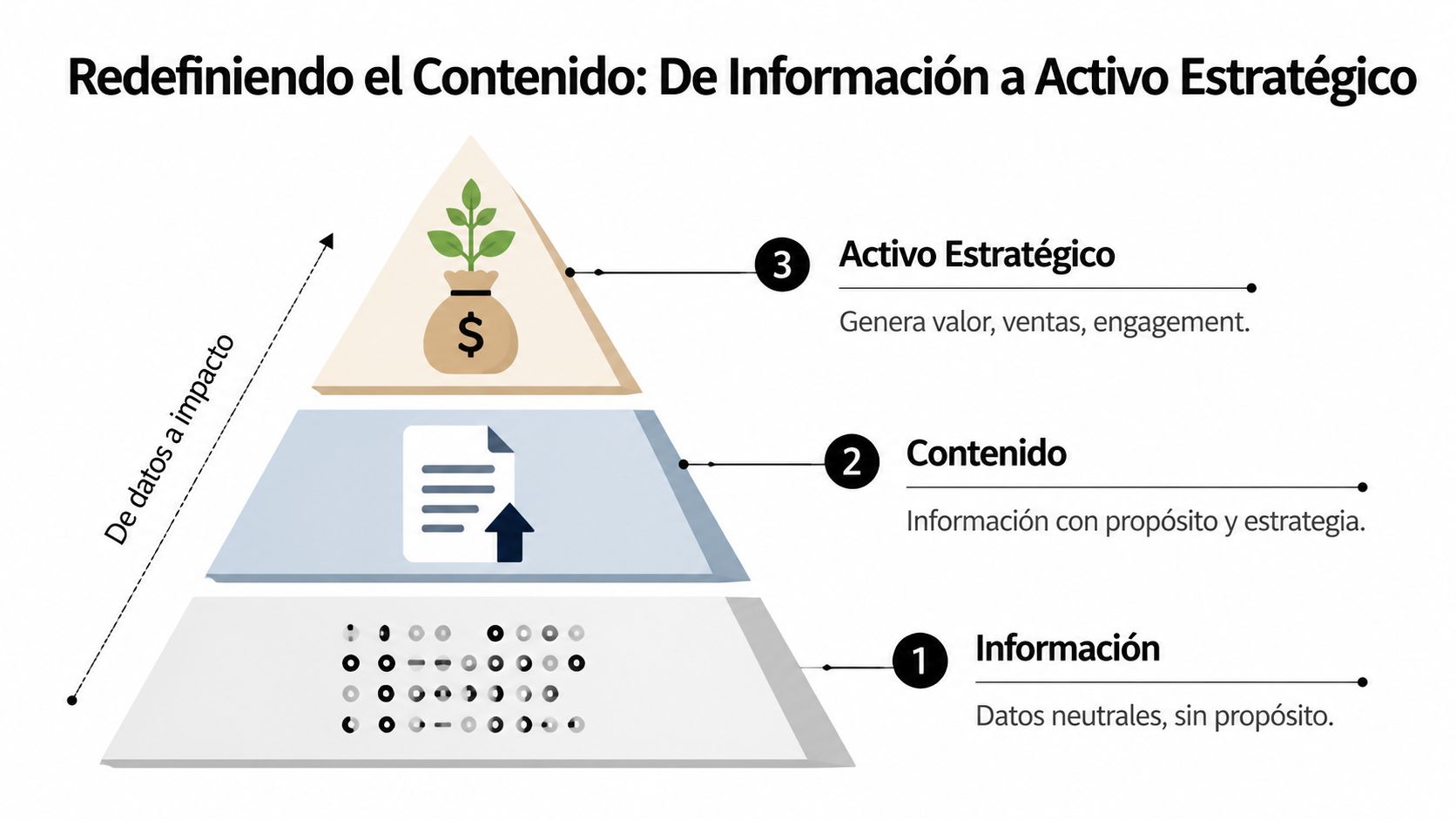
A technical specification on a product page is information. The same specification, written to answer objections, highlight value, and facilitate a purchase, is already content. The difference isn’t in the data, but in the commercial work that data performs.
That forces you to revisit a commonly held idea. Many companies believe their problem is a lack of pieces. In reality, they often have enough published assets, but poorly designed for the decision moment the user is in. They’re not short on content. They’re short on architecture of influence.
Practical rule: if a piece doesn’t have a defined job within the business, it isn’t an asset. It’s editorial busywork.
The strategic definition also changes the quality criterion. It’s not enough for something to “explain well.” Business content must fulfill at least three functions at once:
Treating content with discipline isn’t a digital-marketing fad. Content analysis emerged as a scientific method during World War I to study political propaganda, and later in Chile it was adopted in the 1970s to examine the press. That origin matters because it shows that content has always been analyzed for its ability to shape public perception, not just for its appearance. In its version applied to digital business, that same logic lets you measure impact on conversion. The cited background also notes that agencies like Bigbuda have applied these techniques in CRO, with A/B tests that have improved conversion rates by an average of 25% for local eCommerce, according to the historical reference on content analysis.
That data shouldn’t be read as a methodological curiosity. It should be read as a warning for management. If content can be measured, then it can be optimized. And if it can be optimized, it doesn’t belong in the “soft creativity” category, but in that of an operational asset with commercial impact.
A business leader doesn’t need to review adjectives or approve copy line by line. They need to demand a logic. That logic starts with questions far more demanding than “do we have content?”:
| Management question | What it really evaluates |
|---|---|
| What perception does this piece change? | Positioning |
| What doubt does it eliminate? | Friction |
| What decision does it accelerate? | Conversion |
| What stage of the journey does it cover? | Funnel coherence |
When a company answers those questions with precision, it stops producing isolated pieces and starts building a system. There content changes category. It stops being a tactical expense and becomes growth infrastructure.
Not all content should sell in the same way. That’s another common mistake. A mature company doesn’t operate with a single voice for every customer moment. It operates with a content ecosystem where each format and each message plays a distinct role in the commercial process.
Seen that way, the conversation stops being editorial and becomes strategic. The problem is no longer “what do we publish this month,” but “what type of content is missing so the user can move forward without friction.”
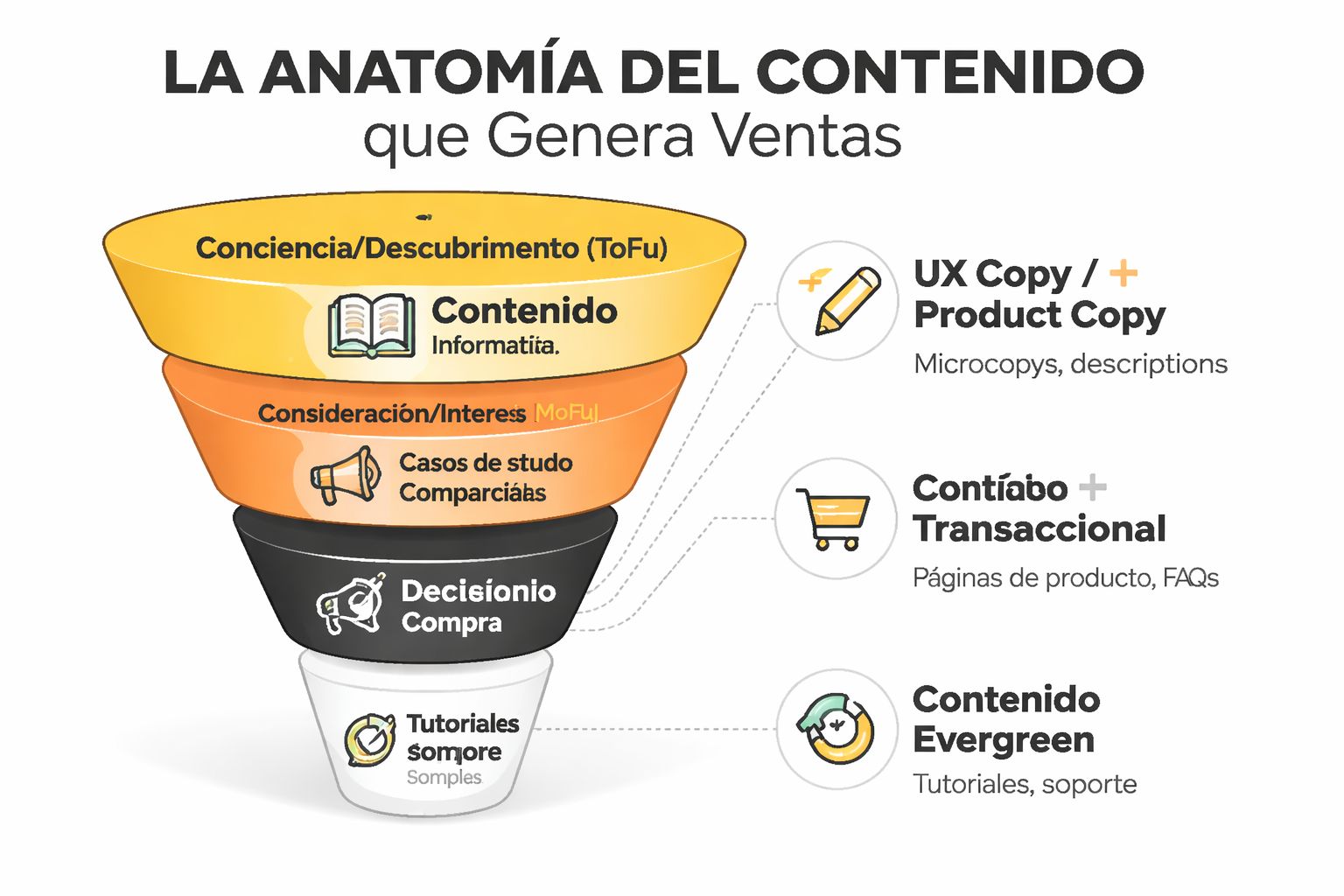
Informational content isn’t there to close sales immediately. It’s there to capture qualified attention. An article, a guide, or a useful explanation acts as an entry point for users who are still understanding their problem.
Commercial content works when the person is already comparing options. There the differences, the approach, the credibility, and the clarity of the proposition matter. It’s not aggressive content. It’s content that organizes the comparison and makes the value visible.
Then comes transactional content. Here you find product pages, answers to objections, delivery details, policies, and trust signals. At this stage, small gaps in the message can break an entire sale.
An eCommerce doesn’t lose conversions only because of price or low-quality traffic. It also loses them when the right content doesn’t appear at the exact moment of the doubt.
There’s a category that many teams underestimate because it isn’t perceived as “content.” UX copy and product copy. The text of a button, a supporting line under a form, a short explanation at checkout, or a well-built description do silent commercial work.
They’re not decorations. They’re pieces that guide, reassure, and push the action. Anyone who wants to dig deeper into this point can review how a CTA is defined and why it changes user behavior.
The anatomy of content isn’t limited to the message. It also includes format. Text, video, images, audio, and visual structure generate different effects on visibility, comprehension, and technical friction.
In Chile, roughly 50% of traffic comes from mobile devices, so content architecture must balance textual density for SEO, visual hierarchy to reduce cognitive load, and multimedia assets for retention. In addition, integrating video increases engagement by up to 90% compared with text-only content, while optimized images reduce load times by 30% to 40%, according to the analysis on content formats and architecture.
That data changes the design conversation. A video can increase interest, but if poorly integrated it can hurt speed or distract from the goal. A page with a lot of text can rank, but if poorly structured it can exhaust the user. The challenge isn’t to choose a “winning” format, but to build a combination that responds to the business context.
A brand that wants to review its content mix can use this quick reading:
Informational content
Useful when the business needs to capture broad searches and educate demand.
Commercial content
Matters when there’s a comparison between alternatives and the brand must defend its proposition.
Transactional content
Decides results when the user is already close to converting and needs certainty.
Evergreen content
Sustains authority and usefulness over time, especially on topics that don’t expire quickly.
UX copy and product copy
Operate across the board. They don’t attract on their own, but they unblock decisions.
The underlying point is simple. If a company produces a lot of discovery content and very little decision content, it doesn’t have a growth strategy. It has an incomplete funnel.
Most companies still think about search as a list of keywords. That model is no longer enough to compete. Today, organic visibility depends on a brand’s ability to respond precisely, organize knowledge, and connect intent with context.
When a person searches, they don’t always want to browse. Many times they want to solve. That’s why the content that gains visibility isn’t simply the one that includes relevant terms, but the one that better structures a useful and trustworthy answer.
In that environment, content quality serves a double function. First, it attracts traffic in early stages when the user is researching. Second, it builds the trust that allows consideration to be sustained. The logic is clear: informational content attracts at the top of the funnel, and educational content builds the trust needed to decide. That separation between neutral information and content designed to influence determines whether a site with traffic achieves conversions or suffers a bounce, as this strategic definition of content explains.
For a marketing director, the most relevant change isn’t technical. It’s economic. If the brand appears but doesn’t respond better than the others, its visibility is worth less. If it responds with clarity, context, and depth, that visibility turns into a cumulative advantage.
That applies to SEO as well as to AEO and GEO. In decision terms, all three share the same requirement: content structured for real questions, adapted to the user’s language, and aligned with a concrete intent. A general guide can attract. A specific, well-contextualized answer can capture demand with much more intent.
The content that dominates search isn’t always the longest. It’s the most useful for a concrete doubt and the clearest about the next step.
For those reviewing the technical foundation that sustains that visibility, it’s worth looking at the work of on-site SEO and its relationship with site structure.
In local markets, geography and context modify search intent. It’s not enough to talk about a category. You have to speak from the problem, the territory, and the buyer’s real need. A company that sells nationally but writes as if it operated in an abstract market usually loses relevance against brands that better understand contextual search.
That’s why content shouldn’t be planned as an isolated library. It should be designed as a visibility layer that connects demand, trust, and action. When that layer is well built, the business reduces dependence on paid channels and improves the quality of the traffic that enters the site.
There are still teams that reduce CRO to minor visual changes. A different button, another color, a block moved around. That exists, but it doesn’t explain most of the problem. The most expensive friction is usually in the message. If the site doesn’t communicate value, doesn’t answer objections, and doesn’t generate trust, the interface alone won’t rescue the conversion.

In Chile, eCommerce grew 14% in 2025 and reached US$12 billion, but only 1.5% of visits convert into sales, below the LATAM average. The same framework indicates that 65% of Chilean online stores with high traffic have low conversion due to non-optimized content, and that CRO methodologies based on persuasive content and A/B testing have shown increases of 20% to 30% on platforms like Shopify and WooCommerce without raising traffic investment, according to this analysis on content and conversion.
That data has a hard consequence for management. Many companies don’t have a demand problem. They have a problem of commercial translation within the site. They buy visits, but don’t convert intent into revenue because the content doesn’t do the work of selling.
The right content doesn’t “accompany” conversion. It provokes it. It does so when it fulfills very concrete functions:
Builds trust
Reduces the natural suspicion toward an online purchase.
Explains value
Translates attributes into benefits the buyer can understand.
Handles objections
Answers doubts before they turn into abandonment.
Orders the decision
Shows the user why to move forward now and not postpone.
A site with stable traffic can grow without expanding ad spend if it improves those four layers. There the real lever of CRO appears. Not in more visits, but in better persuasion per visit.
The problem for many brands isn’t a lack of ideas. It’s a lack of method. They opine on messages they never put to compete. They debate headlines, propositions, and descriptions without a system of contrast with data.
That’s why content must enter the realm of experimentation. Not as a creative exercise, but as a business discipline. Anyone who wants to dig deeper into that logic can review what CRO is and how it connects with commercial performance.
Here it’s worth seeing a complementary perspective on video:
A manager shouldn’t only ask how much traffic arrived this month. They should ask what part of that traffic found an understandable, trustworthy, and convincing proposition. That’s the difference between operating marketing as the purchase of visits and operating it as a revenue system.
If the traffic already exists, content is the asset that can most quickly multiply its economic value.
That also changes how budget is allocated. Investing only in capture when the message doesn’t convert is like filling a leaky bucket. By contrast, improving content on critical pages, commercial sequences, and decision points lets you capture more value from the asset the company already paid for: its audience.
The biggest problem with content in many companies isn’t its quality. It’s its measurement system. As long as it keeps being evaluated with superficial metrics, it will keep looking like a hard-to-defend expense. When it’s connected with business indicators, the budget conversation changes completely.
The clearest signal is in the gap between traffic and result. 65% of Chilean online-store owners report conversions below 2% due to non-persuasive content, while A/B tests on more than 150 WordPress and Shopify sites showed that content with specific CTAs increased leads by 42%. In addition, campaigns with optimized content report an average ROAS of 4:1 in the region, according to the cited reference on applied statistics and content performance.
A commercial director doesn’t need a dashboard full of activity. They need a clear reading of content’s contribution to the business. That requires separating vanity metrics from performance metrics.
| Metric | Why it matters |
|---|---|
| Conversion rate by page | Shows whether the message helps the user decide |
| Leads generated by content type | Indicates which pieces attract useful demand |
| ROAS associated with campaigns using optimized content | Connects message with return |
| Lead quality | Avoids confusing volume with real opportunity |
Social views, time on page, or reach can be useful as secondary signals. But if they don’t end up connected to commercial progress, they’re of little use for deciding investment.
The right way to measure doesn’t start with “how good it looks.” It starts with “what changed in the business when the message changed.” That question forces you to compare before and after, by page, by campaign, or by funnel stage.
A reasonable framework for leaders could be this:
Executive criterion: if a metric doesn’t help decide budget, priority, or focus, it probably isn’t the central metric.
When content is measured this way, it stops being an aesthetic conversation between marketing and design. It becomes a performance conversation between leadership, growth, and sales. That transition is key because it makes visible something that’s normally hidden: how much money a company loses when its message doesn’t persuade even though its traffic exists.
A useful audit doesn’t start by reviewing isolated words or the editorial calendar. It starts by observing whether the content supports the business logic. The question isn’t whether the site “has content.” The question is whether that content helps it sell with less friction.

Use this list as an executive filter. If several answers are ambiguous, there’s no editorial problem. There’s a problem with the commercial design of the message.
Does each important page have a clear business objective?
A page with no defined function rarely contributes to growth.
Does the content distinguish between attracting, educating, and converting?
When everything tries to sell the same way, the user’s journey breaks.
Is the value proposition understood quickly?
If a visitor needs to interpret too much, friction has already begun.
Does the language address the customer’s real problems?
Many brands write from their offer, not from the buyer’s decision.
This is usually where the biggest performance leak is. Not in the lack of visits, but in the lack of clarity to move forward.
Good content doesn’t push hard. It reduces the distance between interest and action.
Having good isolated pieces isn’t enough. The whole system must sustain discovery, consideration, and decision.
| Area | Key question |
|---|---|
| Search | Does the content answer questions the market actually asks? |
| Navigation | Does the architecture help find what matters effortlessly? |
| Consistency | Does the promise of ads, emails, and site match? |
| Updating | Are the critical pieces still current and aligned with the present offer? |
Not everything gets fixed at the same time. A leader needs to identify what to review first to capture impact sooner.
Which pages receive relevant traffic but convert little?
That’s usually where the most immediate opportunity is.
Which content attracts attention but doesn’t move users closer to an action?
That reveals a misalignment between acquisition and conversion.
Where do the most repeated doubts from customers or the sales team appear?
If sales always answers the same thing, the content isn’t doing its job.
Which assets depend too much on ad spend to perform?
If performance disappears when investment is cut, a more solid organic and persuasive base is missing.
A company can do this audit with its internal team, with external consultants, or with a specialized agency. Bigbuda works precisely at that intersection of content, UX, data, and experimentation to improve conversions without depending only on more traffic.
If your company already invests in acquisition but feels that the site doesn’t turn that traffic into sales as efficiently as it should, it’s worth reviewing content as a business asset and not as editorial filler. At Bigbuda you can explore that approach from a strategic lens, oriented toward growth, performance, and better digital decisions.
Related reading: Call to act guide: Turn clicks into growth
Related article: Content Marketing in Chile: Content That Sells, Not Just Fills
Content is not the format; it is intention applied to information. Information is neutral, while content is information prepared, contextualized and organized to influence how a person understands a problem, compares alternatives and decides what to do. If a piece has no defined job in the business, it is editorial busywork.
Informational content captures qualified attention while the user is still understanding their problem. Commercial content organizes the comparison and makes value visible. Transactional content, such as product pages, objection handling, delivery details, policies and trust signals, decides results near conversion. Evergreen content sustains authority, and UX and product copy unblock decisions across the board.
In Chile eCommerce grew 14% in 2025 and reached US$12 billion, yet only 1.5% of visits convert into sales, below the LATAM average. The same framework indicates 65% of high-traffic Chilean stores convert poorly because of non-optimized content. The problem is commercial translation inside the site, not demand.
It has to provoke the decision, not accompany it. That means building trust to reduce the natural suspicion toward an online purchase, explaining value by translating attributes into understandable benefits, handling objections before they turn into abandonment, and ordering the decision so the user sees why to advance now instead of postponing.
Separate vanity metrics from performance metrics. The ones that matter are conversion rate by page, leads generated by content type, ROAS associated with campaigns using optimized content and lead quality. Social views, time on page or reach work only as secondary signals if they connect to commercial progress.
Prioritize by impact. Identify pages that receive relevant traffic but convert little, content that attracts attention without moving users toward an action, the doubts customers and the sales team repeat most, and assets that only perform while ad spend continues. Those four questions reveal the fastest opportunities.