










Solutions
Explore how to grow
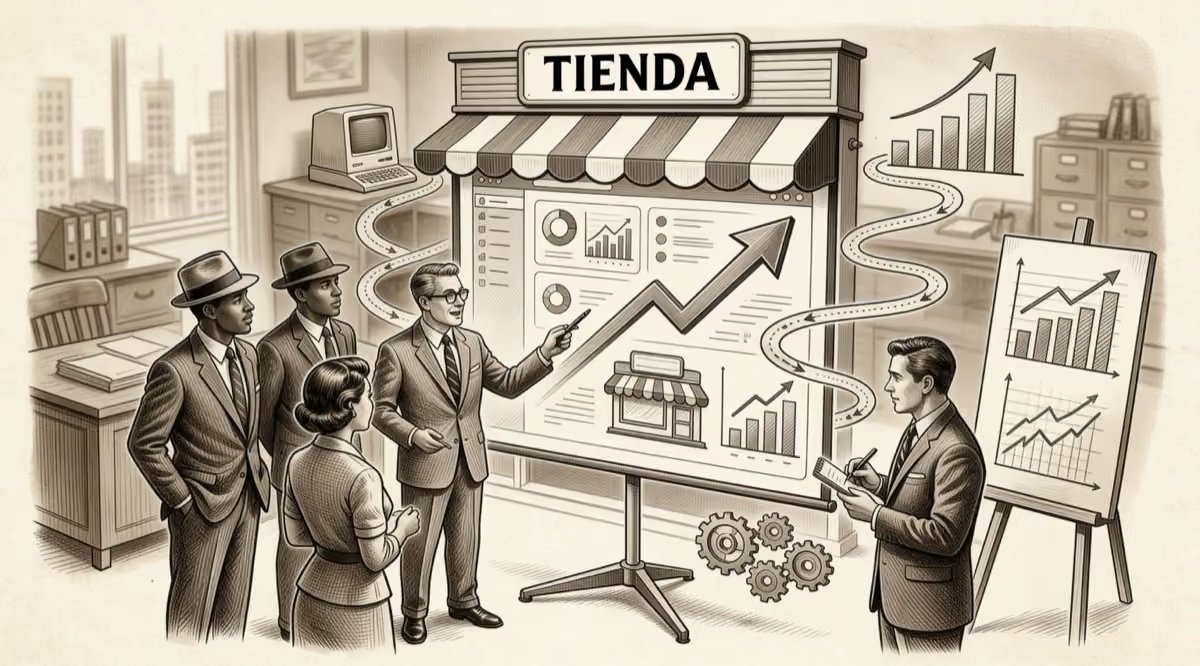
A CTA, or call to action, is much more than a button on a web page. It is the turning point where digital strategy becomes tangible results. For a business leader, the CTA is the precise instruction that guides a user from passive interest toward a measurable, valuable action, such as a purchase, a sign-up, or a request for information.
At Bigbuda we help you with landing pages designed for action.
Without a clear CTA, every visitor is a missed opportunity. They arrive, consume content, and leave without a trace. An effective CTA acts as a bridge, connecting the user's intent with business objectives and turning traffic into real value for the company.

For a marketing leader or business owner, the CTA is where the investment in SEO, advertising, or content finally materializes into return (ROI). It is the mechanism that turns visits into a business asset, whether a qualified lead or a closed sale.
Let's think of web traffic as a potential resource. Without clear, persuasive CTAs, that resource is wasted. The call to action is the catalyst that turns that potential into real performance, driving growth directly.
A well-designed CTA has a direct, measurable impact on the business's key performance indicators (KPIs). Its main function is to reduce friction in the customer journey, making the next step obvious and intuitive. By removing ambiguity, the user's decision is accelerated, and with it, conversion metrics improve.
An optimized CTA can be a huge competitive differentiator. In dynamic markets, the ability to guide the user effectively is crucial. For example, during high-demand events like Cyber Day, a clear call to action can significantly increase conversion rates and average order value.
The following table summarizes how a CTA directly impacts a digital business's strategic objectives.
| Strategic functions of the CTA in digital business |
| Strategic function | Business objective | Main metric affected |
| Lead generation | Build a database of potential customers | Form conversion rate |
| Lead nurturing | Move the user through the sales funnel | Open and click rate (email marketing) |
| Closing sales | Materialize the final transaction | Conversion-to-sale rate |
| Customer loyalty | Encourage repurchase and customer lifetime value | Retention rate, Lifetime Value (LTV) |
As you can see, the CTA is not just a design element; it is a fundamental business tool that aligns user intent with commercial objectives.
For a digital business, the CTA is the moment of truth. It is the exact point where marketing strategy, user experience, and commercial objectives converge to produce a measurable result.
An effective CTA does not just seek the click. Its design and message must answer three key questions from the visitor's perspective:
Mastering the science behind CTAs is a central piece of any conversion rate optimization (CRO) strategy. If you want to dig deeper into how to improve your results systematically, we recommend reading our article on what CRO is and its impact on the business. Ultimately, thinking about a CTA is thinking about how to grow your business.
Calls to action have evolved dramatically. In the early days of digital commerce, their role was brutally simple: a purely transactional, direct "Buy now" button. This approach worked in an environment with less competition for the user's attention.
However, as the digital environment matured, that direct approach lost effectiveness. Companies were forced to refine their strategy, understanding that the modern user rejects pressure and demands relevance.
Today, a well-executed CTA is a precision tool for segmenting and personalizing the experience. It is no longer a generic shout, but a strategic conversation adapted to the user's context. This evolution goes hand in hand with the rise of eCommerce and the maturity of a digital consumer who values building a relationship over the immediate transaction.
This shift in CTAs reflects a deeper transformation in marketing: the focus is no longer just on closing the sale, but on building a long-term relationship.
That is why a modern CTA does not always say "Buy." Often, it invites the user to "Learn more," "Discover how it works," or "Join our community." The goal is to guide the user along a journey, not push them toward the transaction.
Platforms like Shopify have been a key driver of this evolution, allowing companies to implement and test dynamic CTAs with agility. This ability to experiment has turned CTA optimization into a decisive competitive advantage.
For market-leading companies, the CTA stopped being a simple instruction. It is a strategic lever that, through personalization and continuous optimization, can double conversion rates and generate exponential growth in revenue, without needing to invest more in attracting traffic.
In consolidated markets, the sophistication of CTAs is tied to the intense competition during massive events like Cyber Day. Leading brands understood that competing on price was not enough; they had to compete on user experience.
The evidence is compelling. A market study revealed that 92% of buyers on B2C sites consider a clear CTA a decisive factor in their purchase decision. During high-demand events, it has been observed that contextual CTAs can increase conversions by up to 31% for large retail brands. You can dig deeper into the importance of CTAs in consumer behavior.
This maturity is reflected in how CTAs are integrated today:
This approach demonstrates that understanding what a CTA is today means seeing it as a business intelligence tool, not just a tactical element. Its optimization combines psychology, data analysis, and technology to drive sustainable growth.
A call to action is not a one-size-fits-all piece. Its power lies in its ability to align with a concrete business objective and with the exact moment in the customer journey. For a marketing leader, the challenge is not to design an attractive button, but to deploy the right invitation for the right person at the precise moment.
Let's think about CTAs not by their form, but by their strategic function. Each one has a different role: from capturing a stranger's attention to sealing a customer's loyalty. This view transforms a simple button into a key piece of the company's growth architecture.
The first step in turning an anonymous visitor into a contact with a name is lead generation. At this stage, CTAs do not seek a direct sale; their mission is to start a relationship by offering value in exchange for contact information. They are usually the engine of a content marketing strategy, delivering resources that position the brand as an authority.
Strategic examples:
Once the prospect trusts your brand, the tone of the CTA must change. It is the moment of truth, where clarity and certainty are crucial. The language must be direct, action-focused, and designed to eliminate any last-minute doubt. The goal is for the purchase to feel like a natural, safe step.
A closing CTA is not just a button to process a payment. It is the culmination of the customer journey. Every word, color, and trust element around it must be calibrated to turn intent into measurable revenue for the business.
High-impact examples:
For these CTAs to work, they must be placed on pages designed for conversion. To dig deeper into this point, explore our guide on how to create landing pages that really convert and amplify the effect of your calls to action.
Although the principles of persuasion are universal, the execution of a CTA varies greatly between a business model focused on the end consumer (eCommerce) and one focused on other businesses (B2B). Understanding these differences is key to aligning the strategy with each audience's buying cycle.
The following table breaks down these differences to help you define the right strategy for your business model.
CTA TypeeCommerce ExampleB2B ExampleMain ObjectiveLead GenerationDownload the style guideRequest a demoCapture contact data by offering immediate value (information or an experience).Lead NurturingJoin our VIP clubSubscribe to the newsletterMaintain interest and build a long-term relationship with the prospect.Close/ConversionBuy nowGet the Pro PlanDrive the final transaction, whether a direct purchase or signing a contract.Engagement/LoyaltyShare your look and winJoin our communityFoster loyalty and turn customers into brand advocates.
As you can see, while in eCommerce the path tends to be more direct and emotional ("Buy now"), in B2B the process is more consultative and rational ("Request a demo"). Aligning your CTAs with these expectations is essential for success.
Designing an effective call to action is not an act of creativity, but a discipline that combines design, psychology, and, above all, data. For any business leader, understanding this is the first step toward building a predictable, scalable conversion system.
An effective CTA is not the most original, it is the clearest. Its only mission is to eliminate any doubt in the user's mind. Clarity always prevails over originality. The person must know at a glance what you are asking and what they will get in return.
This clarity rests on three strategic elements:
A button, on its own, does not work miracles. The environment around it is just as important, since it can provide the final push the user needs to act.
An isolated CTA is just a button. A CTA surrounded by social proof, clear benefits, and a touch of urgency becomes an irresistible offer.
This is where some key psychological triggers come into play:
The following diagram simplifies the main types of CTAs according to the objective they pursue within your strategy.
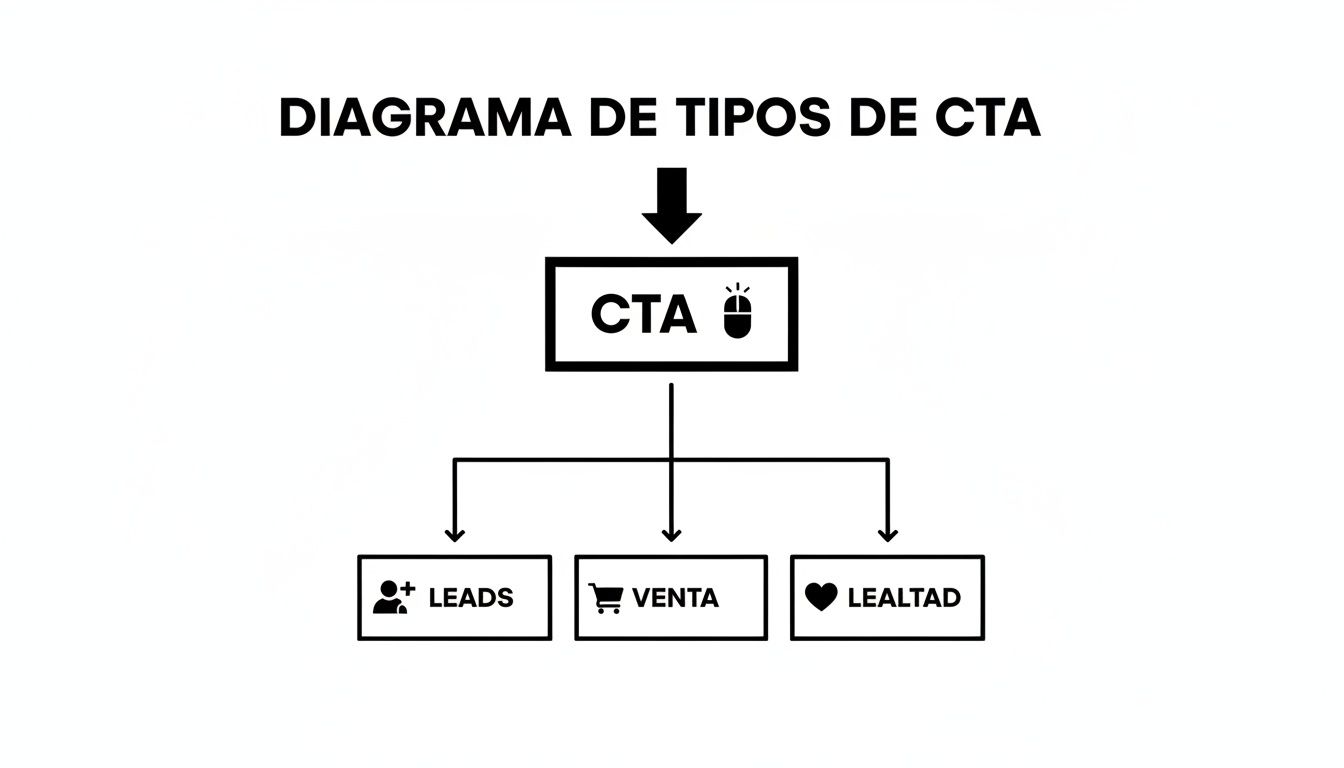
As shown in the image, CTAs branch out to fulfill specific functions, whether capturing a lead, closing a sale, or building customer loyalty. Mastering these principles lets you stop relying on isolated wins and start building a systematic growth engine.
A call to action that is not measured is a gamble. For a business leader, the real value of a CTA lies not in its design, but in its ability to generate measurable results. Ignoring metrics is like navigating without a compass: you move, but you do not know if you are heading in the right direction.
Optimizing CTAs is one of the most efficient ways to drive growth. It is not about investing more in attracting traffic, but about better converting the traffic you already have, maximizing the return on every visit.
To evaluate whether a CTA works, measuring clicks is not enough. You need to understand the real impact of that action on the company's objectives.
A successful CTA is not the one that gets the most clicks, but the one that generates the most conversions aligned with business objectives. Optimization must focus on the final result, not just the initial interaction.
CTA optimization is not based on opinions, but on experimentation. A/B tests are the scientific method for making data-based decisions.
The process is simple: two versions of a page (A and B) are created with a single variation in the CTA. Traffic is split between them, and you measure which one generates a higher conversion rate. The winning version is implemented, and the optimization cycle continues with a new hypothesis.
This mindset of constant experimentation is what drives sustained growth. Analytics tools, like those that can be implemented with Google Tag Manager (GTM), allow you to track every interaction and understand which specific changes are moving the needle. That way, every test, even a failed one, delivers a valuable lesson that feeds the next optimization.
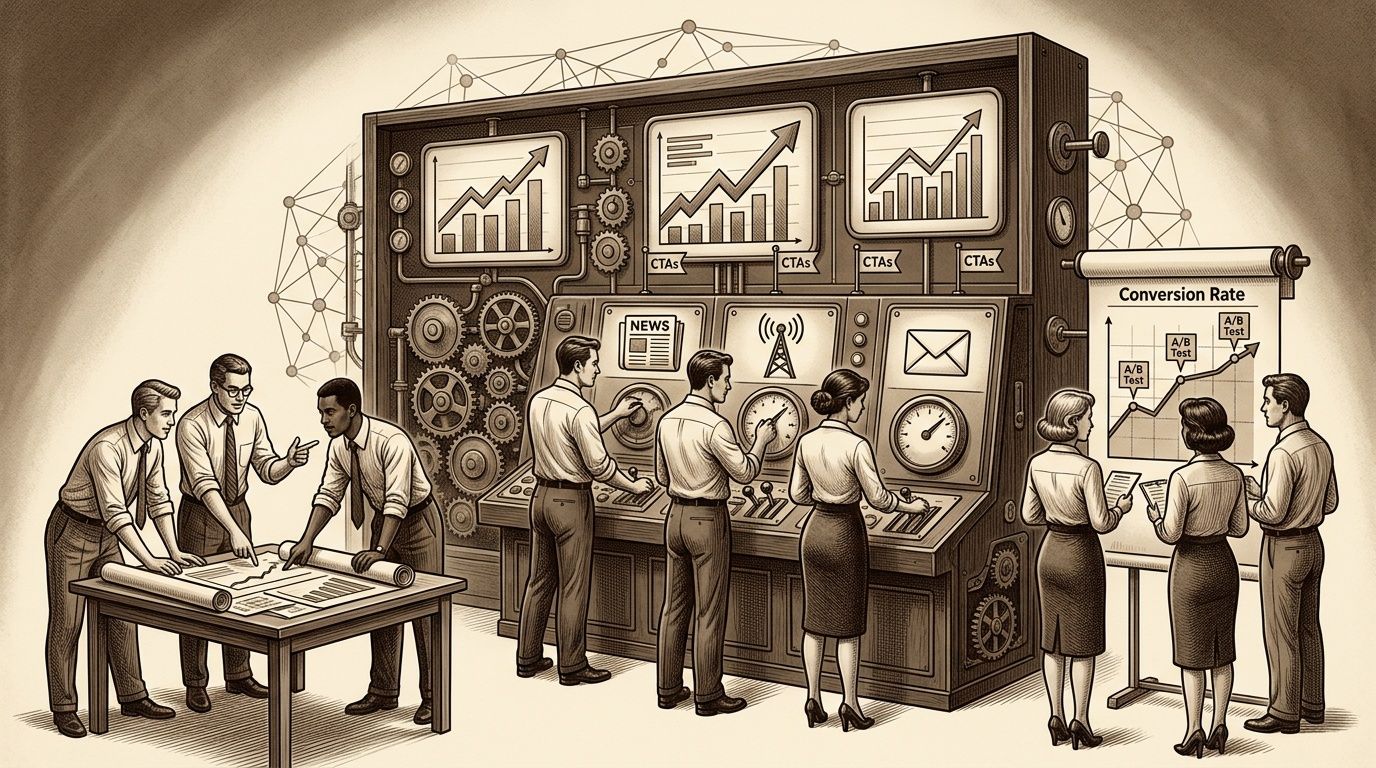
Optimizing a call to action is, ultimately, a matter of technological capability. For any business leader, the tech stack should not be a bottleneck, but an enabler that lets marketing teams implement, test, and adjust CTAs with agility.
The value lies not in having the most complex tool, but in how it integrates into workflows to foster a culture of experimentation. If the current platform makes it hard to run a simple A/B test, it is directly holding back business growth.
Modern platforms like WordPress, Webflow, and Shopify have democratized CTA management. It is no longer necessary to depend on development teams to change a button or launch a test. This agility is fundamental to react to data in real time and capitalize on improvement opportunities.
Technology must be the bridge that connects analysis with action, without friction. If changing a CTA's text requires a development ticket that takes weeks, your company is losing revenue and ceding ground to the competition.
From a strategic perspective, your content management platform (CMS) or eCommerce should at a minimum facilitate:
CTA management is not an isolated task. It must be part of a technological ecosystem where CRO, personalization, and analytics tools operate in an integrated way, not in silos.
A well-designed technological architecture centralizes data and simplifies execution. This frees teams to focus on strategy—which hypothesis to test, which segment to prioritize—instead of getting stuck in technical implementation.
In the end, the right technology transforms CTA optimization: it stops being a one-off event and becomes a continuous, scalable business process.
Let's ground these strategic concepts in the common questions that arise in day-to-day decision-making.
The answer is not a number, but a matter of focus. Each page should have a main CTA that reflects its primary business objective. Secondary CTAs can be included for lower-priority objectives (e.g., "Subscribe to the newsletter"), as long as they do not compete visually with the main one.
Overwhelming the user with too many options of equal hierarchy causes analysis paralysis. The key is clarity and visual hierarchy to guide the user toward the action that matters most to the business.
There is no universal "magic color." The most effective color is always the one that generates high contrast with the page background, making the CTA immediately visible without breaking the brand identity.
Rather than obsessing over color, the energy should focus on the visibility and clarity of the message. The only way to know what resonates with your audience is through controlled experimentation (A/B tests), measuring the real impact on conversion, not just clicks.
CTA optimization is not a project, it is a continuous process. For high-traffic sites, tests can be run weekly or biweekly. For sites with less volume, a monthly or quarterly review cycle is a good starting point.
The key is to adopt a mindset of constant improvement. A practical approach is to start by optimizing the CTAs of the pages with the most traffic and strategic value, and from there, expand the process to other areas of the site.
At Bigbuda, since 2010 we have helped companies build digital growth engines. Our continuous optimization methodology focuses on turning existing traffic into more customers and greater revenue. Discover how we can drive your results at https://bigbuda.cl.