










Solutions
Explore how to grow

You're in a familiar situation. You invest in paid media, improve creatives, adjust pricing, push campaigns and the customer reaches checkout. There the real friction appears: shipping. The question "how much does a chilexpress shipment cost" seems operational, but in eCommerce it's a financial question.
If you want to go deeper, take a look at our digital marketing service.
If you answer wrong, you lose margin. If you answer late, you lose conversion. If you answer with an imprecise rate, you lose trust. And when the logistics promise fails, brand perception also deteriorates.
Most stores look at shipping as a fixed cost. That's a mistake. Shipping is a commercial variable that impacts ticket, close, repurchase and per-order profitability.
Many businesses still treat shipping as a secondary line of the checkout. That works until the customer compares, hesitates or abandons. At that moment, logistics stops being back office and becomes the purchase experience.
The problem isn't only that the dispatch costs money. The problem is uncertainty. When the buyer doesn't understand why the total went up, they grow suspicious. And when they're suspicious, they postpone the purchase or leave.
A well-modeled shipment does three things at once:
That point changes the conversation. You're no longer asking how much Chilexpress charges as if you were looking for an isolated rate. You're defining how to present that rate without destroying conversion.
An opaque checkout doesn't "recover" margin. It shifts it to the worst possible moment, right before payment.
The most expensive mistake is usually strategic. Many stores use simple logic for something that isn't simple: they assume dispatch is calculated by weight and destination, show an estimated figure and hope it closes. Then differences appear due to dimensions, surcharges or delivery modality.
That mismatch generates three immediate consequences:
If your eCommerce has high checkout abandonment, shipping deserves an audit before another acquisition campaign. In fact, reviewing the dispatch structure is usually as important as reviewing pricing, payment methods or site speed. If you need to address the full problem, it's also worth looking at this analysis on how to reduce cart abandonment.
Stop asking for "the shipping price" as if there were only one. At Chilexpress, and in eCommerce logistics in general, the right cost depends on operational decisions that directly affect the business. The company that masters that logic can use dispatch to close more sales. The one that doesn't turns the checkout into a constant leak.
The final rate doesn't arise from a single variable. It arises from a combination of operational conditions. If you want to control costs, you first have to stop looking only at the base rate.
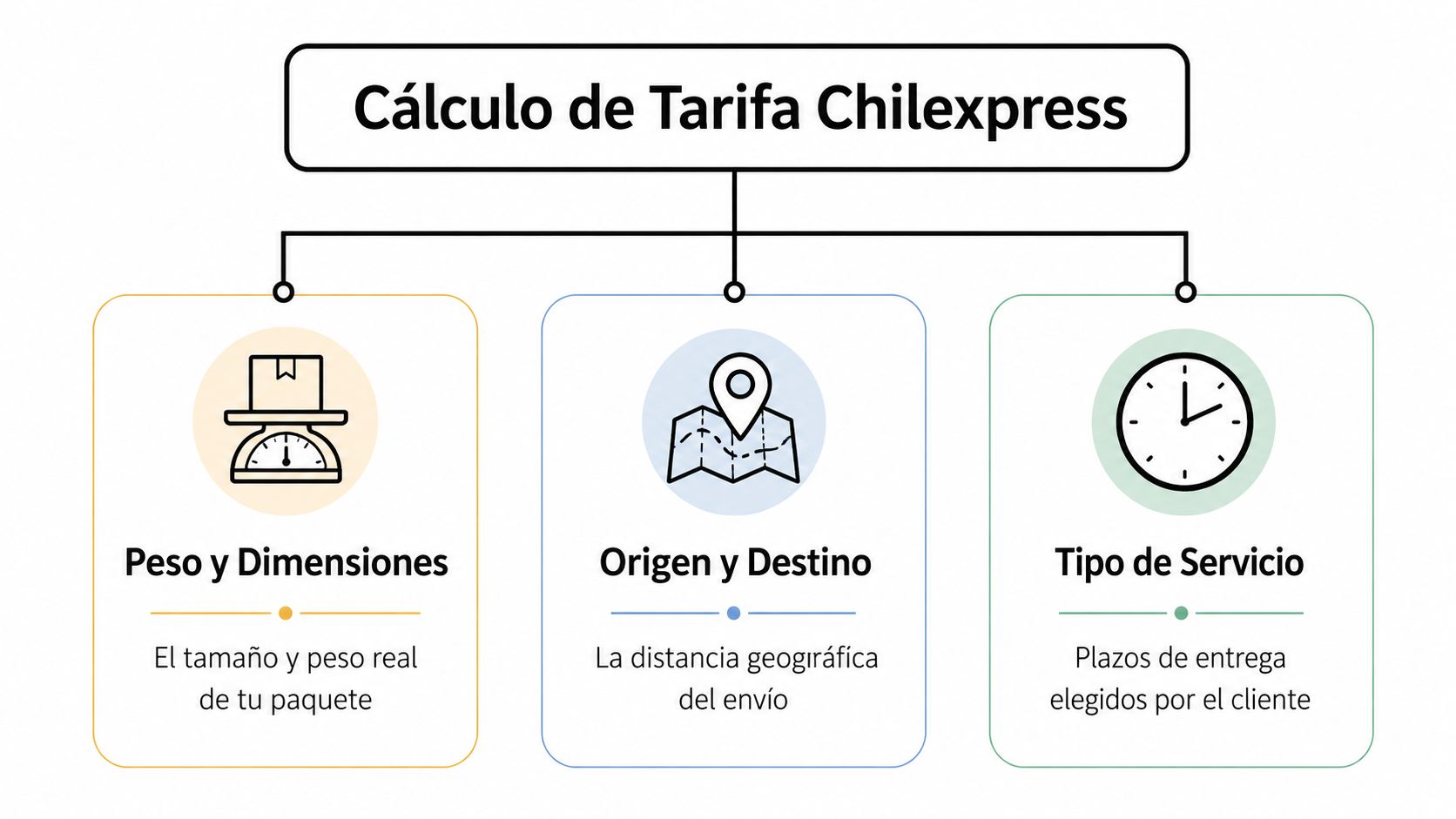
Chilexpress indicates that its domestic shipments can incorporate surcharges for operational complexity. In particular, oversized shipments carry a fixed additional charge of 3,500 CLP + VAT, applied on the rate calculated by destination, origin, weight, dimension and declared value. In addition, in the branch pickup or office reception modality, the recipient must pay the shipping value plus an additional cost of 10% of the shipping value, according to the information published by Chilexpress on national and international courier services.
That completely changes the financial reading of dispatch. The visible rate may be only the first layer. After it come surcharges for size and for modality.
You don't need an endless table. You need to understand which variables rule.
Most businesses quote to sell. The best ones quote to protect margin. They're not the same.
Look at this executive reading:
Variable / What it affects / Risk if you ignore it. Real weight / Basis of the operational calculation / Underestimating unit cost. Dimensions / Possible rate adjustment / Higher charges at dispatch. Pickup modality / Additional surcharge / Friction with the end customer. Oversize / Fixed additional charge / Margin eroded on bulky products.
Rule of thumb: if your catalog includes light, fragile or large-packaged products, simple manual quoting no longer cuts it.
Money is lost when marketing promises a "reasonable" dispatch, operations discovers the package falls into another category and finance absorbs the difference. That happens more often than many teams admit.
That's why, when someone searches how much does a chilexpress shipment cost, my answer is direct: it depends on how your logistics model is designed. If you don't control dimensions, delivery modality and surcharges, you're not estimating. You're guessing.
The quietest blow to margin usually comes from the packaging, not the product. That's where volumetric weight appears. Many eCommerces sell light items and believe their dispatch will be cheap. Then they discover that the courier doesn't charge only by actual kilos.

A cushion, a padded jacket, a pair of boots in a roomy box or a decorative picture can weigh little. But they take up space. And in logistics, space also costs money.
Chilexpress warns that if, upon admitting the package, there are differences relative to what was declared, the rate can vary, and it also applies a fixed additional charge of 3,500 CLP + VAT for oversized shipments in its Courier service, according to its rate calculator for individuals.
That operational detail has an immediate commercial consequence: if your store calculates on incomplete data or poorly defined packaging, the real cost appears too late.
The general concept of volumetric weight is understood with a simple formula:
Length × width × height / conversion factor
There's no need to fix a specific numeric factor here if your operation already uses rate calculators or integrations. What's relevant is the logic: the courier compares the space the package occupies with its actual weight and ends up charging according to the applicable operational condition.
It's usually not the product that fails. It's the data system.
If sales, catalog and fulfillment don't work with the same dimensions, the checkout shows a fiction.
Volumetric weight isn't a technical detail. It's a business decision. If you sell fashion, decor, home, gifts or any low-density item, packaging must enter the profitability discussion.
Negotiating rates isn't enough. You also have to redesign packaging, review measurements by SKU and align catalog with operations. Whoever does that protects margin without touching prices. Whoever doesn't ends up financing air.
The best way to understand this is to ground it in real decisions. I'm not going to invent specific base rates for routes or weights that aren't published in verified information. The right thing is to show how the cost logic changes between two products with totally different profiles.
Chilexpress publishes operational limits of up to 70 kg for parcels and warns of a fixed additional charge of 3,500 CLP + VAT for oversized shipments, applied on the rate by destination, origin, weight, dimension and value, according to its parcel and international shipping page.
Suppose one same online business sells books and soft decor items. Both products can enter the same checkout. But they shouldn't be treated with the same dispatch logic.
Concept / Example A: Book (Dense) / Example B: Cushion (Volumetric). Nature of the product / Small and compact / Light, but with high volume. Main risk / Base rate by route and weight / Adjustment for dimensions and oversize. Sensitivity to packaging / Low if the packaging is tight / High if the box or bag takes up too much space. Probability of a fixed additional surcharge / Lower / Higher if it falls into oversize. Impact on margin / More predictable / More unstable.
The book usually behaves well logistically. It's dense, easy to pack and less exposed to deviations between what's declared and what's admitted. If the team uses correct measurements and efficient packaging, the cost is relatively more controllable.
That makes the book a friendly SKU for campaigns with promotional dispatch or for more aggressive shipping rules.
The cushion seems cheap to ship. That assumption fails quickly. If the package takes up a lot of space or is declared with imprecise measurements, the final cost can be strained by the dimension and by the additional surcharge applicable to oversize.
The cheapest product to manufacture can end up being the most expensive to ship.
Don't look at this comparison as an operational curiosity. Use it to decide:
An eCommerce manager who mixes books, decor, accessories and home goods under a single shipping logic is buying complexity without seeing it in the P&L.
Quoting manually works for an occasional shipment. In a growing online store, it's a bad practice. It generates errors, slows the operation and shows the customer a figure that often doesn't represent the real cost.
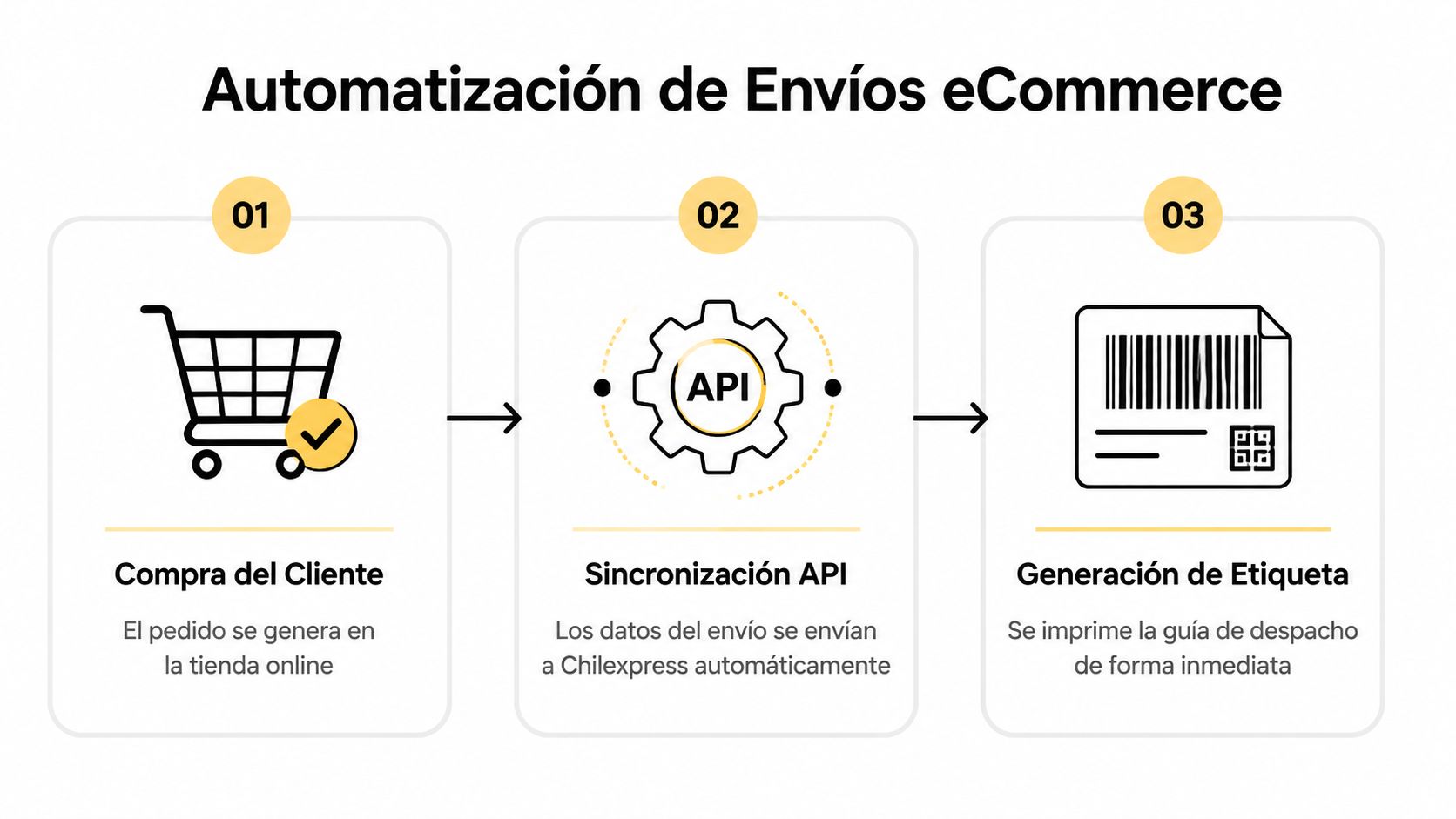
In Chile, the cost of a Chilexpress shipment depends heavily on the type of service. For money transfers, the rate can be fixed, such as 1,300 CLP + VAT up to 60,000 CLP, 2.2% + VAT between 60,001 and 600,000 CLP, and 13,200 CLP + VAT above 600,000 CLP. The informational coverage on bank account transfers also reports a structure of 2,000 CLP + 2% VAT included. That variability, published in Wise's analysis on sending money via Chilexpress, shows a broader point: when the structure changes by service, the business needs systems that select and quote correctly in real time.
That same principle applies to eCommerce of physical products. If the store doesn't automate, it makes two mistakes: it charges wrong and works twice.
An integration between your store and the logistics system isn't a technical luxury. It's commercial infrastructure.
This flow helps visualize it:
When you integrate quoting and label generation with your store, you turn dispatch into a core layer of your digital business rather than an operational patch. This is especially important on platforms like Shopify and WooCommerce, where the checkout process directly impacts conversion.
If your operation involves an ERP, inventory management, invoicing, or complex commercial rules, the conversation goes beyond just couriers. It becomes a matter of architecture. That is where integrations between eCommerce and systems like Bsale come in, organizing data and reducing errors between sales, dispatch, and the back office. An example of this approach is this look at the integration of Bsale Chile and WooCommerce.
There are also partners and agencies that implement this type of flow. Bigbuda works on integrations and automations for stores on Shopify, WooCommerce, and other environments, incorporating dispatch logic into a broader digital operation.
Lowering logistics costs isn't just about "finding a cheaper rate." That view is too short-sighted. Serious businesses reduce total costs, protect conversion, and maintain a delivery promise that is consistent with their brand.

Many companies negotiate with carriers before organizing their own data. It should be the other way around.
Perform these reviews first:
Not every shipment should be subsidized, nor should every shipment be charged in full. The point is to use it with intent.
Some smart decisions:
Decision / When it's worth it / What it avoids. Subsidize part of the shipping / Products with high margins or strong repurchase potential / Losing sales to checkout friction. Charge a dynamic rate / Heterogeneous or volumetric catalogs / Financing poorly quoted orders. Offer pickup as an alternative / Price-sensitive customers / Abandonment due to shipping costs. Segment rules by zone or category / Operations with high logistics dispersion / A misleading average margin.
Not all customers prioritize speed. Many prioritize control or savings. Offering a pickup alternative can help, but only if it's clearly integrated into the experience.
The mistake isn't in offering more options. The mistake is in showing them without context, with confusing text, or with inconsistent rate logic.
A poorly presented delivery method lowers the perceived value of the entire purchase.
Negotiating corporate rates makes sense when you know your real shipment mix. If you arrive at a negotiation without knowing what percentage of your orders suffer from volume, packaging, or complex categories, you'll be discussing price without understanding cost.
The right sequence is this:
The companies that sell best online aren't just the ones that buy traffic. They're the ones that connect pricing, experience, and fulfillment without contradictions. Shipping is part of that architecture.
If you want to broaden that view and compare logistics approaches for eCommerce, it's worth reviewing this guide on shipping companies.
My final recommendation is simple. If you're asking how much a Chilexpress shipment costs, don't look for a single figure. Look for a model. The business that models its logistics costs well can turn dispatch into an advantage. The one that doesn't keeps losing margin at the end of the funnel.
If your store needs to organize quoting, checkout, automation, and logistics integration to sell with less friction, Bigbuda can help you structure that digital operation with a focus on conversion, profitability, and scalability.
{"@context": "https://schema.org", "@type": "BreadcrumbList", "itemListElement": [{"@type": "ListItem", "position": 1, "name": "Home", "item": "https://bigbuda.cl/"}, {"@type": "ListItem", "position": 2, "name": "Insights", "item": "https://bigbuda.cl/insights"}, {"@type": "ListItem", "position": 3, "name": "How Much Does a Chilexpress Shipment Cost: 2026 Prices", "item": "https://bigbuda.cl/insights/cuanto-sale-un-envio-por-chilexpress"}]}
The rate is calculated by destination, origin, weight, dimension and declared value. The base rate is only the first layer: domestic shipments can incorporate surcharges for operational complexity, and the visible figure may change once the package is admitted and differences relative to what was declared appear.
Chilexpress applies a fixed additional charge of 3,500 CLP plus VAT for oversized shipments in its Courier service, applied on the rate calculated by destination, origin, weight, dimension and declared value. It also publishes operational limits of up to 70 kg for parcels.
The courier compares the space a package occupies with its actual weight and charges according to the applicable operational condition. The general concept is length by width by height divided by a conversion factor. A cushion, padded jacket or boots in a roomy box weigh little but take up space, and space costs money.
In the branch pickup or office reception modality, the recipient must pay the shipping value plus an additional cost of 10% of the shipping value. If your checkout communicates only that shipping is paid at pickup, without disclosing that surcharge, the real cost appears too late for the customer.
Start with the catalog, not the courier. Clean up measurements by SKU, group products by logistics behavior instead of mixing dense with volumetric items, define packaging by product family, and review the commercial promise by category. Negotiate corporate rates only after you know your real shipment mix.
Quoting manually works for an occasional shipment, but in a growing store it generates errors, slows the operation and shows a figure that often does not represent the real cost. A good integration delivers a more precise checkout, less manual intervention, streamlined operations and true scalability without added administrative friction.