










Solutions
Explore how to grow

Your team invests in paid media, content, email and redesigns. The site gets visits. Forms come in. Some sales arrive. But when you ask which campaign actually generated customers, which leads are ready to buy or why so many users leave without follow-up, the same problem appears: there's activity, but there's no commercial intelligence.
If you want to go deeper, take a look at our piece on the best digital marketing agencies in Chile.
That gap explains why many companies keep chasing growth through more traffic, when their real lever lies in better managing the traffic they already have. If you run an eCommerce on Shopify or a corporate site on Webflow or WordPress, the critical point usually isn't a lack of visits. It's usually the lack of a system that connects behavior, intent and follow-up.
That's where the CRM comes in. Not as administrative-order software. As growth infrastructure. Its adoption is already part of the business standard. According to CRM statistics compiled by Flowlu, 91% of organizations with 11 or more employees use CRM software, while 50% of companies with 10 or fewer also use it. The same report indicates that global CRM market revenue went from 14 billion dollars in 2010 to 69 billion in 2020. That doesn't happen when a category is optional. It happens when it becomes essential to compete.
Most companies don't have a marketing problem. They have a problem of continuity between marketing, sales and digital experience. They invest to attract demand, but they don't have a consistent way to turn that demand into predictable revenue.
That happens because the data is still fragmented. One team looks at Google Ads. Another reviews forms. Sales works in its own pipeline. eCommerce watches purchases, but doesn't know what the customer did beforehand. The result is simple: nobody has a complete view of the journey.
What crm in marketing is shouldn't be answered with a textbook definition. The useful answer is this: it's the system that turns scattered interactions into coordinated commercial decisions. When that doesn't exist, every campaign operates blind and every opportunity depends too much on human improvisation.
Without a CRM, three things happen that slow growth:
Rule of thumb: if your company needs more budget to compensate for internal disorder, it doesn't have a demand problem. It has a system problem.
In 2026, competing without that layer of intelligence is a bad decision. Not because "everyone does it," but because the market already operates with more automation, more personalization and more pressure on ROI. The CRM solves precisely that. It organizes the data, prioritizes opportunities and lets you act before the user goes cold.
The question is no longer whether you need to record contacts. The question is whether your business can keep growing without an operational center that unites campaigns, digital behavior and commercial follow-up.
If today you have visits but no clarity about who's ready to buy, who abandoned because of friction and who deserves reactivation, your next lever isn't more traffic. It's more control over the existing journey.
A misunderstood CRM becomes an expensive address book. A well-thought-out CRM becomes the central nervous system of the business. It receives signals, organizes them and coordinates the right response across marketing, sales, eCommerce and customer service.
Salesforce defines it clearly in its explanation of what a CRM is: in marketing, a CRM is not just a database, but the central system that concentrates contacts, opportunities, interaction history and customer data to personalize campaigns and automate follow-up. It also lets you connect marketing, sales, eCommerce and customer service into a single operational flow.

The analogy matters because it clarifies its real function. The CRM receives stimuli from the market. A visit to a product page. A click in an email. A submitted form. A purchase. A support ticket. A commercial rejection. All of that stops being isolated noise and becomes part of one same conversation.
When that conversation is centralized, the business can respond with coherence. It doesn't send the same message to everyone. It doesn't treat a frequent customer the same as a user who just discovered the brand. It doesn't force sales to chase cold leads while neglecting high-intent contacts.
That logic also changes how the customer lifecycle is understood. It stops being a theoretical model and becomes a visible, measurable and actionable sequence.
Storing data doesn't generate an advantage. Interpreting context does.
An isolated contact says little. A contact with history says much more. Knowing that someone downloaded a resource is basic information. Knowing that they later returned to the site, checked prices, opened two emails and abandoned the checkout completely changes the quality of the commercial decision.
That's where the strategic role of the CRM appears:
A CRM doesn't improve results by storing more records. It improves them when it turns interactions into priorities and priorities into actions.
For a company with high traffic and irregular conversion, that changes the game. You no longer depend on intuition to decide who to reach, with what message and at what moment. You start managing relationships with business logic.
A CRM without segmentation, personalization and automation is just a database. These three functions turn visits, clicks and purchases into decisions that improve conversion, reduce waste and increase the return on the traffic that already reaches your site.
The difference shows quickly. A team without this logic sends campaigns in bulk, chases leads with little context and leaves money on the table. A team that uses its CRM well detects intent, adapts messages and triggers follow-up at the right moment.

Segmenting by age, role or location does little if your goal is to sell more. What moves results is intent. And intent shows up in behavior.
If a person returns several times to a product page on Shopify, checks prices on your Webflow-built site or abandons the checkout after adding to cart, they've already left clear signals. The CRM organizes those signals and turns them into actionable groups. That's where useful marketing begins.
Examples of segments that do add value:
This changes the conversation. You no longer talk to a generic audience. You talk to people at a specific stage, with a specific need and with a different probability of converting.
Personalizing is not about adding the name to the email subject line. That doesn't change the business. What does change it is adjusting the message, the offer and the sequence according to the user's real history.
In eCommerce, that means showing products, promotions or reminders based on previous browsing and purchases. In B2B services, it means delivering different content to someone who's just researching versus someone who has already reviewed a commercial page several times. The result is simple. Less friction, more clarity and better response rates.
Key point: the more generic your message is, the more budget you need to achieve the same result.
For brands with lots of traffic and irregular conversion, this function has a direct impact on revenue. You don't need to attract another wave of visits to grow. You need to better treat the visits you're already paying for or generating.
A visual example helps explain how this logic connects with commercial execution and data:
Automation matters for a concrete reason. It prevents a valuable opportunity from depending on human memory, manual follow-up or dead time between teams.
If someone abandons a cart, requests a quote or returns several times to a high-value page, the CRM should trigger an action. Not later. At that moment. Every hour of delay cools intent and lowers the probability of closing.
Automations with clear impact:
Executed well, automation turns the CRM into the nervous system of your commercial strategy. It detects signals, distributes priorities and triggers responses without losing timing.
That's the point. Without these functions, marketing generates activity. With them, it turns traffic into better-qualified opportunities, opportunities into sales and sales into more value per customer.
Your store gets visits, generates forms and moves products, but conversions don't rise at the pace of traffic. The problem is usually elsewhere. There's no shortage of audience. There's a shortage of coordination between the systems that should turn that audience into revenue.
A well-integrated CRM fulfills that function. It centralizes context, connects signals and organizes the commercial response on a single foundation. That's where its role changes. It stops being a contact record and starts operating as the system that directs decisions in marketing, sales and retention.

The point is not to add software. The point is to make Shopify, WooCommerce, Webflow, WordPress, email marketing, paid media and sales work with the same customer information.
If each platform stores a different part of the story, you lose money in every handoff. Marketing captures leads without knowing which ones advance. Sales calls without context. eCommerce records purchases without triggering retention or repurchase. Support resolves cases without understanding that customer's real value.
That disorder produces four direct effects:
When the integration is done well, every user action updates a business decision. A purchase changes the customer profile. A form creates or enriches a lead. A repeated visit to a pricing page adjusts commercial priority. A click in an email modifies the next sequence.
That's what matters for a company with high traffic and low conversion. The CRM stops archiving activity and starts coordinating it. On a site built in Shopify or Webflow, this difference shows quickly. The same traffic starts to yield more because follow-up no longer depends on spreadsheets, memory or late reviews.
Semrush and other platforms in the sector insist on the same point: the value of the CRM appears when it connects data, personalization and commercial execution within a single flow. That connection lets you intervene with more precision during the customer journey, which is where a sale accelerates, cools or is lost.
When site, eCommerce, email and sales share context, every interaction has a higher probability of pushing a conversion.
| Scenario | What happens |
|---|---|
| Fragmented operation | Traffic arrives, but follow-up depends on manual review, spreadsheets and assumptions. |
| Integrated operation | User behavior feeds automatic actions, commercial priorities and more relevant messages from a single source of context. |
For a company that already invests in acquisition, this is not a technical decision. It's a profitability decision. If your site already attracts demand, the next leap in growth doesn't come from buying more traffic. It comes from better managing the traffic you already paid for.
Not all CRMs solve the same problem. Choosing wrong usually produces two equally bad results: a tool too heavy for the business's stage or one too basic to support growth.
The right decision starts by understanding the purpose. Not the brand of the software.
There are three strategic categories worth distinguishing.
| Type of CRM | Main objective | Ideal for | Example platform |
|---|---|---|---|
| Operational | Automate marketing, sales and follow-up processes | Companies that need commercial order, flows and repeatable tasks | HubSpot, Salesforce, Zoho CRM |
| Analytical | Analyze customer data and detect patterns to decide better | Teams with a strong focus on reporting, cohorts and commercial performance | Salesforce, Microsoft Dynamics 365 |
| Collaborative | Share information across marketing, sales and customer service | Organizations with several teams that need a shared view of the customer | HubSpot, Freshworks |
Most mid-sized companies start out needing an operational CRM. It's what lets forms, opportunities, follow-up and automations stop depending on human memory. Later, when the volume of data and complexity grows, the analytical component gains weight.
The collaborative CRM becomes critical when the customer experience depends on several areas. If marketing promises one thing, sales says another and support is unaware of the context, the problem isn't internal communication. It's system design.
Choosing a CRM by popularity is a mistake. The right criterion is which business friction you need to solve first.
It's also worth looking at data governance from the start. If your operation collects behavior, commercial history and personal data, the data protection framework is not a peripheral legal matter. It's part of the design of trust and sustainability.
Many implementations fail because they try to capture everything. That clutters the operation. A useful CRM doesn't need more fields. It needs better data.
Think in three layers:
For conversion-oriented marketing, the most valuable tend to be the behavioral ones. They're the ones that show what the user wants to do now, not just who they are or what they did months ago.
If you have to define what to capture first, use this sequence:
That's enough to make better decisions. The rest is added when there's a real reason to do it.
Implementing a CRM without strategy is digitizing disorder. The software doesn't fix confusing processes. It only makes them more visible.
The right priority isn't "installing a platform." It's designing a system that better captures intent, reduces losses and brings marketing closer to real revenue.
In Chile, the context makes this point even more urgent. According to the view set out by DataCRM on what CRM is and what it's for, with high intensity of online purchasing but low conversion due to experience friction, the value of the CRM lies not only in capturing leads, but in closing the loop between campaigns, on-site behavior and sales follow-up. The most useful focus is operational ROI: less lead loss and more conversions from the same traffic.

Don't start by asking which CRM to buy. Start by asking which leak you want to close.
If an eCommerce has high abandonment and poor reactivation, the CRM should be designed to recover intent and improve repurchase. If a B2B business receives forms but sales complains about low quality, the problem may be in scoring, segmentation or response speed. If the site generates traffic but nobody knows which pages anticipate a close, the problem is traceability.
That initial diagnosis organizes everything.
Define a concrete commercial objective
"Improve conversion" is too vague. "Reduce lead loss between form and commercial contact" already lets you design process, automation and measurement.
Map the customer's real journey
Not the ideal one in the PowerPoint. The real one. Where the user arrives, where they hesitate, what action they leave, where they disappear and which team picks it up.
Clean and structure the data before migrating
If you migrate duplicate databases, inconsistent fields and poorly defined stages, the CRM is born contaminated.
Configure few automations, but relevant ones
Abandoned cart, lead nurturing, commercial alerts, post-sale. Start with what protects revenue or prevents leakage.
Align marketing and sales with common rules
What a qualified lead is, how long follow-up should take, what information each team must record and how the system feeds back.
A well-implemented CRM doesn't just show pipeline. It also forces the company to define how it wants to sell.
There are mistakes that recur and cost dearly:
If a company needs external support, it can evaluate platforms like HubSpot or Salesforce, and also partners that work on the integration between site, conversion and commercial operation. Within that framework, Bigbuda offers CRM implementation and consulting focused on centralizing customer information and connecting marketing, sales and automation within a growth logic.
The right implementation doesn't end at go-live. That's exactly where the serious work begins.
If the CRM is evaluated only by number of contacts, the company is looking at an empty metric. Real return appears when you can demonstrate better conversion, more retention, clearer cycles and more productive teams.
That's why it's worth separating volume metrics from business metrics.
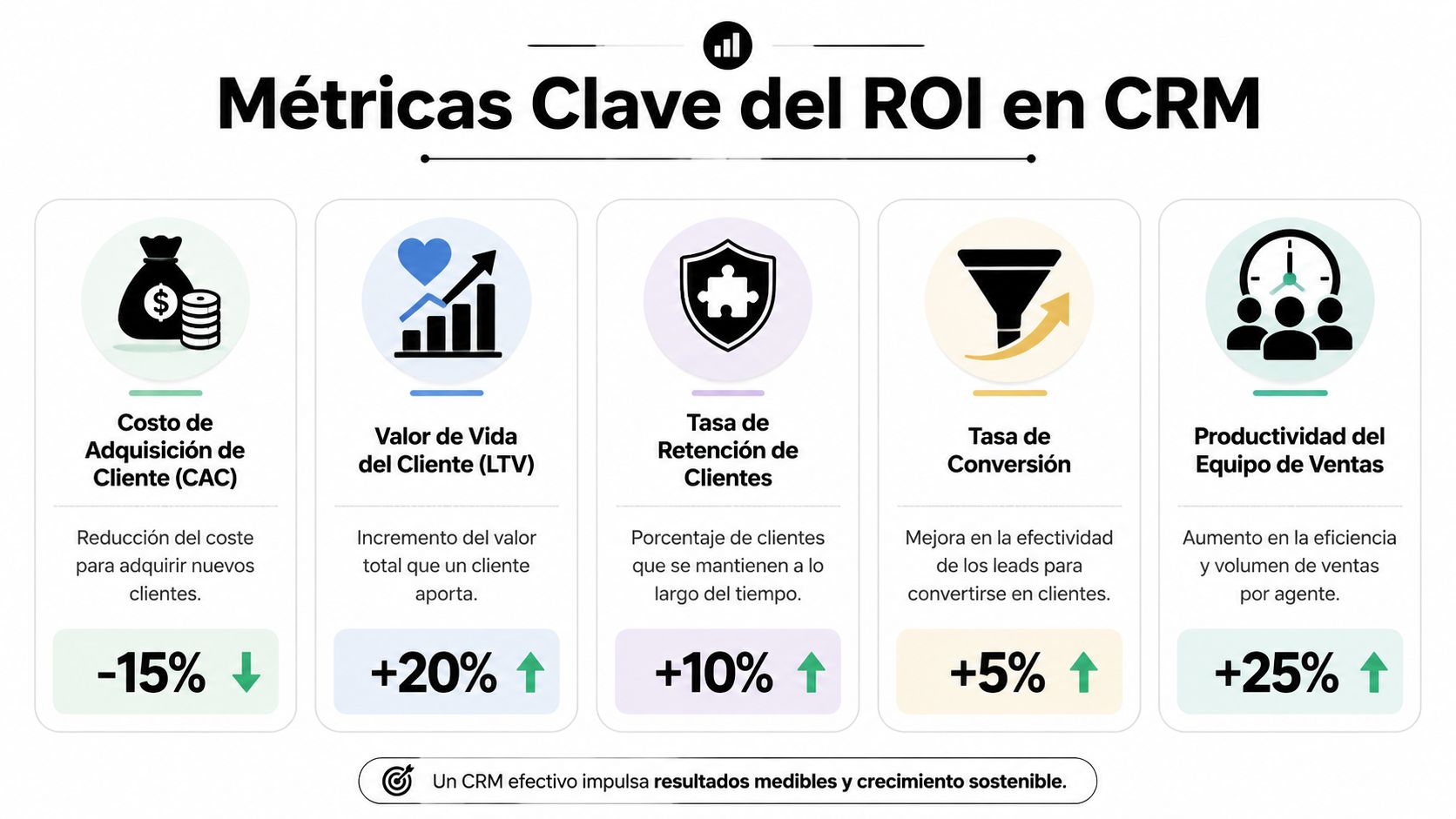
There are five indicators that a well-used CRM helps measure with more precision:
These metrics matter because they connect operation with profitability. A CRM doesn't create value by existing. It creates value when it helps move these variables in the right direction.
Before you see full financial impact, there are signals that usually show whether the strategy is on the right track.
| Operational signal | What it tells you |
|---|---|
| Speed of commercial contact | Whether the team responds while intent is still active |
| Percentage of leads with a defined stage | Whether the pipeline is being managed and not just accumulated |
| Quality of activity logging | Whether the CRM reflects reality or just a partial version |
| Use of key automations | Whether the system is reducing manual work and leakage |
If you can't follow the journey from campaign to close, you're not measuring ROI. You're measuring activity.
The advantage of the CRM is that it organizes operational attribution. It doesn't solve every strategic question on its own, but it does provide a much more solid foundation to answer them.
The right discipline is simple:
If the implementation was good, the CRM should help you distinguish between two very different scenarios: campaigns that generate noise and campaigns that generate customers.
The most expensive mistake in digital marketing isn't always investing badly. Many times it's investing well and then losing value for lack of a system. That's where the CRM stops being a software category and becomes a strategic decision.
The relevant question is not only what crm in marketing is. The useful question is how prepared your company is to turn scattered signals into repeatable growth. If today the answer depends on spreadsheets, manual reviews or the intuition of a few executives, the problem isn't in the demand. It's in the way it's operated.
A well-designed CRM connects campaigns, behavior, commercial follow-up and post-sale. That improves relevance, reduces losses and lets you get more performance from the same traffic. It also lowers the dependence on always betting on more advertising investment to sustain results.
Sustainable growth doesn't come from talking to more people without criteria. It comes from better understanding the right people and acting with more precision. That requires connected data, clear processes and a shared view of the customer.
Those who keep seeing the CRM as an administrative cost will react late. Those who understand it as conversion infrastructure will build an advantage that's hard to copy.
If your company already generates traffic but doesn't convert it with the consistency it should, Bigbuda can help you connect site, CRM, automation and conversion strategy to turn scattered data into decisions that improve revenue.
Related reading: CRM: Meaning, Uses and Why Your Company Needs One · Learn How to Use WhatsApp Business and Sell More · Marketing engineering to convert more traffic
It is the system that turns scattered interactions into coordinated commercial decisions. Rather than an address book, it works as the central nervous system of the business: it receives signals from visits, clicks, forms, purchases and tickets, organizes them and coordinates the right response across marketing, sales, eCommerce and customer service.
Three things slow growth: valid leads are lost because there is no consistent follow-up or clear prioritization, expensive traffic is wasted because the business cannot separate high intent from passing curiosity, and return becomes impossible to measure because marketing data does not talk to sales data.
Most mid-sized companies start needing an operational CRM to automate marketing, sales and follow-up. The analytical type gains weight when data volume and complexity grow and reporting matters more. The collaborative type becomes critical when the customer experience depends on several areas. Choose by the friction you need to solve first, not by popularity.
Think in three layers: demographic or firmographic data to classify the profile, transactional data to understand value and recurrence, and behavioral data to infer intent. For conversion-oriented marketing the behavioral layer is usually the most valuable, because it shows what the user wants to do now.
Do not start by choosing software. Start by defining which leak you want to close, then map the customer's real journey, clean and structure the data before migrating, configure few but relevant automations, and align marketing and sales with common rules about qualification, follow-up times and recording.
Five indicators matter at board level: lead-to-customer conversion rate, customer lifetime value, customer acquisition cost, sales cycle length and retention rate. Alongside them, review operational signals such as speed of commercial contact, percentage of leads with a defined stage, quality of activity logging and use of key automations.