










Solutions
Explore how to grow
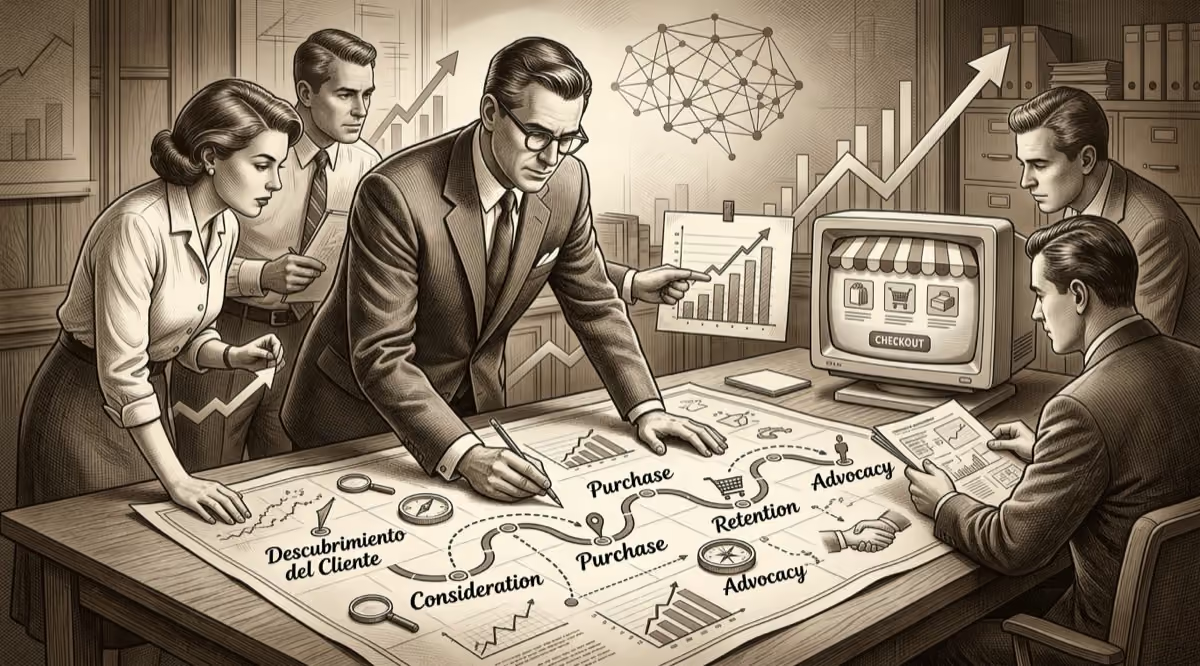
Your company has probably already done the most expensive part. It attracted visitors, invested in media, published content, launched campaigns, and built a reasonable site. Even so, sales are not taking off at the expected pace.
Need help with this? Discover our AI for companies in Chile.
That problem is rarely explained by traffic alone. It is explained by the journey. When the customer journey has friction, every paid click loses value before turning into margin, repurchase, or referral. And when leadership does not look at it systematically, it ends up managing symptoms instead of causes.
The mistake is treating the customer journey as a slide for workshops. In serious digital businesses, it must operate as a system of diagnosis, prioritization, and growth. If it is not connected to business decisions, budget, experience, and measurement, it is corporate decoration.
The pattern repeats. The team celebrates traffic spikes, but conversion stalls. Sales asks for more leads. Marketing asks for more budget. Operations blames the site. No one is looking at the full sequence of decisions the customer makes from detecting a need until repurchasing.
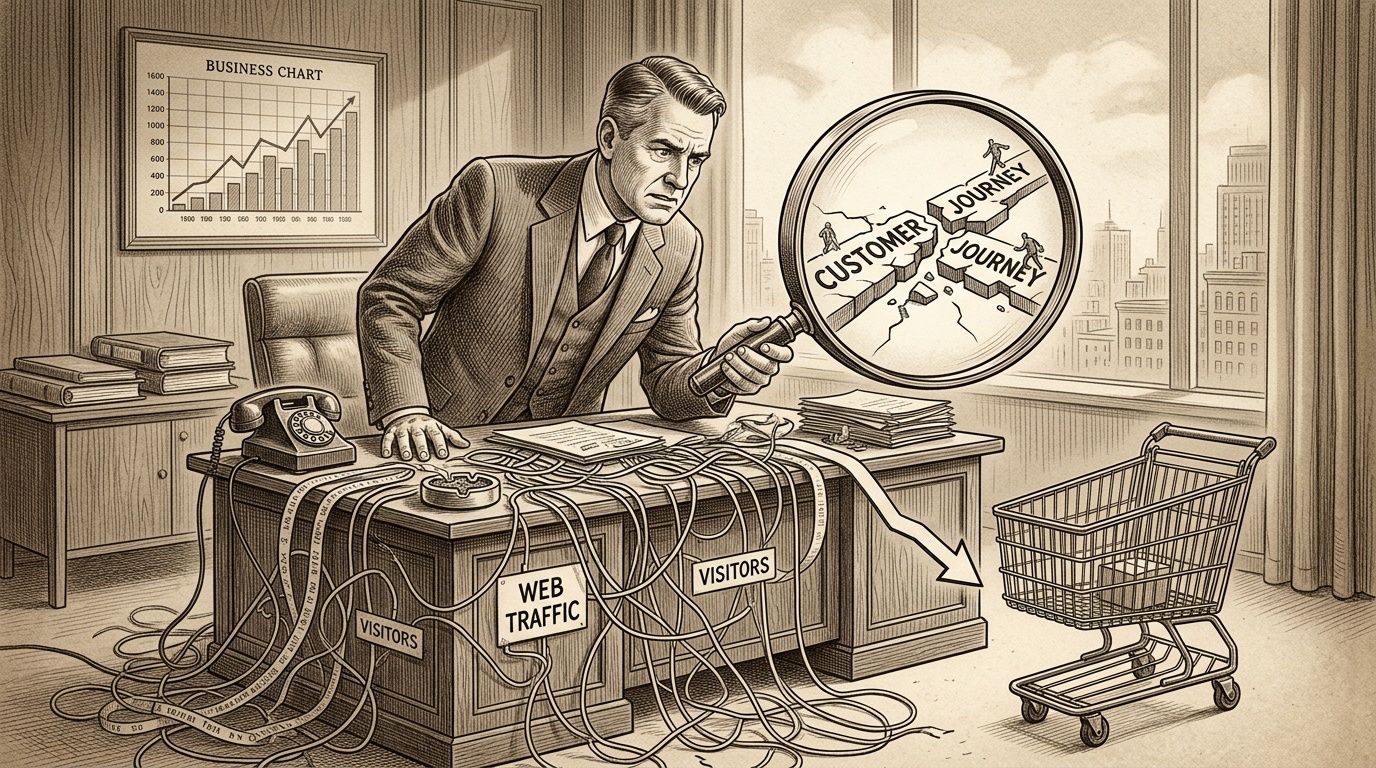
That gap costs money. It also distorts priorities. A company can increase ad investment and keep growing little because the problem is not at the top of the funnel, but in the experience between stages.
The leadership discussion changed years ago. Walker projected that by 2020 customer experience would surpass price and product as the main brand differentiator, a signal that today carries even more weight in digital. In Chile, moreover, the context made this decision urgent. eCommerce grew 200% between 2019 and 2023, and 49% of shoppers make impulse purchases after personalized experiences, according to the data cited in this analysis on key customer experience statistics.
That changes the investment logic. If a better experience moves the purchase without raising traffic, then the customer journey stops being a marketing initiative and becomes a direct lever of profitability.
Executive reading: if your company still competes only on price, you are already behind. The journey, clarity, and friction carry more weight than many boards still admit.
It is not just conversion that is lost. It is the ability to decide well.
A growth leader should not ask whether they need to map the journey. They should ask how much margin they are giving up by continuing to operate without that visibility.
The traditional funnel still works, but it falls short. It explains how demand comes in. It does not fully explain how trust is built, how doubt is removed, or how a purchase turns into loyalty. The customer journey forces you to look at the whole relationship.
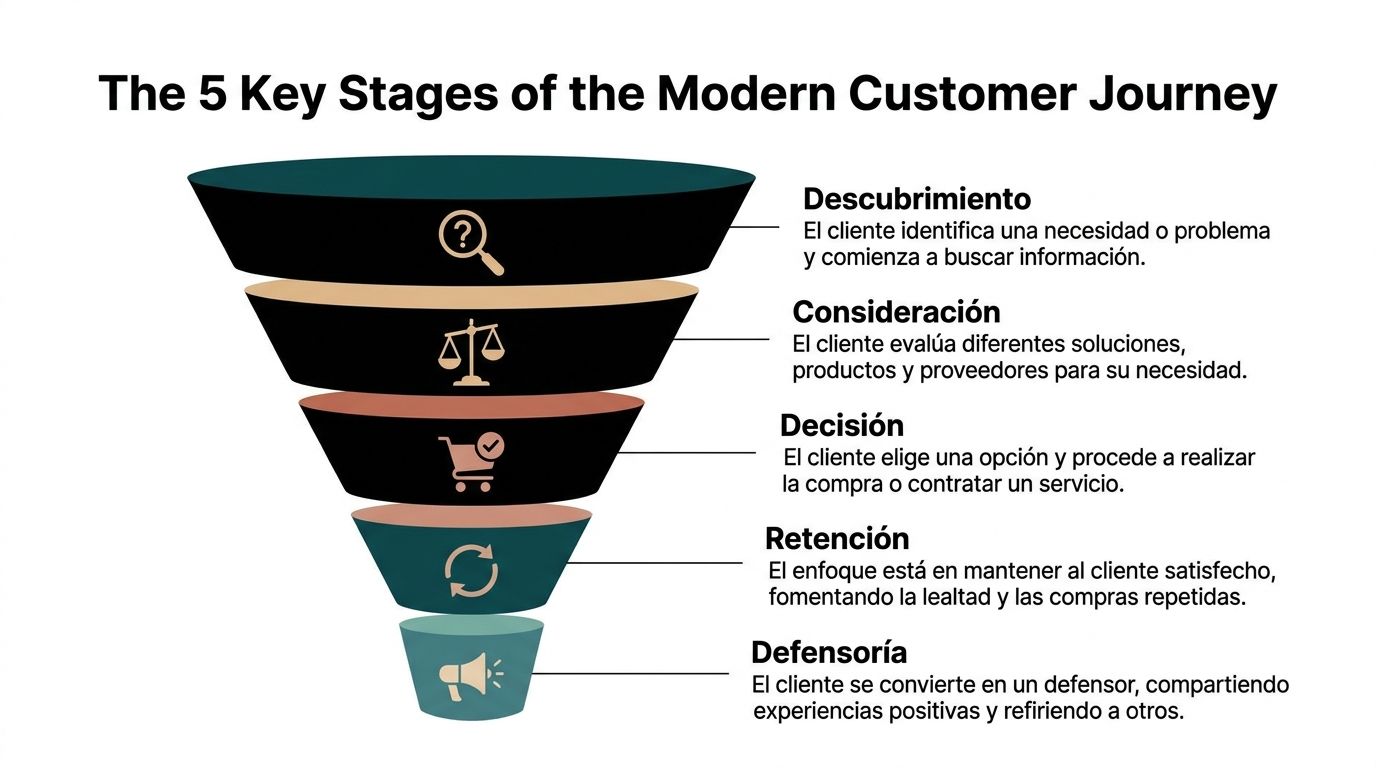
To organize strategic decisions, it is worth working with five stages.
Here the customer does not yet want to buy from you. They want to understand what problem they have, what risk they face, or what opportunity they are missing.
The strategic question is not "how do we sell more." It is "how do we become relevant early."
In this phase, the business needs coherent presence and an understandable promise. If the message is confusing, the brand enters the radar in the wrong way or does not enter at all.
Customer mindset: explores, compares mental frameworks, looks for credibility signals.
Business goal: win qualified attention, not just volume.
Typical friction:
At this stage the customer already knows they have options. Now they decide which ones deserve time. This is the moment where many companies believe they compete on catalog, but in reality they compete on clarity.
A buyer in consideration does not reward the brand with more text. They reward the brand that reduces uncertainty.
Customer mindset: wants evidence, context, social proof, and a sense of control.
Business goal: make evaluation easier and answer objections before sales or support intervenes.
The consideration stage defines whether your brand makes it onto the real shortlist or remains one more tab open in the browser.
Frequent friction in B2C and eCommerce: poorly explained product, badly structured categories, weak trust signals, difficult comparisons. In B2B, the problem is usually different. The site does not help internal buying, because it does not provide arguments for the financial, operational, or technical area.
More than one opportunity drops off here, not because the product is bad, but because the company forces the customer to do the strategic work on their own.
The decision does not happen when the buy button appears. It happens when the perceived risk drops enough to move forward.
Many companies oversize this stage as if the close depended only on the checkout, the form, or the sales rep. It does not. The decision is the accumulated consequence of what happened before.
Customer mindset: wants to confirm they are not making a mistake.
Business goal: remove final friction and protect the intent.
In eCommerce, that means a simple, consistent, surprise-free purchase. In B2B, it means reasonable forms, a clear next step, and a commercial experience that does not break the digital promise.
To ground this framework visually, this resource summarizes the progression between stages well:
This is where the serious work begins. The initial sale only proves that the customer accepted a promise. Retention proves that the company kept it.
Businesses obsessed with acquisition tend to underinvest in this phase. Then they are surprised when repurchase drops or when the cost of growing depends more and more on paid media.
Customer mindset: evaluates whether the post-sale experience lived up to expectations.
Business goal: turn satisfaction into permanence and accumulated value.
Retention is not sending emails. It is designing continuity. Clear confirmations, frictionless onboarding, useful support, timely follow-up, and consistency between expectation and reality.
The last stage is not soft branding. It is efficient expansion. When a customer recommends you, they reduce the weight of future acquisition and strengthen commercial credibility.
Customer mindset: shares when the experience was simple to understand, simple to repeat, and worth mentioning.
Business goal: enable recommendation, social proof, and a positive reputation.
Not every customer will become a promoter. But no company reaches that stage by accident. It is built. And it starts long before asking for a review.
A useful map is not born from a creative meeting. It is born from evidence. If the team draws the journey from what it believes happens, it will end up optimizing an internal fiction.
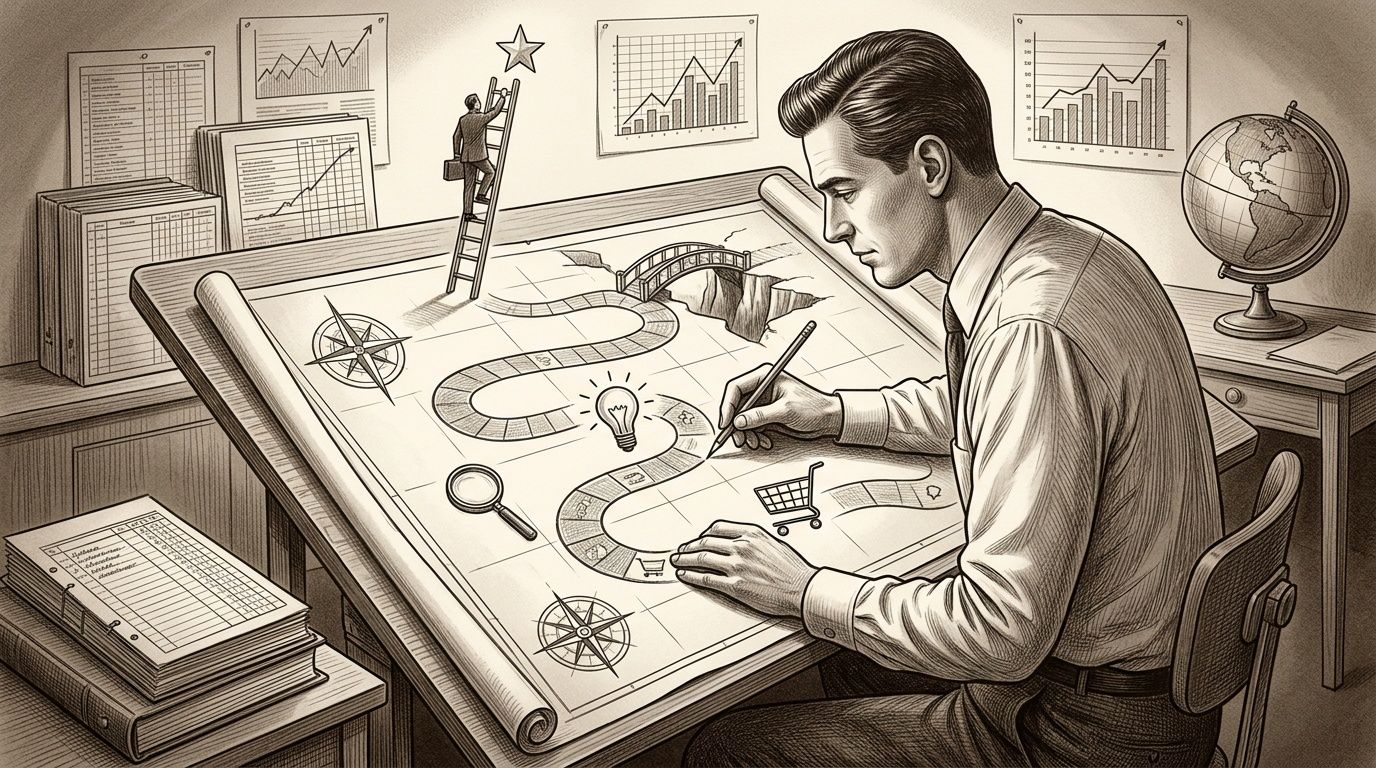
The starting point is brutally simple. Your company must identify where the intent drops off and why. In Chile, 73% of consumers abandon carts due to friction in the journey, and effective mappings can raise conversion from an average of 2.5% to 5-7% by identifying and resolving between 6 and 20 critical moments, according to the analysis by Lukkap on the customer journey.
If the map tries to solve everything, it will solve nothing. First define the business question.
Valid examples:
That focus prevents the map from becoming an academic exercise. It also forces the team to prioritize a real journey, not an idealized process.
A good map unites observable behavior with human interpretation. If you only use analytics, you will see what happened but not understand why. If you only use interviews, you will have opinions without a pattern.
Google Analytics 4, CRM, and commerce or lead data should answer simple questions: which channel starts the relationship, where navigation drops off, which pages sustain interest, where the intent breaks.
The sequence matters more than the isolated metric. A landing with many visits is not worth much if it delivers poorly aligned traffic to a product page that does not contain the central question.
Here the real reasons appear. Post-purchase surveys, brief interviews, commercial feedback, and behavior observation help detect tension.
Heatmaps and session recordings are usually especially useful for seeing where the user hesitates, ignores key elements, or leaves before interacting. If you want to go deeper into that visual reading, this content on a website heatmap helps explain why certain areas of the site attract attention and others simply do not exist for the user.
Practical rule: if the internal team cannot name three concrete frictions per stage, it still does not understand the journey.
One of the most common mistakes is mapping "web, email, social, sales" and believing that is enough. It is not. A channel does not explain a decision.
What matters are the moments. The instant the customer discovers a need. The moment they compare two options. The exact point where they doubt the price, the shipping, the form, or the brand's trustworthiness.
An executive map should include at least these elements:
Map elementWhat it should showStageWhere the customer is in their journeyActionWhat they are really trying to doQuestionWhat they need to resolve before advancingFrictionWhat obstacle stops themBusiness impactWhat revenue, lead, or retention is at riskOpportunityWhich decision is worth prioritizing
Many companies mix both models and end up with a useless map. The B2B journey is usually longer, with multiple actors and internal validations. eCommerce tends to concentrate the decision in less time, but with more sensitivity to visual friction, trust, and speed.
That changes the executive reading.
A serious map ends in a list of priorities. Not in a pretty presentation.
Define which frictions have the greatest economic impact, which are easy to solve, and which depend on several areas. Then assign owners. If no one is in charge, the map dies the next day.
A customer journey map without operational activation is a diagnostic piece without treatment. It serves to describe the problem, but not to capture growth. Leadership needs to translate findings into concrete decisions about experience, architecture, content, and platform.
The most sensitive phase is usually consideration. There the customer is already willing to evaluate, but does not yet trust enough to move forward. In Chilean eCommerce, optimizing consideration with detailed product pages and social proof increases conversions by 20-30%. In addition, reducing friction with load times under 2 seconds on Shopify and local testimonials reduces cart abandonment by 25%, according to this analysis on digital customer journey and customer experience.
If the journey shows that the user arrives, looks, and does not decide, the company does not need more traffic. It needs more perceived certainty.
The right decisions at this stage usually fall into four fronts:
This is not a matter of aesthetics. It is a matter of profitability.
Not all platforms enable the same improvements at the same speed. That has strategic implications.
When the map shows friction in product, cart, or checkout, Shopify lets you activate social proof, commercial structure, and speed improvements in an orderly way. Its strength is not in "having apps," but in reducing operational complexity so the team can prioritize impact.
Webflow makes sense when the brand needs a more controlled experience in storytelling, navigation, or visual differentiation. It is especially useful in journeys where the problem is not only transactional, but also about comprehension and positioning.
This ecosystem works well when the company needs flexibility, content integration, and broader customization. But that freedom demands more judgment. Without clear governance, the experience fragments quickly.
For executives, the question is not which platform is trendy. The question is which one lets you correct most quickly the frictions the map has already detected.
Many teams still treat UX as something that "beautifies" execution. It is a management mistake. User experience defines how much mental effort it takes to move forward.
A profitable journey reduces cognitive load. It does not force guessing, does not hide critical information, and does not punish the user with unnecessary steps. This perspective on UX and UI helps explain why design and performance should not be separated in the leadership discussion.
If the user needs to think too much to buy, compare, or request contact, the business is already losing.
Do not activate twenty ideas at once. Activate the ones that move intent at the point of greatest leakage.
A simple way to prioritize:
Map findingStrategic readingRecommended type of actionLots of visits, little evaluationThe message attracts but does not convinceImprove proposition, evidence, and structureLots of evaluation, little progressThere is interest, but doubt persistsReinforce trust and differentiationHigh intent, low closeThe decision breaks at the endSimplify purchase or next stepInitial purchase, little returnIt sells, but does not retainRedesign post-sale continuity
The map does not replace CRO or UX. It organizes them. It gives them economic context and prevents the team from optimizing secondary elements while the real blockers remain intact.
Many companies do the most visible exercise and skip the most valuable one. They draw the customer journey, present it internally, and then do not set up a system to track it. That is the mistake that empties the whole effort of value.
According to the analysis on customer journey map mistakes, one of the most serious is "not measuring the results and acting on them." In the Chilean context, moreover, there is a critical gap between creating the map and instrumenting KPIs by stage, which leaves a static document with no long-term usefulness, as this article on basic mistakes when building a customer journey map warns.
A committee can agree that there is friction. That is not enough. Leadership needs to see whether that friction improves, worsens, or shifts when decisions are made.
The customer journey should have its own dashboard. Not one full of metrics by accumulation, but one designed to read progress between stages.
Journey StageStrategic ObjectiveMain KPIExample Measurement ToolDiscoveryAttract traffic aligned with the propositionTraffic quality by channelGoogle Analytics 4ConsiderationSustain interest and reduce doubtNavigation depth and progress toward key pagesGoogle Analytics 4 and heatmapsDecisionProtect purchase or contact intentPurchase completion or form submissionAnalytics, CRM, eCommerce platformRetentionFavor continuity and repurchaseRepurchase, usage, support qualityCRM, automation, supportAdvocacyTurn satisfaction into recommendationNPS and referral feedbackSurveys and CRM
You do not need to turn the board into an analytical team. But it does need to ask the right questions.
Measuring the customer journey does not consist of accumulating dashboards. It consists of connecting behavior, decision, and economic result.
The customer journey does not improve through isolated intuition. It improves with a disciplined cycle.
This cycle forces the company to stop discussing opinions as if they were strategy. When it works, marketing, product, sales, and experience start speaking the same language: impact.
Companies that mature digitally stop asking "how do we bring more people to the site" and start asking "how do we extract more value from each visit, each customer, and each interaction." That change of question improves the quality of decisions.
The customer journey matters because it connects acquisition with profitability. It unites marketing with experience, experience with conversion, and conversion with retention. When managed well, it stops being a conceptual map and becomes a growth system.
The organization starts detecting leaks before spending more. It also stops celebrating isolated metrics that do not move the business.
Three critical fronts get better organized:
The advantage is in operating on it. Companies that update, measure, and activate it learn faster than their competition. And that speed of learning is a real advantage.
In the coming years, personalization and artificial intelligence will expand the ability to adapt journeys, detect signals, and anticipate friction. But the base does not change. If the company does not understand the journey, technology will only scale disorder.
Whenever relevant business conditions change. A redesign, a new product line, channel changes, a drop in conversion, or a change in the commercial process are sufficient reasons.
If none of that happened, it is still worth reviewing it periodically. The map should not stay frozen while customer behavior evolves.
Yes. In fact, in B2B it is usually more valuable because the journey includes more actors, more doubts, and more internal validations. The mistake is copying an eCommerce logic and applying it to consultative leads.
In B2B, the customer journey helps detect whether the site clarifies the proposition, filters demand better, and better prepares the commercial conversation.
It must be led by someone with business vision and the ability to coordinate areas. It is not enough to leave it to marketing, UX, or sales separately.
The best leadership combines commercial reading, data, experience, and the ability to prioritize. Without that integration, the map ends up reflecting the partial view of the area that talks the most.
Then you already have pieces of the puzzle, not the solved puzzle. The tools show events and records. The map organizes that data around customer decisions.
Having software is not the same as understanding the journey.
It is probably where it adds the most value. When traffic already exists, the problem is almost always in friction, message, trust, or continuity. There the customer journey delivers a more profitable reading than continuing to buy visibility.
Yes. Excluding after-sales is a strategic mistake. The initial purchase does not summarize the relationship. If the experience after buying is weak, the pressure on acquisition rises and the customer's accumulated value drops.
A very simple one. If the team cannot look at the map and decide what to change first, that map is not helping to run the business.
If your company already has traffic but is not capturing its full commercial potential, it is time to stop treating the customer journey as theory. At Bigbuda, we help eCommerce, marketing, and leadership teams turn data, UX, and experimentation into measurable growth.