










Solutions
Explore how to grow

The most repeated recommendation about WhatsApp Business is also the most superficial: "use it because it's free." That advice is good for opening an account. It isn't good for designing a commercial operation.
This is amplified by a good digital marketing service.
If you run eCommerce, marketing or sales, the right question isn't what WhatsApp Business does. The question is what it's for within your revenue engine. In Chile, the channel is already part of the customer's everyday behaviour. According to the analysis cited by Cámara on DataReportal, as of January 2024 there were 15.95 million WhatsApp user identities in Chile, equivalent to 79.0% of the total population. That changes the conversation. You aren't evaluating an additional app. You're evaluating a touchpoint that already lives in the buyer's pocket.
For many companies, WhatsApp doesn't solve the acquisition problem. It solves something more urgent: the leakage between interest and purchase. That's where many brands lose sales without realizing it. They have traffic, forms, campaigns and catalogues. What they don't have is a conversational layer capable of clearing up doubts and pushing the close.
The strategic mistake is treating it as messaging. The smart use is treating it as commercial infrastructure. If you want to understand where it fits within the customer lifecycle, WhatsApp Business isn't just support. It's validation, accompaniment and closing.
Using WhatsApp Business to convert, and not just to reply, changes the channel's function within the business. It stops being a useful inbox and starts operating as a commercial piece that reduces friction, accelerates decisions and recovers sales the website alone doesn't close.
That change matters because many companies integrate it too late. They activate WhatsApp when there are already complaints, delays or upset customers. That's a mistake. The channel performs better when it appears before the abandonment: in the doubt about the product, in the question about shipping, in the final validation before payment. That's where it influences revenue.
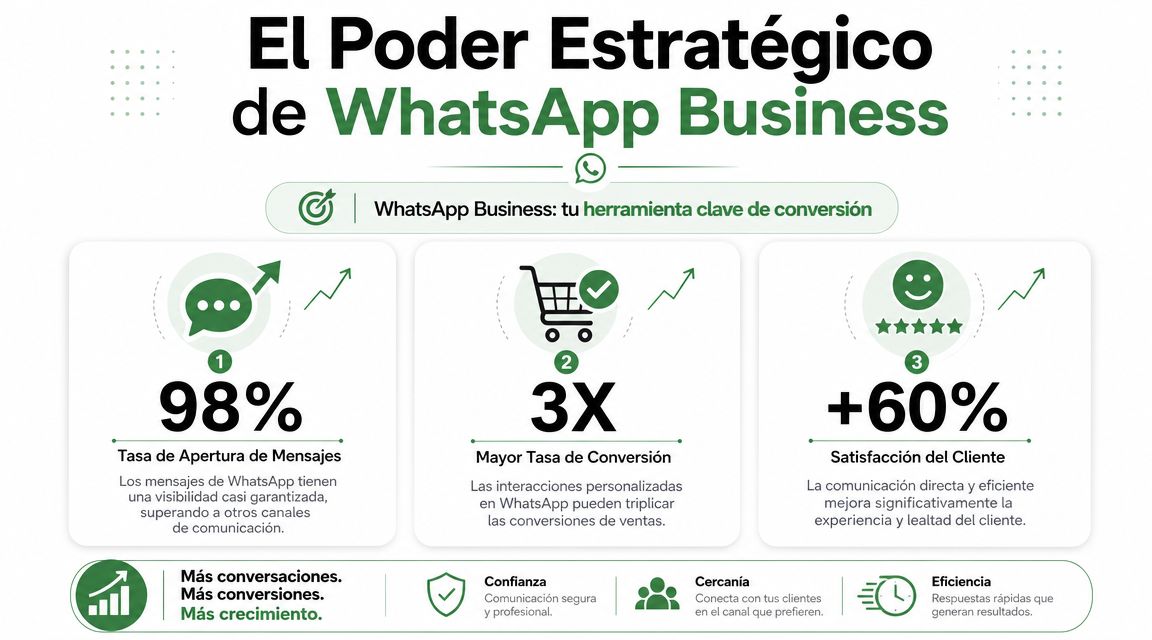
WhatsApp Business fits well in commercial operations with visible friction. For example:
In those cases, WhatsApp doesn't replace the website or advertising. It does something more useful. It connects intent with action at the exact moment. And if it's integrated with a customer lifecycle management strategy, it stops being an isolated channel and starts to sustain acquisition, closing and repurchase.
A simple rule. If your company uses WhatsApp only to put out fires, you're leaving money on the table.
The relevant difference isn't communication versus support. The difference is reactive operation versus designed conversion. A messaging channel with no process behind it only moves messages. A channel connected to sales moves decisions.
That's why it's worth looking at WhatsApp Business as a strategic asset and not as a free app that "is good for support." The free version handles basic order and closeness. It's fine to start with. But if the channel starts to concentrate inquiries, leads and closes, it also starts to expose operational limits. That's where the real business question appears: not just what WhatsApp Business is for, but for how long the app suffices before it stalls growth.
The most expensive mistake isn't using WhatsApp Business. It's believing the app and the platform are the same thing.
For a business, WhatsApp Business isn't a single product. It's two layers with distinct functions. The free app handles basic commercial order. The API platform handles operation, control and integration. If you mix the two under the same label, you'll make decisions that are comfortable in the short term and expensive when volume increases.
The difference matters because it changes the channel's role within the business. With the app, WhatsApp serves to reply, classify and close opportunities manually. With the API, it becomes part of the commercial system. It no longer depends on a phone or a person. It depends on processes, rules, automation and connection with the rest of your stack.
The business app includes what's needed to start well: business profile, catalogue, labels, quick replies, automated messages and basic metrics. For an SME with low volume and a simple commercial operation, it does its job.
The problem appears when the channel stops being support and starts concentrating demand. More conversations mean more risk of delay, more handoffs between people and less consistency in the response. That's when the app stops being a sufficient solution. It becomes an operational constraint.
FeatureWhatsApp Business AppWhatsApp Business Platform (API)Main focusSupport and basic management for SMEsConversational operation at scaleType of useMore manualMore integrable and automatableTeam involvedUsually fits small operationsSuitable for several agents or departmentsAutomationAutomated messages and quick repliesMore advanced automationIntegrationsLimitedIntegration with CRM, eCommerce and other systemsOperational visibilityBasic statisticsGreater traceability and controlStrategic roleOrganize and respondScale, measure and coordinate
The app fits well in three scenarios: businesses with few salespeople, low conversation volume and commercial follow-up still manageable from a single number.
The API is worth it when you already need to assign chats among agents, record every interaction, automate steps of the commercial process or connect WhatsApp with sales, support, inventory or marketing. That change isn't technical. It's strategic. It marks the moment when WhatsApp stops being a support tool and becomes revenue infrastructure.
If your team already needs traceability and coordination, it's worth reviewing how a CRM works to organize the commercial relationship and lead follow-up. That's where you understand the real difference between using WhatsApp as a channel and operating it as a system.
Starting with the app is a good decision. Staying on the app when the business already demands traceability, automation and teamwork is a bad decision.
The real usefulness of WhatsApp Business isn't in accumulating features. It's in removing friction at moments that define a sale: the first response, resolving doubts, follow-up and the close.
That's why it's worth assessing each feature with a simple question: does it shorten the path between intent and purchase, or does it just organize the chat better? That difference matters. Organizing conversations improves the operation. Turning conversations into revenue improves the business.

A complete profile serves a concrete commercial function. It reduces initial distrust and avoids basic questions that delay the purchase. Hours, address, category and website help the customer quickly validate whether they're talking to a serious business.
The catalogue also contributes more than it seems. It doesn't just serve to show products. It serves to keep interest inside the conversation, without forcing the customer to leave the chat to ask for photos, prices or details over and over. Fewer jumps. More progress.
In businesses with short sales cycles, that difference shows up fast.
Automation in the free app works well as long as it resolves repeated tasks and doesn't try to replace a commercial conversation that requires context.
This improves commercial discipline. It also frees up the team's time for conversations with real purchase intent. If the business is already working on sales-oriented AI marketing automation, WhatsApp is a logical channel to apply that criterion with operational focus and not with empty automation.
Responding quickly doesn't just improve support. It improves the probability of closing.
The strategic answer to "what WhatsApp Business is for" is this:
Here a point appears that many articles overlook. These features generate value as long as the volume remains manageable. When conversations grow, the same structure that helps today can start to stall. A catalogue organizes. Quick replies save time. Labels give basic visibility. But none of those features solve coordination among several agents, full traceability or automation connected with CRM, eCommerce or after-sales.
That's when WhatsApp stops being just a practical channel and starts to demand a strategic decision. The free app is good for starting. It isn't good for scaling without friction.
The most valuable use cases aren't the flashiest. They're the ones that unlock revenue where there's friction, slowness or commercial disorder today.
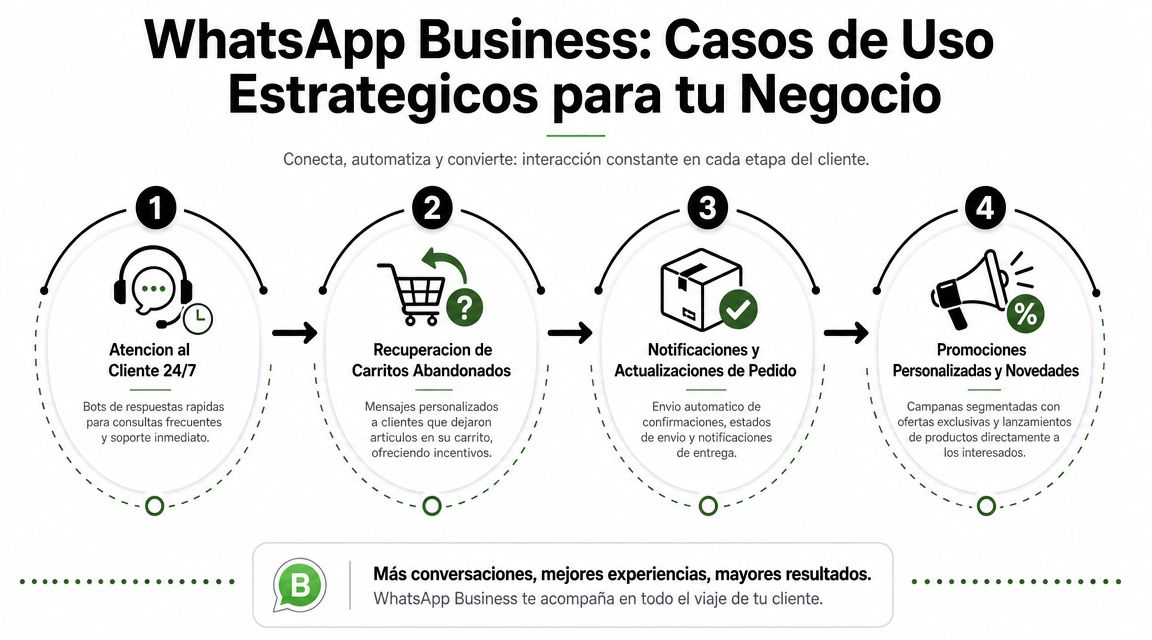
A common scenario: the customer browses, adds products, compares and stalls. They don't always abandon over price. Sometimes they abandon because no one resolved a simple doubt about size, stock, shipping or returns.
At that point, WhatsApp Business serves as a rescue channel. Not with invasive messages, but with contextual assistance. A timely contact can turn a doubtful purchase into a closed sale. The difference is in the tone and the moment. If the message feels like pressure, it annoys. If it feels like help, it sells.
A good conversational flow doesn't chase the customer. It removes mental work for them.
When the product requires explanation, the website alone falls short. That happens in technical categories, services with several options or purchases that involve more than one decision-maker.
There, WhatsApp Business works as a lightweight sales room. The rep can clarify alternatives, filter needs and lead the conversation toward a safer decision. That applies both to SMEs that sell via Instagram and to B2B companies with forms that convert poorly.
A useful format in these cases:
Another underrated use is after-sales. Confirmations, order statuses and updates reduce customer anxiety and also offload the support team. When a company doesn't inform, the buyer asks. And when many buyers ask the same thing, the team collapses.
This kind of use doesn't just improve experience. It also protects operational capacity for conversations of higher commercial value.
For a complementary perspective on the channel, this resource offers a useful visual summary:
An SME usually starts well with WhatsApp because the founder answers everything. The problem appears when sales, support and follow-up live on the same number with no shared process.
At that stage, WhatsApp Business serves to impose a minimum of order: separate conversations, classify opportunities and professionalize the contact. It isn't sophistication. It's control. And without control there's no healthy growth.
The free app doesn't fail because it's bad. It fails when the company asks it for something it wasn't designed for.
That's the point almost no one explains well. The real cost of WhatsApp Business isn't in downloading the app. It's in what happens afterward, when volume grows and the operation gets trapped in a tool meant for a smaller scale. The official WhatsApp Business documentation clearly distinguishes between the free app for SMEs and the platform/API for medium or large companies. It also makes clear that the change becomes necessary when there's more than one person responding, when integration with CRM or Shopify is required, or when incoming messages exceed human capacity, as the official comparison between WhatsApp, WhatsApp Business and its platform points out.
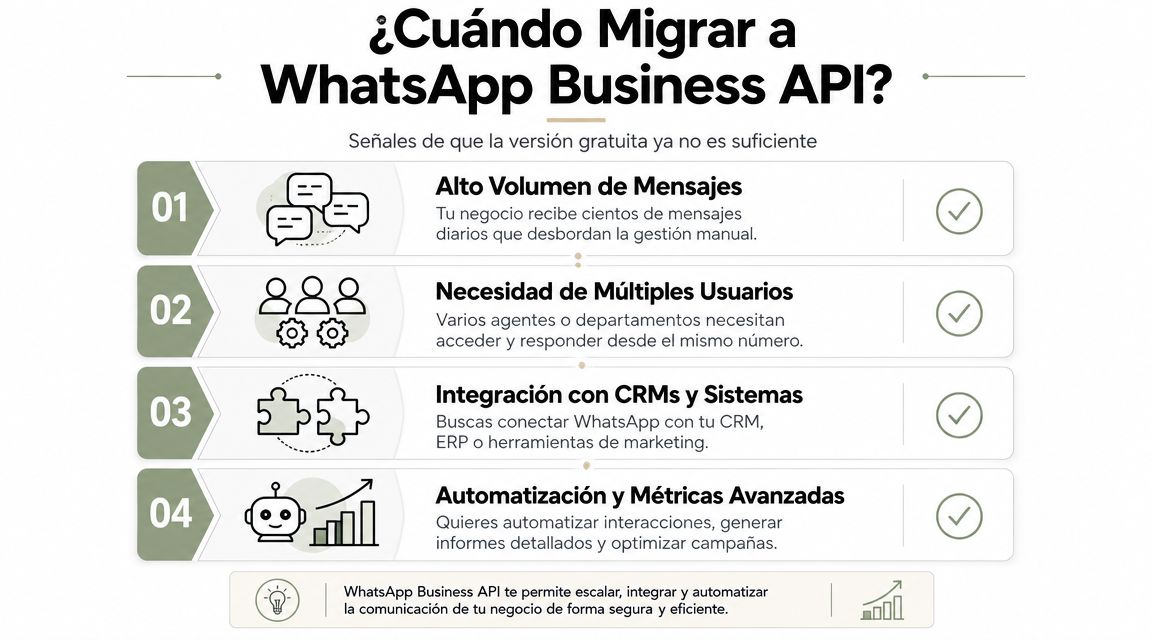
If you recognize several of these symptoms, you're no longer evaluating an improvement. You're facing a structural constraint.
Many companies defend the app because it doesn't pay a license. But that view is too short. The real cost appears in the form of unclosed sales, inconsistent experience and opaque management.
Think about these silent losses:
Operational frictionCommercial impactLate responsesLeads that cool offNo shared historyRepetition and customer fatigueLow team visibilityHard to detect failures or trainNo integration with systemsFragmented follow-upManual volume managementTeam saturation
If your operation depends on individual heroics to respond on time, you no longer have a commercial channel. You have a vulnerability.
The right decision isn't to migrate "someday." It's to migrate when the cost of staying starts to eat into the channel's value.
A simple criterion:
That's the real tipping point. It isn't technological. It's about the business.
The right implementation doesn't start with tools. It starts with a commercial hypothesis. What friction do you want to reduce? What part of the revenue do you want to protect or improve?
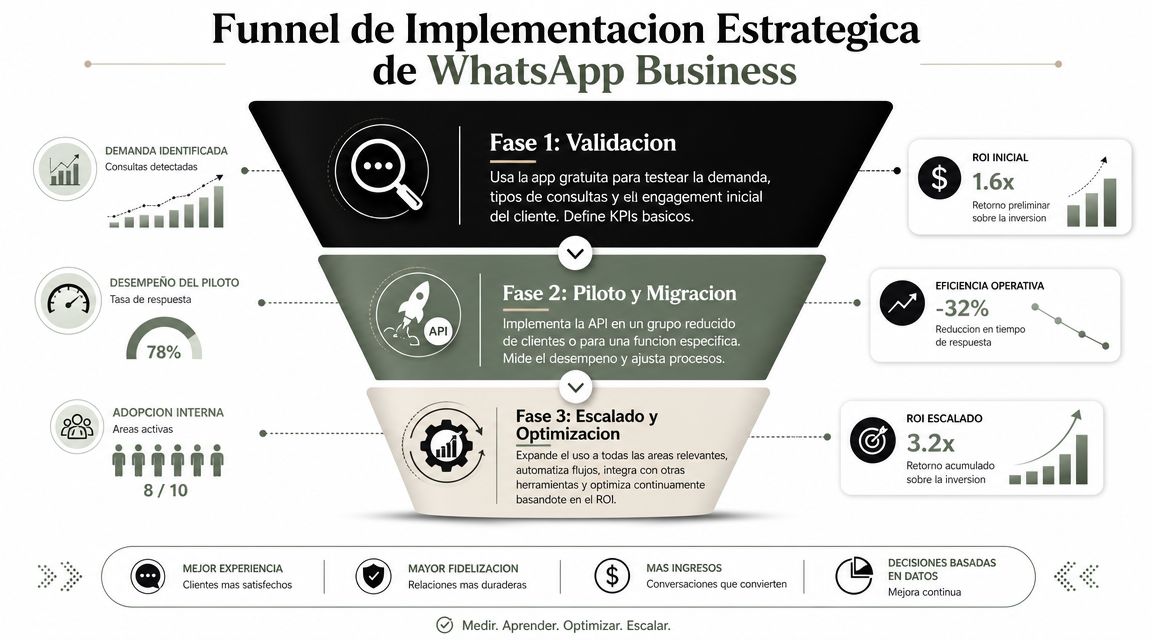
Start with the app if you need to validate demand, types of inquiry and internal capacity. But do it with concrete objectives, not as a trend.
A good pilot seeks to answer questions like these:
At this stage, the goal isn't "to have WhatsApp." The goal is to discover whether the channel improves closing, support or recovery.
If the channel proves its value, it's time to organize the operation. That's where migration planning, integration and channel governance come in. It can be done with specialized providers, with technology partners or with teams that already work on conversion, automation and eCommerce platforms. Bigbuda, for example, works on conversion optimization, digital flows and scalable systems for sites and online stores, which is the kind of context where WhatsApp stops being an accessory and becomes part of the commercial system.
The right metrics aren't messages sent or chats opened. Measure business results:
Measure WhatsApp as a revenue channel or a revenue-protection channel. If you measure it as simple messaging, you'll under-invest in or overstate its value.
Don't launch the channel without an internal owner. Don't mix support, sales and after-sales without rules. And don't wait until there's chaos to think about integration.
The healthiest sequence is simple: validate, design, scale, optimize.
WhatsApp Business pays off when it stops being treated as a "useful" app and starts being managed as a conversion asset. The free app is a good starting point. It isn't the destination for a company that wants to grow without losing commercial control.
The decision between app and API isn't technical. It's strategic. It depends on how much weight the channel carries in sales, support and follow-up. When implemented with judgment, WhatsApp doesn't just reply to messages. It organizes the operation, reduces friction and sustains digital growth with less leakage between interest and close.
If your company already generates traffic but doesn't convert it with the consistency it should, Bigbuda can help you assess where WhatsApp fits within your commercial system, which frictions are worth attacking first and when it makes sense to move from a useful app to an infrastructure that actually scales.
Related reading: Learn How to Use WhatsApp Business and Sell More
It captures intent when the customer does not want to fill a form yet, recovers opportunities that cool off over simple doubts or slow follow-up, standardizes support so the business does not depend on each salesperson's style, and accelerates decisions where a good conversation beats another page.
The free app covers support and basic management for SMEs: profile, catalogue, labels, quick replies and basic statistics. The API platform is for conversational operation at scale, with more advanced automation, integration with CRM and eCommerce, greater traceability and coordination across several agents or departments.
When several people respond from the same commercial front, sales and support do not share context, there is no lead traceability, follow-up depends on human memory, or the store and CRM live separately from the chat. Migrate when the cost of staying eats the channel's value.
Not messages sent or chats opened. Measure conversations that end in a sale, recovered leads that would have gone without follow-up, the commercial value of after-sales or closing interactions, response time at critical funnel moments, and the quality of the handoff between marketing, sales and support.
Rescuing carts abandoned over doubts about size, stock, shipping or returns; consultative selling for complex tickets, where the rep works like a lightweight sales room; after-sales confirmations and order statuses that reduce support load; and growing SMEs that need order when sales and support share one number.
It is not a license fee: it shows up as unclosed sales, inconsistent experience and opaque management. Late responses cool leads, no shared history creates repetition and customer fatigue, low team visibility hides failures, and manual volume management saturates the team. That is a vulnerability, not a channel.