










Solutions
Explore how to grow

The most repeated advice about leads in marketing is still the same: get more traffic, expand reach, raise the budget and fill the funnel. The problem is that this logic usually hides a more expensive inefficiency. Many companies are not limited by a lack of initial demand, but by the way they manage the interest they already capture.
Need help with this? Explore our list of the best digital marketing agencies in Chile.
The uncomfortable question is not how many leads are missing. The right question is how many are being lost to internal friction, slow sales response or poor prioritization. An analysis of real estate lead capture raises precisely that under-addressed angle: when the first response takes more than 15 minutes, conversion is already hurt, and the recommended follow-up runs between 7 and 10 multichannel touches over 10 days (analysis on cold or poorly handled leads). In other words, a significant part of the problem is not at the top of the funnel, but in the stretch where marketing and sales turn intent into a real opportunity.
For general management, this changes the budget conversation. If current traffic already contains untapped intent, the next unit of investment should not necessarily go to acquisition. It can go to coordination, scoring, follow-up, automation and conversion architecture. That shift in focus is the same one underlying a strategy of CRO in Chile to sell more without more traffic: extracting more value from the existing flow before buying more volume.
In Chile, the pressure to convert better no longer comes only from marketing. It comes from the whole business. When e-commerce reached US$ 11,933 million in 2023 and grew 7.1% versus 2022, the demand on every digital visit and every captured contact rose as well (digital commerce and lead generation data from HubSpot). More digital activity does not guarantee more profitable growth. It only increases the cost of wasting opportunities.
The management error appears when the board looks at the funnel as a volume machine. Under that logic, more impressions equal more business. But a lead does not produce value just by existing in a CRM. It produces value when the company can classify it, prioritize it, respond on time and move it toward a decision.
Many companies call “cold lead” what is actually a poorly managed lead.
That nuance matters because it changes the diagnosis. If the friction is in response, follow-up or qualification, buying more traffic only amplifies the waste. It is like speeding up a production line that already has quality-control failures.
There is a direct financial implication. Every additional peso invested in acquisition without resolving the middle of the funnel raises the volume of contacts, but not necessarily the creation of opportunities or revenue. For a company under efficiency pressure, that is a poor allocation of capital.
Treating a lead as a business asset changes the way you allocate budget, prioritize follow-up and estimate revenue. It also changes the management conversation. Instead of asking how many contacts entered the CRM, the relevant question becomes how many of those contacts have a real probability of advancing and how much economic value they concentrate.
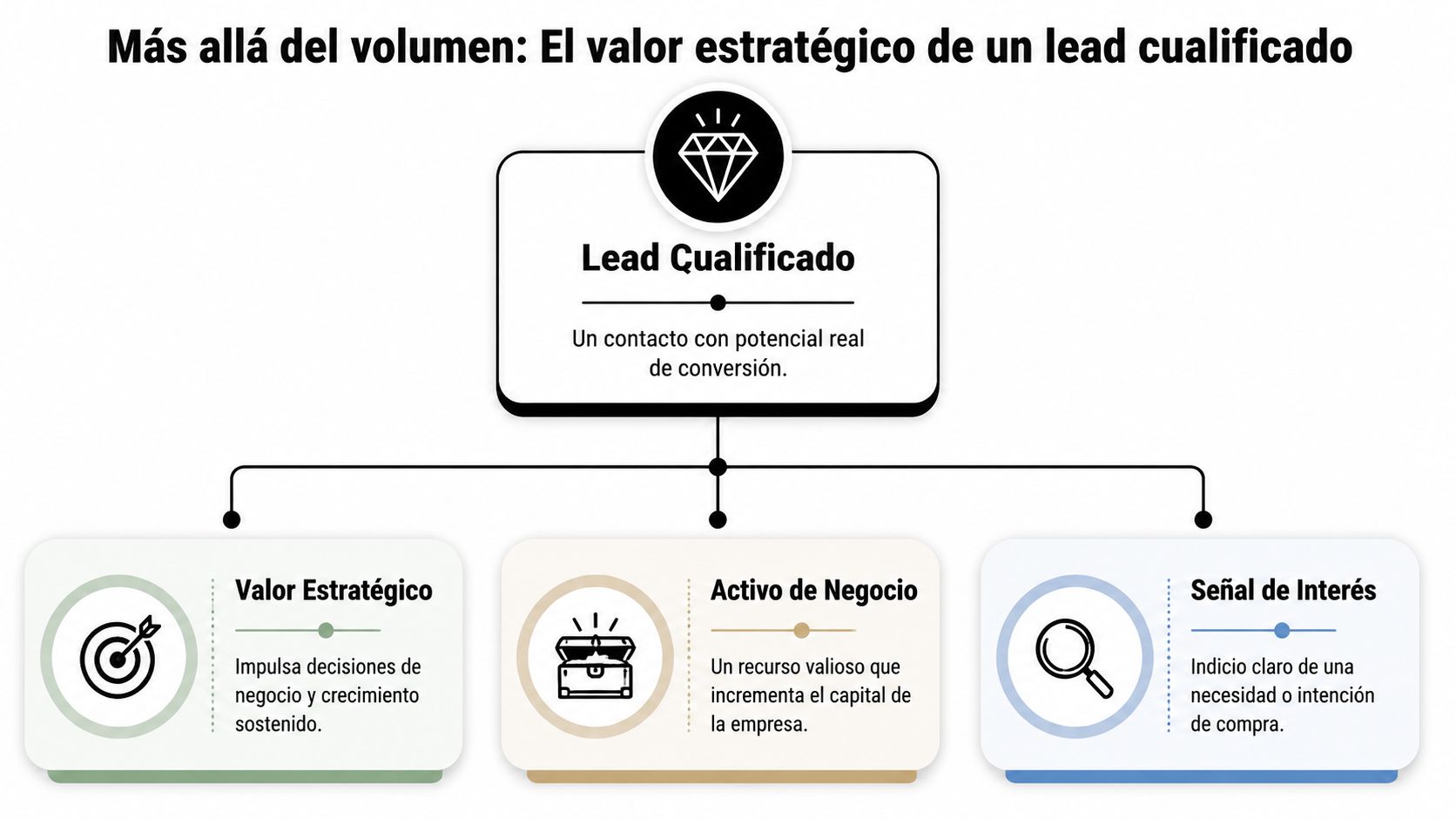
A qualified lead serves a function closer to a signal than to a simple administrative entry. It reduces uncertainty. It indicates potential fit with the offer, proximity to a decision and the level of sales effort required. Under that logic, two leads with the same acquisition cost can have very different financial impacts.
That difference usually stays hidden when marketing reports aggregate volume. A content download, a newsletter subscription, a demo request and a pricing inquiry coexist in the same figure, even though they anticipate very different commercial behaviors. The problem is not one of terminology. It is one of management.
A leadership committee that looks only at volume tends to reward channels that fill the database. A committee that looks at qualification can distinguish which channels produce useful intent and which only inflate activity.
Lead classification exists to improve decisions, not to add labels to the CRM. Separating contacts by maturity level allows scarce resources to be organized, especially sales time and follow-up capacity.
| Lead type | What it represents | What decision it enables |
|---|---|---|
| Lead | Detectable initial interest | Worth continuing to observe behavior |
| MQL | Interest that meets marketing criteria | Worth nurturing, segmenting and prioritizing |
| SQL | Enough readiness for sales intervention | Worth assigning sales time |
In businesses with a free trial or a digital product, the PQL also appears. There the signal does not come from a form, but from real product usage. The logic is the same. The greater the evidence of intent, the greater the operational priority.
The companies that convert best manage their contacts as a portfolio of opportunities with different expected value. That view produces concrete effects on three fronts.
The strategic consequence is less obvious, but more important. If a channel generates many leads and few MQLs or SQLs, the problem is not always in the campaign's creative. Sometimes it is in a proposition poorly aligned with demand, in targeting that is too broad, or in a capture process that rewards quantity over intent.
That is why it pays to connect lead management with a broader view of the commercial journey. A valuable contact does not arise in isolation. It arises within a process where context, timing and friction matter as much as the initial capture. That approach is better understood by reviewing the customer lifecycle and its conversion points.
The board does not gain useful visibility by receiving more reported forms. It gains visibility when it can answer questions like these: what proportion of leads advances, how long that advance takes, which sources contribute contacts with intent, and where value is destroyed before reaching sales.
That is where the shift in focus that many companies in Chile still postpone appears. The main opportunity is not always in opening the top of the funnel wider. It usually lies in designing a system that extracts more value from the traffic and leads already captured. If the company still mixes low- and high-potential contacts in the same service queue, the cost of generating more volume may exceed the benefit.
A qualified lead, then, is not just an operational metric. It is a unit of decision. And when that unit is well defined, the business stops buying activity and starts building performance.
Most funnels fail for a simple reason. They treat every contact as if they were asking the same question at the same moment. They are not. An anonymous visitor explores. An MQL compares. An SQL seeks to reduce uncertainty in order to decide. If the company answers everyone the same way, it wastes context.
When you look at the lead as a trajectory and not as an event, management improves. Each stage demands a different response.
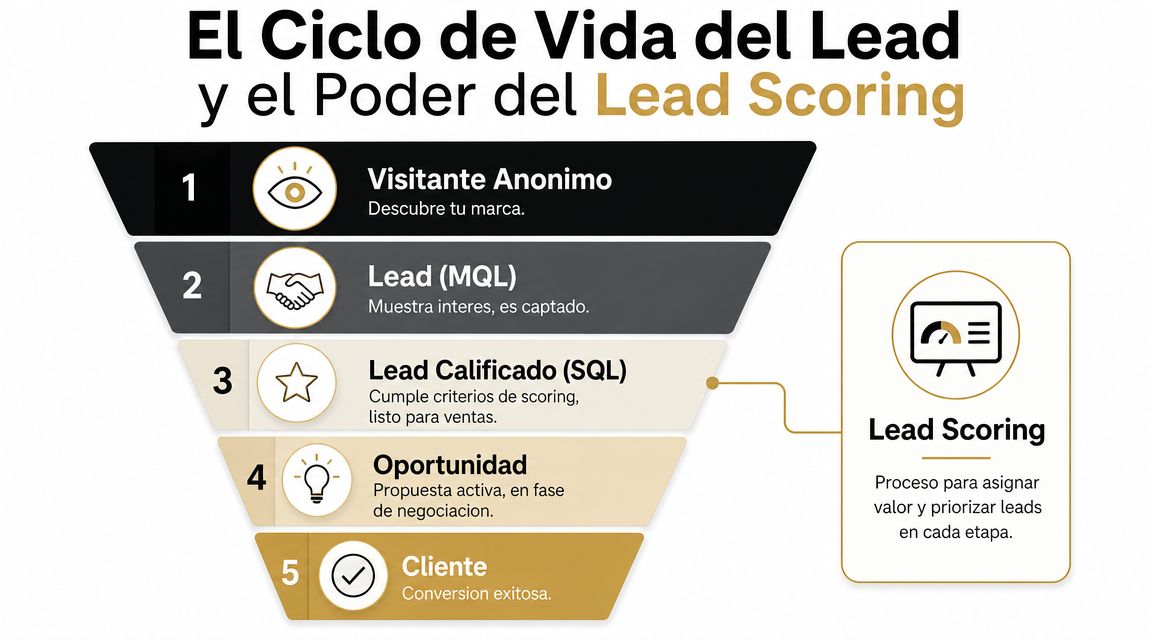
The lifecycle can be read as a chain of uncertainty reduction:
Anonymous visitor
Has not yet provided data. There is only evidence of attention.
Lead or MQL
Has already left information and meets initial signals of interest.
SQL
Reaches the threshold that justifies sales intervention.
Opportunity
There is an active conversation and a concrete possibility of business.
Customer
The decision has already happened. A new stage of expansion or retention begins.
That sequence looks more like a handoff system than a campaign. Marketing does not “generate” value on its own. It prepares it. Sales does not “rescue” value on its own. It converts it. If both teams do not share criteria, the funnel breaks at the point of transfer.
A useful framework for thinking about this transition is the customer lifecycle in digital businesses, because it forces you to connect acquisition, evaluation and the subsequent relationship under a single logic of value.
Lead scoring is usually presented as a technical function of the CRM. In reality, it performs a more important task. It translates behavior and information into operational priority. It is the mechanism that keeps sales from working on intuition and marketing from qualifying by volume.
It is not about building a complex model from day one. It is about agreeing on which signals matter. Some come from the contact's profile. Others from behavior. Others from the commercial context.
| Signal | What it suggests | Strategic use |
|---|---|---|
| Contact attributes | Fit with the ideal customer | Filter relevance |
| Digital behavior | Intensity of interest | Prioritize follow-up |
| High-commitment action | Closeness to a decision | Activate sales |
| Inactivity or bounce | Risk of loss | Adjust nurturing |
Good scoring does not answer “who filled out a form.” It answers “who should sales call now.”
This visual resource sums up the progression logic well:
Without scoring, teams usually fall into three distortions:
With scoring, the company can define intervention thresholds. It does not eliminate human judgment, but it does organize the commercial effort better. A lead still understanding their problem requires education. One who has already requested a demo or contact requires speed and context. Mixing them in a single cadence is inefficient.
The distinction between a cold lead and a poorly managed lead is not philosophical. It is operational. If a contact shows clear signals and the company responds late, the coldness was not in the demand. It was in the process.
That is why scoring should not end in a label. It must trigger an action, an internal SLA, a follow-up sequence or a sales handoff. If it does not change the team's behavior, it is not fulfilling its function.
The right metrics are not there to decorate dashboards. They are there to answer business questions. In lead management, that means leaving behind activity indicators and focusing on the points where value is created or lost.
In Chile, the most effective performance teams measure lead-to-customer conversion rate, cost per lead (CPL), average conversion time and the progression between MQL and SQL to identify where value is lost and optimize investment toward channels with better purchase intent (metrics framework for leads and conversion).
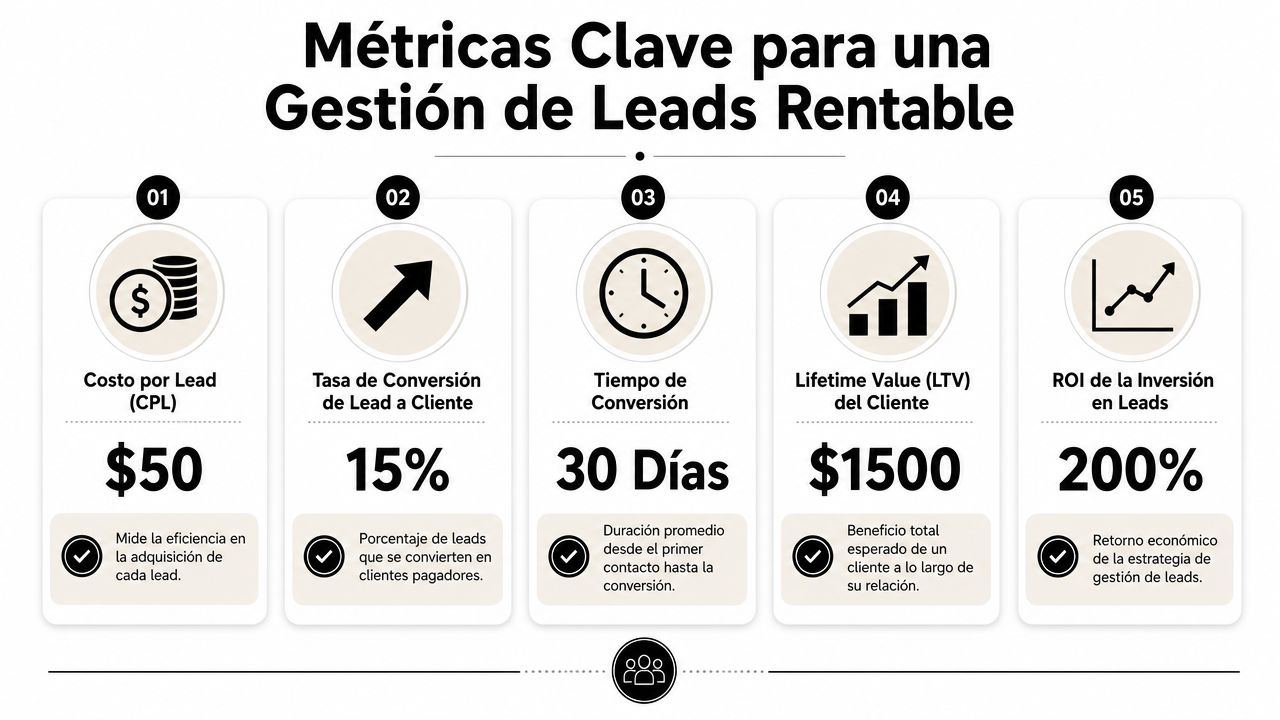
Not all metrics deserve the same level of attention. Some change decisions.
How much does it cost to capture a usable opportunity?
CPL should not be read in isolation. A low CPL can hide weak leads. A higher CPL can be profitable if it brings better intent.
Where does the funnel get stuck?
The step from MQL to SQL shows whether marketing is sending useful signals or operational noise.
How long does the company take to convert?
Average conversion time affects cash, predictability and sales workload.
What proportion ends up as a customer?
The lead-to-customer conversion rate reveals the total efficiency of the system, not just of one campaign.
Many reports confuse visual precision with strategic clarity. An executive dashboard should let you see whether the problem is in capture, classification, handoff or close.
| Metric | Question it answers | Risk if misinterpreted |
|---|---|---|
| CPL | How much do we pay to enter the funnel? | Rewarding cheap but useless volume |
| MQL to SQL | Is qualification working? | Blaming sales for weak leads |
| Lead to customer | Does the whole system convert? | Celebrating activity without revenue |
| Conversion time | How fast do we monetize demand? | Underestimating operational friction |
Executive reading: if CPL drops but final conversion does not improve, the efficiency is apparent, not real.
A company can have campaigns with good surface performance and, even so, a poor funnel economy. That happens when each channel is evaluated by its own clicks, forms or cost, without checking what quality it contributes to the next stretch.
The best channel is not always the one that generates the most leads. It is usually the one that generates leads that advance with less friction and greater clarity of intent. That is why measurement by stage matters more than aggregate volume.
When the leadership team installs these metrics as a discipline, three healthy adjustments occur:
That is when the conversation matures. It no longer revolves around “we want more traffic.” It revolves around “we want more value per interaction.”
The tactical discussion is usually poorly framed. It is not about choosing between SEO, paid media, email or automation as if they were isolated pieces. The strategic question is different: which combination attracts and develops better opportunities with less waste?
The available data points in a clear direction. Taboola summarizes that content marketing costs 62% less than outbound and that leads obtained through content are 6 times more likely to convert. In addition, HubSpot indicates that email marketing records an average open rate of 17%, a click-through rate of 4% and an average value per lead just below US$ 200 (content marketing and email marketing statistics). The implication is not tactical. It is financial. Nurturing and qualifying is usually more profitable than continuing to buy cold traffic.

Not all channels produce the same type of economic value.
Content and SEO usually build a cumulative asset. Each evergreen piece capable of attracting relevant intent keeps working beyond the campaign period. Paid media, on the other hand, buys immediate access. It can be valuable, but its effect depends on budget continuity and a solid conversion architecture behind it.
A company that depends only on paid traffic is like a business that rents its storefront every month. A company that combines content, SEO and nurturing builds part of its own demand asset.
Lead nurturing is underestimated because it does not always look spectacular in a sales presentation. However, it performs a critical function: it takes incomplete interest and moves it closer to a purchase conversation. That includes email marketing, automation, follow-up sequences and CRM.
The question is not whether the company “does email.” The question is whether it has a logic for maturing demand. A well-configured CRM, with segmentation and automation, allows that process to be organized. For teams that need that layer, a useful reference is understanding what a CRM is in marketing and how it organizes the relationship with leads.
Cold traffic buys attention. Nurturing buys time for intent to mature without getting lost.
Instead of asking “which channel brings the most forms,” it pays to evaluate each tactic under three criteria:
Quality of intent
Does the channel attract people who advance or only low-commitment curiosity?
Learning capacity
Does the system provide signals to improve targeting, message and timing?
Cumulative effect
Does the investment create an asset that keeps generating value after the campaign?
A firm can use paid media to accelerate demand, content to build preference and email to sustain the relationship. The error appears when a single channel is expected to do everything. Capturing, educating, qualifying and closing rarely happens in a single interaction.
The businesses that convert best do not necessarily run more tactics. They connect them better. An ad promises something. A page captures the right interest. The CRM classifies. Email nurtures. Sales steps in when the contact already has sufficient signals.
In that logic, providers like HubSpot, Salesforce, ActiveCampaign or custom implementations can play different roles. There are also specialized teams like Bigbuda, which works on conversion, automation, web design and performance to turn the same traffic into more commercial opportunities. The relevant point for a board is not the tool itself. It is whether the complete system reduces friction and improves value per visit.
The theory becomes clearer when observed in different contexts. An eCommerce and a B2B company do not manage leads the same way, but both share a structural truth: conversion depends on coherence between capture, experience and follow-up.
In Chile, a successful conversion architecture requires alignment between ad, landing page and follow-up. Landing pages must include visible forms, clear CTAs and conversion measurement in order to test and reduce CPL. In addition, lead-oriented SEO requires informational or transactional intent, evergreen content and technical optimization of speed, usability and indexing (technical framework on prospect generation and nurturing).

In eCommerce, the lead does not always take the classic form of “I want a call.” It can be a subscriber to a list, someone who activates a restock alert, a user who abandons a cart or a first-time buyer who enters a retention sequence.
The value logic changes depending on the moment:
| Moment | Lead type | Recommended decision |
|---|---|---|
| Discovery | Subscriber or initial registration | Educate and segment |
| Consideration | User with explicit interest | Reduce doubts and reinforce trust |
| Intent | Abandoned cart or inquiry | Respond quickly and remove friction |
| Post-purchase | Recent customer | Activate recurrence or cross-sell |
Here, the obsession with attracting more sessions can be misleading. If the store already receives enough visits, growth may depend more on capturing existing intent better and following it up with greater consistency.
In B2B, the lead usually goes through more stages before being ready for sales. It can begin with a content download, advance to a webinar, then to an exploratory conversation and finally to a formal request.
That journey forces a better distinction of maturity. A contact who consumes content does not necessarily want to talk to sales. One who requests a demo, proposal or evaluation is in another state. Treating both the same way damages the experience and distorts sales productivity.
In B2B, accelerating too soon is usually as costly as arriving late.
Even when the context changes, the pattern repeats:
An eCommerce tends to monetize more immediately. A B2B usually requires more nurturing and more coordination between areas. But in both cases, the main opportunity rarely lies in “more traffic” in the abstract. It lies in extracting more value from current traffic with a better conversion architecture.
The management of leads in marketing matures when the company stops thinking of capture as an end and starts thinking of conversion as a system. That shift seems conceptual, but it has direct effects on budget, sales productivity and revenue predictability.
The first decision is to redefine the object of analysis. A lead is not a captured data point. It is an economic signal with a different probability of becoming business. As long as that difference does not exist in the reports, marketing will keep celebrating volume and sales will keep questioning quality.
The second decision is operational. If the organization does not respond quickly, does not prioritize by intent and does not maintain coherent follow-up, it will keep losing opportunities already acquired. In that scenario, more investment in traffic only amplifies a leak.
The third decision is architectural. The businesses that sustain digital growth do not depend on a single brilliant tactic. They combine capture, qualification, nurturing, measurement and sales handoff under a single logic. That demands discipline more than novelty.
A reasonable roadmap for boards and sales leadership includes three moves:
The goal sought is not a larger database. It is a more profitable process. That is the difference between marketing that uses up budget and marketing that improves the business's performance.
If your company already generates traffic and interest, but is not converting at the expected level, Bigbuda can help review the complete conversion architecture, from site and forms to automation, performance and coordination between marketing and sales, with a focus on selling more without depending solely on buying more visits.
A lead shows detectable initial interest and is worth observing. An MQL is interest that meets marketing criteria, so it deserves nurturing, segmentation and prioritization. An SQL shows enough readiness to justify assigning sales time. In businesses with a free trial or digital product, the PQL adds a signal from real product usage.
Often not. If the friction sits in response, follow-up or qualification, buying more traffic only amplifies the waste, like speeding up a production line that already has quality-control failures. Every additional peso spent on acquisition without fixing the middle of the funnel raises contact volume, not revenue.
It translates behavior and information into operational priority. It keeps sales from working on intuition and marketing from qualifying by volume. Good scoring does not answer who filled out a form; it answers who sales should call now. If it does not change the team's behavior, it is not doing its job.
Four questions matter: how much it costs to capture a usable opportunity, since CPL should never be read in isolation; where the funnel gets stuck, shown by the step from MQL to SQL; how long the company takes to convert; and what proportion ends up as a customer.
No, and the distinction is operational rather than philosophical. If a contact shows clear signals and the company responds late, the coldness was in the process, not in the demand. That is why scoring should trigger an action, an internal SLA, a follow-up sequence or a sales handoff.
Judge each tactic on three criteria: quality of intent, meaning whether it attracts people who advance or only low-commitment curiosity; learning capacity, meaning whether it gives signals to improve targeting, message and timing; and cumulative effect, meaning whether the investment builds an asset that keeps producing value after the campaign.