










Solutions
Explore how to grow

Improving the user experience can generate an ROI of up to 9,900% for every dollar invested, according to statistics gathered by Procreator. If you run an eCommerce, lead marketing or are accountable for digital growth in Chile, that data should immediately change the conversation. A UX UI designer is not a digital decorator. It is a business decision with direct impact on revenue, commercial efficiency and the ability to compete.
At Bigbuda we help you with web design that converts.
The most expensive mistake I see in growing companies is treating design as a final layer. First they buy traffic, then they invest in campaigns, then they ask the commercial team for more budget, and only when the numbers do not add up do they look at the site. That is backwards. If the digital experience has friction, every peso invested in acquisition works worse.
In Chile, that negligence is even more expensive because the environment has already changed. The local UX/UI design market was estimated at US$150 million in 2023 and is projected at US$450 million for 2028, while 78% of Chilean companies with a digital presence invested in UX/UI in 2024, according to the same source cited earlier. Your competition is not waiting. It is reorganizing its digital experience to sell better with the traffic it already has.
The right question is no longer whether you need design. The question is whether you have the right professional to turn digital experience into a financial result. A bad UX UI designer can leave you with a pretty interface that does not move the business. A good one reduces friction, aligns expectations, organizes decisions and improves KPIs that truly matter.
Talking about UX/UI as if it were an aesthetic matter is a misreading of the market. A CEO does not hire a UX UI designer to "modernize the website." They hire one to protect margins, improve conversion, sustain growth and reduce the cost of wasting visits they already paid for.
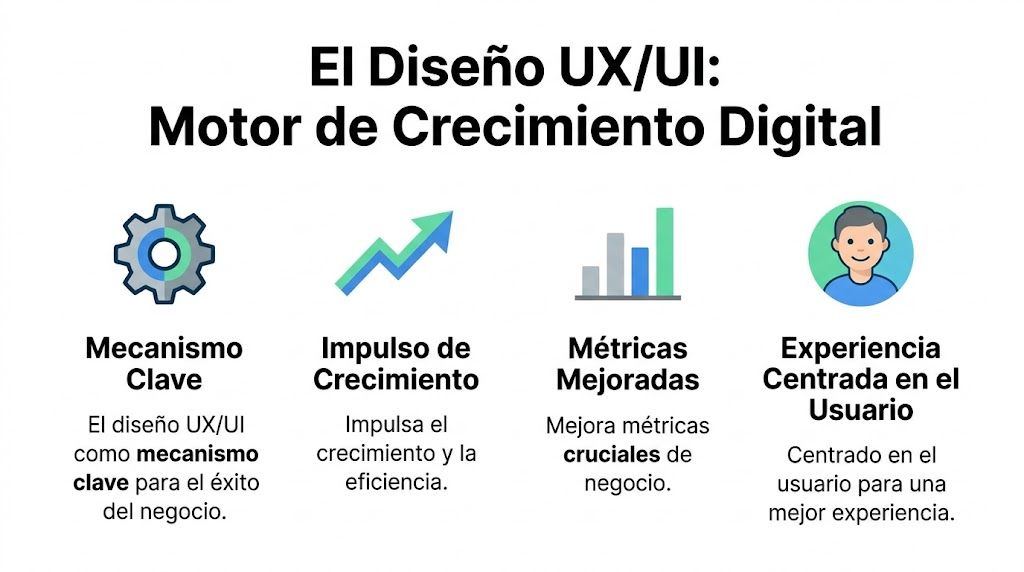
The reason is simple. Design determines whether the user understands quickly, trusts quickly and acts quickly. When that fails, the business pays three times. It pays in ads that do not convert, it pays in lost commercial opportunities and it pays in internal teams trying to compensate with more effort for a structural problem.
You do not buy screens. You buy decisions.
You buy someone capable of translating business objectives into experiences that make a purchase, a registration, a quote or a commercial request easier. You buy clarity at moments where the user tends to hesitate. You buy order where today there is noise.
Business rule: if the site forces the user to think too much, the company ends up paying for that confusion.
In the Chilean market, that logic has already become visible at scale. The growth of eCommerce and the pressure to make digital investment profitable pushed companies to look more rigorously at the performance of their digital assets. Having a presence is not enough. You have to have performance.
Many leaders keep hiring visual profiles to solve business problems. That mismatch produces flashy redesigns and mediocre results. The site looks "more premium," but conversion does not improve, forms keep filtering poorly and the funnel keeps losing users at the same points.
A strategic UX UI designer changes that dynamic because they work on behavior, not just on appearance. They understand that every visual decision has a commercial consequence. They understand that a button, a flow, a hierarchy or a checkout screen can accelerate a sale or kill it.
If your company depends on the digital channel to grow, this role is not optional. It is part of the system that turns attention into revenue.
Most companies mix UX and UI as if they were the same. They are not. They are needed together, but they respond to different problems. If you do not distinguish that, you will diagnose poorly and hire worse.
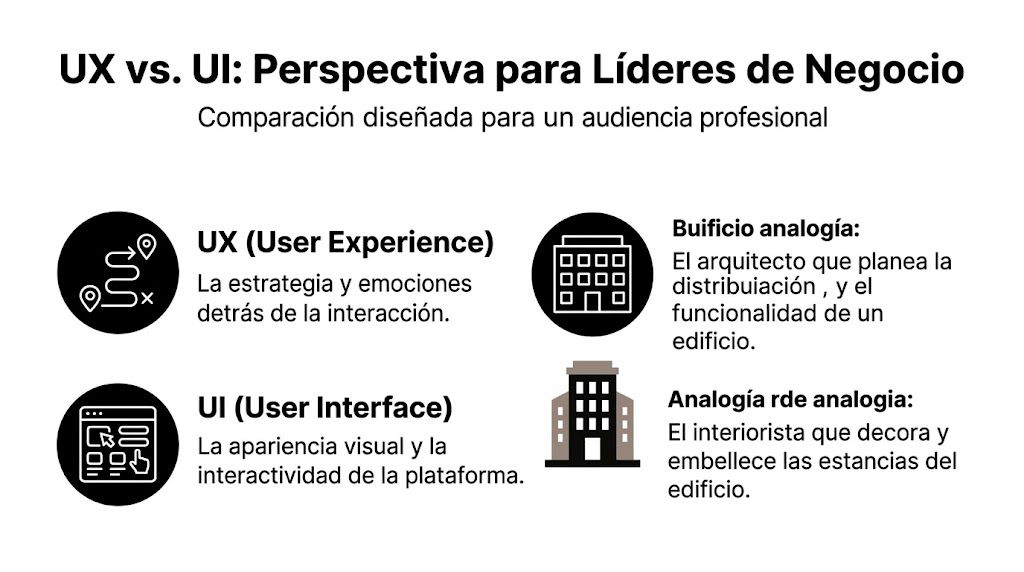
Think of a house. UX is the architecture. It defines how you enter, how people move around, where the key spaces are and whether the layout makes sense. UI is the interior design. It defines how those spaces look, which materials build trust, which elements ease interaction and what impression the whole leaves.
UX works on structure, logic and journey. It asks uncomfortable but necessary questions.
When the problem is in UX, changing colors or typefaces fixes nothing. If the flow is confusing, the user gets lost. If the value proposition appears late, it cools off. If the form asks for too much or in the wrong order, the user abandons.
UI intervenes where presentation influences action. It is not makeup. It is the layer that makes the experience designed in UX usable, credible and consistent.
UI answers questions like these:
Good UI helps the user act without friction. Bad UI creates doubt, visual fatigue or distrust, even if the site architecture was correct.
A poor structural experience is not saved by a pretty interface.
If your company receives traffic but people do not advance, you probably have a UX problem. If users advance but hesitate when it is time to click, complete or confirm, you probably have a UI problem. In many cases, both coexist.
That is why it is worth reviewing the difference with a more strategic view in this guide on UX and UI from a business perspective.
A business leader does not need to master Figma or talk like a designer. They need to recognize whether they are facing a journey problem or a presentation problem. That distinction avoids expensive decisions and speeds up smarter hires.
If you evaluate digital performance seriously, the central point is not whether the site "looks good." The point is whether it converts. That is where the UX UI designer stops being a creative role and becomes a growth player.
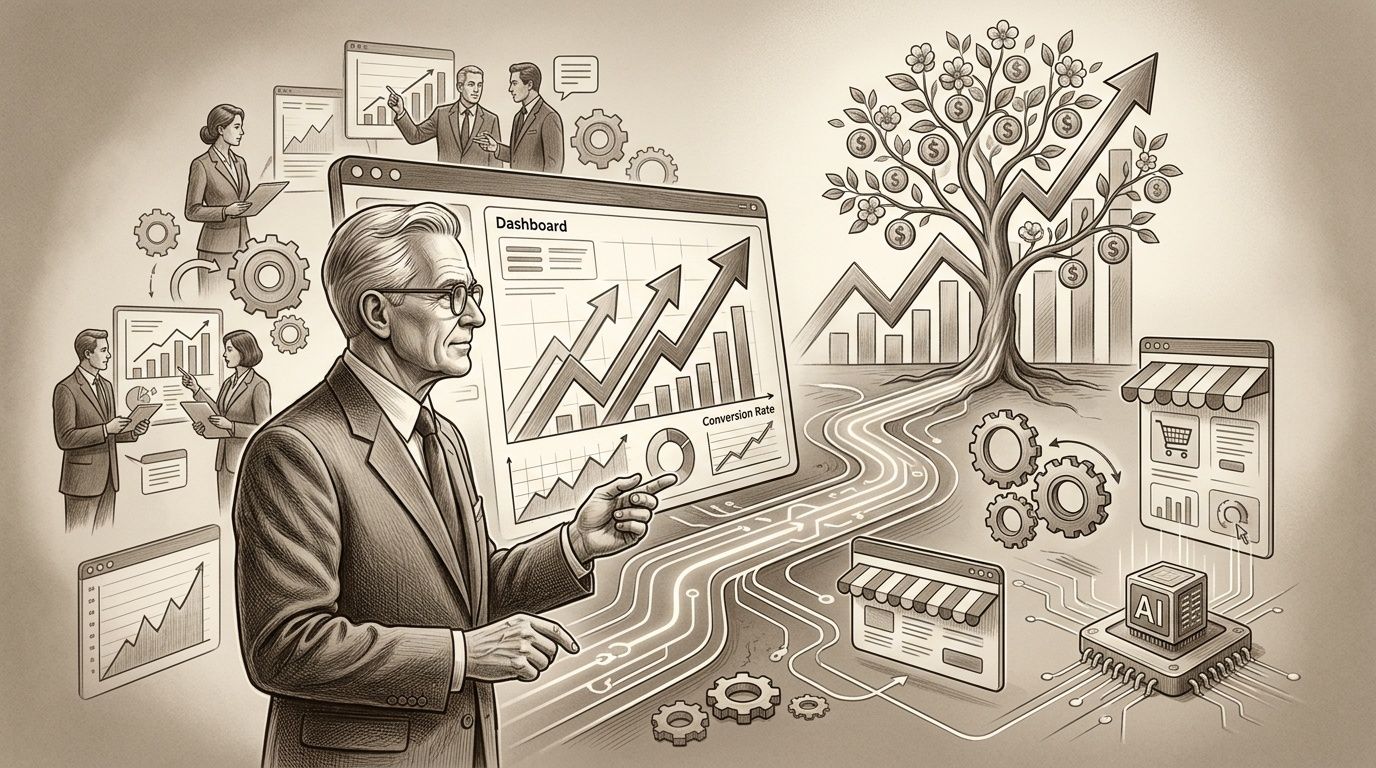
In Chilean eCommerce, a well-executed UX/UI optimization on Shopify and WordPress can increase conversion rates between 18% and 25%, and the use of interactive prototypes has shown a 32% reduction in cart abandonment, according to data cited by Grauberg. This is not a marginal detail. It is commercial impact.
Conversions do not drop from a single big failure. They drop from an accumulation of frictions. An ambiguous headline, a navigation that distracts, a CTA that does not build trust, a product page that forces you to hunt for information, a checkout that asks for too much.
That explains why CRO and design are connected. If you want to dig deeper into that business logic, it is worth reviewing this explanation of what CRO is and why it affects commercial performance.
A solid UX UI designer does not start by drawing. They start by prioritizing the critical moments of the journey. They detect where the user hesitates, where they get distracted, where they feel risk and where they abandon. Then they turn those findings into design decisions that lower friction.
In digital retail, the right designer usually influences four points:
When those pieces align, traffic performs better. The same acquisition budget produces more sales because the site stops sabotaging the purchase intent.
The best growth does not always come from attracting more people. Often it comes from losing fewer of those who already arrived.
In B2B, the problem is usually not just the number of leads. It is quality. A bad design attracts empty forms, poorly qualified inquiries or contacts that did not properly understand the offer.
There the UX UI designer acts as a commercial filter. They organize the journey so the right visitor advances with more conviction and the wrong one drops off earlier. That improves the conversation between marketing and sales because it reduces noise in the pipeline.
After a first review of metrics, it is worth also looking at this audiovisual take on how design, business and conversion intersect in practice.
Many teams try to fix poor conversion with more paid media. That increases volume, but does not resolve the leak. If the experience fails, the additional budget only accelerates the waste.
That is why a competent UX UI designer is a piece of financial efficiency. They do not just seek to have more users convert. They seek for the business to need less effort to generate the same result.
Do not hire the candidate who shows you pretty screens and talks a lot about visual trends. Hire the one who understands how a design decision changes a KPI. That difference separates an executor from a professional with real impact.
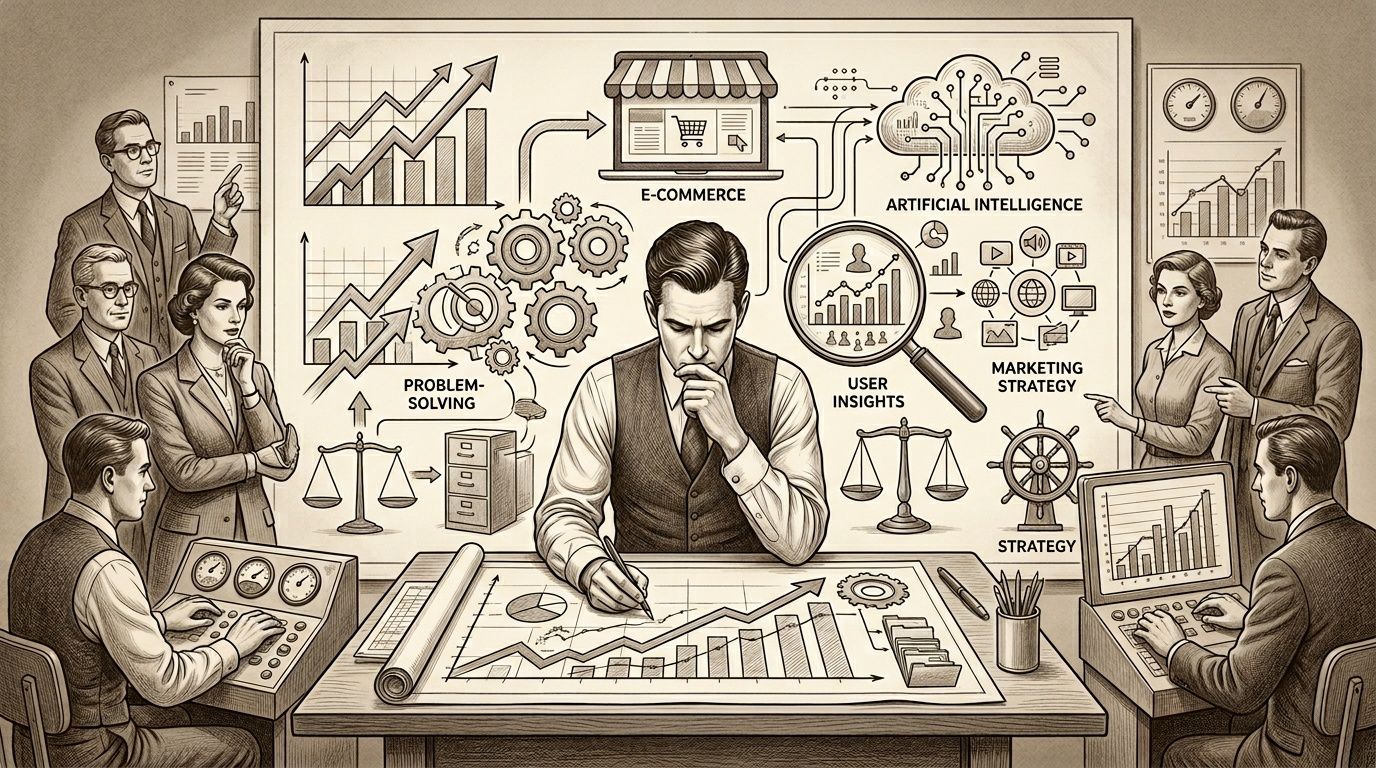
I have seen three pillars in designers who truly move the business. They do not depend on trends or on a specific tool. They depend on judgment.
The first pillar is the ability to connect design with commercial priority. That designer does not ask only "what do they want to see." They ask "what has to happen on this page for the business to win."
That approach changes everything. It changes how you prioritize pages, messages, hierarchies and flows. It also changes the relationship with leadership, because they no longer present personal tastes. They present decisions with business logic.
Clear signs of strategic thinking:
Empathy is not an ornamental soft skill. It is the ability to understand why a person hesitates, compares, postpones or abandons. Without it, design becomes self-referential.
A good UX UI designer knows the user does not arrive to admire the interface. They arrive to resolve something. Buy quickly. Understand prices. Get a quote without friction. Trust that they will not waste time.
Designing well is not about impressing. It is about removing doubts before they turn into abandonment.
That is why this profile observes behavior with discipline. They look at signals, interpret context and avoid imposing internal assumptions as if they were market truth.
The third pillar is not about collecting software. It is about understanding the limits and opportunities of implementation. A designer useful for business knows that a good solution must be able to be executed consistently in WordPress, Shopify or Webflow, and that speed, responsive structure and interaction clarity matter as much as aesthetics.
Today that technical fluency includes AI. In Chile, integrating AI into UX/UI for CRO already shows an average increase of 22% in conversions on B2B and B2C sites, and systems that personalize the interface in real time can reduce funnel abandonment by up to 40%, according to the data cited by Product Leadership. That does not mean automating judgment. It means expanding the capacity to adapt experiences more intelligently.
Do not look for the "digital artist." Look for someone who combines these three capabilities:
| Pillar | What it brings to the business | How it shows in an interview |
|---|---|---|
| Strategic thinking | Prioritizes impact, not isolated aesthetics | Talks about objectives, trade-offs and decisions |
| Empathetic reading | Reduces friction and improves trust | Describes problems from the user's perspective |
| Technical fluency | Designs viable, scalable solutions | Understands implementation, data and personalization |
If they also work with growth, development and content teams without losing focus, you are facing a serious profile. That kind of designer does not decorate projects. They make them more profitable.
Business leaders often hear terms like wireframe, prototype or user flow and assume they are design documents. That is a poor way to see them. In reality, they are instruments to make better decisions before spending more money on development, campaigns or sales.
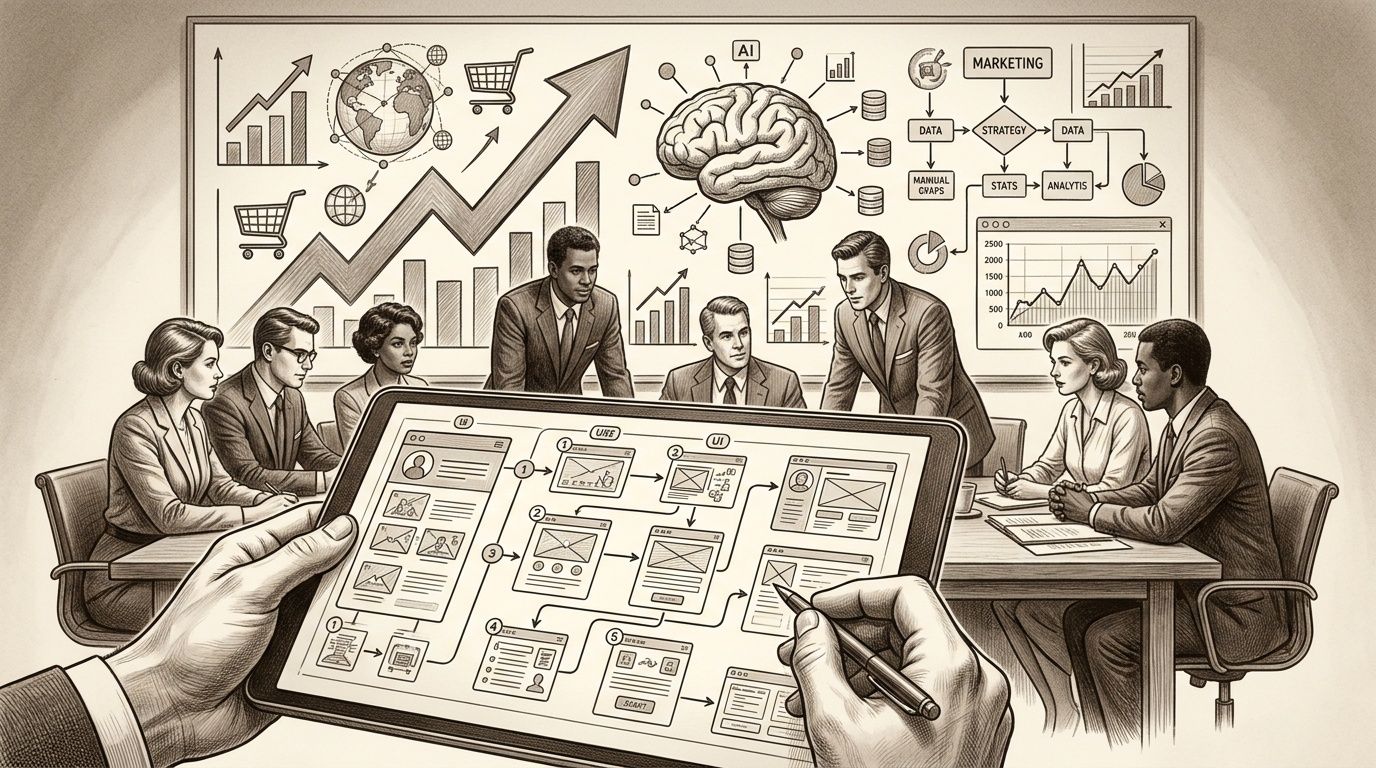
A valuable UX UI designer does not deliver files. They deliver clarity. Every piece they produce should help you answer a critical business question: what to build, what to change, what to validate and what risk to avoid.
A wireframe is not for "seeing how the site will look." It is for aligning structure, priority and journey before discussing visual details. In executive terms, it is for detecting logic errors while it is still cheap to fix them.
If at that stage it becomes clear that navigation distracts, that the form interrupts or that the value proposition appears late, the company can change course before committing development. That is the kind of invisible saving a good leader values.
The interactive prototype serves another function. It allows you to observe whether the experience makes sense before launching it to the market. It does not replace real metrics, but it filters out bad decisions before they reach production.
In businesses with high commercial pressure, this matters a lot. It allows you to avoid impulsive redesigns approved by internal hierarchy rather than by user logic. It also forces more mature conversations between marketing, product and leadership.
A strategic deliverable is not evaluated by its visual level. It is evaluated by the quality of decisions it enables.
Think of an online store on Shopify with a good volume of visits and a sharp drop between the product page and payment. The typical business reaction is to ask for more traffic, more remarketing or more discounts. The right designer would read it differently.
They would detect that the problem may be in the purchase sequence. Maybe the relevant information appears fragmented. Maybe the CTA does not generate enough clarity. Maybe the flow adds friction where the user expects continuity.
In the Chilean context, when UX/UI optimization is executed well on Shopify and WordPress, conversion can rise between 18% and 25% and interactive prototypes have shown a 32% drop in cart abandonment, as indicated earlier with data from the CCS cited by Grauberg. The point is not to copy a pattern. The point is to understand that those results come from improving journey and decision, not from beautifying the page.
Now think of a B2B company with reasonable traffic, but contact forms that generate poor conversations. The site receives interest, but sales says "the leads are no good." Again, the problem may not be in demand but in the experience.
A designer with a strategic focus would review the entire path. Message, argumentative sequence, trust, form order and signals of seriousness. Maybe the site attracts anyone because it does not qualify well. Maybe it asks for data too soon. Maybe the visitor does not understand precisely what happens after submitting.
In these scenarios, a UX audit oriented to lead capture helps identify where intent breaks before turning it into a commercial opportunity. It does not replace marketing strategy, but it gives it a much more solid base.
Not all carry the same weight in every company, but these tend to have executive value when used well:
What matters is not memorizing names. What matters is requiring that every deliverable have a clear commercial function. If it does not help to decide better, it has no strategic value.
Hiring fails when the portfolio dazzles and the conversation does not go deep. A CEO or marketing director does not need to evaluate aesthetic details the way an art director would. They need to detect whether the candidate thinks like a business problem-solver.
Start with the portfolio. If everything looks clean, modern and orderly, that is not enough. The relevant question is another: can they explain what problem existed, what hypothesis they took, what decision they defended and how they connected that to a business result?
| Element to Evaluate | Sign of a Strategic Profile (Positive) | Red Flag (Negative) |
|---|---|---|
| Project context | Explains industry, objective and business constraint | Shows only screens without context |
| Original problem | Defines the friction or challenge they had to solve | Talks only of "modernizing" or "refreshing" |
| Design reasoning | Justifies decisions with user and business logic | Appeals to personal tastes or trends |
| Relationship with data | Mentions how they used evidence or behavioral learning | Names no validation or change of criteria |
| Collaboration | Explains how they worked with marketing, development or sales | Presents themselves as the isolated author of everything |
| Prioritization ability | Distinguishes between the important and the accessory | Treats everything as equally urgent |
| Executive clarity | Can summarize impact and trade-offs in simple language | Uses jargon to hide a lack of judgment |
The best questions do not look for software. They look for judgment.
Tell me about a project where you changed a design decision because user behavior said otherwise.
If they cannot describe a change of criteria, they probably design from assumptions.
How do you decide which problem to solve first when there are several frictions at the same time?
Here their prioritization ability appears.
What do you need to understand about the business before proposing a solution?
A strong profile will talk about objectives, audience, offer, constraints and metrics.
Describe a situation where an attractive visual proposal was not the best option.
This question separates design with judgment from ornamental design.
How do you work with developers when an idea is not viable as it was conceived?
Look for pragmatism, not rigidity.
How do you explain a design decision to a manager who does not come from the creative world?
If they cannot translate their work into business language, they will have internal problems.
What signals would make you think the problem is not in the interface, but in the commercial proposition?
This question is key. A good designer knows not everything is fixed with design.
Hiring well is not about finding the most "creative" candidate. It is about finding the one who reduces risk and improves decisions.
Advance if the candidate demonstrates structured thinking, active listening and the ability to connect experience with results. Stop if everything revolves around tastes, visual inspiration or tools.
Also observe something simple: how they talk about users, business and other teams. If they dismiss commercial or technical constraints, it will be hard to integrate them into a company that needs results and not just intention.
The conversation about design has matured. It is no longer enough to ask for a cleaner website, a more modern brand or a more attractive interface. If your digital channel has real weight in sales or demand generation, hiring the right UX UI designer is a profitability decision.
The value of this role is not in producing elegant screens. It is in turning complexity into clarity, friction into progress and traffic into results. That impacts revenue, improves marketing efficiency and reduces the risk of continuing to invest in an experience that stops the user just before they act.
Companies that understand this make better decisions. They do not debate design as a personal taste. They manage it as a strategic lever within growth, conversion and competitive differentiation.
For 2026, the point will not be who has the most tools or who launches the most campaigns. It will be who best turns digital intent into real business. And there design stops being a detail. It becomes commercial infrastructure.
Review your site honestly. If there is traffic and no proportional result, do not immediately assume you need more media investment. You may need a better design decision.
If your company wants to transform existing traffic into more sales or better leads, Bigbuda can support that evaluation from a business perspective, combining UX, CRO, data and artificial intelligence to detect frictions and turn the digital experience into a measurable competitive advantage.
Related reading: Freelance community manager: your strategic guide
Think of a house. UX is the architecture: it defines how you enter, how people move around and whether the layout makes sense. UI is the interior design: how those spaces look, which materials build trust and which elements ease interaction. They are needed together but solve different problems.
If your company receives traffic but people do not advance, you probably have a UX problem. If users advance but hesitate when it is time to click, complete or confirm, you probably have a UI problem. In many cases both coexist, and a pretty interface will not save a poor structure.
In Chilean eCommerce, a well-executed UX/UI optimization on Shopify and WordPress can increase conversion rates between 18% and 25%, and the use of interactive prototypes has shown a 32% reduction in cart abandonment. Improving user experience can generate an ROI of up to 9,900% for every dollar invested.
Three pillars: strategic thinking, which connects design with commercial priority; empathetic reading of the user, which explains why a person hesitates, compares or abandons; and technical fluency, understanding that a solution must be executable in WordPress, Shopify or Webflow. Judgment matters more than tools or trends.
Clean, modern screens are not enough. Ask whether they explain the industry, objective and business constraint, the original friction they had to solve, the reasoning behind decisions, how they used evidence, how they collaborated with marketing or development, and whether they can summarize impact and trade-offs in simple language.
They are instruments for making better decisions before spending more on development, campaigns or sales. A wireframe aligns structure, priority and journey so logic errors are detected while they are still cheap to fix. An interactive prototype lets you observe whether the experience makes sense before launching it.