










Solutions
Explore how to grow

Creating a website in Chile in 2026 costs, in general terms, between CLP $150,000 and $600,000 for a landing page, between CLP $500,000 and $2,500,000 for a corporate site, and between CLP $400,000 and $700,000 for a basic e-commerce. If the project demands a larger catalog, integrations, or custom development, the budget rises from there and can easily exceed CLP $2,000,000, even reaching CLP $10,000,000+ in projects such as marketplaces.
Need help with this? Discover our web design that converts.
If you are currently evaluating providers, you have probably already seen quotes that seem to have no relation to each other. That happens because many companies still buy “a website” as if it were a piece of design, when in reality they are deciding how much to invest in acquisition, commercial trust, operational efficiency, and future growth.
The right question is not just how much it costs to create a website in chile. The useful question for a CEO is another one: what business capacity does each investment range buy. That is where a cheap site separates from a profitable digital asset.
The Chilean market already shows relatively clear ranges. According to the price comparison published by Tecnoinver on how much it costs to create a website in Chile, a landing page or basic website ranges between CLP $150,000 and $600,000, a corporate site between CLP $500,000 and $2,500,000, a basic e-commerce between CLP $400,000 and $700,000, advanced online store versions can reach CLP $2,000,000 or more, and custom projects such as marketplaces exceed CLP $2,000,000 and can reach CLP $10,000,000+.
That does not describe only levels of technical complexity. It describes levels of commercial ambition.
A landing page works when the objective is simple and narrow. Capturing leads for a campaign, validating an offer, presenting a service. If your company needs speed to market and a clear proposition, that range may be enough.
A corporate site already plays in another league. There the objective is not just to “be online,” but to reduce commercial friction, convey solvency, organize information for different audiences, and support consultative sales processes. In B2B companies, this directly influences lead quality and brand perception before the first meeting.
E-commerce introduces another logic. It is no longer enough to look good. The store must sell, load fast, integrate with payments, and support operations. That is why the initial range does not say much on its own. A cheap e-commerce that does not scale ends up costing more.
A low-cost website can fulfill a tactical function. A higher-investment website must justify it with commercial impact, not with aesthetics.
Type of Web ProjectInvestment Range (CLP)Main Strategic ObjectiveIdeal ForLanding page or basic website$150,000 to $600,000Launch a digital presence and capture contactsEntrepreneurs, specific campaigns, offer validationCorporate site$500,000 to $2,500,000Build trust, organize the offer, and support salesB2B companies, professional services, expanding brandsBasic e-commerce$400,000 to $700,000Sell online with controlled initial operationSMEs, narrow catalogs, first digital salesAdvanced e-commerce$2,000,000 or moreScale sales, automate operations, and improve conversionDigital retail, brands with growth and multiple linesCustom project or marketplace$2,000,000 to $10,000,000+Create a central platform for the business modelCompanies with platform logic, integration, and scalability
If your business depends on generating sales, leads, or credibility, choosing on price alone is a management error. The cheapest website is usually the most expensive when it forces a redesign in a short time, loses conversions, or does not support critical integrations.
The sensible criterion is this:
The final price of a website does not come from an Excel template. It comes from decisions. Some improve the business. Others only inflate the budget. The problem is that many quotes mix both things and the client ends up comparing amounts without understanding what they are really buying.
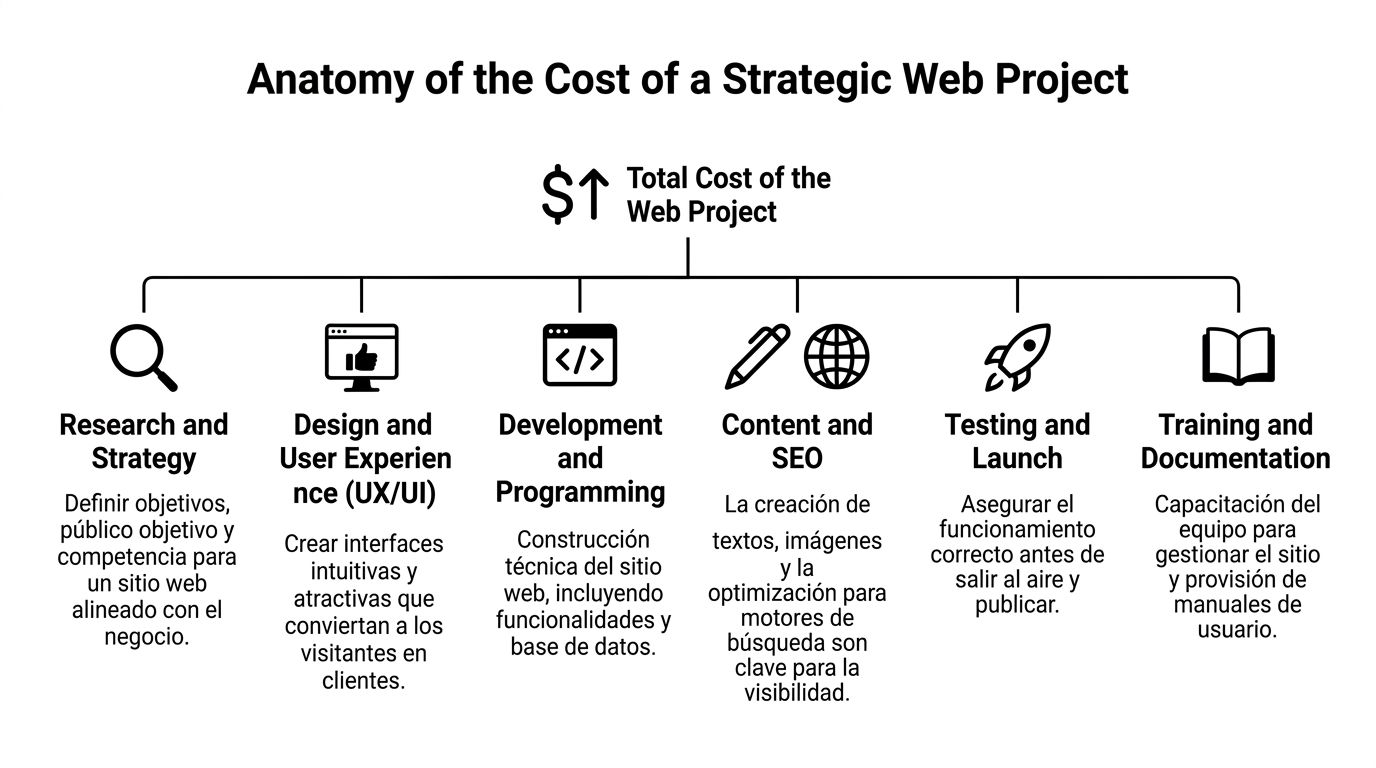
There are six components that define the real value of a strategic web project:
The most underestimated component is usually hosting. A serious mistake. According to the analysis by Metadigital on web costs and performance in Chile, basic shared hosting costs between CLP $5,000 and $15,000 monthly, while e-commerce with medium traffic requires VPS Litespeed infrastructure from CLP $50,000 to $120,000 annually. The same analysis notes that every additional 100 ms of latency generates conversion drops of 7%.
That figure changes the whole conversation. We are no longer talking about hosting as a minor expense. We are talking about a variable that affects revenue.
Practical rule: if your site has commercial responsibility, technical performance must be evaluated as an investment in conversion.
The same study suggests that investing CLP $1,440,000 annually in premium hosting versus CLP $60,000 in a basic one can generate a conversion differential of 15% to 25%, with a ROI of 300% to 500% for a store that bills CLP $10 million monthly. In other words, the technical savings can destroy commercial value much faster than it reduces costs.
Do not review a web proposal only by the total. Review it by the logic of resource allocation.
Ask this:
A healthy quote distributes investment across decisions that sustain growth. A weak quote concentrates the value in “design” and leaves the business exposed in what really matters.
The difference between a reasonable quote and an unnecessarily high one is usually not in the provider. It is usually in the real complexity of the project. If the company is not clear about that, it ends up asking for too much, too soon, or accepting a solution that falls short from the first quarter.

Not all factors weigh the same. These are the ones that most alter the final budget:
A company may ask for “a corporate site” and actually need three things at once: brand showcase, lead capture, and commercial support. If that is not clear at the start, the project comes in underquoted and then fills up with adjustments, delays, and cost overruns.
A good quote does not just say how much it costs. It explains what business problem each block of the budget solves.
Use this filter before quoting:
Key questionIf the answer is yesProbable impact on the budgetDo you need to differentiate yourself visually in a clear way?Custom designIncreasesWill there be integration with payments, CRM, or automations?Additional developmentIncreasesWill the internal team edit content frequently?More robust CMS and trainingIncreasesDo you need to migrate a lot of content or catalog?More operational load and reviewIncreasesDo you only need to validate an offer or campaign?Narrow scopeReduces
The correct way to define a budget is not to ask “how much is a website worth.” It is to decide what level of complexity the business really needs today, and which can be left for a second stage. That prioritization saves money without sacrificing growth.
The biggest budgeting mistake in web projects is not overpaying at the start. It is believing that the spend ends when the site goes live. It does not end there. That is where the real cost of ownership begins.
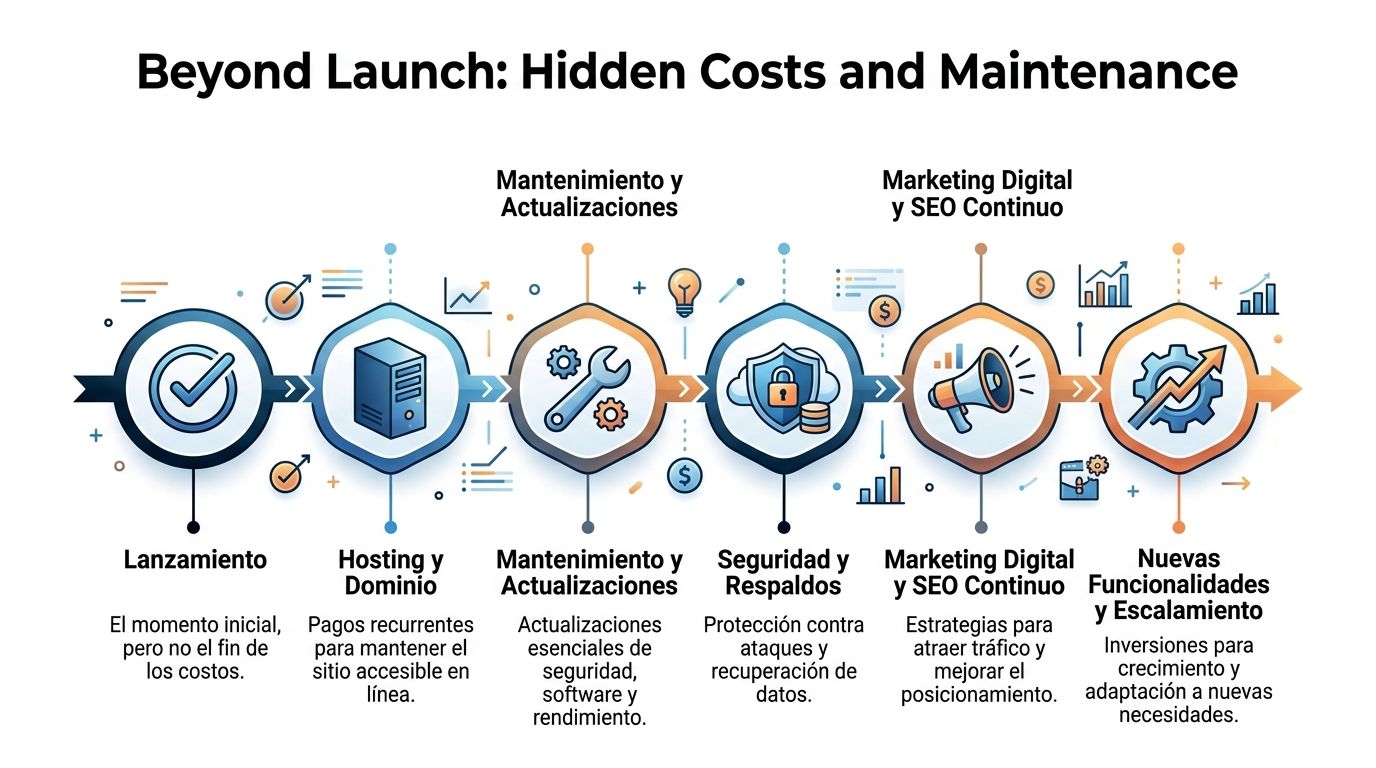
According to the analysis published by GoDaddy on how much a website costs in Chile, for an established SME the annual maintenance of hosting, updates, and security adds up to CLP $545,178 per year. To that is added SEO for approximately CLP $4.3M per year and advertising for around CLP $10.9M per year. The point is not just the amount. The point is that those subsequent costs can double the annual investment.
A professional website requires continuous work across several layers:
Many companies invest heavily in the initial build and then abandon the site. Months later, loading problems appear, forms that do not send, outdated content, and an experience that no longer supports the commercial process.
If your website has a real role in sales, marketing, or lead generation, maintenance is not optional. It is part of the operational cost of the digital channel. Whoever treats it as an extra ends up paying more in emergencies, performance losses, and premature redesigns.
To better understand that operational logic, it is worth reviewing how WordPress maintenance for companies works, especially if the site is a living asset and not a static piece.
The launch is a milestone. The website's profitability depends on what the company does afterward.
Do not authorize a website without also approving a continuity framework. At a minimum, the annual budget should contemplate:
The mature decision is not “how much it costs to build it.” It is “how much it costs to operate it well so that it keeps producing value.”
A website stops being an expense when it is managed as a performance system. That is the difference between a site that merely exists and one that reduces commercial friction, makes better use of traffic, and improves the return on every peso invested in marketing.

According to the data cited by this review of the impact of CRO on Chilean websites, sites with high traffic but conversion below 2% are common in 70% of Chilean SMEs. That same analysis indicates that Bigbuda data shows a sales increase of 25% to 45% with A/B testing and speed optimization, and that a strategic investment in a professional site with CRO can recover 2 to 3 times its cost in 6 months, in addition to reducing CAC by 25%.
That completely changes the evaluation framework. The site should no longer be justified by how much it cost. It should be justified by how much performance it generates on the traffic the company is already paying for or attracting.
Many companies believe they need more paid media when what they have is a conversion problem. If the site does not guide well, loads slowly, does not answer key questions, or does not make action easy, each visit becomes less valuable.
That affects two things at the same time:
If your company already invests in Ads, SEO, email, or social media, improving the website is usually the fastest way to extract more value from the same acquisition budget.
It is not about filling the site with features. It is about improving the points where the business gains or loses conversions.
Some levers have a direct impact:
LeverWhat it fixesBusiness effectSpeed and performanceFriction and abandonmentImproves the probability of purchase or contactContent architectureCommercial confusionClarifies the offer and speeds up decisionsA/B testingUnvalidated assumptionsTurns learning into performanceCTAs and flowsDisorder in the journeyIncreases relevant actionsMobile UXLosses on mobile devicesRecovers existing demand
This video summarizes well why the return depends on how the digital asset is built and optimized, not only on its online presence.
Evaluate any web project with three questions:
If the answer is no, the quote can be low and still be a poor investment. If the answer is yes, a larger budget can be the most profitable decision of the year.
The last decision is not technical. It is one of judgment. A provider can deliver a functional site. The right partner helps you build an asset that supports sales, marketing, and growth.
Do not compare only design, timeline, and price. Compare strategic capacity. If the partner does not understand how your company makes money, it will hardly build a website that improves that result.
Ask uncomfortable questions. They are the only ones that help.
There are classic symptoms of a poor choice:
SignalWhat it usually hidesA quote that is too vagueDiffuse scope and future cost overrunsEverything revolves around designLack of focus on business and conversionThey do not ask about sales or marketingDisconnection from real objectivesThey do not talk about maintenanceA project vision, not an asset visionThey promise “everything” for very littleProbable technical debt or low quality
The right partner does not sell pages. It helps make better decisions about a channel that affects revenue, reputation, and growth.
If you are evaluating how much it costs to create a website in chile, use price as an initial filter, not as a final criterion. What you should really buy is strategic clarity, a solid technical foundation, and a digital structure capable of producing results for years.
If your company needs to turn its site into a growth asset and not into an isolated expense, Bigbuda can help you evaluate the right investment, define the scope with criteria, and build a platform focused on sales, performance, and scalability.
Related article: The website that does generate results.
A landing page or basic website ranges between CLP $150,000 and $600,000, a corporate site between CLP $500,000 and $2,500,000, and a basic e-commerce between CLP $400,000 and $700,000. Advanced stores and custom projects such as marketplaces exceed CLP $2,000,000 and can reach CLP $10,000,000 or more.
Six components define the real value: research and strategy, UX/UI design, development and programming, content and SEO, testing and launch, and training and documentation. A healthy quote distributes investment across those decisions instead of concentrating the value in design and leaving the business exposed where it matters.
Yes. Basic shared hosting costs between CLP $5,000 and $15,000 monthly, while e-commerce with medium traffic requires VPS Litespeed infrastructure from CLP $50,000 to $120,000 annually. The same analysis notes that every additional 100 ms of latency generates conversion drops of 7%, so performance becomes a revenue variable.
For an established SME, annual maintenance of hosting, updates and security adds up to CLP $545,178 per year, plus SEO of approximately CLP $4.3M and advertising of around CLP $10.9M per year. Those subsequent costs can double the annual investment, so continuity must be approved alongside the project.
Evaluate any web project with three questions: will it convert current traffic better, will it reduce acquisition costs or commercial friction, and will it support growth without redoing everything within a year? If the answer is no, a low quote can still be a poor investment.
Do not compare only design, timeline and price. Ask how they define project success, how they connect the site with commercial objectives, what they propose for the post-launch stage and how they address scalability. Warning signs include vague quotes, everything revolving around design and no mention of maintenance.