










Solutions
Explore how to grow
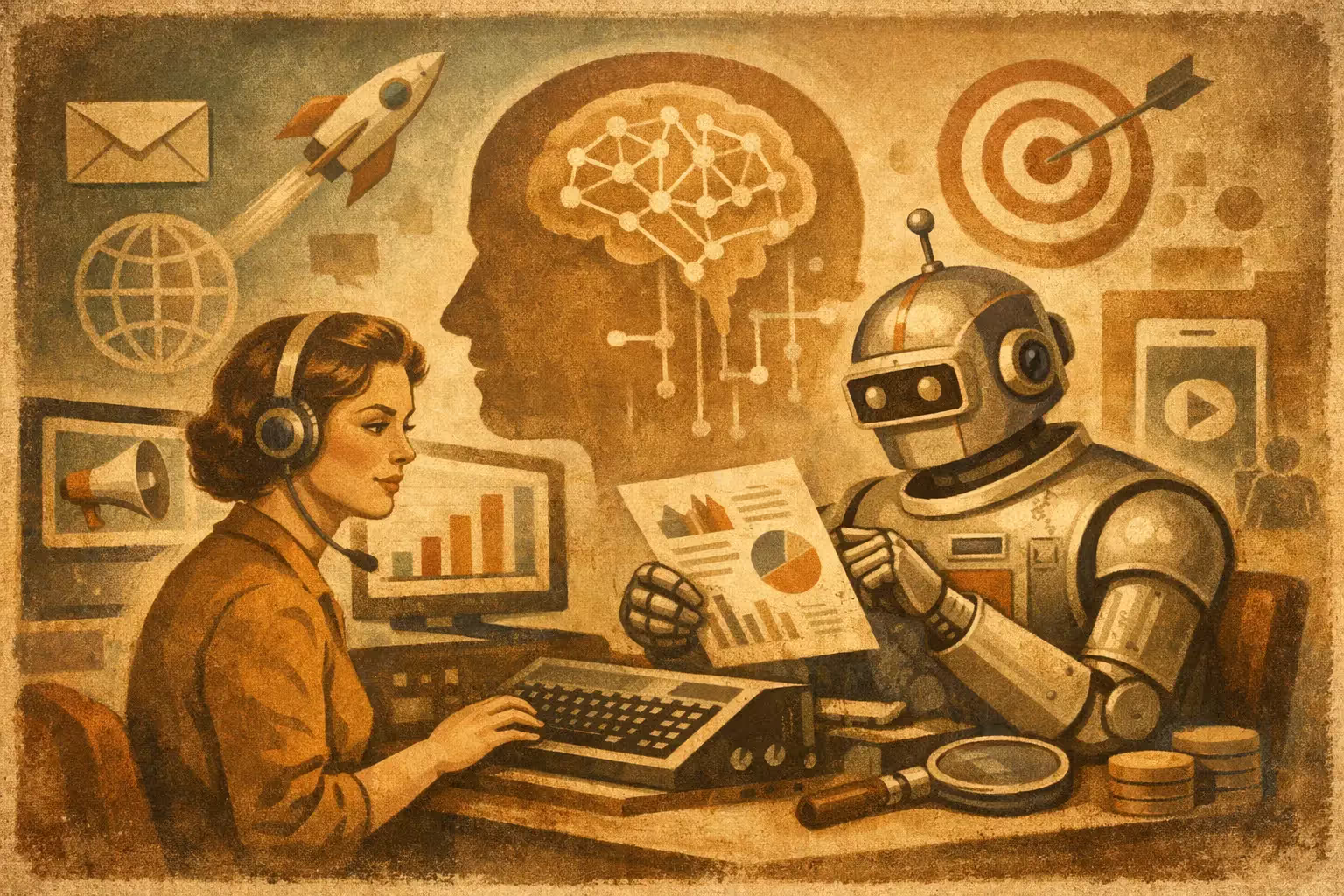
If your team already invests in paid media, SEO, content or automation, but conversions aren't growing at the same pace, the question isn't whether you should bring in AI. The real question is how to use artificial intelligence in digital marketing without adding complexity, noise or tools that nobody ends up using. Applied well, AI doesn't replace strategy. It makes it faster, more precise and more profitable.
Need help with this? Check out our AI for companies in Chile.
In companies that already have traffic, a database or active campaigns, AI's greatest value isn't in “creating more content” on its own. It's in spotting patterns, speeding up decisions and improving the commercial experience at specific points in the funnel. That distinction matters, because a messy rollout can fill your operation with pretty automations and mediocre results.
Artificial intelligence works best when it's brought in to solve specific friction points. For example, imprecise targeting, campaigns with low returns, poorly qualified leads, content that doesn't match search intent or websites that get visits but don't convert.
In that context, AI can add value on four very clear fronts: data analysis, personalization, automation and creative optimization. Not because it works magic, but because it processes more signals in less time than a team operating manually.
A typical case is the ecommerce store that already sells but has a low conversion rate. There, AI can help identify abandonment patterns, predict purchase likelihood, fine-tune product recommendations and improve remarketing campaigns. In a services company, on the other hand, it can prioritize leads, detect commercial intent in forms and automate follow-ups with more context.
The most profitable way to implement AI doesn't start with the tool. It starts with the business goal. If you don't first define what you want to improve, you'll end up buying software to inflate processes that were already inefficient.
If your priority is to sell more with the same traffic, AI should be applied to conversion, average order value, cost per acquisition or speed to close. If your problem is in lead generation, then it's better used on audiences, ad creative, SEO or lead qualification.
This seems obvious, but many companies do it backwards. They start by testing text generators, email assistants or bots with no connection to their KPIs. The result is usually more output, but not more sales.
AI depends on useful data. If your CRM is incomplete, your analytics events are misconfigured or you don't distinguish between a cold lead and a real opportunity, any model or automation will learn poorly.
Before scaling, it's worth reviewing three foundations: reliable measurement, connected data sources and clear commercial criteria. This includes on-site events, conversions, behaviour by channel, lead quality and real sales results. Without that, AI only accelerates mistakes.
AI performs best when there are repetitive tasks, enough data and a clear opportunity for improvement. That's why it usually works very well in paid campaigns, email marketing, initial support, operational SEO and onsite personalization.
If your business has little traffic, highly consultative cycles or a deeply relationship-driven sale, the impact will be different. Not smaller, but less immediate. In those cases, it's more useful for commercial support and analysis than for aggressive automation.
Ad platforms already use AI for bidding, audiences and creative distribution. The mistake is letting that run without a strategic structure behind it. AI can optimize campaigns, but it needs good signals: correct conversions, clean audiences, clear offers and aligned landing pages.
When that's in place, you can reduce cost per acquisition and increase volume without scaling budget at the same rate. When it isn't, the platform optimizes toward surface-level metrics rather than real business outcomes.
One of AI's most valuable uses is in adapting the site experience based on behaviour, traffic source or the user's stage. It's not just about changing a headline. It's about showing content, products, arguments or calls to action based on intent.
That can improve both the conversion rate and lead quality. On high-traffic sites, even small changes produce a meaningful cumulative impact. There, AI becomes especially useful when combined with CRO, A/B testing and behavioural analysis.
Not every automation sells more. Many just send emails. The difference lies in using AI to interpret signals and adjust the message based on interest, urgency or likelihood of closing.
For example, you can prioritize outreach to leads with higher intent, trigger different sequences based on the pages they visited or summarize interactions so the sales team comes in better prepared. That reduces friction and improves response times, which in many businesses directly impact conversion.
AI can speed up topic research, semantic clusters, opportunity detection and editorial optimization. But it's not a good idea to use it to mass-produce content without judgment. That not only lowers quality. It can also damage authority, differentiation and organic performance.
Its best use is in supporting search-intent analysis, content gaps, page structure and updating existing assets. In competitive markets, the content that performs best isn't the longest or the fastest to publish. It's the one that answers better, converts better and connects with a solid SEO architecture.
There's no single platform that solves everything. The choice depends on your digital maturity, your current stack and your main objective. Some companies need to strengthen CRM and automation. Others need analytics, testing or web personalization.
The key is to avoid the “bloated tool stack” syndrome. More tools don't mean a better operation. In many cases, a well-thought-out integration between CRM, analytics, ad platform and automation delivers more results than five disconnected solutions.
It's also worth assessing the hidden cost. Not just the licence, but implementation, training, maintenance and team dependency. If a tool promises a lot but demands an operation your company can't sustain, it's probably not a good decision.
Talking about AI only in terms of efficiency is incomplete. There are also risks, and several hit results directly.
The first is automating a bad strategy. If your offer is weak, your site converts poorly or your message doesn't connect, AI won't fix the underlying problem. It will only scale it.
The second is losing commercial judgment. Some companies start relying on automated recommendations without validating whether those decisions are aligned with margin, positioning or the quality of the customer being acquired.
The third is damaging the experience. A poorly configured chatbot, invasive personalization or hyper-automated emails can erode trust. And in mid- to high-ticket businesses, trust remains a decisive variable.
The healthiest way to move forward is with a focused pilot. A specific problem, a clear hypothesis and a defined success metric. It could be improving lead quality, recovering carts, reducing response time or increasing a landing page's conversion.
Then comes the critical part: measuring against a baseline. If you don't compare against previous performance, it's very easy to confuse activity with real improvement. AI has to prove business impact, not just operational efficiency.
From there, it's the right moment to scale. First in processes where you already have consistency, then in more complex automations and finally in predictive layers or advanced personalization. That order avoids building technology on a weak foundation.
In digital growth projects, the best scenario appears when AI is integrated with conversion strategy, UX, analytics and performance. Not as an isolated block. If your website isn't ready to convert, no automation will fully make up for it. That's why, in practice, the question isn't just how to use artificial intelligence in digital marketing, but how to connect it with a commercial operation that's already designed to sell.
That's the point where AI stops being a novelty and starts becoming a competitive advantage. If you use it to understand the user better, make faster decisions and improve conversions with evidence, the results show. Same traffic. Better results. If you want to check whether your site, campaigns or funnel are ready for that level of optimization, at Bigbuda.cl that diagnosis starts from the business, not from the tool.
Related article: A UX audit to capture more leads.
Where there are specific friction points: imprecise targeting, campaigns with low returns, poorly qualified leads, content that does not match search intent, or websites that get visits but do not convert. It adds value on four fronts, data analysis, personalization, automation and creative optimization, because it processes more signals in less time.
With the business goal, not the tool. If the priority is selling more with the same traffic, apply AI to conversion, average order value, cost per acquisition or speed to close. Many companies do it backwards, testing text generators, email assistants or bots with no connection to their KPIs, producing more output but not more sales.
Useful data. If your CRM is incomplete, your analytics events are misconfigured or you do not distinguish a cold lead from a real opportunity, any model or automation will learn poorly. Review three foundations first: reliable measurement, connected data sources and clear commercial criteria. Without that, AI only accelerates mistakes.
No. It performs best where there are repetitive tasks, enough data and a clear opportunity for improvement, such as paid campaigns, email marketing, initial support, operational SEO and onsite personalization. With little traffic, highly consultative cycles or a relationship-driven sale, it is more useful for commercial support and analysis than for aggressive automation.
Three stand out. Automating a bad strategy, because if the offer is weak or the site converts poorly, AI scales the problem instead of fixing it. Losing commercial judgment by trusting automated recommendations without checking margin or positioning. And damaging the experience with a poorly configured chatbot, invasive personalization or hyper-automated emails.
Start with a focused pilot: a specific problem, a clear hypothesis and a defined success metric. Then measure against a baseline, because without comparing to previous performance it is very easy to confuse activity with real improvement. Scale afterwards, first in consistent processes, then complex automations, and finally predictive layers or advanced personalization.